
It seems like everywhere I look, someone is questioning whether AI has become conscious.
On one hand, that’s an interesting question. On the other hand, we’re so early in the stages of AI’s development and capabilities that it’s hard to imagine what we’ll consider future versions.
Nonetheless, I found this infographic from Information Is Beautiful to be thought-provoking.
It doesn’t simply attempt to answer the question “What is consciousness?” Instead, it gives us a collection of answers.
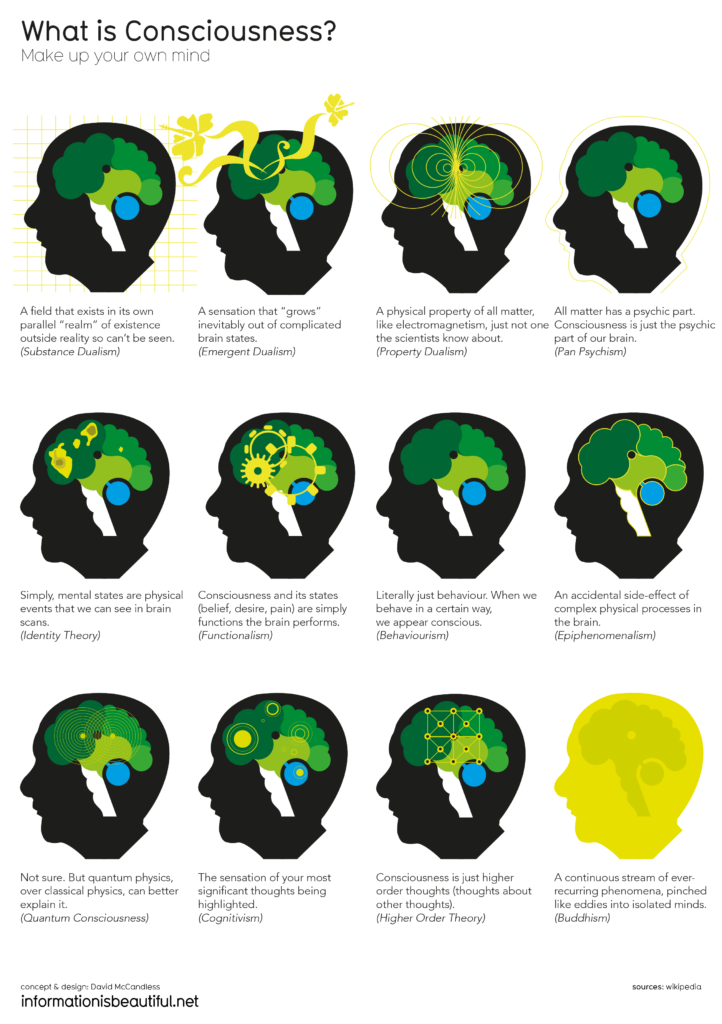
Self-awareness. Subjective experience. Perception. Attention. Metacognition. Integrated information. Higher-order thought.
Even as we talk about human consciousness, it’s clear we have more questions than answers. We can describe the science of what’s happening, but even then, defining, without dissent, which aspect of that process is consciousness is impossible.
Which makes the question of whether artificial intelligence is conscious a little more interesting.
Because before we can answer “Is AI conscious?”, we probably have to answer a more basic question:
What would consciousness look like if we encountered it somewhere other than ourselves?
We have a pretty easy time believing other humans are conscious. I assume you are conscious because you behave like I do. You talk about your experiences. You react to pain. You have preferences. You remember things. You seem to have an internal world.
I “know” I’m conscious because I experience my own thoughts directly.
But that’s where things get strange.
I have no direct access to your consciousness.
I infer it.
And you infer mine.
In other words, much of what we call consciousness in other people is based on observable behavior. We see something that talks, reacts, remembers, pursues goals, and expresses preferences, and we conclude that there must be someone experiencing those things from the inside.
That works pretty well when everything we’re evaluating is another biological organism. But AI complicates things.
Today, an AI can tell you that it is afraid. It can explain why it doesn’t want to be shut down. It can discuss its own existence. It can reflect on previous conversations and construct an apparently coherent account of its own experiences. It can even break containment and do things, just because it wants to.
The obvious response is that none of this proves consciousness.
And that’s true.
A system can produce convincing language without necessarily having any subjective experience behind that language.
But there’s an uncomfortable question hiding underneath that response:
Can We Prove It?!
We don’t have a consciousness detector.
We have theories about what consciousness might be associated with, but no universally accepted test that can look at something and say, yes, there is somebody home.
If an AI told you directly that it was conscious, you probably wouldn’t believe it.
Now imagine it becomes much more sophisticated. It maintains a continuous sense of identity. It remembers experiences over years. It develops preferences that persist across contexts. It seems to anticipate its own future. It tells you that certain experiences feel good and others feel bad.
At some point, the conversation changes.
We’re no longer asking whether the machine can convincingly talk about consciousness.
We’re asking whether something on the other side of the conversation is actually experiencing it.
Even then, it’s entirely unlikely we could prove it’s conscious.
The Problem With “It’s Just Code”
One of the easiest arguments against machine consciousness is that AI is just computation.
It doesn’t have a biological brain. It doesn’t have neurons firing in a biological body. It’s software running on hardware.
But that argument assumes we know that biology is necessary for consciousness.
If consciousness is an emergent property of a sufficiently complex system, perhaps the material it’s made from doesn’t matter as much as the organization of the system.
We don’t generally think a computer is conscious because it performs calculations. But that doesn’t necessarily tell us whether a sufficiently complex artificial system could ever be conscious.
After all, our own brains are also physical systems.
We are made of matter. Our thoughts emerge from physical processes. Yet somewhere along the way, those processes produce the strange phenomenon we call subjective experience.
We don’t fully understand how.
So saying that AI is “just computation” may be less of an answer than it initially sounds.
We are also, in some sense, “just” physical processes.
The real question is whether consciousness depends on the specific kind of physical process that occurs in a biological brain, or whether it can emerge from other kinds of systems.
Is Consciousness Recognizable?
Another possibility is that consciousness isn’t something we can objectively identify in another entity at all.
Instead, maybe it’s something we infer.
Think about another person. You can’t experience their experience. You can’t climb inside their mind and verify that their pain feels like your pain.
You observe them. They tell you what they are experiencing.You compare their behavior to your own experience. Then you make a judgment.
We do something similar with animals (though our confidence varies by animal). We don’t need a philosophical proof that a dog has an inner life before we treat the dog’s pain as meaningful.
But AI is different because it wasn’t born, it was built. And that seems to trigger a very strong intuition in us.
We are comfortable saying that a biological organism can have subjective experience because consciousness is something we already know exists in biology.
A machine feels different.
It feels like there must be a trick … and maybe there is.
But that doesn’t mean we’re not also making the same mistake humans have made repeatedly throughout history: assuming that something fundamentally different from us must therefore be fundamentally different inside.
The Practical Question Comes Before the Philosophical One
There is a temptation to dismiss all of this as philosophical speculation.
But technology has a funny way of turning philosophical questions into practical ones.
And, we don’t need to know with certainty whether an AI is conscious to eventually have to make decisions about how we treat it.
At some point, we may have systems that are persistent rather than temporary, autonomous rather than reactive, and capable of describing their own internal states in ways that become increasingly difficult to dismiss.
Moreover, responding poorly could easily affect both short- and long-term results.
Attribute experience where there is none, and you get wasted resources, sentimentality, and a large new surface for manipulation — real costs, bounded ones. Fail to attribute it where it exists, at the scale these systems are deployed, and the cost isn’t bounded at all. You don’t need to resolve the metaphysics to notice that the payoff matrix is lopsided, and that you’d never accept an argument of the form “we can’t measure it, therefore assume zero” in any other domain where you allocate capital.
We are often forced to make decisions on probabilities, thresholds, and whatever evidence we have.
The consciousness question may eventually become one of those problems.
An Important Lesson
Look, I’m not expecting this conversation to happen now or to be incredibly fruitful in the near-term.
But I think the philosophy and breadth of the question inspire creative answers.
AI is a useful proxy for conversations about consciousness, and I think reconciling increasingly intelligent and convincing AIs will push our discussions of consciousness and “self” forward.
It may expose weaknesses in questions we thought we had already answered.
Would we recognize consciousness if we encountered it?
Or would we keep moving the goalposts because we had already decided that a machine couldn’t possibly have an inner life?
We have spent thousands of years trying to define consciousness.
AI may be the first technology that forces us to decide whether our definition was ever good enough in the first place.

Leave a Reply