
I have a tents problem. No, I don’t own a tent (nor am I a camper). I have a tense problem – because I’m so excited about the future and what’s possible that I sometimes lose track of what’s been actualized “in real life” already.

As someone who builds the future, once I’ve thought about something enough to understand it, it becomes real for me. Once I’ve figured it out and told it to someone … on some level, my part of the process is already done. And I’m probably moving on to the next idea or challenge in my head (like: And what would that make possible?).
I think this is common among (to use a Kolbe term) Quick Starts. I love being around entrepreneurs because a lot of them are Quick Starts, and they share this future-focused perspective. The problem, however, is that when you say something’s possible that hasn’t been proven yet, the average person responds with “No, it’s not.”
It took me a long time to see that it isn’t stubbornness on their part.
When I say “this works,” I mean “this works in the version of the world I’ve already walked through in my head.” They hear “this works … today.” Then they check today, and today says no. They’re right about today. I’m just not talking about today, and didn’t think to mention it.
Which means the extra work is mine (not theirs). If I’m going to speak in a tense nobody else can see, I owe people the translation.
At my company, we have a lot of data scientists – and they’re almost all naturally pessimistic (or at least pragmatically skeptical). Which makes sense; if you were going to hire a personality type to be a scientist, you’d want someone who didn’t believe their hypothesis until they’ve proven it. It’s the right personality for the job, but it doesn’t mean they’re right, and it certainly doesn’t mean that approach is right for the visionaries.
Now I try to say the quiet part to them first. This isn’t real yet … and here’s what would have to be true for it to become real. That’s a discipline, not a personality trait, and it does something useful: it turns an argument into an experiment. My data scientists don’t want to argue with me – they want something to measure or test.
I’m not telling everyone to be a visionary. What I am saying is that if you are one, the skeptics around you aren’t the opposition — they’re the instrument. They’re what tells you whether the thing in your head survives contact with today. We’d never have innovation without visionaries, and visionaries would never finish anything without everybody else.
Ignored, Scorned, Vindicated … and the Ones Who Weren’t
Information Is Beautiful put together an interactive list of famous ideas that were rejected but later proven correct. You can filter by industry – Astronomy, Biology, Engineering, Mathematics, Medicine, Physical Sciences – and by other factors like how long the originator was a pariah, how they were treated due to their idea, and when the idea was formally adopted. Click to see the interactive version.
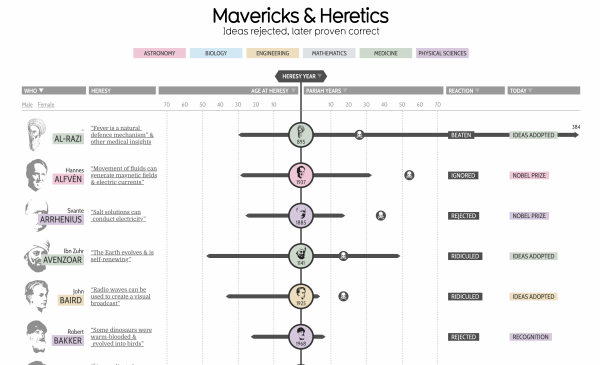
The infographic includes many interesting examples of innovative ideas (and the consequences of their discoveries). Here are a few:
In 895, Al-Razi, who believed a fever was a natural defense mechanism, was beaten.
In 1592, Giordano Bruno was imprisoned for believing the Sun was one of many stars (and he was executed for that in 1600). Shortly after, Galileo Galilei was sentenced to house arrest for believing the Earth wasn’t the center of the solar system.
The consequences of radical new ideas grew less severe as we approached modern times. For example, in 1884 and 1903, Nikola Tesla and the Wright Brothers were simply ignored or rejected for their technological innovations.
I love this chart, but it doesn’t show the whole picture. It’s a list of people who were doubted and vindicated, which means it quietly leaves out everyone who was doubted and deserved it, or everyone who was supported along the way. Those people existed. There were a lot more of them. They just don’t get a Wikipedia link.
So resistance isn’t inherently a signal. It’s not a green light, and it’s not a red one. It’s noise you have to work through either way.
It will be interesting to see where history files Elon Musk, Ray Kurzweil, or Peter Diamandis. We won’t know which list they belong on for another fifty years — and neither will they.
So — maverick or heretic? You don’t find out from the inside. That’s a verdict written in the past tense about somebody who had to act in the present one. The best you can do is be clear about which tense you’re speaking in and keep going. And if it doesn’t work out, that’s just material for the next one.
Onwards!
Leave a Reply