
Every election cycle brings a familiar warning: This is the most important election of our lifetime.
The stakes are enormous! The country is at a crossroads! Democracy is on the ballot! The economy is hanging in the balance! If the other side wins, no one knows what will happen next!
And then, a couple of years later, we do it all over again.
Miraculously, the world keeps turning.
As the 2026 midterm elections approach, it’s worth taking a step back and thinking about how we consume (political) information, how we react to disagreement, and how easily we can lose perspective when everything is presented as a crisis.
This isn’t an argument that elections don’t matter. They do. Policies have consequences, elected officials make consequential decisions, and political disagreements often reflect genuine differences in values and priorities.
But there’s a difference between recognizing that something matters and treating everything as an emergency.
Unfortunately, the modern media environment doesn’t always reward that distinction.
Outrage is a business model
The media landscape has changed dramatically. News is no longer something we simply sit down and consume at a particular time of day. It’s an ongoing stream of headlines, notifications, commentary, clips, reactions, and opinions.
And much of that content competes for the same limited resource: our attention.
The Mountains Out of Molehills interactive graphic below shows the news cycle for topics ranging from asteroids and vaccines to Ebola and Zika. It’s an interesting reminder about media-informed fears.
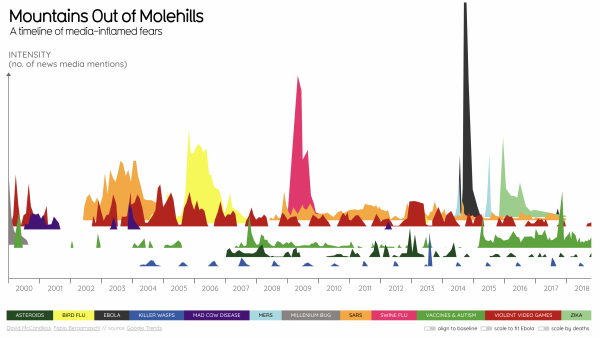
(Click To View Interactive Infographic) via InformationIsBeautiful
A measured explanation rarely travels as far as an inflammatory headline. Nuance takes time. Outrage takes seconds. A complicated policy discussion might generate a few thoughtful responses, while a provocative soundbite can generate thousands of comments, shares, and arguments.
This creates an interesting incentive structure.
The more emotionally charged a story becomes, the more likely people are to engage with it. The more people engage, the more visibility it receives. And the more visibility it gets, the more important it can appear.
The original story can get lost somewhere along the way.
This isn’t limited to traditional news organizations, social media, podcasts, or even news stories. The attention economy has become a part of our culture.
The cost of losing perspective
This kind of environment has real consequences.
For one, it makes productive conversations harder. It’s difficult to find common ground when we assume the worst about anyone who disagrees with us.
It also makes it harder to tell meaningful developments from temporary distractions. Not every headline deserves the same level of attention. Not every controversy changes the country’s trajectory.
Unfortunately, some do, and so you can’t just tune out.
The challenge is that we’re often asked to make that distinction while we’re emotionally invested in the outcome.
We have to be very conscious of the information we take in, the urgency and importance of the issues, and whether we truly need to react with haste or whether a cooler head would likely lead to better choices.
Markets have a similar problem
This is one of the reasons I find the relationship between media, politics, and financial markets so interesting.
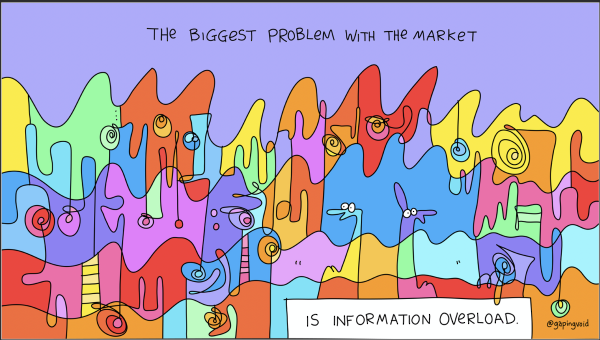
If you don’t know what your edge is … you don’t have one. And it’s tough to find a “signal” in a sea of noise.
Markets are constantly processing new information. Elections, economic policy, international conflicts, interest rates, corporate earnings, and countless other developments can influence investor expectations.
But markets don’t react to headlines in a vacuum. They react to changing expectations about the future, and there’s often a big difference between how an event is portrayed and how it ultimately affects the underlying economic environment.
An election can create uncertainty without fundamentally changing the long-term outlook for businesses. A frightening headline can trigger a temporary market reaction without changing an investment’s underlying value. Conversely, a seemingly unremarkable development can have meaningful consequences that take months or years to become apparent.
I sound like a broken record, but it all boils down to signal vs. noise.
It’s a fractal lesson that applies to trading, politics, and the media we consume.
We should care about what’s happening in our country. We should pay attention to the decisions being made on our behalf, challenge our assumptions, and be willing to change our minds when the evidence calls for it.
But we should also be careful not to let every headline, disagreement, or political development become a mountain.
Sometimes a molehill really is just a molehill.
So, as you head to the polls and into the last quarter of the year, take a breath, step back, and focus on the mountains worth climbing.
Onwards!
Leave a Reply