Web/Tech

  • “It’s So Over”: The Rise of Sora and Nano Banana

    Your eyes are now officially unreliable.

    AI imagery has crossed a line from “obviously synthetic” to “unapologetically believable”. This fundamentally shifts the issues from technical glitches to psychological blind spots.

    The Future Is Appearing Faster Than Ever.

    I first wrote about AI art back in 2019, when AI-generated self-portraits were suddenly everywhere.

    By 2022, the technology had advanced enough to warrant a revisit.

    This May, it leapfrogged again, when OpenAI’s GPT-4 went far beyond clever image generation into something more akin to actual art. It felt like a turning point, not just for what AI could make, but for what it meant.

    Now, only six months later, we’re at yet another inflection point. “Seeing is believing” means a lot less than it used to. AI imagery has become so realistic that you often can’t tell whether what you are seeing was captured from reality or generated by AI.

    That may sound like a small shift in aesthetics, but it marks a big shift in how easily AI-generated content can slip into our feeds and our beliefs unnoticed. Ultimately, this will have a profound impact on what we think, what we know, and how we make decisions.

    And the quality isn’t limited to paintings or digital compositions — these generation capabilities apply to portraiture, video, and other convincing replicas of real life.

    Do Your Eyes Deceive You?

    Here is an example a content creator posted on X, showcasing two images created by Google’s Gemini AI. The one on the left was created by the original version, and the one on the right was created using Google’s new Nano Banana engine.

    Showing the difference between Nano Banana on the left and Nano Banana Pro on the right

    @immasiddx via X

    The first has the classic look we associate with AI — shiny, airbrushed, and clearly AI-generated.

    The latter looks like it came from a random Instagram post. The image’s texture and tone look real.

    I didn’t choose this image because it was technologically impressive. Instead, it was how unremarkable the ‘better’ image looked — ordinary enough to blend into a feed without ever tripping your ‘this might be AI‘ alarm.

    At the same time, Sora 2 is affecting video in the same way.

    While you could use a tool to check whether an image or video is likely fake or real, what percentage of the population is doing that? And even if you did … we got to this level of quality fast enough that it’s hard to imagine what it will be able to produce in the near future.

    Artificial Reality Has Real Consequences

    Meanwhile, people are increasingly consuming and believing AI videos they find on social media or even mainstream programming (here’s an example from Fox News). Further, some people don’t care whether the image was captured live or generated (because they consider it all part of their narrative-building process).

    This video of bunnies jumping on a trampoline fooled so many people that it inspired musician Oliver Richman to release a song about them.

    via YouTube

    This video might seem trivial because the it looks pretty unassuming and straightforward. But it shows that we are now on the other side of a gateway to artificial, augmented, or alternative realities … and the implications are enormous.

    For example, automation bias and grandparent scams are becoming more common, capitalizing on these trends.

    Real Eyes Don’t Always Realize Real Lies

    AI is an incredible tool, but it can also reduce people’s willingness to question what they see. Some might argue that, even more dangerously, AI makes the least curious part of the population even less inquisitive.

    AI-generated content is such a reliable crutch that many people now trust it at face value. For some, it has replaced friends and loved ones (not to mention search engines) as their go-to source for information or confirmation.

    But you don’t have to be intellectually lazy to fall for AI anymore.

    As AI imagery and video become indistinguishable from reality, the hard part is no longer generating convincing content; it’s preserving your ability to distinguish signal from noise. 

    Avoiding automation bias means staying skeptical of anything that looks too perfect or aligns too neatly with what you already believe.

    Seeing Clearly In an AI World

    Treat AI-generated content the way you would any unverified claim: look for the source, check for corroboration, and slow down before reacting. The easiest way to avoid being fooled is to build a habit of pausing and asking, “Who created this, and why?

    Another great strategy is to rely on multiple trusted signals rather than a single compelling image or clip.

    In a world where fakes are frictionless, trust becomes more valuable, and critical thinking becomes a survival skill.
  • The Seven Giants Carrying the Market: What the S&P 493 Tells Us About The Future

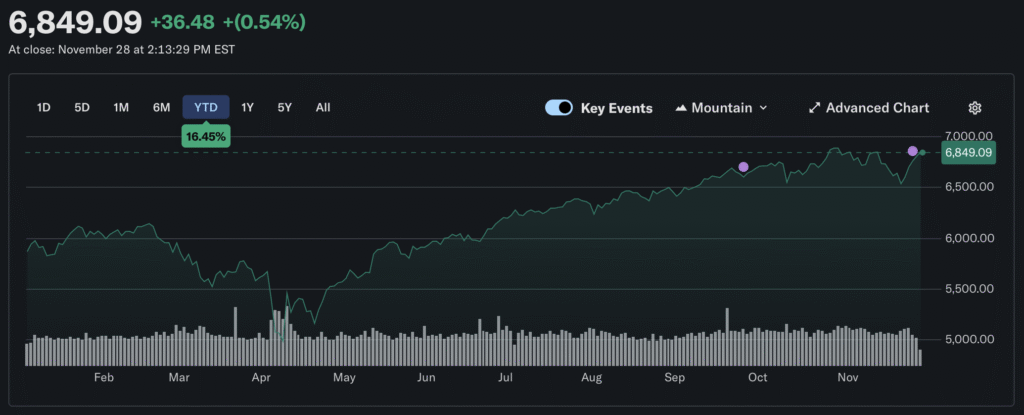
    If you’ve been watching markets lately, you’ve probably felt both fear and greed as we push toward uneasy highs. Last week, staring at a chart of the S&P 500, so did I.

    The S&P 500 Index was up double digits again this year– incredible! Yet I keep hearing fear, uncertainty, and doubt around me. Many are still optimistic … but most are frustrated. So, on one level, it’s just another normal year in markets.

    But what if it isn’t?

    Does the current performance of the S&P 500 Index really represent what’s happening in America’s leading companies?

    via Yahoo! Finance

    The Story Behind The Headline

    The S&P 500 Index is intended to represent the top 500 large companies on the U.S. Stock Exchange.

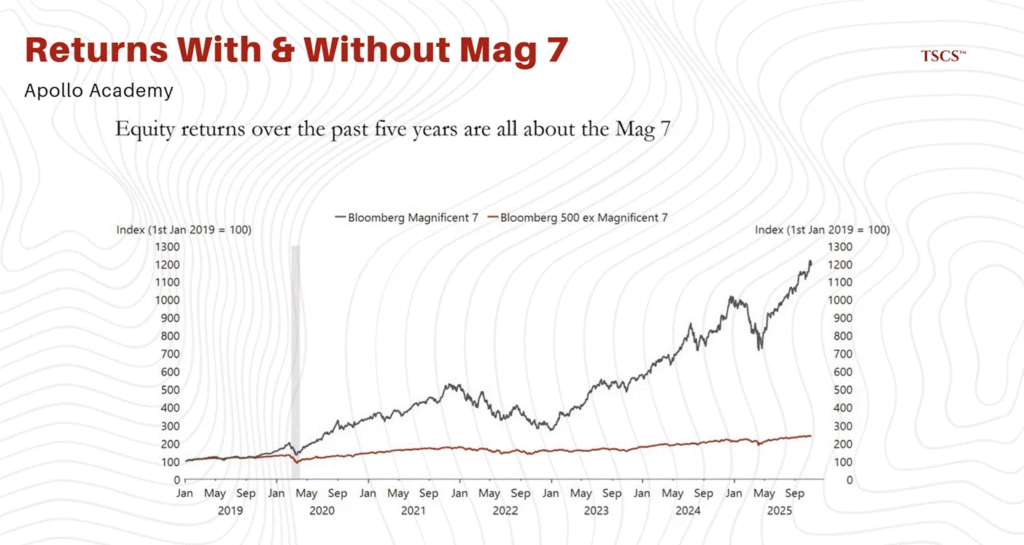
    Today, seven enormous firms (Alphabet, Amazon, Apple, Meta, Microsoft, Nvidia, and Tesla) account for about one-third of the index’s total value. Their success is real, and much of it is fueled by the AI boom. But when a few companies get that big, they don’t just show up on the chart … they bend the chart around them.

    That’s why the “S&P 500” is really two markets:

    • The Magnificent Seven, riding a tidal wave of AI-driven demand,
    • And the S&P 493, filled with companies facing higher costs, tighter credit, slower demand, and more pressure.

    via The Small Cap Strategist

    Why You Care

    If you lead a company or allocate capital, you know a simple truth:

    Signals shape decisions — but only if you trust the signal.

    The problem today is that the most visible signal (the headline index) is being lifted by a narrow slice of the economy. And when that happens, we risk misreading:

    • The true economic climate
    • The real risks beneath the surface
    • The strengths and weaknesses that will matter over the next cycle

    When the map and the terrain aren’t aligned… It’s worth asking why. So let’s explore what the S&P 493 is quietly telling us.

    Spoiler Alert: It’s telling us to be excited about AI.

    ChatGPT launched three years ago. Since early 2023, Nvidia has surged more than 1,000%, including a 29% gain this year alone. Micron is up about 130% year-to-date, while Palantir has doubled over the same period. Vertiv has climbed roughly 35%, driven mainly by demand for data-center cooling, and even Intel (despite announcing major layoffs) has risen around 70%.

    AI is the new “picks and shovels” trade. Infrastructure is hot. Compute is oxygen. And the biggest firms with the deepest moats are attracting a disproportionate share of investment and attention.

    This post isn’t claiming that the market is wrong. Instead, it suggests that the market is telling us where the opportunities and dangers concentrate.

    The Main Street Struggle

    Step outside the Magnificent Seven, and you see something very different.

    • A third of small-cap stocks are unprofitable.
    • Many are getting squeezed by higher interest rates.
    • Tariffs and supply-chain frictions hit smaller firms first.
    • Capital spending outside AI is flat.
    • Small caps (e.g., the Russell 2000) look even more stressed: many are unprofitable, more leveraged, more exposed to tariffs, and more sensitive to interest rates.

    Please note that the “S&P 493” contains strong, durable businesses; this post is not trying to overgeneralize that everything outside the Magnificent Seven is broken. With that said, small companies are the canaries in the economic coal mine. So it pays to pay attention to them, too.

    For example, when the Fed hinted at “further adjustments,” small caps jumped 2.8% in a single day because the move was driven by relief at the prospect of easier policy, not by improving fundamentals — a sign of fragility rather than confidence.

    So how do we reconcile booming giants with struggling small firms?

    Concentration as a Systemic Risk

    When seven firms drive the index, you don’t just get skewed headlines. You get a hyper-sensitive economy and a single-point-of-failure scenario not-so-hidden in plain sight. Not to mention, a gravitational pull that draws resources, talent, and eyes towards them and away from the average business.

    That gap between giants and everyone else isn’t just a curiosity — it’s changing how the whole system behaves.

    Are the Magnificent Seven-type companies Apex predators monopolizing an ecosystem? Not yet. Is it a potential future if nothing changes? Absolutely. This is where intentionality matters, and where leaders need frameworks and decisive actions.

    A few concepts I really like in situations like this are:

    • Signal Vs. Noise – a lot of information comes across your feed … which of it is actually moving the needle?
    • Power Law Thinking – not all companies, markets, or ideas are equal. A few drive most of the alpha. Your job is to identify the drivers, not just the momentum.
    • Barbell Strategies – Make safety your bread and butter, but leave attention and capital ready for high-risk, high-reward opportunities. Allows you to play the game (and bet on a bigger future) without losing your shirt.

    For example, as you try to stay ahead of the curve and sift the signal from the market noise, you can try looking at small-cap health as an early‑warning indicator. Also, look at interest coverage ratios, AI spending vs. AI Profits, and supply-chain lead times.

    These are examples of underlying drivers that go beyond simply looking at a stock market chart.

    Closing Thoughts

    Ten years from now, I suspect we’ll see a few things clearly:

    • Diversification wasn’t what people thought it was.
    • AI winners (chips, compute, data) will look different from AI users.
    • Small firms will remain the early-warning system for economic stress.
    • And the companies — and leaders — who thrive will be the ones who learned to read the real signals, not just the loud ones.

    Markets always leave tracks … but not always where people expect.

    The future belongs to leaders who don’t chase noise, but who understand nuance … and who can see the quiet signal inside the uproar.

    Remember, volatility is not the enemy; fragility is.

    So here’s the question I find myself asking — and one I encourage you to wrestle with too:

    What part of your strategy depends on the strength of giants? And what part depends on your own ability to adapt, innovate, and stay resilient?

    I’d love to hear what you think. Let me know.

    Onwards!

  • A Look At Gartner’s 2025 Hype Cycle for Emerging Technologies

    As technology advances at a breakneck pace, understanding what’s real and what’s hype has never been more crucial. Gartner’s Hype Cycle is more than just a framework — it’s a vital compass for leaders navigating the disruptive frontier of Emerging Technologies.

    I typically share an article about Gartner’s Hype Cycle each year. It does a great job of documenting what technologies are reaching maturity and which technologies’ ascents are being enhanced by the cultural zeitgeist (hype, momentum, great timing, etc.).

    Creating a report like this requires a unique blend of technological analysis and insight, along with an acute understanding of human nature and a considerable amount of common sense.

    Identifying which technologies are making a real impact (and thus will have a significant effect on the world) is a monumental task. 

    In my opinion, Gartner’s report is a great benchmark to compare with your perception of reality.

    What’s a “Hype Cycle”?

    As technology advances, it is human nature to get excited about the possibilities … and to get disappointed when those expectations aren’t met. 

    The Hype Cycle itself is built around this paradox — the excitement of emerging tech juxtaposed by the oft-inevitable disappointment. This tension forces leaders to recognize both risks and rewards, reminding us that true opportunity often hides behind initial letdowns.

    At its core, the Hype Cycle tells us where we are in the product’s timeline – and how long it will likely take the technology to reach maturity. It highlights technologies with the potential to move beyond initial hype and transform how we live and work.

    Gartner’s Hype Cycle Report is a considered analysis of market excitement, maturity, and the benefits of various technologies. It aggregates data and distills more than 2,000 technologies into a concise and contextually understandable snapshot of where various emerging technologies sit in their hype cycle.

    Here are the five regions of Gartner’s Hype Cycle framework:

    1. Innovation Trigger (potential technology breakthrough kicks off),
    2. Peak of Inflated Expectations (Success stories through early publicity),
    3. Trough of Disillusionment (waning interest),
    4. Slope of Enlightenment (2nd & 3rd generation products appear), and
    5. Plateau of Productivity (Mainstream adoption starts). 

    Understanding this hype cycle framework enables you to ask important questions, such as “How will these technologies impact my business?” and “Which technologies can I trust to stay relevant in 5 years?

    That said, it’s worth acknowledging that the hype cycle can’t predict which technologies will survive the trough of disillusionment and which ones will fade into obscurity.

    Some Historical Context …

    Before focusing on this year, it’s essential to note that in 2019, Gartner shifted its emphasis towards spotlighting new technologies at the expense of those that would typically persist through multiple iterations of the cycle. This change helps account for the increasing number of innovations and technology introductions we are exposed to compared to the norm when they first started producing this report. As a result, many of the technologies highlighted over the past couple of years (such as Augmented Intelligence, 5G, biochips, and the decentralized web) are now represented within newer modalities or distinctions. 

    It’s interesting to look at old articles (such as my Hype Cycle article from 2015  and the Hype Cycle article from 2019) and watch how quickly priorities shift as emerging technologies evolve.

    2021 marked the introduction of NFTs and advancements in AI. It also focused on the increasing ubiquity of technology. By 2023, Gartner focused on emergent AI, emphasizing the importance of human-centric security and privacy in this new paradigm.

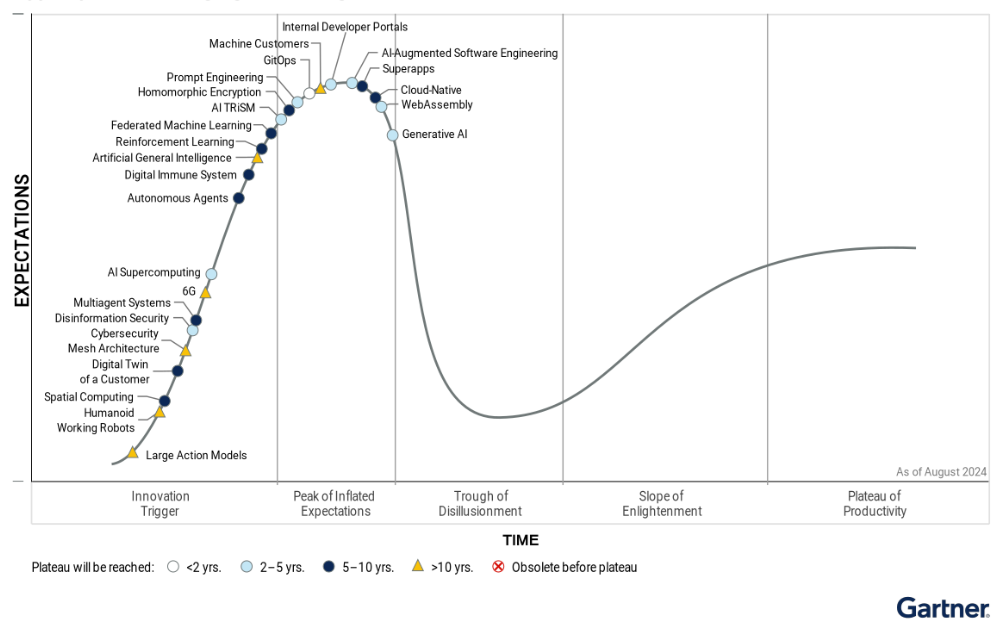
    Somehow, for the first time since 2015, I didn’t post about the hype cycle last year. So before exploring this year’s list, here’s a brief recap of Gartner’s 2024 Hype Cycle.

    Themes From Gartner’s 2024 Hype Cycle

    • Autonomous AI – Technologies evolving toward systems that can act with minimal human oversight: e.g., autonomous agents, large action models, machine-customers, humanoid working robots.
    • Boosting Developer Productivity – Tools and practices aimed at accelerating software delivery, improving dev flow, collaboration, and enabling higher-velocity innovation (e.g., AI-augmented software engineering, internal developer portals, GitOps).
    • Total Experience (TX) – A holistic take on experience: linking customer, employee, user, and multi-experience, enabled by spatial computing, superapps, 6G, and digital twins of customers.

    What’s Exciting This Year?

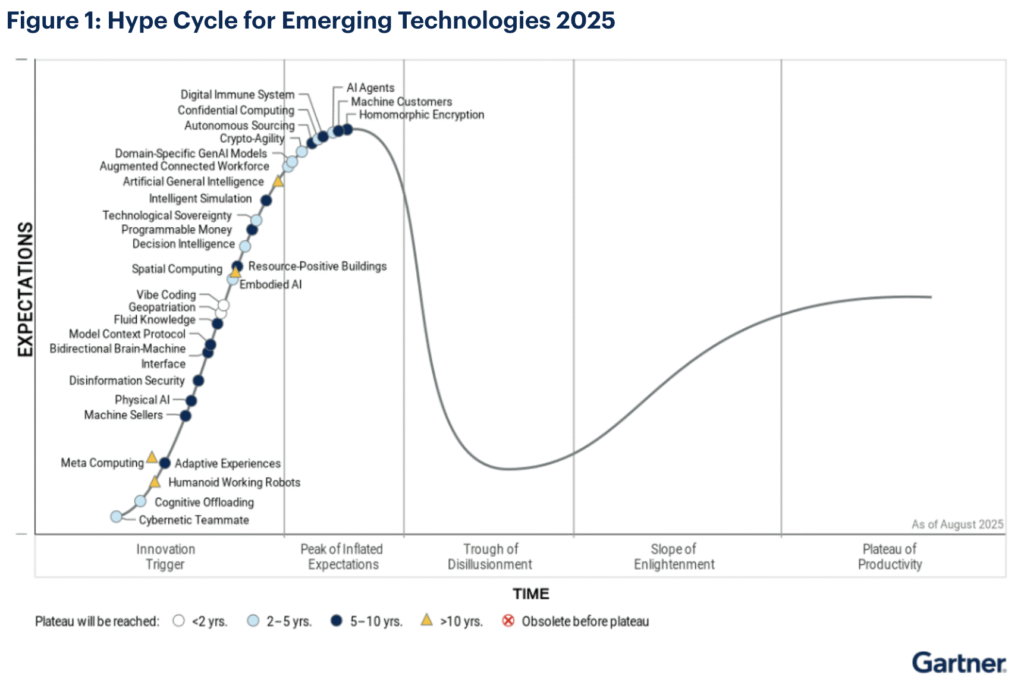
    Here is Gartner’s Hype Cycle for Emerging Technologies 2025. Click on the chart below to see a larger version of this year’s Hype Cycle.

    via Gartner

    This year, the key technologies were bucketed into four major themes.

    • Autonomous Business describes a future where machine-customers, AI agents, autonomous sourcing, and self-adapting products converge beyond automation to create self-governing value systems. It’s almost entirely closed systems acting and transacting with minimal human intervention. This represents a shift from AI as a co-pilot to AI as the whole flight crew, and the passengers. A question to be asking yourself is “Where in your value-chain could a machine act as customer, supplier, or decision-point, rather than a human?”
    • Hypermachinity continues the conversation around advanced systems and autonomy, but takes it one step further. This is about intelligent systems that outperform traditionally hybrid processes via context-aware intelligence, sensors, meta-computing, and embodied AI. In this pillar, the boundary between the digital and physical becomes increasingly blurred. A question you should be asking is “Which processes in your business remain manual, fragmented, or isolated  … and might become fully autonomous systems in the next wave?”
    • Augmented Humanity represents the evolution of the human-machine partnership. The goal isn’t to replace humans, but to amplify them. This is clearly a topic we discuss frequently. AI won’t take most people’s jobs, but someone who uses AI effectively will. What upskilling, training, or redesign of roles will be required to shift from “humans doing tasks” to “humans supervising and collaborating with systems”?
    • The final theme is Techno-Societal Fragility. As technology becomes increasingly embedded in society, more aspects of daily life fade into the background; the risks of societal disruption, disinformation, privacy erosion, and other threats increase. The downsides of AI aren’t just side-discussions now. They are strategic imperatives. Organizations (and governments) must balance innovation with pragmatism, resilience, trust, and ethics. Do you have a strategy and budget for safety and resilience, in addition to speed and efficiency?

    Implications for Leaders

    While the technologies and scale have evolved, the discussion remains remarkably similar to that of 2023. For the past few years, the discussion has centered on the spread of emergent technologies, followed by how to respond to their increasing ubiquity.

    Moreso than ever, it’s about building systems that help adopt these new technologies efficiently … while also protecting yourself from making mistakes at lightspeed. 

    Still, too many organizations treat these technologies as experimental. That ship has sailed. You must adopt a platform-thinking approach to stay competitive: scalable, governed, and operable systems.

    Platform thinking will underpin not just tech stacks, but entire business and governance models — companies will win or lose based on their ability to orchestrate AI, humans, and data seamlessly.

    ROI for these technologies has shifted from simplification and automation to new capabilities and profit centers.

    It may seem silly to make this juxtaposition in an article about hype cycles, but the game is shifting from hype to execution.

    While “experiments” aren’t enough anymore, you don’t need a flawless system to begin. You can (and should) start with small, controlled tests that show the process is sound, the team can operate the tools effectively, and the safeguards function as intended. Establish reliability and build competence first. Once those foundations are in place, increasing scale & speed becomes an advantage rather than a risk.

    A final note, tools and technologies don’t change the game by themselves — you must ask what game the tool makes possible. Shift your focus from “Can we build it?” to “What does this let us become?

    Hope that helps.

    Onwards!

  • Building A Better Business 101

    As conversations about AI and rapid technological change dominate headlines, it’s easy to forget something fundamental:

    To have a business, you actually have to build a business.

    Too often, entrepreneurs string together a series of short-lived promotions — chasing trends and pivoting from one idea to the next. They launch quickly, make a modest profit, and just as quickly move on. In their haste to stay “current”, they bypass critical business building steps like product management, developing infrastructure, and consistent execution.

    That approach works — until it doesn’t. Businesses built on trends are fragile. They rarely weather the shocks of a market crash, a platform crackdown, or a pandemic-sized disruption.

    Like most good lessons, this one’s fractal — you’ll see it everywhere once you start looking.

    Selling Picks and Shovels

    Most of us have heard the old adage about selling picks and shovels during the gold rush.

    During the gold rush, many people rushed to the goldfields in the hope of striking it rich by finding valuable gold nuggets. However, many participants in the gold rush did not find enough gold to become rich.

    Why mine for gold when you can sell picks and shovels?

    Often, the people who make the most money are the ones selling picks and shovels (goods and services) to the speculators. Said differently, profits often flow to people who provide the systems and infrastructure that enable others to dream of a bigger and better future. It’s why it’s easier to count on the blockchain being successful, rather than any specific cryptocurrency.

    It’s not sexy, but it’s reduced risk, consistent demand, and a long-term perspective. When the mine dries up, you move on to the next mine and patiently stack your gold nuggets. 

    And, there are plenty of opportunities that don’t involve selling picks and shovels. You can build temporary lodgings, open a bar, and, of course, you can’t forget the world’s oldest profession … trading

    Okay, But What About AI

    The AI boom feels a lot like the gold rush — a wave of excitement, hype, and promise. Both attract ambitious early movers chasing big wins. And both are marked by uncertainty: the fear of missing out, the fear of being left behind, and the fear of not knowing which way is up.

    That fear drives people to adopt every new app or feature that flashes across their feed — anything to stay afloat. But AI is the tool, not the goal.

    Chasing every shiny object is like panning for flakes of gold while ignoring the deeper veins underground. The real value lies in building something enduring: a business or system that leverages technology with purpose and focus. It’s about extending the edge you already have or finding a new one that supplements or complements your current business.

    And here’s the key difference: while the gold rush came and went, AI is reshaping industries, economies, and society itself. The winners won’t be those who chase tools … but those who build with them.

    In My Own Business

    As an entrepreneur, it’s easy to fall in love with technology and let the perfect get in the way of the good.

    In addition, it’s easy to get distracted chasing shiny new things. Jeff Bezos tells a story about how everybody asks him about “What’s new?”… but a better line of inquiry would seek to identify “What remains constant?” In a sense, there will always be a new market or a new technique that’s exciting and promising. However, your real business is the part that remains the same.

    Continuity and recurring revenue create the bandwidth for innovation and ideation. 

    Over the years, we’ve built fault-tolerant systems that have survived fires, floods, internet outages, bad data, and global chaos — from market crashes to “Snowpocalypse.” Every challenge strengthened the foundation we stand on.

    Yes, we’ve evolved. But our why hasn’t changed. New technologies, partnerships, and ventures are part of the journey — not distractions from it.

    When you’re exploring the Wild West, whether it’s in a gold rush, an AI boom, or in the world of e-commerce, your chances of success rise rapidly with a goal, a why, and a plan. 

    The goal is to be timeless … not timely.

    The next gold rush is always just around the corner. Real success isn’t measured by how many trends you chase, but by how resilient and anti-fragile your business becomes in the face of change. The foundation you build today determines the heights you’ll reach tomorrow.

    Hope that helps.

  • How to Adopt New Technologies: A Look at Innovation Activity Centers

    The future tends to scare people who’ve grown comfortable in the present. They hope tomorrow looks like yesterday — because if it does, they already have the answers.

    But that’s not how progress works.

    I often say, Standing still is moving backward,” and You’re either growing or dying.”

    So when I hear people resist new technologies, I can’t help but cringe a little. Smart people don’t avoid innovation and new technologies — they find ways to harness them.

    Think of it like surfing: it’s easier (and a lot more fun) to ride the wave than to fight it. A good surfer doesn’t chase every swell — they’re selective. Sometimes it’s better to skip a small wave and wait for the right one to build momentum. The same applies to technology adoption.

    Last week, while discussing OpenAI’s move toward an IPO, I reintroduced the Technology Adoption Model.

    Capability → Prototype → Product → Platform.

    It’s a simple way to understand how innovation matures — from what’s possible to what’s profitable — as each stage expands in capability, audience, and monetization.

    At the heart of adoption is human behavior. It’s not always the best technology that wins — it’s the one people actually use. Understanding what stays constant amid change is the real key to scaling innovation.

    This idea keeps resurfacing in my presentations and in the book I’m writing, Turning Thoughts Into Things. With that in mind, in this post, I will share two models to help you explore this process more deeply.

    Learning To Surf

    The first is a framework I developed based on how people tend to adopt new technologies. It’s an internal-facing model that consists of these 4 stages:

    1. Improve
    2. Innovate
    3. Redefine, and
    4. Transform.

    Here’s a video that explains the technology adoption framework and what to expect when applying it.

    It’s similar to Maslow’s Hierarchy of Needs; you have to deal with things like food and shelter before you can address higher-level issues like affiliation or self-actualization. 

    The Improve phase is crucial because if you don’t pass this stage, you don’t get to the stuff beyond it. Said simply, the first stage is about helping somebody do what they already do, just better. Doing this increases efficiency, effectiveness, or certainty … buying you time and space to focus on what comes next. It’s also a way to show that you’re making progress in the right direction, increasing capabilities, and building confidence (which is the fuel you need to continue making progress).

    Next, many try to jump straight to transformation, but that’s a mistake.

    Transform is the big, hairy, audacious goal that you want to make possible. It’s the mountain top you’re trying to climb. It’s helpful to know what that is. But when trying to climb the mountain, you still have to take the steps in front of you.

    The first step on the mountain is to Innovate. It’s about what you could do, and what you should do – instead of what you’re already doing.

    Redefine is where you start climbing the mountain and adding new capabilities to your arsenal. You’re now at a stage where you can imagine a bigger future and grow your vision to match your new capabilities. In a sense, you’re playing the same game, but at a different level and with different expectations.

    When you finally make it to Transform, you are playing a new game (often on a different playing field) and you’re likely influencing not just your company but other companies. At this point, it’s common for former competitors to approach you with ideas and resources, seeking to collaborate.

    Another distinction I make about transform is that it’s very different from change. Change is about bringing the past forward and hoping that minor adjustments yield desired outcomes. Transform is about committing to the outcome and accepting the fact that the process may change dramatically.

    Another key mistake entrepreneurs make is that they pivot to something completely new. When you’re charting a path up a new mountain, you will find unstable ground or insurmountable peaks. At that point, many people give up and look for something new. They start wandering in different directions. That’s a lot of wasted movement.

    My rule at Capitalogix is “This … or something better.” When we reach a roadblock, we’re allowed to go around it, but only if it’s an improvement on our current goals. 

    Riding The Waves

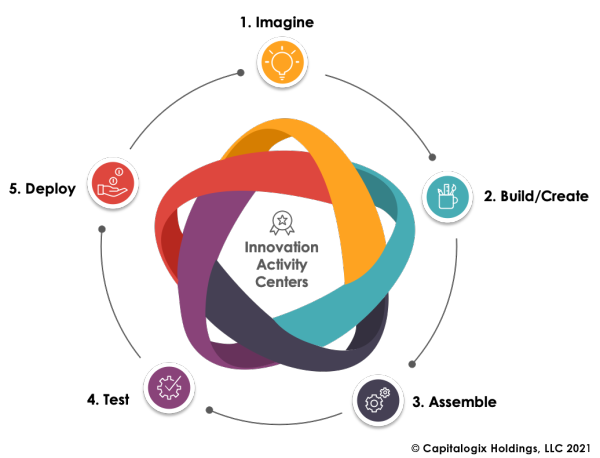
    Within the technology adoption model, there’s an underlying concept that I don’t talk about as much. Innovation Activity Centers are the underpinning of each stage. This framework identifies the different unique abilities and temperaments required to get from start to finish at each stage.

    It’s the framework within the framework that ensures you’re equipped to take decisive action and build momentum on your journey toward transformation. 

    Earlier, I mentioned you don’t have to ride every wave. You just have to skillfully ride the waves you choose. This concept is meant to help you do that. 

    While the stages and seasons of your business change, the activity centers and foci within your business don’t have to. That’s what allows you to stay steadfast in ever-changing currents.

    Each of these activity centers requires a different type of person working on it, different KPIs, and different timelines.

    I also shot a video going into more detail on these activity centers. There are many ideas worth considering in there. So, watch the video.

    Understanding these models helps you anticipate the capabilities, constraints, and milestones that define the path forward — no matter how the world changes. They’re one proven path toward technology adoption, though certainly not the only one.

    We’ve made significant progress refining these frameworks, and they continue to shape our plans for expanding the Amplified Intelligence Platform. I’m excited to keep improving them — and to share what we learn along the way.

    Ultimately, frameworks only matter if you use them. Imperfect action beats perfect planning. My hope is that these ideas help you clear the path as you walk it.

    If you have thoughts or questions about the model or how to apply i,— I’d love to hear from you.

    Onward.

  • The Cloud Experiences Rain … Lessons from the “Great” Outages

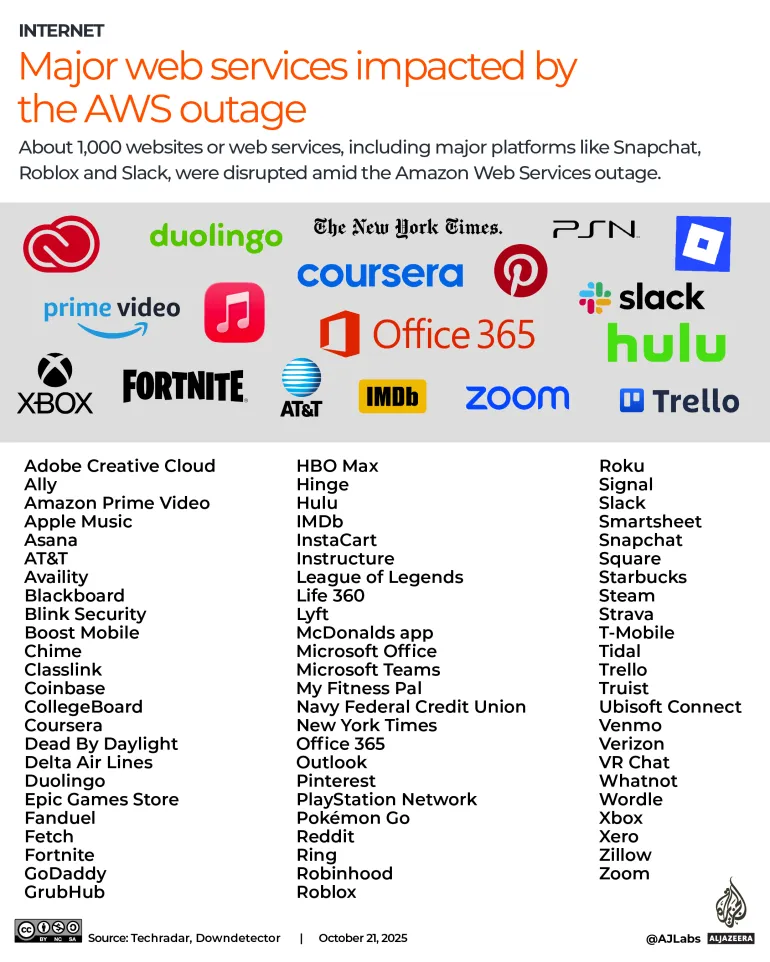
    Cloud technology powers our daily lives — from workplace applications to smart beds. Just like AI, it‘s the underpinning for many technologies that are now largely unnoticed by the average consumer. Over the past two weeks, two major outages helped us realize how deeply connected — and vulnerable — our systems have become.

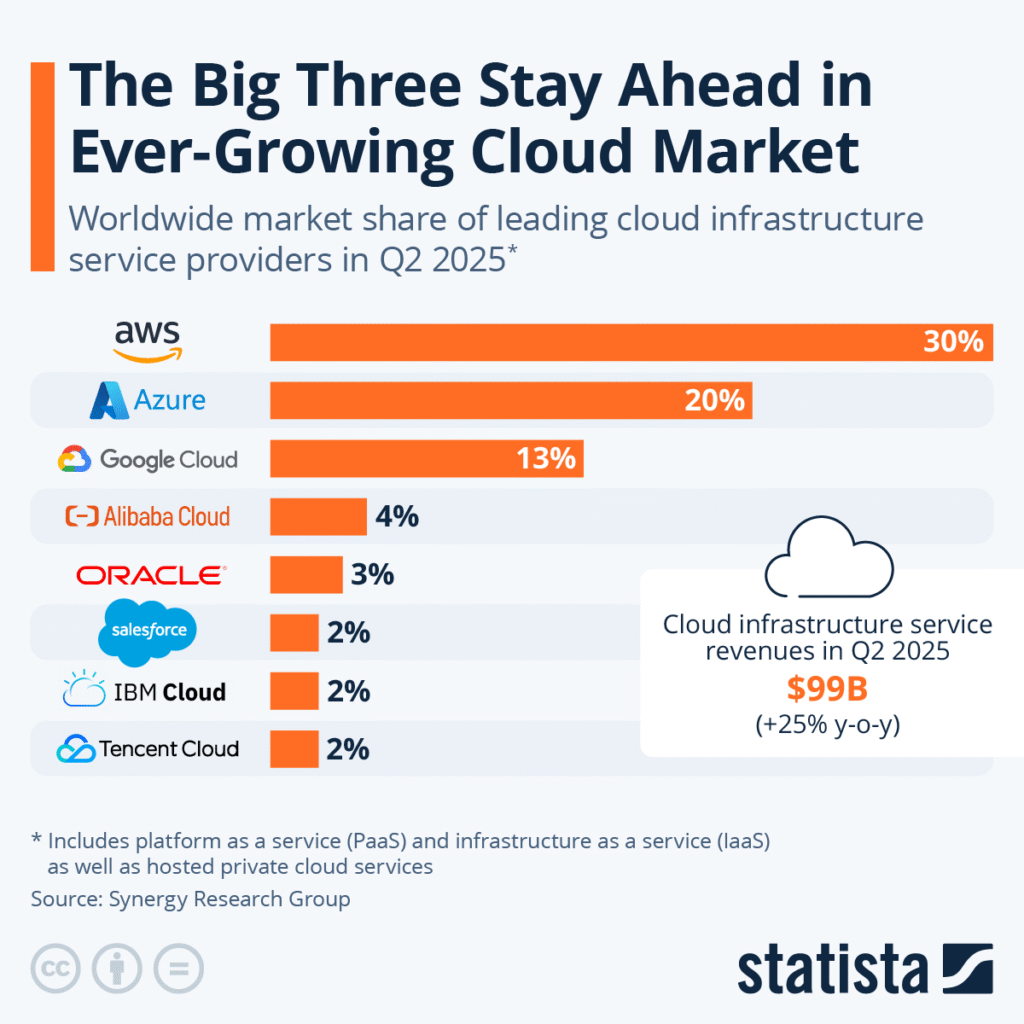
    First, on October 20, Amazon‘s AWS US-EAST-1 region went down, and it felt like the world stopped, in part, because AWS powers over 30% of the cloud market.

    via Al Jazeera

    Ironically, even 8Sleep users experienced outages. Why does a bed have a cloud dependency (and why does it send 16GB of data a month)? Because you can’t manage what you don’t measure. Part of that involves data, and another part involves updates and reporting. You can expect an increasing number of our household appliances to require cloud access.

    Then, barely a week later, on October 29, Microsoft Azure experienced its own outage, affecting Microsoft 365, Kroger, Alaska Airlines, and even the Scottish Parliament.

    A helpful reminder that when it rains, it pours, and even in the business of “uptime,” you should plan for downtime.

    So, what happened?

    Amazon AWS

    The outage in the US-EAST-1 region (Northern Virginia) originated from a malfunction in an internal subsystem that monitors the health of network load balancers (within the Amazon DynamoDB API domain). This triggered Domain Name System (DNS) resolution failures, making key services unreachable or very slow.

    AWS has 38 geographic regions (with plans to add 3 more). But US-EAST-1 was AWS’s first region, and is the largest, making it the default for documentation, new features, and cost-sensitive users. Additionally, some critical “global” AWS services have their control planes hosted in US-East-1, meaning an outage in this region can impact services in other regions too. 

    Microsoft Azure

    Microsoft’s outage was triggered by an “inadvertent CDN configuration change” affecting the Azure Front Door (a global content-delivery / routing service), which resulted in widespread DNS and routing problems.

    Both AWS and Azure experienced DNS issues, which anyone in tech should recognize as the most common point of failure in situations like this.

    via Statista

    But, since Amazon and Microsoft account for over 50% of cloud infrastructure, errors become especially noticeable.

    Is Centralization the Issue?

    To many, this seems like a call to break up these powers and spread responsibility.

    “If a company can break the entire internet, they are too big …”

    Not only is this not how the internet works, but it’s not how business works. Breaking up these providers would make it harder and more expensive for small businesses to compete. Access makes things cheaper.

    As we discuss these global “utility” providers, it is beneficial to have a few key vendors. You don’t want it to be one. Then you get into monopoly territory. But, scale lowers cost. Most people understand this.

    The reality is that, when compared to previous issues, Amazon has significantly improved its resiliency. They’ve also made efforts to lower the global dependence on US-EAST-1.

    Before I go forward, it’s worth reminding people that the cloud is ultimately just a computer that you don’t own. Granted, it’s a very large computer with incredible infrastructure. But it is still a glorified computer. It will never be invincible and 100% faultless.

    What Should I Learn From This Situation?

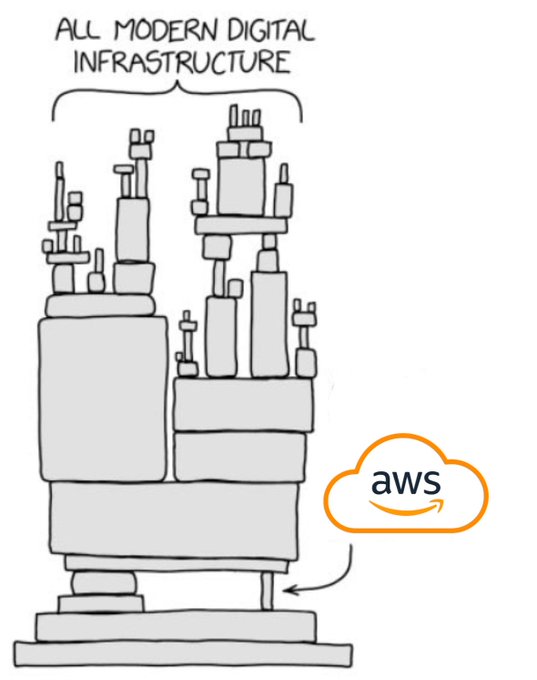
    I am reminded of a great image from Randall Munroe and XKCD. It has been adapted to fit the current situation.

    via XKCD

    The reality is every system is fallible. Any sufficiently complex system will create bottlenecks and failure points.

    The lesson isn’t decentralization, it’s redundancy.

    One of the lessons a mentor taught me was that planning for failure is an important part of hoping for success.

    It’s great to look toward the future and be proud of all that you’re doing things the right way. However, without a disaster recovery plan and redundancies for failures, you’ll eventually face consequences.

    Without a plan, downtime can result in lost revenue, damaged trust, and data exposure. A good recovery strategy ensures that when your primary systems fail, you have a clear path to restore operations quickly and minimize disruption and business impact.

    To be transparent, we were also affected by the AWS outage. AWS is one of our key providers. However, because we have systems on other platforms and strategies in place, we were able to navigate it without a significant impact on our business.

    Building safeguards starts with redundancy — distributing workloads across regions, providers, and availability zones so no single failure can take you down. It can even be as simple as moving your main AWS region away from US-EAST-1.

    Here are some other strategies to consider:

    • Combine automated backups with regular failover testing to ensure optimal system uptime.
    • Document your recovery playbook so your team isn’t scrambling in the dark.
    • Implement real-time monitoring, alerting, and security protocols that detect minor issues before they escalate into major problems.
    • Put expiration dates on decisions (especially automated ones) to make sure that it’s still the correct choice (long after you forget that you made the decision in the first place).

    No system is immune to failure. That means that as exponential technologies power more of our world, mistakes and outages will happen (probably more often than they do now).

    You can’t prevent every outage, but you can dramatically increase the odds that it’s a manageable inconvenience, rather than a potential catastrophe.

    What safeguards are you putting in place today?

    Hope that helps.

  • Does A Larger Workforce Mean More Millionaires?

    Does the size of a country’s workforce determine its wealthiest citizens?

    Beyond Headcount—The Real Drivers of Wealth

    In a world shaped by rapid technological change and evolving labor dynamics, this post explores which nations lead in workforce size, where millionaires reside, and why capital concentration often defies population trends.

    Recent research by Visual Capitalist sheds light on both the world’s largest workforces and the distribution of wealth among its richest citizens.

    via visualcapitalist

    Unsurprisingly, Asia dominates the global workforce, with China and India accounting for over 1.3 billion workers.

    Although the U.S. trails far behind China and India in absolute workforce size, it maintains a strong position as the world’s third-largest labor force with 174 million workers.

    Africa’s workforce is rapidly expanding – with potential to double by 2050.

    Following the Wealth Flows

    As we know, workforce isn’t the only factor that influences where wealth flows. For example:

    • Global trade & resource distribution,
    • Financial & governmental policies,
    • Urbanization & tech Infrastructure,
    • And, access to opportunities

    Where Wealth Accumulates

    In 2025, we’ve surpassed 60 million millionaires worldwide.

    Together, this group holds over $226 trillion in wealth.

    via visualcapitalist

    America, China, and France top the list – holding over half the global total. If you were to imagine the list as 10 people, four would live in America, one would live in China, and the rest would be scattered across the globe.

    France, Germany, and the UK, are relatively small populations boasting outsized ratios of millionaires.

    Notably, almost 1/10 American adults are millionaires (Luxembourg and Switzerland top this ratio with 1/7). That surprises me.

    Also, while major cities like New York, Los Angeles, and San Francisco remain millionaire hubs, Scottsdale, Arizona, actually boasts the fastest millionaire growth over the last decade.

    Ultimately, I think it’s clear that a large labor force doesn’t necessarily translate into a large population of millionaires. Countries like India and Indonesia rank among the biggest contributors to the global workforce, yet their per capita wealth remains modest. Meanwhile, nations such as the United States, Japan, and Germany — home to far smaller workforces — consistently dominate global millionaire rankings.

    Why Efficiency Beats Size

    Countries like the United States demonstrate how access to markets and capital, combined with robust innovation ecosystems, drive wealth far beyond population scale.

    The difference lies less in the number of workers and more in the structure of opportunity: productivity, access to capital, innovation, and financial markets create wealth far faster than population alone. In short, a big workforce builds economies — but efficient systems and upward mobility build millionaires.

    Economic opportunity grows when connections (between people, ideas, and markets) multiply — think of a telephone network: one phone is useless, but as more connect, the system’s value rises exponentially.

    Disruptive innovation often happens in small, focused markets before scaling. Early adoption, not just raw numbers, signals where outsized returns will come.

    As AI continues to shift productivity from in-person humans to digital agents, the very nature of value, employment, and opportunity will likely undergo a profound transformation. It will also change what we believe is possible.

    For example, I expect to see a one-person Unicorn as artificial agent technologies become more capable, scalable, and adaptive.

    Conclusion: Building Pathways to Prosperity

    In summary, a large labor force may grow economies, but upward mobility and innovation are the true engines of millionaire creation. For leaders aiming to foster national prosperity, the goal should be cultivating efficient, inclusive systems — not merely expanding the workforce.

    We live in interesting times!

  • A Brighter Tomorrow Through Medicine

    In writing these articles and newsletters, I often try to alternate between optimism, pragmatism, and an acknowledgement of where progress might still fall short.

    An Area of Boundless Optimism, Grounded In Progress

    Health and longevity and things almost every human strives for. As a result, medicine isn’t just a field — it’s a quest. With every breakthrough, we rewrite the boundaries of what’s possible. Today, optimism is more than wishful thinking … it’s anchored in real, measurable progress.

    The Steady Rise of Lifespan Worldwide

    Life expectancy has been on a steady global rise for a long time. Global life expectancy has risen by nearly 20 years since 1950. As of 2023, average life expectancy is estimated at 76.3 years for women and 71.5 for men, returning to pre-pandemic levels after COVID-related dips.

    Screenshot 2024-08-24 at 9.40.59 PM

    via worldometers

    Life expectancy depends on many factors. While genetics lay the foundation, access to healthcare, quality nutrition, reliable infrastructure, and income levels shape how long — and how well — people live. Here is an infographic showing expected lifespans across the globe.

    Life Expectency Around the World

    via VisualCapitalist.

    Meanwhile, global health continues to make progress. For example, age-standardized mortality rates have dropped by 66.6% worldwide from 1950–2023, even as the overall number of deaths rose due to population growth and aging.

    Breakthroughs in Medicine

    I am astounded by the pace of progress in diagnostics, imaging, treatments, cures, and now even regenerative medicine.

    Examples abound. When I was growing up, if an athlete had an ACL injury, it almost certainly meant their career was over. Today, even after three ACL repairs, my son continues to play rugby competively.

    In addition, my son’s ACL surgery scars are smaller than his knee, I remember when they had to slice you open, and peel your skin back just to perform that surgery. Even my mom’s knee replacement was easier, with less scarring, and less immuno-rejection that before.

    But that’s only the tip of the iceberg.

    You don‘t have to be an athlete to desire the ability to continue to do what you want to do for longer. Extending not just lifespan but healthspan — the years spent active and well — is medicine’s true measure of success.

    Emerging Technologies Are Changing What’s Possible

    Growing up, I remember when medicine first began using lasers, or when the world witnessed the first successful human heart transplant. I remember when antiretroviral therapy transformed HIV/AIDS from a death sentence into a manageable condition.

    Now, advancements like these are happening in years or months, not decades.

    For example, Gene therapy adoption is growing, and so is its impact. The number of patients treated with gene therapies in the U.S. is expected to grow from 16,000 in 2020 to about 95,000 in 2025. By the end of 2034, over 1 million patients may have been treated, with an average quality-adjusted life expectancy gain of 5.12 years per recipient.

    Even the rise of Semaglutide and Tirzepatide represents an amazing transformation in medicine science. They change appetite signaling and satiety, showing that pharmacology can now reliably alter the biology of hunger in ways researchers once thought impossible. And, while it’s great for weight loss, it’s also incredible for diabetes care.

    From gene therapy to early detection of Alzheimer’s, AI-enhanced cancer diagnostics, and even preliminary treatments (not just symptom management) for Huntington’s disease and AIDS — the world is changing for the better. And the effects are global. Thanks to rapid innovation, affordable treatments for conditions like malaria are reaching communities that were once out of reach.

    Forecasting The Road Ahead

    • Personalized medicine will be mainstream —treatments tailored to genetic profiles, lifestyles, and early diagnostics, reducing trial-and-error therapies.
    • AI-driven preventive care will spot risks and recommend actions before symptoms arise, changing “medicine” from reactive to proactive.
    • Expect radical decentralization — healthcare delivered everywhere, not just in clinics, with patient data guiding choices in real time.
    • It’s a ‘Journey’ not a ‘Destination’: Medicine is like a city’s traffic system—treating one bottleneck may shift or reveal another. Life expectancy gains require coordination (genetics, public health, tech, economy) to avoid congestion in vulnerable areas.
    • Longevity Risks: Like a pebble dropped into a pond, each breakthrough creates ripples of unexpected effects — longer lives mean new societal needs, workforce changes, and shifting cultural attitudes toward aging. Longer lives will bring promises and perils we’re only beginning to see.
    • Hype vs. Evidence: Not all breakthroughs deliver widespread impact; many promising treatments prove costly, ineffective, or even harmful at scale.

    Conclusion

    In a world obsessed with headlines about division and setbacks, medicine offers something different: hope grounded in evidence.

    We’re not only adding years to life but adding life to years—making more moments meaningful for more people, everywhere.

    The promise of a healthier future doesn’t come from wishful thinking. It comes from pragmatic optimism — acknowledging the challenges, investing in innovation, and daring to imagine what’s next.

    That’s a future worth working toward.

    Onwards!

  • The Rise of Stablecoins

    A few months ago, I wrote about how cryptocurrency was entering the mainstream.

    To recap that piece: I’ve historically been skeptical and resistant about crypto on several fronts. Still, I’ve recognized that blockchain and decentralized finance are here to stay.

    One of my biggest arguments against crypto is that governments have fiercely protected their right to print money and tax it. Now, even governments are warming up to crypto. Additionally, regulators are getting on board. Big banks and established industries are creating infrastructure. As the momentum builds, the push toward crypto seems unavoidable.

    New giants were — and are —forming. Coinbase recently joined the S&P 500Circle just had a wildly successful IPO. The performance of stocks like these also hints at a growing market appetite for crypto-focused businesses.

    Some of this momentum has been fueled by policy shifts during the Trump presidency and his administration’s openness to the space. Yet even with that tailwind, I believe there are still significant barriers to the adoption of most cryptocurrencies—barriers that stablecoins, in particular, are designed to address.

    The Stablecoin Surge

    Since that article, tremendous growth continues. And if you haven’t paid attention to stablecoins yet, it’s time to start paying attention.

    What is a Stablecoin?

    Stablecoins are cryptocurrencies designed to maintain a stable value, typically pegged to a traditional currency like the US dollar (e.g., 1 stablecoin = $1 USD). Unlike Bitcoin or Ethereum, which can swing wildly in price, stablecoins aim for predictability.

    Think of stablecoins as the digital equivalent of cash — useful for transactions, storing value, and moving money across borders without the volatility of traditional cryptocurrencies.

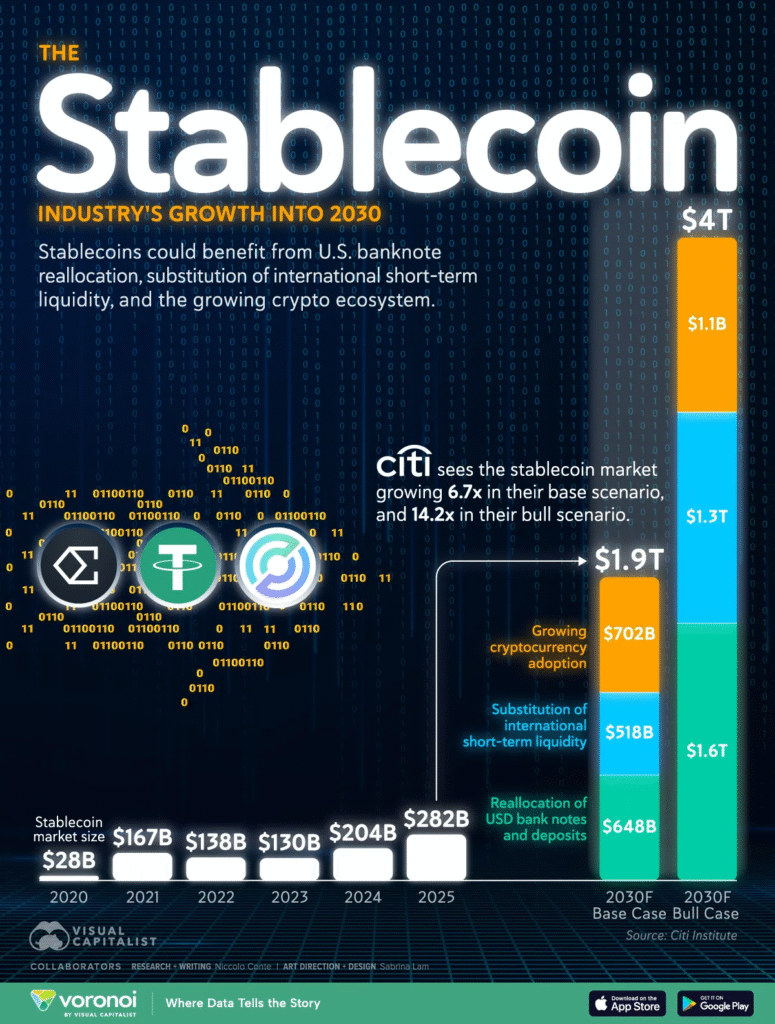
    via visualcapitalist

    The stablecoin market has seen a 10X increase in just five years. In fact, their transfer volume is now more than both Visa and Mastercard.

    They’ve quickly grown from a niche asset to one of the fastest-growing market segments.

    Citi projects that the market will grow 6.7X to 14.2X in the next 5 years. Their justification is based on three main pillars.

    • the reallocation of US cash and deposits into digital tokens,
    • the substitution of international short-term liquidity tools with stablecoins,
    • and the growing role of stablecoins as the backbone of cryptocurrency adoption (in a growing ecosystem)

    It’s also worth noting that stablecoins have become a kind of “parking spot” for capital moving in and out of crypto trades. As smart contracts have enabled holders to earn yield by lending, providing liquidity, or farming rewards, stablecoins’ appeal has only grown.

    A Glimpse of Crypto’s Future

    It’s easy to imagine a future of money built on digital tokens. Stablecoins appear to be the first step toward that future.

    Just like everything else … it’s happening faster than you think.

    A few weeks ago, we took a look at the state of the US dollar.

    This week, visualcapitalist released a graphic looking the value of stablecoins in relation to US cash in circulation.

    via visualcapitalist

    Comparing the market value of stablecoins to the amount of U.S. currency in circulation (bills and coins) shows that stablecoins now make up about 11% of that total. That’s a remarkable jump in just five years.

    The industry keeps innovating, and stablecoins are increasingly becoming part of traditional finance. I expect this trend to grow faster soon.

    What’s your opinion on how quickly stablecoins might transform the monetary landscape?

  • Revisiting One of my Favorite Parables: “The Nail in the Fence”

    Have you ever said something in anger that you later regretted — only to find that your apology couldn’t erase the damage? In today’s high-pressure world, emotional wounds are more common than we realize.

    We are living in a period of heightened sensitivity to hurt feelings. Whether it’s politics, kids in school, or even in business … it’s clear that emotions and detection sensors are high.

    What do you think it means? Has something fundamental changed, or is it just the natural result of stress, and high expectations?

    Happy people tend to find reasons or ways to be happy. Frustrated people are good at finding the things that frustrate them. Meanwhile, people are naturally inclined to notice and avoid things that hurt them.

    Of course, a little conflict is normal (or even beneficial).  But, perhaps, the pendulum has swung too far?

    Let’s be clear, some people intend to hurt others. However, it doesn’t take “intent” to hurt someone’s feelings (or to have your feelings hurt).  Hurt feelings can arise from a simple disagreement, a fixed perspective, a careless remark, or even a look.

    Effective strategies can sometimes trigger conflict, too. Why? Because people generally prefer winning to losing. It reminds me of angry kids on a playground. As a result, minor outbursts are often dismissed or explained with excuses like, ‘I was angry,’ ‘I’m only human,’ or, ‘There’s no room for emotion in business.’ Nevertheless, it’s important to remember that we should strive to be better.

    Lessons From the Nail In The Fence Parable

    To drive the point home further, here is the story of “The Nail in a Fence.”  I share it every few years, but as we look to finish the year strong, and begin the new year even stronger, I think it’s worth revisiting.

    Nail In The Fence

    There once was a little boy who had a bad temper. His Father gave him a bag of nails and told him that every time he lost his temper, he must hammer a nail into the back of the fence.

    The first day the boy had driven 37 nails into the fence. Over the next few weeks, as he learned to control his anger, the number of nails hammered daily gradually dwindled down.

    He discovered it was easier to hold his temper than to drive those nails into the fence.

    Finally, the day came when the boy didn’t lose his temper at all. He told his father about it; and the father suggested that the boy now pull out one nail for each day that he was able to hold his temper.

    The days passed and the young boy was finally able to tell his father that all the nails were gone.

    The father took his son by the hand and led him to the fence. He said, “You have done well, my son, but look at the holes in the fence. The fence will never be the same. When you say things in anger, they leave a scar just like this one. You can put a knife in a man and draw it out. It won’t matter how many times you say I’m sorry, the wound is still there.”

    A verbal wound is as bad as a physical one.

    This story is a reminder to be mindful of cause and intent.  Hope it helps.

    How Technology Can Amplify (Not Replace) Our Humanity

    As a technology entrepreneur focused on amplified intelligence (which means making better decisions, taking smarter actions, and continually improving performance), I recognize that we’re not using technology to replace humans.  Instead, we’re automating activities that humans used to do – so that humans can focus on things more important and more in line with their unique abilities and tendencies.

    On the other hand, one of the main reasons for automation is to avoid certain tendencies that are baked into human nature – like these little outbursts.  I say that because, as much as the world has changed in the last several thousand years, human nature has remained stubbornly the same. 

    Making Best Practice Common Practice

    It’s hard enough to change yourself … so, it’s unrealistic to expect to radically change others.  Instead, if you want to increase the likelihood of certain actions, it makes sense to rely on technologies that are simple, reputable, consistent, and scalable to make your best intentions and best practices more common.  This is why I say that amplified intelligence has an automatic advantage … because it eliminates the fear, greed, and discretionary mistakes that humans naturally bring to a process.

    The Power (And Limits) of Forgiveness

    Inflicting pain on others is harmful — but holding on to anger can be just as damaging to ourselves.

    Feeling and stoking anger is like taking poison and hoping the other person suffers.  It isn’t efficient or practical.

    So, what about “Forgiving”? It doesn’t have to be synonymous with forgetting.

    Forgiving removes the valence (or charge) from a situation or memory. It serves you even more than it serves the person you’re forgiving.

    It only takes a moment to create an emotional trigger (think about how you felt when you saw a high school bully in the hallway).  It is simple, evolution and natural selection favored species that remembered and avoided danger.  It is in our DNA.  But avoidance isn’t always a great strategy … especially when it is blocking the attainment of something beneficial.

    Forgiveness is a way to disable or mute the emotional trigger (this is called “collapsing an anchor” in NLP). It’s also a choice to move forward.

    Forgiveness is also a release of “claim”.  When we are wronged, we expect an apology, retribution, restitution, or recognition.  And until we get it, we are stuck, waiting for it.  In a sense, forgiveness releases the stuck energy and makes it available for something else (hopefully, something better).

    Forgiveness changes the route and allows you to move forward.

    And I’ve found that good things happen more often when you are in motion.

    As you look ahead, ask yourself:Who or what do you need to forgive?

    Onwards!