Personal Development

  • Velocity Versus Speed

    Recently, I've been thinking a lot about how businesses scale and technology adoption accelerates.

    For example, consider how fast AI is improving and transforming business.

    Last year, I shared a short video called Speed Matters. It includes some thought-provoking ideas. You can view it by clicking here.


    While speed matters, faster is not always better.

    As you focus on doing more things faster, it becomes more essential to give people room to do important things slower.

    You've almost certainly heard the phrase, "It's better to measure twice and cut once."  It's much easier to do something the right way from the beginning rather than trying to fix it after you mess it up. 

    Activity does not create progress if it doesn't move you in the right direction.

    This reminds me of a distinction my friend Nic Peterson makes. What you want in your business is velocity rather than speed. Velocity implies a vector (and preferably only one vector). You want to move fast in the desired direction, not fast towards distractions, mistakes, or money down the drain. 

    To add one more layer to this, there's an "almost true" axiom in technology: you can only have two out of these three things: a project done fast, done right, and done cheaply.

    But it's only almost true for a big reason. If you've already built the team and put in the work, replicating that work for new projects can be done fast, right, and comparatively cheaper. 

    Are you just moving fast, or do you have velocity in your business?

    Something to think about … 

  • The U.S. Is Back On The Moon!

    When I was young, the Space Race captured the hearts and souls of Americans.  But, for the past few decades, it was in the background.  Recently, that has changed.  The space race is getting hot again.  Resources are pouring into this area, and SpaceX is leading the pack. 

    In 2018, I shared excitement that the boosters he used were reusable.  Today, people are talking about how his ship, Starship, could render other rocket programs obsolete. 

    Fifty-one years after we last landed on the moon, the U.S. is back, and it wasn’t Elon, but the private company Intuitive Machines finally accomplishing the feat. 

    Odysseus, the unmanned lander, is now sending data back to Earth. 

    Despite the massive leapfrog in technology over the past 51 years, this is still a massive achievement for several reasons.  It was done by a private company, it was still very expensive, it precedes a 2026 manned flight from NASA, and it’s the first commercial flight – not just from the U.S. – to make it to the moon.  The trip’s goal is to research the area NASA plans to use for an upcoming mission.  They believe there are beads of frozen water in the area, which could help sustain a permanent settlement. 

    For many years, landing on the moon wasn’t getting any money.  Money was scarce.  We brought back over 800 pounds of moon rock on our last visit, and what little money there was went to more novel missions.  The moon landing symbolizes excitement about the long-term potential of the moon, not just space travel. 

    I love spaceflight for a lot of the same reasons I love AI. 

    It’s a global initiative heralding innovation and improvements that transform the world.  It’s the genesis of many exponential technologies. 

    Many astronauts, even from back in the Apollo days, talk about the incredible feeling they get after a few days in space.  As they gaze on the Earth from above, they lose their sense of borders and nationality.  The Saudi astronaut Sultan bin Salman Al-Saud, who flew on the Space Shuttle in 1985, commented on this, saying, “The first day or so we all pointed to our countries.  On the third or fourth day, we were pointing to our continents.  By the fifth day, we were aware of only one Earth.”

    It reminds me of Carl Sagan’s video on “The Pale Blue Dot.” 

    In 1977, five years after we left the moon, the Voyager 1 launched into space.  Just over a dozen years later, the Voyager 1 spacecraft had traveled farther than any spacecraft/probe/human-made anything had gone before.  It was approximately 6 billion kilometers away from Earth.  At that point, the Voyager 1 was “told” by Carl Sagan to turn around and take one last photo of the Earth … a pale blue dot. 

    The resulting photo is impressive precisely because it shows so little in so much.

    “Every saint and sinner in the history of our species lived there–on a mote of dust suspended in a sunbeam.” – Carl Sagan

    Earth is in the far right sunbeam – a little below halfway down the image.  This image (and the ability to send it back to Earth) was the culmination of years of effort, the advancement of technology, and the dreams of humankind.

    The resulting speech from Carl Sagan is still profound, moving, and worth a listen. 


    via Carl Sagan

    Here’s the transcript: 

    _____

    Look again at that dot.  That’s here.  That’s home.  That’s us.  On it everyone you love, everyone you know, everyone you ever heard of, every human being who ever was, lived out their lives.  The aggregate of our joy and suffering, thousands of confident religions, ideologies, and economic doctrines, every hunter and forager, every hero and coward, every creator and destroyer of civilization, every king and peasant, every young couple in love, every mother and father, hopeful child, inventor and explorer, every teacher of morals, every corrupt politician, every “superstar,” every “supreme leader,” every saint and sinner in the history of our species lived there–on a mote of dust suspended in a sunbeam.

    The Earth is a very small stage in a vast cosmic arena.  Think of the rivers of blood spilled by all those generals and emperors so that, in glory and triumph, they could become the momentary masters of a fraction of a dot.  Think of the endless cruelties visited by the inhabitants of one corner of this pixel on the scarcely distinguishable inhabitants of some other corner, how frequent their misunderstandings, how eager they are to kill one another, how fervent their hatreds.

    Our posturings, our imagined self-importance, the delusion that we have some privileged position in the Universe, are challenged by this point of pale light.  Our planet is a lonely speck in the great enveloping cosmic dark.  In our obscurity, in all this vastness, there is no hint that help will come from elsewhere to save us from ourselves.

    The Earth is the only world known so far to harbor life.  At least in the near future, there is nowhere else to which our species could migrate.  Visit, yes.  Settle, not yet.  Like it or not, for the moment the Earth is where we make our stand.

    It has been said that astronomy is a humbling and character-building experience.  There is perhaps no better demonstration of the folly of human conceits than this distant image of our tiny world.  To me, it underscores our responsibility to deal more kindly with one another, and to preserve and cherish the pale blue dot, the only home we’ve ever known.

    ____ 

    Today, we have people living in space, posting videos from the ISS, and high-resolution images of space and galaxies near and far. 

    We take for granted the immense phase shift in technology.  You have more computing power in your pocket than we first used to go to the moon.

    As humans, we’re wired to think locally and linearly.  We evolved to live in small groups, fear outsiders, and stay in a general region until we die.  We’re not wired to think about the billions and billions of individuals on our planet, or the rate of technological growth – or the minuteness of that all in regard to the expanse of space.  

    However, today’s reality necessitates thinking about the world, our impact, and what’s now possible.

    We created better and faster ways to travel, we’ve created instantaneous communication networks across vast distances, and we’ve created megacities.  Our tribes have gotten much bigger – and with that, our ability to enact massive change has grown as well. 

    Space was the first bastion of today’s innovation, but today, we can look toward AI, medicine, epigenetics, and more. 

    It’s hard to comprehend the scale of the universe and the scale of our potential … but that’s what makes it worth exploring!

    Onwards!

  • Going With The Flow: Functional Mapping

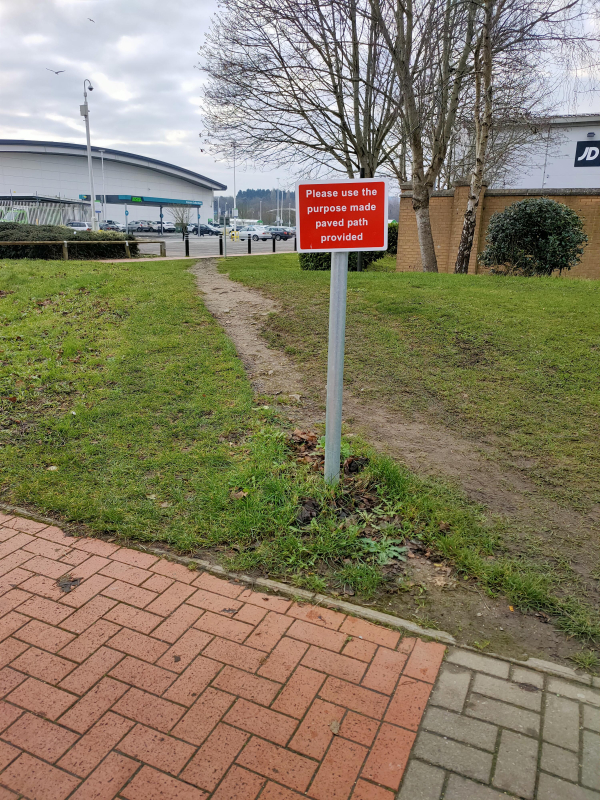
    There’s a concept in design and transportation called Desire Paths

    The desired path is the path that users take despite the intended path by the builder of a community or application. 

    Here’s a great example

    6tj18p093vb81

    Reddit via itstartswithani

    And, here’s a whole community forum focused on desire paths

    It’s often easier to take advantage of human nature … or just nature … than fight against it. 

    To that effect, I shot a short video on how this relates to your business and tech adoption.  I call it functional mapping.  Check it out


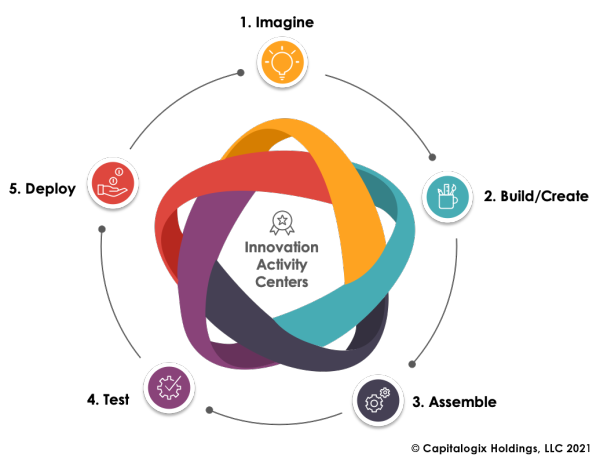
    Understanding the natural path for both technology and your clients makes it easier to understand and anticipate the capabilities, constraints, and milestones that define your path forward.   That means you actually have to understand the different types of users and what they expect to do.

    6a00e5502e47b28833026bded38d1b200c-600wi

    Each stage is really about the opportunity to scale desired capabilities and automation.

    It isn’t really about building the technology; rather, it is about supporting the desire.

    You don’t have to get it right.  You just have to create momentum in the right direction.  This means that if you understand what is coming, you don’t have to build it … but you should figure out where you want to build something that will move things in the right direction.

    You’ve probably heard me talk about how Capabilities become Prototypes.  Then, Prototypes become Products.  And ultimately, Products become Platforms.

    This model is fractal.  That means it works on many levels of magnification or iteration.

    What first looks like a product is later seen as a prototype for something bigger.

    SpaceX’s goal to get to Mars feels like their North Star right now … but once it’s achieved, it becomes the foundation for new goals.

    This Framework helps you validate capabilities before sinking resources into them. 

    It helps you anticipate which potential outcomes you want to accelerate.  Rather than simply figuring out the easiest next step … you have to figure out which path is the best next step to your desired outcome.

    The world is changing fast!  I hope you’re riding the wave instead of getting caught in the riptide!

  • How To Make Real-Time Decisions

    I recently came across an interesting technique that fighter pilots use to make fast and accurate decisions in high-stakes situations. 

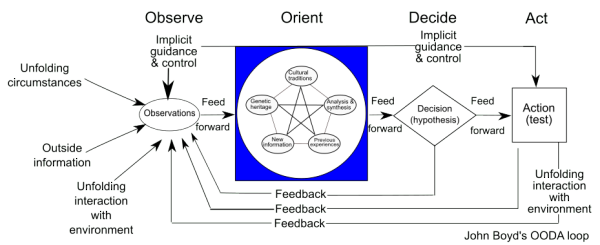
    The Air Force calls it an OODA Loop.

    It is an iterative feedback model that Colonel John Boyd designed as a foundation for rational thinking in chaotic situations like dogfights.

    It stands for Observe, Orient, Decide, Act. 

    OODA.Boyd

    via Wikipedia

    Why do people use decision models?  Obviously, to make better decisions.  But really, they use models to create a process that avoids many of the mistakes or constraints that prevent good decisions.

    You make countless decisions every day – and at a certain point, you reach decision fatigue.  It can be harder to make decisions when you are tired, after you've made too many, or when the intensity of the environment distracts or drains you. 

    It's one of the reasons I rely on artificial intelligence.  Here are some others. 

    • Best practice becomes standard practice. 
    • It accounts for signal and noise.
    • It attempts to quantify or otherwise make objective assessments, comparisons, and choices. 
    • And, it often gives you a better perspective by letting you apply and compare different models or decision techniques to achieve the desired outcome.

    Nonetheless, many algorithms are dynamic and adaptive automation of processes or strategies that humans have used successfully before.

    So, let's take a closer look at the OODA Loop, which stemmed from analyzing many interactions between and among fighter pilots during battle and training. 

    Observe

    The first step is to observe the situation to build the most accurate and comprehensive picture possible.  The goal is to take in the whole of the circumstances and environment.  It's not enough to observe and collect information … you must process the data and create useful meaning. 

    It's the same with data collection for an AI system.  Ingesting or collecting data isn't enough.  You have to be able to apply the data for it to become useful. 

    Orient

    The second step is less intuitive but very important.  When you orient yourself, it becomes easier to recognize strengths, weaknesses, opportunities, and threats to identify how changing the dimensionality or perspective alters the outcome. 

    This step reconnects you with reality in the context of your cognitive biases, recent decisions, and more.  For example, have you received new information since starting?

    I think of this as carrying a map and pulling out a compass while exploring new lands.  Sometimes, you need to remember where you started, and sometimes, you need to make sure you're going where you think you are. 

    Decide

    The last two steps provide the foundation for taking action. 

    When there are multiple decisions in front of you, observing and orienting help you choose wisely. 

    In business and with AI, you can go through these loops multiple times. 

    Act 

    Finally, remember that the best-made plans mean nothing if you don't act on them. 

    Once you've taken action, you can reobserve, reorient, and keep moving forward. 

    Conclusion

    Like most good mental models, The OODA loop works in many situations and industries.

    Speed is often a crucial competitive advantage.  For example, knowing (and taking decisive action) while others are still guessing (and taking tentative action) is something I call time arbitrage

    Said another way, you make progress faster by walking in the right direction than by running in the wrong direction. 

    These processes (and technology) also help us grow more comfortable with uncertainty and uncomfortableness.  Markets are only getting more volatile.  Uncertainty is increasing.  But, when you have the ability to adapt and respond, you can survive and thrive in any climate. 

  • New Beginnings or Evolutionary Growth

    Last week, I started getting “Happy Work Anniversary!” messages on LinkedIn … and I was a bit confused because people kept mentioning 24 years. 

    Twenty-four years … That can’t be right.  Can it?

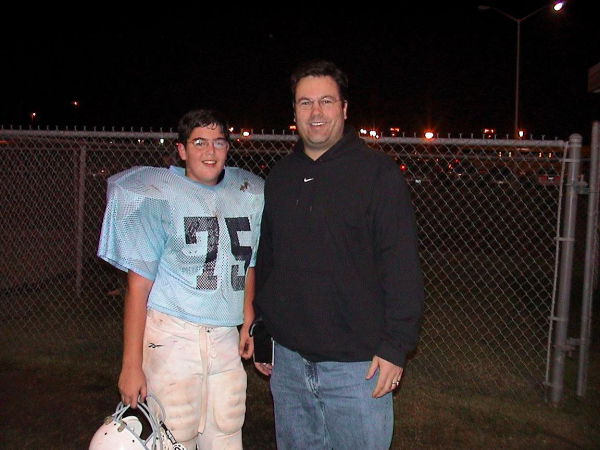
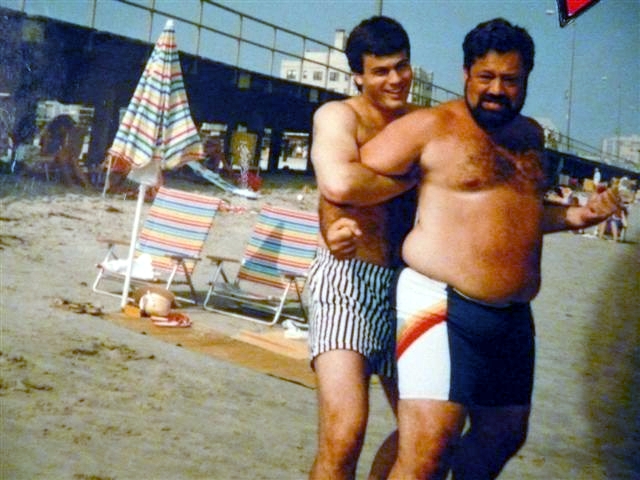
    For context, here’s what I looked like around that time.

     IMG_5265

    My eldest son (who’s now married with a baby) was in middle school.  I was just out of the events I described in my TEDx talk

    However, depending on your definition, the 24th anniversary can be true or false.  Legally, the Capitalogix that exists today is distinct from the initial iteration.  Additionally, the company has expanded, its direction has shifted, and what was once a one-person operation has grown into a team of over 20 individuals focused on advancing and commercializing the field of Artificial Intelligence through something we call Amplified Intelligence (which is the ability to make better decisions, take smarter actions, and continually improve performance).

    Thinking back on the effort, the ideas, the people, the inventions, and even the purpose … in some respects, it feels like change is the only constant.  However, there are certain things that remain unchanged.  It is by observing these unaltered elements that you can truly understand the essence of the thing itself.

    It reminds me of the Ship of Theseus (also known as Theseus’ Paradox), which is a philosophical thought experiment that poses the question of whether an object that has had all of its parts replaced is still considered to be the same object.  It raises issues of identity, continuity, and change over time.  The concept can be applied to physical objects, living organisms, and even organizations or businesses.  It challenges our understanding of what it means for something to be fundamentally the same, and if an object can remain unchanged despite undergoing significant changes over time.

    The name “Capitalogix” originated in 2000, and a surprising amount of the original “North Star” purpose still exists.  Looking back at my early notes and plans, I’m surprised by how much holds up despite 20+ years of passing … but almost all of it has needed some course correction to adjust to changing tides.  

    Regardless, it’s staggering to think about how long I’ve worked in A.I. (since 1991, when it was hard to spell A.I.) and how far we’ve come. 

    If I had known how difficult it was going to be at the beginning, I would have probably never pursued it.  However, after experiencing the challenges and realizing how hard it is to make meaningful progress, I feel better that I did.  This is because I now know that we didn’t just create a competitive advantage – we learned how to create a sustainable competitive advantage.

    It’s easy for people to focus on a capability; it’s another to make it industrial-grade, robust, reliable, and able to work in challenging conditions. 

    They say that things that don’t kill you make you stronger.  It’s true for people, but it’s also true for technologies.  

    Life (and Business) constantly expose us to conditions and opportunities that lead to new beginnings and evolutionary growth.

    As I write this, I see it at Capitalogix as we pursue new possibilities and probabilities. 

    We didn’t come this far — just to come this far!

    What about you?

    Onwards!

  • Some New AI Tools I’ve Been Hearing Good Things About

    At the core of Capitalogix's existence is a commitment to systemization and automation. 

    Consequently, I play with a lot of tools.  I think of this as research, discovery, and skill-building.  There is a place for that in my day or week.  However, few of those tools make it into my real work routine.

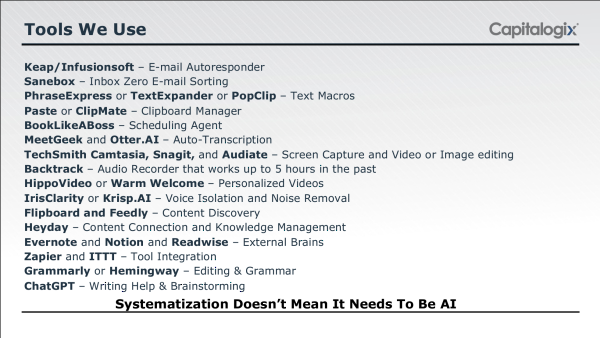
    Here is a list of some of the tools that I recommend.  I'm not saying I use them regularly … but in some cases, I should (it reminds me of some exercise equipment I have). 

    Screenshot 2024-01-19 at 4.56.40 PM

    Since the late 90's, I've been collecting tools to make my business more efficient and my life easier. 

    It's a little embarrassing, but my most popular YouTube video is an explainer video on Dragon NaturallySpeaking from 13 years ago.  It was (and still is) dictation software, but from a time before your phone gave you that capability. 

    Today, I have more tools than I know what to do with, but here are a few that keep coming up in conversations. 

    Daily.AI – AI Newsletters

    We've launched a new newsletter that is AI-curated by Daily.ai.  It matches the tone and style of my newsletters, gets good engagement, and (honestly) looks much better than what we put out.

    Our handwritten newsletters still do better on some metrics – but it's a nice addition and a promising technology. 

    For transparency, our handwritten newsletters get around 45% opens, and 10% click-throughs and our new AI newsletter is averaging around 38% opens but around 30% click-throughs.  Our normal newsletter isn't focused on links – which is why the click-through isn't as good. 

    That said, Daily.AI is a great tool that creates compelling two-way communication with your audience way easier and cheaper (time, money, and effort) than something similar done manually.

    This is an example of how people won't get replaced by AI … people will get replaced by people who use AI better. 

    Opus.pro – AI Video Repurposing 

    Opus.pro takes your long-form video content and cuts it into short-form content that you can post as teasers to other channels like YouTube Shorts, TikTok, or Instagram Reels. 

    For me, I tend to do more long-form content naturally.  I go on a podcast, speak at a conference, or to a mastermind group.  I end up with a 30-minute+ video that I don't have the time or interest in using.  This tool allows me to find the best parts quickly – and still allows editing to make it perfect. 

    For someone interested in really pursuing video, it's not worth it.  If you're interested in being present online, and not worried about making it your career, this is a great tool to streamline and systematize your process. 

    Type.AI 

    Type.AI is an interesting AI-first document editing tool.  At its core, Type is a faster, better, and easier way to write.

    A lot of people are using chat GPT for some editing.  Type is a good example of a next-generation tool that incorporates ChatGPT and other LLMs under the surface.  It is aware of what you are doing and lets you know what it can do. 

    Type jumpstarts the creative process and banishes the blank page.  Underneath its gorgeous UI are powerful features for generating ideas, querying your document, experimenting with different models, and easily formatting your work.

    The point is that with a tool like this, you don't have to be good at prompt engineering.  The tool does that for you – so you can focus on the writing.

    GetVoila.AI 

    Voilà is an all-in-one AI assistant in a browser extension.  That means it goes with you everywhere you go on the web and supercharges your browser by making it use ChatGPT to do what it does best without you having to do more than check what is available.
     
    Voilà simplifies the process of working with the content of websites and URLs, making it easy to convert them into various types of content, summarize them, or extract key information.  For example, if I am watching a YouTube video, I can right-click and choose "Summarize" – it creates a short video summary from the transcript.  Or, while writing this sentence, a simple right-click lets me choose: Improve, Fix grammar, Make longer, Make shorter, Summarize, Simplify, Rephrase, or Translate.
     
    This is more useful than I thought.  I use it well … then forget about it.  When I use it again, I often find that it got better.  I think you will find that with a lot of the tools these days.

     Don't worry about how well you use tools like this.  It is enough that you get better at using tools like these to accomplish what you really want.

    Explore a little.  Then, let me know what you found worth sharing.

  • Almost 20 Years Together …

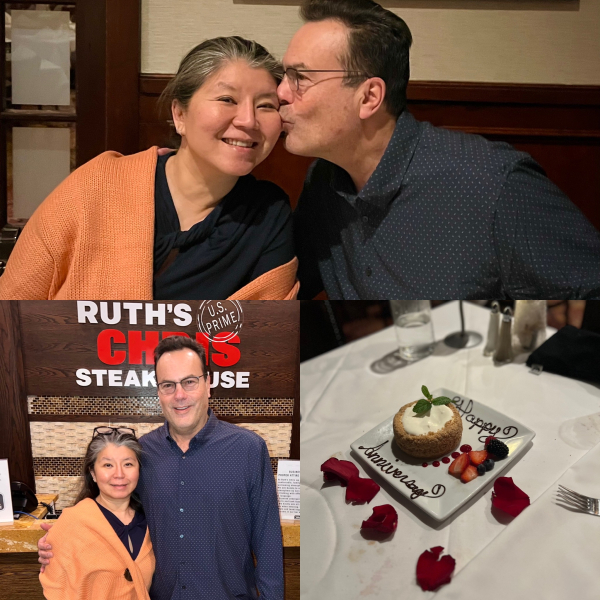
    I met Jennifer in April of 2004.  We got married in January of 2008.  That means we celebrated our 16th Wedding Anniversary this week – and we're nearing 20 years together. 

    EEE02D7B-B8F2-47C0-93B3-6C57B1C51556

    Wow, how time flies!

    On one hand, it seems like it was just yesterday.  On the other hand, portions of that decade seemed to take forever.

    As an entrepreneur, I live in a weird "tense".  For me, the future and the present are often blended.  Meaning, that I imagine the future I want – and then I find the path to create (or manifest) that destiny.  Not surprisingly, some of the things that were easy to imagine were hard to bring into reality (in a reproducible, efficient, and effective manner or process) … And these things seem to take forever.  

    Other things (like relationships or the growth and maturation of my kids) seemed to happen in the blink of an eye.

    I consciously try to be more mindful and grateful for the progress (and even the minor moments, wins, or curiosities) before me.  The truth is that if you fail to notice them, you don't experience them.

    Here is to experiencing all that you need or want … and I hope the rest serves as raw material, learning, or fuel to get you there faster.

    Onwards!

  • The Time You Have Left …

    I recently asked How Long Do You Have Left?

    As I wrote that article, I was reminded of my TEDx talk on my father's passing. 

    Time Flies – My Dad Would Have Been 77 | Capitalogix

    In finance, the "time value of money" refers to the principle that the purchasing power of money can vary over time (meaning, money today might have a different purchasing power than money later). This is partly because money's future value might be calculated by accounting for other variables (like interest earned, inflation accrued, etc.).

    A similar calculation applies to life … or living.

    Live Like You Only Have a Year Left.

    During the last part of my Dad's life, I think he would have done almost anything for a little more time.

    Things that used to be unimportant, or even mildly irritating, took on increased importance. For example, a dinner together became almost a sacred event; a kiss goodnight was truly heart-felt; and saying good-bye meant something … because it could be the last time.

    Nevertheless, as a result of that focus, he took more life out of that time.

    Shouldn't we do the same thing?  Think about it … We are never going to be younger than we are, right now.  We are never going to have more time to fix a big mistake.  Isn't it likely that the time value of your life, is worth maximizing?

    If you realize that your time is worth more than it ever will be, what can you do differently now to get the most out of it?

    For another impactful view of life, here's a great video on how you spend the time in your life – visualized using jelly beans. I think it's pretty powerful and worth watching. 


    Ze Frank (via YouTube)


    So, if (after accounting for sleep, eating, work, commute, TV, chores, and more) an average person only gets 2,740 days to do what they want … those days are precious. That's less than 8 years of "free time" for you to make the most of. 

    Based on the demographics of who's likely reading this, you may have half that time (or a fourth).

    What are you going to focus on? Making the most money? Helping the most people? Spending the most time with your family? Relaxing? I hope you don't choose worrying. 

    There's never a better time than now to live a life worth living … and only you can decide what that means!

    I'd love to hear what you choose. 

    Best wishes for a Happy Holiday Season … and I hope you spend your time wisely and well in 2024!

  • Happy New Year!

    I love planning for the new year – both personally and professionally.  To read about my professional planning, check out this article

    I've always been a big-picture person, so I tend to think in 5, 10, and 20-year increments … but thinking about the coming year is helpful, too.

    I think about it a bit like using a map.  Even if you know your intended destination, you still have to start with 'where you are' to figure out the best way to get there.

    There are seemingly infinite potential paths … but motion in a direction isn't really "progress" if it doesn't take you towards your desired destination.

    At midnight tonight, it'll be 2024.  I know a new year isn't really a blank slate, but I've always enjoyed the symbolism.  So, I thought I'd revisit how I set New Year's resolutions. 

    Future

    To start with, resolutions only work if you actually "want" to make them happen.  It's one thing to hope that something magically falls in your lap; it's another to want to do the work. 

    With that being said, here are some tips. 

    • Focus on What You Want.
    • Focus on Why You Want It.
    • Focus on Ways You Might Get it.
    • Focus on Evidence of Progress.

    Below, I'll take you through an example of each of the four steps.

    Moving Towards a Solution, Rather Than Suffering From the Problem.

    Before I got back into my health, my first instinct was to think, "I need to lose weight."  Knowing that "you're fat" isn't helpful … my head quickly translates that to something a tad more positive, yet generic, like: "I choose to be healthy and vital, and to live a healthy lifestyle."

    Blah, blah … They are just words.  What I needed was something specific, measurable, and actionable.  How about: "I will lose 15 pounds and stop eating after dinner."  OK, but that isn't inspiring, and there isn't much for me to do.  I can do better than that.

    Figure-Out a Big Enough WHY, Rather Than Worrying about the HOW's.

    This post isn't about health and fitness; it is about the mindset and techniques you can use to set empowering goals and plans in any situation.

    So, while I could list many ways to lose weight (and I might even remember to do some of them), leveraging a driving force creates momentum.  In other words, the first step in "Doing" is knowing WHY you want something.

    I really do want to be healthy, fit, and vital (it sure beats the alternatives), and I want to have the energy and confidence to live and enjoy my life fully.  The world is my playground, and I want to take advantage of more opportunities to play with family and friends.  However, to do those things, I must find better ways to live a healthy lifestyle.

    The WHYs are just as important for business goals too.

    Focus on Potential Solutions Rather than Problems or Challenges.

    Obstacles Exist.  The bad news: I don't eat fish, and I don't like vegetables (unless French Fries are vegetables).  My joints aren't close to healthy from years of violent contact sports.  I rarely get 7 hours of sleep, and who'd have thunk it, but being the CEO of a startup is stressful.  The good news: none of those things matter … and even if they did, it just would mean that I have a lot of room for progress.

    It is natural to focus on obstacles.  But most obstacles are surmountable – with a big enough WHY, I'll even start to eat vegetables.  Instead of dwelling on the limitations, use them as a reminder to focus on potential solutions instead.  They are beacons marking the way.

    How do you do it?  To focus on solutions, you can make two action-based lists: one is of things To-Do … and another is of things Not-To-Do.

    Here are some of the sample To-Do Items:

    • I will drink more water than coffee.
    • I will stretch or do basic calisthenics on days that I do not go to the gym.
    • I will make a healthy shake as a meal replacement rather than a snack if I'm hungry between meals.
    • I will focus on relaxation and meditation as much as I focus on strength & physical exercises.

    Here is the actionable list of Not-To-Do Items.

    • I will not buy new bigger pants or wear stretchy pants because of an expanding waistline.
    • I will not eat snacks out of their container – and will portion out what I want first.
    • I will not compare my current level of fitness to what I used to be able to do.  Instead, I will focus on my actions and improvement.

    Create Healthier Habits.

    It is easy to follow a routine.  So, here's another tip … make your routine better.  Here are some examples of things you could do to make being healthier happen with less effort.

    • Pre-sort your vitamins into daily doses, and keep them by the coffee machine.
    • Buy healthy snacks, like fruit, raw nuts, or organic energy bars (instead of chips).  If Doritos aren't in your house, it's hard to eat them on any regular basis. 
    • When you do snack, don't keep them near you.  Make yourself get up to get them.  That'll make it harder for you to binge. 
    • Enjoy listening to music, audiobooks, or podcasts during your "exercise time." Dedicating time to something doesn't mean you can't be multitasking.
    • Park at the end of the parking lot, so you get to walk.
    • Meet with friends at the gym or a hiking spot rather than a bar or restaurant.

    You get the idea.  Get in the habit of looking for ways to create better habits.  What habits could you alter slightly to make a big difference?  Which things can you automate or outsource?

    For two books about the subject, I recommend Tiny Habits by B.J. Fogg and Willpower Doesn't Work by Benjamin Hardy. 

    Focus on Your Progress.

    In this case, it really is about the journey.  Instead of tracking how far you have to go … notice how far you've come.  Utilize an internal locus of control.  It is about creating energy, momentum, and a sense of possibility.  You may have a big, hairy, audacious goal in mind.  That's fine, as long as you realize that reaching each milestone along the way is still an accomplishment.

    • Find shoes that don't hurt your feet.
    • Pick a gym or a personal trainer that you enjoy.
    • Run more than two laps without stopping.

    It doesn't matter what they are … they all count, as long as you know that you are moving in the right direction.

    Summary

    The point of this exercise was not really to focus on fitness.  These techniques and goal-setting tools work in any situation.  The principles are:

    1. First, figure out what you want and why it is important to you.  Only focus on the few things that are actually important to you. 
    2. Second, find something you can do, right now, which moves you in the right direction.
    3. Third, notice which things create (rather than take) energy.  Spend your time on those, and automate or create routines to take care of the rest.
    4. Fourth, plan forward, but measure backward.  Set milestones so that you can recognize and celebrate your progress.

    In my business, this translates to having a mission and vision – it's what we want, why it's important to us, and a basic strategy to get there.  Then, we create yearly "Big 3" goals that move us toward that long-term vision.  Then, the team creates SMARTs (goals that are specific, measurable, attainable, relevant, and timely) and KPIs (key performance indicators) so they know where to spend their time, and what milestones tell them they're on the right track.

    It isn't magic, but it works.

    Hope this helped.