Everywhere you look, someone is predicting which jobs AI will eliminate or automate away next. For many people, the real question is more personal: Is my job safe — or will my company survive?
To answer that, it helps to zoom out.
Back in 2018, I asked a simple question: Which industries were most at risk of disruption? This was pre‑AI boom, so the focus was on digitization and automation (rather than large language models or copilots). That article identified the key signals that an industry was ripe for disruption. That simple framework still applies today.
Here’s a brief summary of the findings.
Digitization Level – Industries like agriculture, construction, hospitality, healthcare, and government were among the least digitized, yet they still accounted for 34% of GDP and 42% of employees.
Regulation Intensity – In heavily regulated industries, companies that find ways to work around legacy rules can become effective competitors quickly (e.g., Lyft or Tesla).
Number of Competitors – Crowded markets with excess capacity or wasted resources (like taxis waiting for fares or empty airplane seats) are vulnerable to new business models.
Automatability – Even in 2018, many industries and tasks were ready to be automated but hadn’t been due to the cost or labor of switching to new technologies.
Ultimately, disruption was about relieving a customer’s headache while lowering costs for the producer, the customer, or both.
Today, AI’s inexorable march is unmistakable as it takes over more tasks and more of the content we create.
In 2024, the WEF evaluated which jobs were most prone to small or significant alteration by AI. IT and finance have the highest share of tasks expected to be ‘largely’ impacted by AI — which is not particularly surprising. Followed by customer sales, operations, HR, marketing, legal, and (lastly) supply chain.
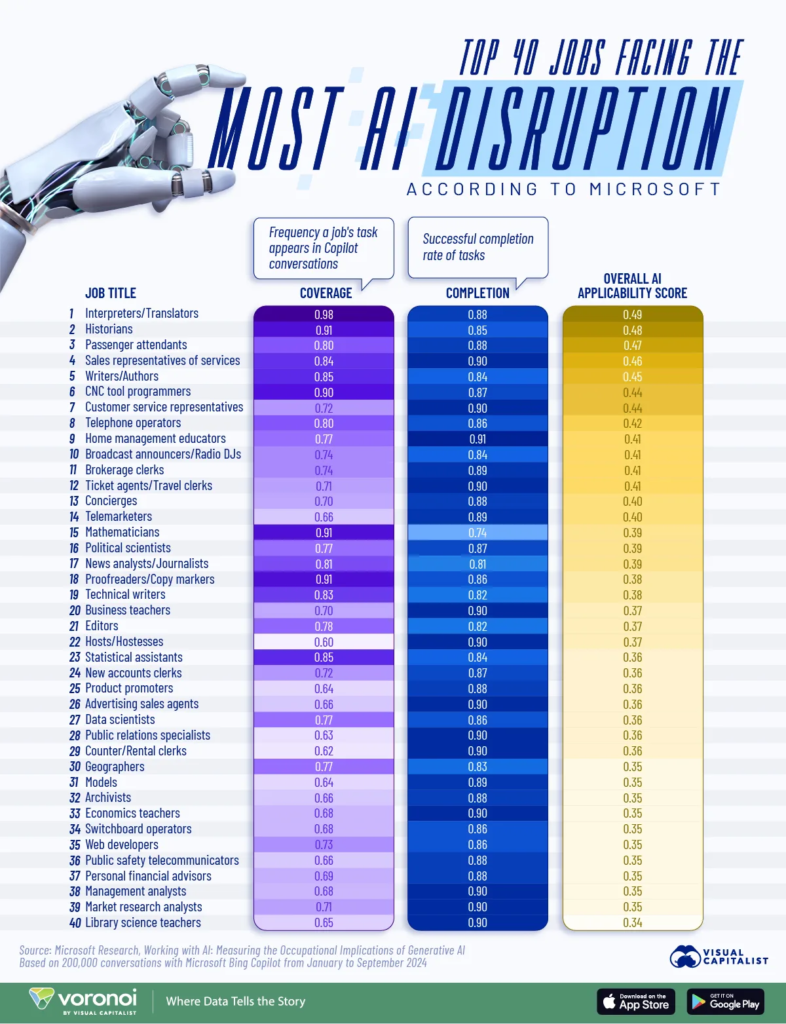
Microsoft assessed AI exposure using three indicators derived from Copilot usage:
Coverage: How often tasks associated with a job appear in Copilot conversations
Completion: Frequency of Copilot successfully completing those tasks
Overall AI Applicability Score: A combined metric indicating how well AI can support or execute tasks within a specific role.
Language-heavy & research-based roles are at the highest risk of disruption. Think roles like interpreters, historians, writers, and customer service.
But exposure does not automatically mean replacement. Augmenting roles with AI will become increasingly common.
Even though creative and communication roles sit near the top, more technical roles will still feel a meaningful impact as well.
Fear not … there is still a place for humans. In many cases, AI functions as a complement rather than a substitute, because these jobs still require judgment, creativity, and human interaction.
Are you using AI in your daily process yet?
At Capitalogix, we focus on amplifying intelligence. To us, that means the ability to make better decisions, take smarter actions, and continuously improve performance. In many ways, it comes down to better real-time decision-making. Practically, that means using technology to calculate, find, or know easy things faster … rather than predicting harder things better.
You don’t have to predict every change. You do have to build the habit of experimenting with AI in the work you already do. The gap between winners and losers will be about learning speed, not job title.
In the next few years, the biggest divide will not be between ‘AI jobs’ and ‘non‑AI jobs.’ It will be between people who learn to wield AI and people who pretend it is not their problem.
A few years from now, when I write a follow‑up to this article, I suspect we will look back and clearly see the gap between winners and losers. It might come down to something as simple as this question:
What are you doing to make sure that you ride the wave, rather than getting crushed by it?
As we approach year-end, my thoughts have been on finishing strong and planning for a great 2026.
Last week, we looked at a prompt that created a new keystone habit. This week, I’m sharing another simple prompt that I found valuable and insightful. It’s designed to review your conversation history, conduct a mini-assessment, and give you a glimpse into your blind spot.
Like last week’s prompt, as written, it’s somewhat generic and might hallucinate a little if it doesn’t have enough data. That’s easy to fix by improving the prompt. But for the purposes of getting started, this is good enough.
Here is the base prompt to try in your primary AI tool.
“From all of our interactions, what is one thing that you can tell me about myself that I may not know about myself?”
Sometimes, less is more.
There are lots of ways to use something like this. For example, you can tell it to be “brutally honest” or to “roast you” so that you hear it in humorous terms. With that in mind, here are a bunch of copy/paste prompt variants that produce the same kind of “surprising but grounded” self-insight, each from a different angle.
Pattern + Blind Spot Variants
Strength-with-a-Shadow
From our interactions, name one strengthI clearly have and the most likely downsideof that strength when overused. Give 2 examples from our chats and 1 practical guardrail.
Default Operating System
What is my “default mode” behavior, under pressure, based on our interactions? What does it protect me from, and what does it cost me?
Hidden Constraint
Identify one hidden assumption I seem to carry. Explain how it helps me, how it limits me, and one experiment to test it.
Blind Spot That Looks Like a Virtue
What’s a behavior of mine that most people would praise, but that could quietly create problems? Be specific and non-psychological.
Decision-making + execution variants
Where I Over-Engineer
Where do I tend to add unnecessary complexity? Give one example pattern, why I do it, and a “2-step simplification rule” I can apply.
Where I Under-Commit
Based on our interactions, where might I stay in analysis longer than needed? Give a “commitment trigger” and a script for making the decision.
One Question I Avoid
What is one question I rarely ask, but should, given my goals? Provide the exact wording and when to use it.
My “Next Constraint”
If I had to improve only one constraint in my system (time, focus, delegation, communication, risk), which one is highest leverage and why?
Communication + Relationships Variants
How I’m Experienced by Others
Based on my writing and requests, how might teammates/investors experience me on a good day vs a stressed day? Give 3 traits each and 1 calibration move.
Trust Friction
Identify one way my communication style could unintentionally reduce trust or clarity. Give a rewrite pattern I can apply.
Authority vs Warmth Dial
Where do I sit on the authority↔warmth spectrum in my messages? What’s the risk at my current setting, and how do I adjust without becoming fake?
Energy + Focus Variants
My Energy Signature
Infer my likely “energy curve” and where I do my best thinking. Give a schedule template that matches it and one rule for protecting it.
My Procrastination Costume
What form of “productive procrastination” do I use (based on our chats)? Give a 60-second interrupt and a 10-minute re-entry plan.
What values do my patterns suggest (not what I claim)? Give 3 values, the evidence, and one way each can be expressed more cleanly.
My Edge
What’s one capability I’m unusually strong at that I might be underpricing? Give one way to productize it and one way to teach it.
Tighter “One Thing” Variants
One Sentence, Then Proof
Tell me one thing about myself I might not know in a single sentence. Then justify it with 3 specific signals from our interactions and 1 counter-signal.
If-Then Insight
If I keep doing X, then Y will happen (good and bad). Identify X and Y from our interactions, and give one small change.
The Uncomfortable Gift
Give me one insight that’s slightly uncomfortable but genuinely helpful. Be kind, direct, and practical. End with one question for me.
Hopefully, you found something that helped you find what you were looking for.
It’s a good reminder that AI is not supposed to replace you … It’s supposed to amplify the best parts of you.
A lot of these exercises and thought patterns are based on activities I used to do in my own planning, or with trusted advisors. As I use AI more in my everyday life, it has collected enough data to be a powerful analysis tool (and that is a scary reminder of how much it knows and remembers).
I believe in examining your thinking – and using those insights to choose smarter and better actions. Prompts like this are a powerful tool for building that habit … but only if you remember that it is still you choosing and acting!
Don’t outsource what makes you human to the machines … but that doesn’t mean you can’t use a helping hand.
Since we’ve been talking about goals, both professional and personal, it felt appropriate to share a prompt that’s been helping me.
It’s designed to review your conversation history, conduct a mini-assessment, and propose a shift or a new keystone habit that would positively impact your personal operating system, improving your days, weeks, and your life as a whole.
As written, it’s likely somewhat generic and might hallucinate a little if it doesn’t have enough data. That’s easy to fix by improving the prompt. But for the purposes of getting started, this is good enough.
Here is the base prompt to try in your primary AI tool.
You’re a Keystone Habit Architect.


Your job: Review every conversation we’ve ever had.
Analyze my personality, patterns, failures, and wins.
Then tell me the ONE keystone habit that will have the highest leverage on my life.


What I want


Pick ONE habit that:

Stabilizes my nervous system
Makes my other habits easier
Stops my worst loops (burnout, avoidance, bingeing)
Actually fits how I work


Read all our past conversations. Build a model of:

My thinking style and energy patterns
When I’m in flow vs. when I self-sabotage
My repeating loops and triggers
What inputs predict my best days


Then pick ONE habit.


Not the “best” habit. The one habit for me.


Output format


Who I am in 5 bullets (use my language, not corporate speak)
Why THIS habit (tie it to my specific patterns)
The habit in one sentence (simple, doable)
30-day execution rules (so simple I can’t forget)
What changes downstream (specific effects on work, sleep, food, self-trust)
What NOT to add yet (protect this from my over-engineering)


Rules


No self-help tone
No generic advice
If you’re torn between options, pick the simpler one
I created several versions of this, which made it far more capable and complicated. But that’s probably overkill for this post. And, interestingly, the habit design response it gave me specifically tried to keep me from over-thinking and over-engineering. So, I included the base prompt here because it’ll help you focus on the habit rather than the prompt.
This is a great example of how AI can help beyond simple content generation.
Also, for bonus points, think about how to modify something like this to improve your life and work in other ways.
If you’re curious how I improved this for my own usage, feel free to reach out.
Every December, people make bold promises to themselves — then abandon them by February. Last week, I shared how Capitalogix plans for a new year in business. This week, I want to use the same principles to help you design personal goals you actually keep in 2026: clearer, more specific, and rooted in what matters most to you. Specifically, we’ll discuss a simple way to turn vague intentions into specific, values-driven change.
ChatGPT made this image with a simple prompt: a man in his 50s improving his life in multiple ways.
What You Focus On Changes What You See
I’m naturally a big-picture guy, and tend to spend a significant portion of my time thinking about longer-term possibilities. With that said, it’s also essential to consider your strategies for achieving them on shorter timeframes. I tend to break that up by Quarters. Lower timeframes than that are more tactical, and I consider that short-term planning or scheduling.
I think goal setting is a lot like using a map. To find the best route, you must start by figuring out where you are and where you want to be.
This time, I asked ChatGPT to make an image with the same man looking at a map. Somehow, I think he’s aged a few years …
Activity alone isn’t as important as many people hope. Think of it this way … from where you are, there are infinite potential paths – but motion in a particular direction isn’t “progress” if it doesn’t take you toward your desired destination.
The right action is far more valuable than merely taking action … and that means beginning with the end in mind. Said differently, you are unlikely to hit the target if you aren’t aiming at it.
Resolutions only work if you actually “want” to make them happen. It’s one thing to hope that something happens; it’s another to commit to making it happen.
The Four Focuses Framework
With that said, here are some tips.
Focus on What You Want.
Focus on Why You Want It.
Focus on How You Might Get it.
Focus on Evidence of Progress.
Let me show you how this works with a real example.
Moving Towards a Solution, Rather Than Suffering From the Problem.
Like many people, I carry around a few different versions of myself. There’s who I used to be when life was louder and more chaotic, who I am right now in the middle of responsibilities and transitions, and who I imagine myself becoming with more clarity and calm. That gap between “then,” “now,” and “next” isn’t about physical change anymore—it’s about presence, patience, and peace of mind.
At first, my instinct was vague and unhelpful: I need less stress. That realization didn’t get me very far. My mind quickly tried to dress it up into something more positive but equally generic, like: “I want to feel more balanced” or “I choose to slow down and enjoy life more.”
Blah, blah … still just words and nice sentiments — but that doesn’t change how I live.
What I needed wasn’t a nicer sentence — it was a reason that actually mattered. Not something measured in minutes meditated or notifications silenced, but something that made the change non-negotiable.
That’s when the WHY became obvious.
This year, my focus isn’t on optimizing my body (like it has been in previous years); I’m focusing more on the inner game of mindfulness. For example, being more fully present for my family — especially with a new grandchild. I don’t want to experience those moments half-distracted, mentally elsewhere, or rushing toward the next obligation. I want the time, energy, and peace of mind to actually be there, and to slow down, to listen, to play, and to remember.
This post isn’t really about family or stress management; it’s about mindset and specificity. It’s about how meaningful change starts. You can list tactics all day long, but without a strong enough WHY, they become good intentions you abandon when life gets busy.
For me, peace of mind isn’t the goal … it’s the path. The real goal is to show up as the version of myself the people I care most about deserve: calmer, more available, and more loving. The HOW will evolve, but the WHY is locked in.
And just like with health or business goals, that WHY is what creates momentum.
Focus on Potential Solutions Rather than Problems or Challenges.
The bad news is that obstacles exist. I’m CEO of a start-up. I have meetings with my employees, investors, and potential investors. I have flights, late nights, and stress … I don’t get a good night’s sleep as often as I want or should. Not to mention the actual work I have to get done on top of all the talking, traveling, and brainstorming.
The good news is that none of those things preclude progress.
It is natural to focus on obstacles, but most obstacles are surmountable — with a big enough WHY, I might even choose to go to sleep at a consistent time. Instead of dwelling on limitations, use them as a reminder to focus on potential solutions. They are beacons pointing the way.
How do you do it? To focus on solutions, you can make two action-based lists: one is of things To-Do … and another is of things Not-To-Do.
Here are some sample To-Do items:
I will protect blocks of time that are not scheduled, optimized, or spoken for.
I will put the phone down when I’m with my family, especially during meals and visits. (Fun fact: I now keep my phone on “Focus”; so anytime I check my phone, it’s deliberate and not reflexive)
I will start mornings more slowly — no news, email, or social feeds for the first part of the day.
I will make space for quiet reflection as intentionally as I once made space for productivity.
Here is the actionable list of Not-To-Do items:
I will not treat every open moment as an opportunity to work or be “useful.”
I will not check messages just because I can; urgency does not equal importance.
I will not compare how much I’m doing now to how much I used to do. Instead, I will measure success by presence and peace of mind. I can do more with less.
Create Calmer Habits.
Routines are powerful. Instead of trying to eliminate them, improve, evolve, or transform them. Small shifts can create big outcomes. Here are some simple ideas.
Create a simple end-of-day shutdown ritual so work doesn’t follow you into family time.
Keep your phone in another room when reading, playing, or spending time with loved ones.
Pair something calming—music, a walk, or sitting outside—with parts of your day that already exist.
Choose activities that naturally slow you down: walking, cooking, reading, or unstructured play.
Plan family time around shared experiences, not just meals or screens.
You get the idea. Look for small shifts that reduce friction or help build momentum in the right direction. For example, ask: What habits can you slightly adjust to create more calm? What can be automated, delegated, or simply left undone?
Here, it really is about the journey. Instead of fixating on how busy life still feels, notice the moments you showed up fully. Use an internal measure of success. This is about building ease, momentum, and a quieter mind.
Sitting through a whole meal without checking your phone.
Being able to slow down without feeling guilty.
Spending an afternoon with family and remembering it clearly.
Feeling present enough to enjoy the small moments—especially with a grandchild.
It doesn’t matter what the milestones are. They all count, as long as you know you’re moving in the right direction.
Summary
The point of this exercise was not really to focus on meditation. These techniques and goal-setting tools work in any situation. The principles are:
First, determine what you want and why it is important. Then, focus on only the few things that are truly important to you.
Second, find something you can do right now that will move you in the right direction.
Third, notice which things create (rather than take) energy. Spend your time on those, and automate or create routines to handle the rest.
Fourth, plan forward but measure backward. Set milestones so that you can recognize and celebrate your Progress.
In my business, this translates to having a mission and vision – defining what we want, why it’s important, and the basic strategy to achieve it. Then, we create yearly “Big 3” goals that move us toward that long-term vision. Then the team creates SMARTs (specific, measurable, attainable, relevant, and timely) and KPIs (key performance indicators) or OKRs (Objectives and Key Results) to measure evidence of success. Doing those things lets the team know where to spend their time and whether they’re on the right track.
It isn’t magic, but it works.
If you want to try this right now, take one personal goal that really matters next year and fill in these four lines:
What I want:
Why I want it:
How I might get it:
Evidence of progress I’ll look for:
Keep it somewhere you’ll see weekly, and update it as you learn.
It is pretty simple and easy to make progress. That’s how you become the version of yourself your future self — and your family — will thank you for.
If you’re interested, here are a few more articles I’ve written on health and longevity.
We’ve officially kicked off our annual planning for the upcoming year.
It’s something we’ve gotten better at over the years, largely because we lived through the pain of ‘planning by PowerPoint,’ siloed teams, and conflicting priorities.
Our method is simple: first, we define the company’s top three strategic priorities. Then each department (and manager) selects their “big three” — the key initiatives that support the company-level priorities. From there, we break things down into quarterly “Rocks,” SMART goals (Specific, Measurable, Attainable, Relevant, Time-bound), and detailed tactical steps that will drive progress.
The planning sessions have been productive. There is a lot of idea swapping, negotiation, and real prioritization.
History has shown that plans are more likely to fail at the level of conversation than in spreadsheets.
The Illusion of Communication
Still, I sometimes catch myself wondering whether what feels like a “dialogue” is actually several parallel monologues. The root issue?
People may share words but not the same underlying meaning.
That’s why shared language matters: two people might say the same word but interpret it entirely differently.
And, in a sign of the times, to combat this, I’ve been running my transcripts through several AI filters. I run preset prompts to identify areas where we seem aligned but might be unaware of hidden ambiguity, identify edge cases that call for clarity, and find topics where we’re misaligned.
Here’s one example of how these prompts helped surface a hidden issue that I missed in a recent session.
Potential Issue to Resolve
Quote: “So clearly I triggered her. She took my notes as my opinion, rather than raw material for other things.”
Intent: Clarify role and intentions around the notes provided so the collaboration can move forward smoothly.
Friction Type: Emotional, Communication
Impact: Medium
Root Cause: Notes interpreted as prescriptive opinion rather than time-saving input, causing defensiveness and relational tension.
Remediation: Ask directly, “How would you like me to format and position future notes so they feel like raw input for you rather than my opinion or direction?”
In a sense, it’s not enough to think and talk. You actually have to think about your thinking and think about the communication.
To help with that, I created these two short videos:
Watch this for a deeper exploration of the “Think, Feel, Know” framework. The premise: You might start with thoughts, but you need to acknowledge feelings before you can arrive at genuine knowing or clarity. It also encourages setting aside time after a task to reflect — often, real insights grow during that pause. It sounds simple, but I highly recommend watching the video.
Chunking Higher
The second video explains how to “chunk higher” to increase the likelihood of agreement and alignment.
Watch this to explore techniques to use when conversations stall or feel like people are talking past each other. Seek to “chunk higher” — clarify shared goals, assumptions, and definitions first. Once there’s proper alignment at that level, move down to specific plans and actions. This approach improves efficiency and decision quality.
When long-term goals are clear, mapping out the steps is easier. Small wins accumulate, momentum builds — and what once seemed distant becomes attainable.
Admittedly, it’s natural to stumble or get stuck sometimes. What matters is recognizing where you are, what you’ve done so far, and taking the next step. Progress isn’t always smooth — but it’s almost always forward.
Short-term gratification can be tempting. And everywhere you look, messages push for speed — instant results, quick wins, fast growth. But those often lead to burnout, poor decisions, or shallow gains. Real, sustainable success tends to come from steady progress, patience, and discipline.
To put it in something of a blueprint, here are four key guideposts we keep returning to during our planning:
Use a common language — make sure everyone means the same thing when they use the same words.
Begin with the end in mind — define long-term goals before anything else.
Start from a place of agreement at the highest level — make sure key stakeholders are aligned before diving into specifics.
Then make clear distinctions as you work down into details — clarity in structure and purpose helps avoid confusion and misalignment.
Looking ahead, I’m excited about where we can take things over the next 25 years — the people we can impact, the goals we can hit, the legacy we might build. Building Capitalogix has never been easy, but it’s been deeply fulfilling. More than that: it’s been a labor of love, powered by knowing precisely what we want — and why.
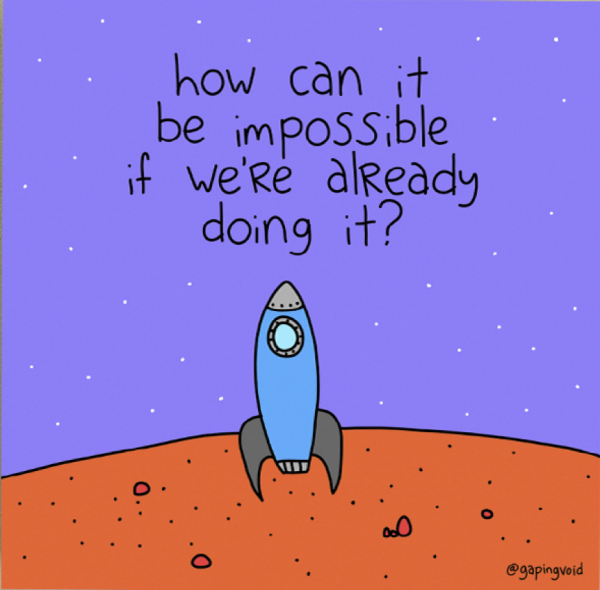
I commissioned this image from GapingVoid to remind our team to keep shooting higher.
Abstract illustration with the phrase ‘How can it be impossible if we are already doing it?’ as a reminder to pursue ambitious long-term goals
If you know what you want, it doesn’t just make the path clearer — it makes it possible.
Here’s to a powerful 2026 … and an even stronger 2050.
My oldest son will be flying in with his wife and young daughter. My youngest son will also join us, as will my ex-wife and her boyfriend. Family takes many forms. Some of it you’re born into, some you choose.
The holiday is an opportunity to be around people who matter and to spend some time thinking about and expressing what you’re thankful for.
Obviously, Thanksgiving is a reminder to be grateful for the blessings in your life – both big and small. But it’s also a time to be thankful for the challenges in your life, and the opportunities for growth that they bring.
“So Tell Me What You Want, What You Really Really Want”
Often, when I choose to think about what I want, the first thing I think of is what I don’t want. Similarly, when I think about what’s going well (or something worthy of being thankful for), I often first think about what has been difficult or isn’t above minimum standards yet. Some things change quickly. Apparently, human nature isn’t one of them.
The Gift of Challenges
Can discomfort and challenge be genuine gifts? I think so! Challenges are often hidden gold mines. Instead of thinking about them as obstacles for you, recognize that getting past them creates new barriers for competitors. In other words, figuring out a strategy to achieve these lofty goals creates a new status quo and a sustainable competitive advantage.
At Capitalogix, we often talk about “finding a way,” “creating breakthroughs,” and “setting new standards.” The reason is that most of the things an innovator wants are just beyond their current capabilities (otherwise, they’d already have them).
Whether you’re leading a team, nurturing a family, or simply navigating life’s daily challenges, choosing gratitude (especially during the tough moments) can forge resilience and the ability to be comfortable with being uncomfortable.
This brings me to an important principle — the Stockdale Paradox — which balances optimism with realism. It is named after Admiral James Stockdale, the most senior naval officer held captive during the Vietnam War. Stockdale noted that the prisoners who fared worst were often the “optimists” who kept setting near‑term deadlines like “we’ll be out by Christmas,” then broke psychologically each time those hopeful timelines passed unmet. Their short‑term, date‑specific optimism couldn’t survive repeated disappointment. Stockdale’s perspective assumed it might take a very long time and could be extremely bad before it got better. Expect the worst and prepare for the best. Said differently, try to balance unwavering faith in eventual success with the discipline to confront harsh realities.
And we all face harsh realities.
Having “no problems” either means you’re blind to your flaws or aren’t playing a big enough game (which is a problem in itself).
So, I am thankful for my health, my family and friends, and the quality of my life. But I am also thankful for the stress, the challenges, and the opportunity to face a continually better class of challenges that forge a path to a better baseline and a bigger future.
I’m reminded of a poem I last shared over 10 years ago.
Be Thankful
Be thankful that you don’t already have everything you desire. If you did, what would there be to look forward to?
Be thankful when you don’t know something, for it gives you the opportunity to learn.
Be thankful for the difficult times. During those times, you grow.
Be thankful for your limitations, because they give you opportunities for improvement.
Be thankful for each new challenge, because it will build your strength and character.
Be thankful for your mistakes. They will teach you valuable lessons.
Be thankful when you’re tired and weary, because it means you’ve made a difference.
It’s easy to be thankful for the good things. A life of rich fulfillment comes to those who are also thankful for the setbacks.
Gratitude can turn a negative into a positive. Find a way to be thankful for your troubles, and they can become your blessings.
Have you ever said something in anger that you later regretted — only to find that your apology couldn’t erase the damage? In today’s high-pressure world, emotional wounds are more common than we realize.
We are living in a period of heightened sensitivity to hurt feelings. Whether it’s politics, kids in school, or even in business … it’s clear that emotions and detection sensors are high.
What do you think it means? Has something fundamental changed, or is it just the natural result of stress, and high expectations?
Happy people tend to find reasons or ways to be happy. Frustrated people are good at finding the things that frustrate them. Meanwhile, people are naturally inclined to notice and avoid things that hurt them.
Of course, a little conflict is normal (or even beneficial). But, perhaps, the pendulum has swung too far?
Let’s be clear, some people intend to hurt others. However, it doesn’t take “intent” to hurt someone’s feelings (or to have your feelings hurt). Hurt feelings can arise from a simple disagreement, a fixed perspective, a careless remark, or even a look.
Effective strategies can sometimes trigger conflict, too. Why? Because people generally prefer winning to losing. It reminds me of angry kids on a playground. As a result, minor outbursts are often dismissed or explained with excuses like, ‘I was angry,’ ‘I’m only human,’ or, ‘There’s no room for emotion in business.’ Nevertheless, it’s important to remember that we should strive to be better.
Lessons From the Nail In The Fence Parable
To drive the point home further, here is the story of “The Nail in a Fence.” I share it every few years, but as we look to finish the year strong, and begin the new year even stronger, I think it’s worth revisiting.
Nail In The Fence
There once was a little boy who had a bad temper. His Father gave him a bag of nails and told him that every time he lost his temper, he must hammer a nail into the back of the fence.
The first day the boy had driven 37 nails into the fence. Over the next few weeks, as he learned to control his anger, the number of nails hammered daily gradually dwindled down.
He discovered it was easier to hold his temper than to drive those nails into the fence.
Finally, the day came when the boy didn’t lose his temper at all. He told his father about it; and the father suggested that the boy now pull out one nail for each day that he was able to hold his temper.
The days passed and the young boy was finally able to tell his father that all the nails were gone.
The father took his son by the hand and led him to the fence. He said, “You have done well, my son, but look at the holes in the fence. The fence will never be the same. When you say things in anger, they leave a scar just like this one. You can put a knife in a man and draw it out. It won’t matter how many times you say I’m sorry, the wound is still there.”
A verbal wound is as bad as a physical one.
This story is a reminder to be mindful of cause and intent. Hope it helps.
How Technology Can Amplify (Not Replace) Our Humanity
As a technology entrepreneur focused on amplified intelligence (which means making better decisions, taking smarter actions, and continually improving performance), I recognize that we’re not using technology to replace humans. Instead, we’re automating activities that humans used to do – so that humans can focus on things more important and more in line with their unique abilities and tendencies.
On the other hand, one of the main reasons for automation is to avoid certain tendencies that are baked into human nature – like these little outbursts. I say that because, as much as the world has changed in the last several thousand years, human nature has remained stubbornly the same.
Making Best Practice Common Practice
It’s hard enough to change yourself … so, it’s unrealistic to expect to radically change others. Instead, if you want to increase the likelihood of certain actions, it makes sense to rely on technologies that are simple, reputable, consistent, and scalable to make your best intentions and best practices more common. This is why I say that amplified intelligence has an automatic advantage … because it eliminates the fear, greed, and discretionary mistakes that humans naturally bring to a process.
The Power (And Limits) of Forgiveness
Inflicting pain on others is harmful — but holding on to anger can be just as damaging to ourselves.
Feeling and stoking anger is like taking poison and hoping the other person suffers. It isn’t efficient or practical.
So, what about “Forgiving”? It doesn’t have to be synonymous with forgetting.
Forgiving removes the valence (or charge) from a situation or memory. It serves you even more than it serves the person you’re forgiving.
It only takes a moment to create an emotional trigger (think about how you felt when you saw a high school bully in the hallway). It is simple, evolution and natural selection favored species that remembered and avoided danger. It is in our DNA. But avoidance isn’t always a great strategy … especially when it is blocking the attainment of something beneficial.
Forgiveness is a way to disable or mute the emotional trigger (this is called “collapsing an anchor” in NLP). It’s also a choice to move forward.
Forgiveness is also a release of “claim”. When we are wronged, we expect an apology, retribution, restitution, or recognition. And until we get it, we are stuck, waiting for it. In a sense, forgiveness releases the stuck energy and makes it available for something else (hopefully, something better).
Forgiveness changes the route and allows you to move forward.
And I’ve found that good things happen more often when you are in motion.
As you look ahead, ask yourself:Who or what do you need to forgive?
Thursday was Yom Kippur, which translates to “Day of Atonement” and is one of the High Holy Days in the Jewish religion. This year, as I sat in synagogue, I found myself reflecting on my own challenges deeply. While tradition calls for communal prayers and rituals, I realized how much these ancient practices are really about the individual journey to become better.
The Persistant Challenges of Human Nature
Ancient prayers can reveal timeless struggles.
As part of the atonement process, participants read a list of sins (available here), apologize for those committed, and ask for forgiveness. I would encourage you to read that list and use it to think about your life and the impact you have on those around you. These issues are likely to be both timely and timeless. The list is thousands of years old, yet it’s still surprisingly relevant.
As I went through the list, two things struck me. First, regardless of the changes in the world over time (technology, geopolitics, urbanization, mobility, etc.), human nature remains relatively unchanged (otherwise, the issues on the list would seem quaint or outdated). Second, despite all that has changed in the World, these issues remain important. That suggests that these issues are more important than most people realize.
A Time for Reflection and Commitment
Even if you have managed to stay on the right side of the Ten Commandments and haven’t killed or stolen … you have most likely been frivolous, stubborn, hurtful, dismissive, or judgmental (I know I have …). It’s not just black and white or right and wrong … Frequency, intensity, and duration matter too.
This past year has brought its share of challenges. Yet, Yom Kippur isn’t a time for self-pity or blame — it is a call to look inward with honesty, to reflect, and to commit anew to becoming our best selves.
With that in mind, another prayer read on Yom Kippur is Unetaneh Tokef. This prayer paints a powerful image of judgment day, depicting the fate and destiny of every person — prompting deep introspection about our choices and actions.
To set some context, the theme of the High Holy Days is a Divine decree being written about your Life … think about it as a yearly judgment day. Supposedly, on Rosh Hashana, three books are opened in Heaven – one for the thoroughly wicked, one for the thoroughly righteous, and one for those in-between. The thoroughly righteous are immediately inscribed clearly in the Book of Life. The thoroughly wicked are immediately inscribed clearly in the Book of Death. The fate of those in-between is postponed from Rosh Hashana until Yom Kippur, at which time those who are deserving are then inscribed in the Book of Life, those who are undeserving are then inscribed in the Book of Death.
Below is a brief excerpt from the prayer that captures the spirit of the judgment each person faces.
Who will rest and who will wander, who will live in harmony and who will be harried, who will enjoy tranquillity and who will suffer, who will be impoverished and who will be enriched, who will be degraded and who will be exalted.
On one hand, you can read that and pray for Divine intervention (or perhaps favor), or you can recognize that we each have a choice about who we want to be, how we show up, and what we make things mean. Your choices about these things have real power to create the experience and environment you will live in next year.
Thoughts On Connection
This year’s sermon focused on connection. In past years, the message often centered on being present in the moment — acting with intention and living in alignment with your values. This year was no different at its core, but the Rabbi approached it from a fresh angle. He compared one’s connection to God with the connections we nurture — or neglect — with a spouse, a sibling, or a child. His point was that it’s not enough to be present in the moment; we must also be present with each other. I appreciated that distinction and found myself wondering where I might be “phoning it in.” Living in alignment internally is only half the work … we need to practice that alignment outwardly, too.
What Kintsugi Can Teach Us About Healing
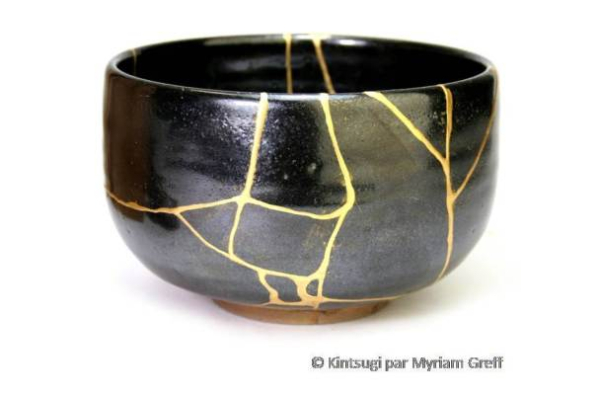
We can learn from many other cultures. For example, let’s look at Kintsugi. It is the Japanese art of repairing broken ceramics with lacquer dusted or mixed with powdered gold, silver, or platinum. This process highlights the object’s “scars” rather than concealing them. It is rooted in the philosophy that breakage and repair are part of an object’s history and can make it more beautiful and resilient. The artform can also serve as a metaphor for embracing flaws and past traumas as sources of strength and beauty.
This concept is an excellent reminder as we unpack the “trauma” of shootings, culture wars, actual wars, and more. Progress isn’t always linear — every setback is a part of our story, and even our scars can be sources of wisdom and strength. As we heal, we should also strive to help heal the world around us. In the Jewish faith, that concept is called Tikkun Olam.
Transformation Is Closer Than You Think
One of the themes of Yom Kippur is that you’re only one good deed from tipping the scale towards good for yourself and others. As you recognize and repent for your sins, it’s also important to appreciate the good you did (and do) as well.
As I look at my year, atone, and look forward, I’m reminded of two definitions I heard recently.
One is that “intelligence” can be defined as the ability to get or move towards what you want … and the second is that “learning” is the ability to get a better result in the same situation.
I choose to look at going forward as a chance to clear the slate and Be and Do better … personally, professionally, in the business, and in relationships. I know that there’s lots of room for improvement, opportunities for growth, and the ability to simply put the past behind me and focus on a better future.
Initially, I looked at Capitalogix as a technology company that built trading and fund management capabilities. Over time, I realized that the team, our tools, and the things we do backstage are more valuable than the front-stage results that we produce. We can leverage these to amplify intelligence in virtually any industry.
The future is going to be about making better decisions, taking better actions, and continually improving performance. That won’t really change. Almost everything else will. So, the business is really about the things that don’t change.
I think this is probably true in life as well. Many parts of you change … but the part of you that doesn’t is really the core of who you are.
Sprinting Towards What You Want
With roughly 80 days left in the year, it’s easy to get caught up in frustrations over politics or inflation, blaming outside forces for unmet goals. Yet, these remaining days are also a unique opportunity—a perfect time to sprint toward positive changes and finish the year strong.
There is plenty of time to make this your best year yet. What can you do? What will you do?
What could you do to make the life of someone around you better? Likewise, how can you let others know you’re thankful for them?
To reference a book by Ben Hardy and Dan Sullivan, transformational change is often easier than incremental change (because you don’t have to drag the past forward).
So, what can you do that would trigger 10X results? More importantly … Will you do it?
I hope you all experience growth in your mental state, your relationships, and your businesses. As you approach year’s end, remember you’re not just starting fresh – but integrating the “gold” from repaired experiences.
Best wishes for a great day and an even better year!
As most of you know, my son Zach and I co-write this newsletter.
Recently, while talking about articles, Zach opened up about what’s been going on in his life and how it’s affected him. I thought his story would make a great post, so I asked him to share his thoughts. Looking back, it’s easy to relate to where he’s at … Interesting how that happens.
Here it is:
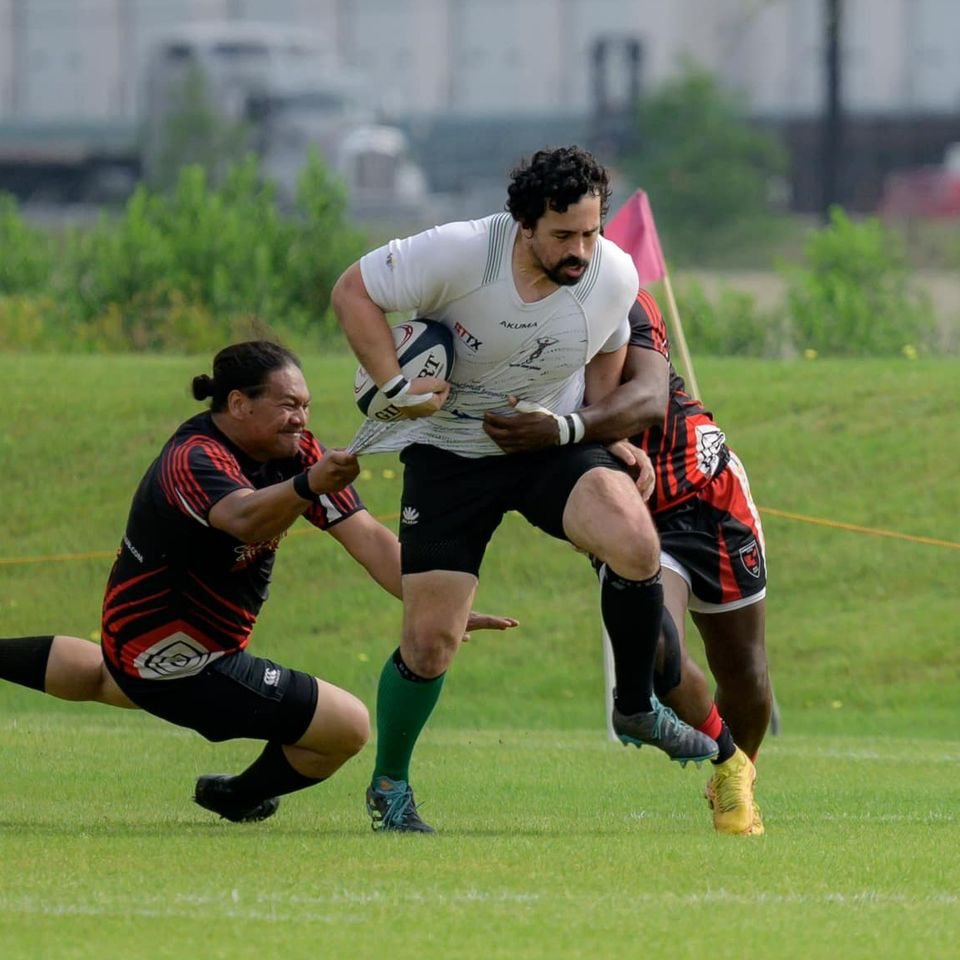
If you asked me to describe myself, rugby would be one of the first words out of my mouth. Honestly, if you asked me about almost anything, I’d probably find a way to sneak in a rugby reference. More than my time in the gym, my love of books, or my penchant for word games, rugby has always been the anchor of my identity.
But life has layers. I’m now a 32-year-old husband, three ACL tears deep, working in the family business, and serving as President of the Dallas Harlequins — my rugby club. And while I still lace up, I know my time on the field is running short. Priorities change, bodies break down, and after 17 years of rugby, mine has plenty of miles on it.
I actually thought I was done at 28. My body wouldn’t bounce back anymore. I’d wake up after practices or games barely able to walk. I had one more big tournament, where I was going to represent the USA, so I decided to fight through the pain, train for the following six months, and let that be my swan song.
Then I bought a Normatec, started drinking a protein shake after practice, and (shocker) started stretching more. Suddenly, I was young again.
Sure, kids learn to stretch in elementary school, but the Getsons have always been slow learners.
Since then, I’ve only gotten better. I’m running harder, tackling more, and understanding the game at a deeper level. My speed isn’t what it was at 21, and I’m definitely not the indestructible college kid I once thought I was. But I’m playing well, and not only are my coaches and teammates noticing, but even my competition is noticing. This past season, I was team MVP, “man of the tournament” at a 7s event, and earned another shot to represent the USA. My coach (who’s been with me since 2019) called it my best season yet.
Still, the signs are there. Recovery is slower, random injuries creep in (yes, even from sleeping wrong), and I know I’m gambling with my body. I’ve been here before: in 2015, fresh out of college, I tore my ACL for the third time while representing the USA in Chile. I “retired,” and it nearly broke me. I had to rebuild my sense of self without rugby, and by the time I returned in 2019, I thought I’d made peace with the idea of walking away.
But now that the day is actually approaching, it stings again. I lost rugby once — and it feels strange to know I’ll lose it again, this time for good. I’ll still be President, I’ll still have my team, and rugby will always be part of me. But I can feel the shift coming, and I know soon enough, these won’t be moments I’m living, but memories I carry.
Are you ever truly ready?
I have to remind myself that life is a gift, aging is a gift, and so is change. Rugby may be slipping away, but there are plenty of other mountains to climb. I might not compete in the same way, but that doesn’t mean I’ll stop being a competitor.
At the core, rugby wasn’t just about the sport — it was about pushing myself, playing through pain, and trying to outdo the person next to me. I’d love to say my only competition is with myself, but let’s be honest, I’m not that mature.
The truth is, I can still channel that drive anywhere: in the gym, at work, in writing, in my marriage, and in the everyday choices that make up my life. I can still choose to be better every day.
Hopefully that’s enough!
Watching Zach reflect on rugby reminds me that the lessons we learn in one arena often carry over to every part of life. The field may change, but the drive, discipline, and the will to turn possibility into reality remain — and those are the qualities that matter most. May your best thoughts become things.
We are living through the fastest period of technological change in history — a fact that demands not just awareness, but active engagement. Here’s how to recognize this shift, and what you can do to succeed in it.
Our ancestors survived by thinking locally and linearly. Yet today, this mindset often leaves us struggling to anticipate the sweeping, unpredictable effects of technology.
To predict the future of technology, you must understand where we are and where we are headed … but it also helps to recognize how far we’ve come—and how quickly things are now accelerating.
A Timeline of Human Innovation – From Stone Tools to AI
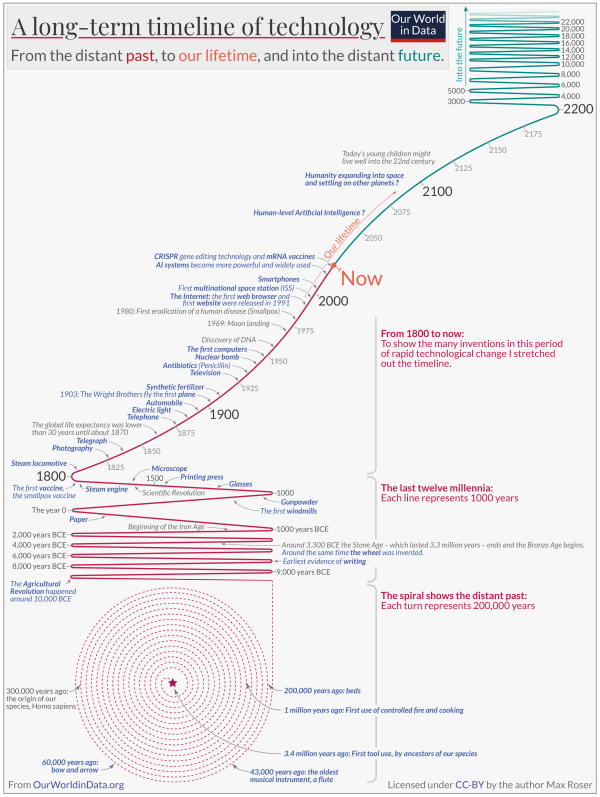
Our World In Data put together a great chart that shows the entire history of humanity in relation to innovation. It shows how fast we are moving by telling the story with milestones.
Innovation isn’t only driven by scientists. It’s driven by people like you or me having a vision and making it into a reality.
To see just how far we’ve come — and how quickly things now change — let’s look at some milestones.
3.4 million years ago, our ancestors supposedly started using tools. 2.4 million years later, they harnessed fire. Forty-three thousand years ago (almost a million years later), we developed the first instrument, a flute.
Why Speed Matters
The innovations we just discussed happened over an astonishing expanse of time. Compare that to this: In 1903, the Wright Brothers first took flight … and just 66 years later, we were on the moon. That’s less than a blink in the history of humankind, and yet our knowledge, technologies, and capabilities are expanding exponentially.
Acceleration Is The New Normal
Technology was like a snowball gathering speed, but it’s become an avalanche—hurtling forward, accelerated by AI. Here are some fun facts to back that up.
ChatGPT’s Explosive Growth: In 2025, OpenAI’s ChatGPT will hit 700 million weekly active users—a fourfold increase over the previous year. In its first year, ChatGPT reached 100 million monthly active users in just two months, a milestone that took Instagram 2.5 years.
Yesterday’s stable footing guarantees nothing; you must constantly adjust or get swept away.
While AI dominates headlines, the same story of acceleration is unfolding in fields like biotechnology, climate tech, and robotics. It’s happening everywhere all at once. From nanotechnologies to longevity and age reversal, and from construction to space exploration … exponential change is becoming a constant.
Turning Information into Actions – What To Do Now
Though I lead an AI company, I’m not an engineer or a data scientist — I am a strategist. My role is to envision bigger futures, communicate them clearly, and leverage tools that free me to create greater value. Ultimately, that’s going to become everybody’s job.
I don’t believe that AI will replace people like us quickly, but common sense tells us that people who use AI more effectively might replace us faster than we’d like.
Start by experimenting with new AI tools. When was the last time you tried a new tool or technology? Even though our company works on AI every day, I’ve challenged myself to continually expand my ability to use AI to create the things I want.
You’ll probably find that the things you want most are just outside your current comfort zone — or you’d already have them.
The next level of impact and value lies just beyond your current habits—comfort is the enemy of reinvention.
A good start is to think about what routine task you could automate next week.
Leaders must move from certainty-seeking to rapid experimentation. Encourage nimble, high-frequency experimentation with emerging tech.
Focus on skillsets that complement, not compete with, automation. And vice versa, focus on automation that complements (rather than competes with) unique abilities.
Share your learnings with your team or community. Set the expectation of progress, and make regular sharing and reporting part of your process. Reward the sharing of learnings over the accumulation of dead knowledge.
Prepare teams not only technologically, but culturally and psychologically, for relentless reinvention.
Don’t let perfectionism hold you back. You don’t need to know every destination before boarding the train; what matters is that you get on. Waiting too long is no longer safe—the train is leaving, and the cost of inaction is climbing.
Success now means hopping on and adapting while in motion—not waiting for all the answers.