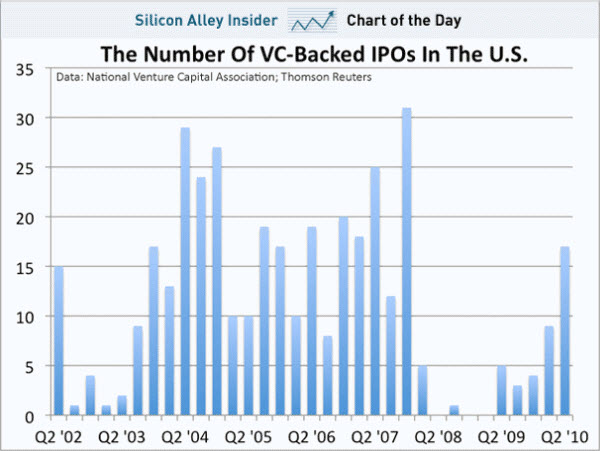
Initial Public Offerings are an indicator of market health. Well, here is some good news. More venture-backed companies have hadIPOsthis
year than there were in the last two years combined.
The bad news is that the market has not been kind to these newly
public companies. Scott Austin at the WSJnotesthat only six of this year's
venture backed IPOs are above their first day of trading.
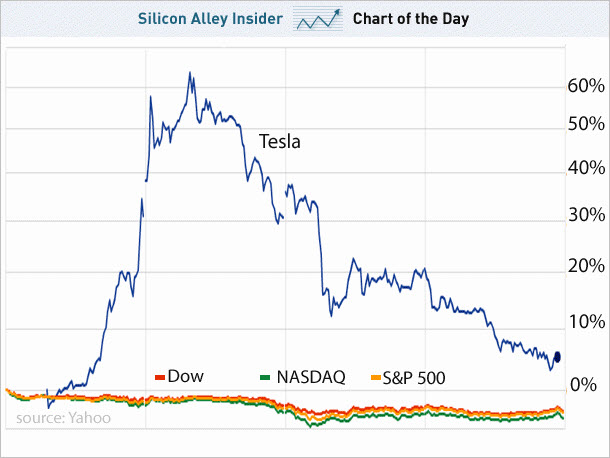
For example, a recent IPO with a lot of "buzz" was Tesla. The enthusiasm generated for Tesla's stock during its first day on the market has waned. After reaching almost $30, Tesla faded fast. It's back down to $17.40. Here is the chart.
Nonetheless, I'm starting to see more articles about M&A activity too. I take the increase in IPO and M&A activity as a positive economic sign. What about you?
We started using 37signals' web-based applications: Basecamp (for project management), Campfire (for work-group chat), and Backpack (for knowledge management). These are simple, focused tools designed to help you collaborate, get organized, and to get things done.
The software is terrific, and so is the philosophy behind it. 37signals got so much positive feedback from their blog … they parlayed it into a best-selling book.
Why Is the Book Relevant?
Rework is about the business, design, programming, and marketing philosophies of a developer that makes web-based software used by millions of people.
What's In It For Me?
It is easy to find value, fresh perspectives, and inspiration in this practical book. At less than 300 pages, it's a quick read too. Each chapter is only a page or two, so it's a great airplane or nightstand book.
Also, they proudly present ideas in bold strokes; clearly favoring provocative over wishy-washy. For example, 37signals proclaims it builds software products with the least number of features necessary. In other words, their products intentionally do less than their competition.
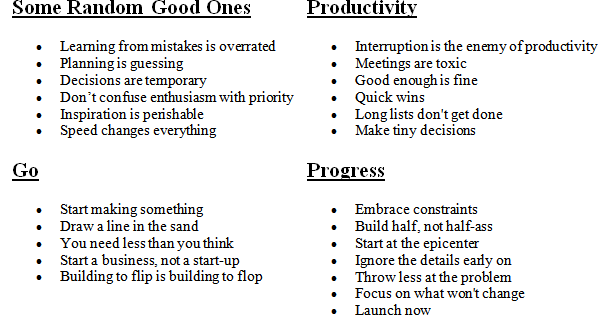
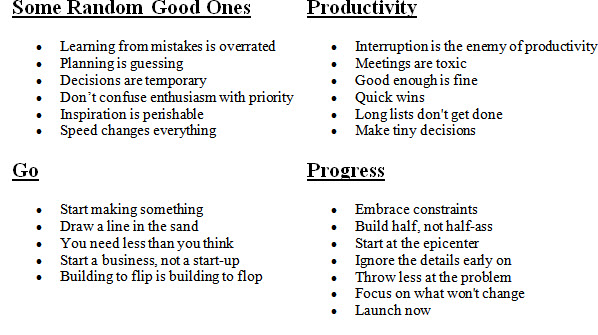
Here is a Partial List of the Essays in the Book.
This list will give you a sense of the book and its tone. Click the image for a more complete list.
I don't agree with some of what they preach. Yet, it is easy to get lots of value quickly from the book. Another way I know it is good, is that it is making its way around the office; and I often hear people referencing it and referring to it. All-in-all, it is worth reading.
We started using 37signals' web-based applications: Basecamp (for project management), Campfire (for work-group chat), and Backpack (for knowledge management). These are simple, focused tools designed to help you collaborate, get organized, and to get things done.
The software is terrific, and so is the philosophy behind it. 37signals got so much positive feedback from their blog … they parlayed it into a best-selling book.
Why Is the Book Relevant?
Rework is about the business, design, programming, and marketing philosophies of a developer that makes web-based software used by millions of people.
What's In It For Me?
It is easy to find value, fresh perspectives, and inspiration in this practical book. At less than 300 pages, it's a quick read too. Each chapter is only a page or two, so it's a great airplane or nightstand book.
Also, they proudly present ideas in bold strokes; clearly favoring provocative over wishy-washy. For example, 37signals proclaims it builds software products with the least number of features necessary. In other words, their products intentionally do less than their competition.
Here is a Partial List of the Essays in the Book.
This list will give you a sense of the book and its tone. Click the image for a more complete list.
I don't agree with some of what they preach. Yet, it is easy to get lots of value quickly from the book. Another way I know it is good, is that it is making its way around the office; and I often hear people referencing it and referring to it. All-in-all, it is worth reading.
I've been reading a pretty good new book that is an interesting mix of stories, life-lessons, and business content. It combines a behind the scenes peek into the situations, emails, checklists, sample interview questions, and "Happiness Framework" that led to some surprising results.
For example, here are Zappos' Core Values from which they develop their culture, brand, and business strategies:
In 1999, Tony Hsieh (pronounced Shay) sold LinkExchange, the company he co-founded, to Microsoft for $265 million. He then joined Zappos as an adviser and investor, and eventually became CEO.
In 2009, Zappos was listed as one of Fortune magazine's top 25 companies to work for, and was acquired by Amazon later that year in a deal valued at over $1.2 billion on the day of closing.
So, you might guess that he learned a few things about what worked, and what didn't.
In his first book, Tony shares the different business lessons he learned in life, from a lemonade stand and pizza business through LinkExchange, Zappos, and more. Ultimately, he shows how using happiness as a framework can produce profits, passion, and purpose both in business and in life.
I've been reading a pretty good new book that is an interesting mix of stories, life-lessons, and business content. It combines a behind the scenes peek into the situations, emails, checklists, sample interview questions, and "Happiness Framework" that led to some surprising results.
For example, here are Zappos' Core Values from which they develop their culture, brand, and business strategies:
In 1999, Tony Hsieh (pronounced Shay) sold LinkExchange, the company he co-founded, to Microsoft for $265 million. He then joined Zappos as an adviser and investor, and eventually became CEO.
In 2009, Zappos was listed as one of Fortune magazine's top 25 companies to work for, and was acquired by Amazon later that year in a deal valued at over $1.2 billion on the day of closing.
So, you might guess that he learned a few things about what worked, and what didn't.
In his first book, Tony shares the different business lessons he learned in life, from a lemonade stand and pizza business through LinkExchange, Zappos, and more. Ultimately, he shows how using happiness as a framework can produce profits, passion, and purpose both in business and in life.
Mike Novogratz is the President of Fortress Investment Group, the first U.S.-based private equity/hedge fund manager to sell shares to the public. He joined Fortress in March 2002, and is responsible for the liquid hedge fund business, which includes running the Global Macro Funds.
When we met earlier this year, I was impressed by his openness and perspective on the industry. It also comes through in the interview below.
In this revealing three-part interview, Novogratz shares his insights and reflections about:
1. How he earned his position.
2. The DNA, Risk Management, and Rules of Success in Macro Trading.
3. The significance of Instinct, Luck, Intuition, and a "Real Intelligence".
Mike Novogratz, President of Fortress Investment Group — Opalesque TV — Part 1.
Mike Novogratz, President of Fortress Investment Group — Opalesque TV — Part 2.
Mike Novogratz, President of Fortress Investment Group — Opalesque TV — Part 3.
Prior to joining Fortress, Novogratz spent 11 years at Goldman Sachs,
where he became a partner in 1998. He held the positions of president of
Goldman Sachs Latin America and Head of Fixed Income, Currencies and
Commodities Risk in Asia, where he lived from 1992 to 1999. Mr.
Novogratz received a B.A. from Princeton University, and served as a
helicopter pilot in the U.S. Army.
Fortress Investment Group
(NYSE: FIG) is a leading global
investment management firm. Total assets are around $41.6bn, with
$4.3bln in a global macro and a commodities based hedge fund.
Mike Novogratz is the President of Fortress Investment Group, the first U.S.-based private equity/hedge fund manager to sell shares to the public. He joined Fortress in March 2002, and is responsible for the liquid hedge fund business, which includes running the Global Macro Funds.
When we met earlier this year, I was impressed by his openness and perspective on the industry. It also comes through in the interview below.
In this revealing three-part interview, Novogratz shares his insights and reflections about:
1. How he earned his position.
2. The DNA, Risk Management, and Rules of Success in Macro Trading.
3. The significance of Instinct, Luck, Intuition, and a "Real Intelligence".
Mike Novogratz, President of Fortress Investment Group — Opalesque TV — Part 1.
Mike Novogratz, President of Fortress Investment Group — Opalesque TV — Part 2.
Mike Novogratz, President of Fortress Investment Group — Opalesque TV — Part 3.
Prior to joining Fortress, Novogratz spent 11 years at Goldman Sachs,
where he became a partner in 1998. He held the positions of president of
Goldman Sachs Latin America and Head of Fixed Income, Currencies and
Commodities Risk in Asia, where he lived from 1992 to 1999. Mr.
Novogratz received a B.A. from Princeton University, and served as a
helicopter pilot in the U.S. Army.
Fortress Investment Group
(NYSE: FIG) is a leading global
investment management firm. Total assets are around $41.6bn, with
$4.3bln in a global macro and a commodities based hedge fund.
Here is a video that condenses Steve Jobs keynote address at Apple Developer’s Conference from two hours to less than five minutes. All the data, but perhaps not all the magic you’d expect.
Strangely, that sums up the response to the new iPhone 4 product
announcement. Here is a link to a live blog feed from the event. And here is a WSJ video questioning whether the iPhone is becoming a commodity product, rather than a consumer product.









![Reblog this post [with Zemanta]](http://img.zemanta.com/reblog_c.png?x-id=ac21ca56-b8e3-4e7a-9398-a4b0a42477d1)