
Business

  • A Different Perspective On Getting Things Done

    100829 Dunce Cap Back when I was in school, my father asked me to do something. I don't remember what it was, specifically … but it was a normal thing for a father to ask a son to do.

    Later that day, while we were talking, he asked how my day went. I told him about all the things I did. Then, he asked whether I did the thing he asked me to do.  I tried to explain that because of how busy I had been, I didn't have time to do what he asked.

    He frowned, and I still remember the look in his eye when he told me that from his standpoint, I hadn't done anything.

    That put things in a different context.

    Each day we make a host of commitments great and small. If my to-do list has 15 items on it, and I do the 13 or 14 of them … then on one hand, I can feel good about how productive I was. Yet, on the other hand, chances are that the one or two things I didn't do were the only things that were supposed to get done for the person whose task got put off until another day.

    Getting Things Done.

    Stephen Covey makes a big distinction between importance versus urgency. It's easy to lose sight of what needs to get done if you fill your day with interruptions, distractions, busywork, or time-wasters.

    100829 ChecklistBy understanding what is both important and urgent it's easy to clarify the value of what really needs to get done.

    Understanding why things need to get done is also a big step forward in terms of prioritizing what you commit to do. For example, Scott Scheper suggests your goal should be to balance out your tasks so that 20% are spent on reactive tasks, and 80% are spent on proactive tasks.  Why?  Because reactive tasks will make you a living, while proactive tasks will make you successful.

    Ultimately, there are many ways to sort, sift, filter and prioritize your list.

    There is a rule-of-thumb that 20% of your activities will account for 80 percent of your success (this is often called the "Pareto Principle" or the "80%-20% Rule"). In other words, if you have 100 tasks in your task list, there probably will be about 20 of those that are the key ones to focus on. The key is to find a prioritization method that helps you pinpoint these tasks.

    Here is an interesting video from Chris Brogan.


    A Little Bit of Automation Can Help Too.

    I use several tools.  Toodledo and Nozbe are both easy-to-use online to-do lists with a great iPhone client. For teams, I highly recommend the stuff from 37 Signals.

    In addition, there are some terrific new Visual Thinking, Idea Mapping or Mind-Mapping tools available to help you think and plan better.

    Enhanced by Zemanta

  • The Surprising Truth About What Motivates Us

    Bill Gates recently predicted that the Internet would be a better source of education than any single university

    The video in this post is an example of how good Internet content is getting.  Watch the "Surprising Truth About What Motivates Us" from Dan Pink. It is very well done.

    Don't let the cartoons fool you; you can learn a lot in a little over 10 minutes. I really like the visualization technique (of drawing what is spoken); it is surprisingly effective.


    This video comes from RSA.  You can find other videos like this one at their website.

    Is Money the Best Way to Motivate Performance?

    In today's business environment, is it optimal to entice people with a sweeter carrot, or threaten them with a sharper stick?

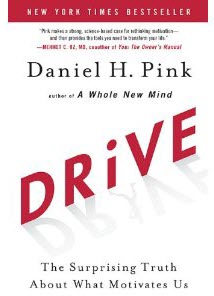
    100812 Drive Book by Dan Pink In his book, Drive, Pink calls for a different approach … one that is built much more around intrinsic motivation. Around the desire to do things because they matter, because we like it, because they're interesting, because they are part of something important.  The new operating system for our businesses should revolve around three elements: autonomy, mastery and purpose.

    In other words, the main point is that when someone is already intrinsically motivated, applying extrinsic motivation (in the form of reward for good behavior or punishment for bad behavior) is self-defeating because it detracts from the intrinsic motivation, which is a much more powerful force.

    If you like this, then click here to see his TedTalk video too.

    Enhanced by Zemanta

  • The New Version of Dragon NaturallySpeaking Is Very Cool.

    Another barrier between person and machine is fading … and your voice is the key.

    Here is a demo I made showing how Dragon NaturallySpeaking 11 turns your talk into typing (or helps you send an e-mail without touching the keyboard).  It really is as accurate and easy to use as it looks in this video.


    Communicate More Naturally With Dragon NaturallySpeaking.

    Can you type is quickly as you think? I certainly can't.

    How do you think that affects your writing?

    100806-HMG-Making-a-PointHumans can only focus on a few things at a time, and if you're focused on where your fingers are going or whether you've made a mistake, you are using cognitive resources that could have gone into thinking better or communicating more clearly.

    It shouldn't come as a big surprise to you that talking is so much more natural than typing. Think how much more practice you get doing it. So, it follows that it's easier to create natural sounding content by transcribing what you say, rather than typing what you think.

    With Dragon NaturallySpeaking, you get the best of both worlds. It transcribes your voice, and then you have an opportunity to edit it using your voice or the keyboard.

    The Whole Process Is Faster … Not Just the Typing.


    Because the process is more natural (and less error-prone), something that might take hours to compose on a keyboard can be dictated in a few minutes. More importantly, it will probably sound better and be easier to understand.

    100805 Fingers of Fire Typing Challenge How Fast Do You Type? You can check your speed here or here.

    I was surprised to learn that my average typing speed is between 40 and 50 words per minute.  Dragon NaturallySpeaking clocks in about three times faster than that.

    Speech Recognition Is Getting Better All the Time.


    The first time I saw someone use speech recognition was in the mid-1990s. As you might suspect, the technology was much cruder than it is today.  However, the user had Parkinson's disease. So the hassle of learning to use a pre-cursor to this technology made sense. As an early adopter, I tried it too. But back then, it didn't make sense for me to use it regularly. Fast forward to today, and I use Dragon NaturallySpeaking almost every day. Why? Because it's easier for me than typing.

    Nuance has become a leader in this field. In addition to DNS, they've got great applications that work on smart phones, and they also bought the popular service called Jott. I mention it because their massive user-base across these products and services allow Nuance to collect millions of voice samples and customer feedback from around the world. The samples show not only different ways that people pronounce words, but which words are more likely to be spoken, and in what context. Add that to the improvements in microphones, sound cards, processing power, etc. — and the result is a faster and more accurate recognition engine.

    Earlier versions of the technology were very dependent on how well you trained it. Now, it works decently out-of-the-box, with virtually no setup or specialized training. As good as it is, I appreciate that Nuance makes it easy for the program to learn my writing style and particular vocabulary. To do this, for example, you can let it look at your sent mail folder or a folder of word processing documents.

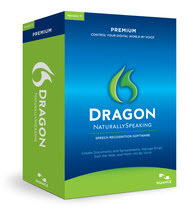
    100805 Dragon NaturallySpeaking Product ImageTry It Yourself.

    If you're a fumble-fingered typist, I highly recommend that you go out and find a copy of this program. However, even if you're a good typist, I recommend that you get a copy because you'll find that you write better and spend more time focusing on what you're going to say … rather than worrying whether you got it down on paper the right way.

    Bottom-Line:  It's time to give this technology a fresh look. It's ready for prime time, and I think Nuance has a hit.

    Give it a try.

    Enhanced by Zemanta

  • The New Version of Dragon NaturallySpeaking Is Very Cool.

    Another barrier between person and machine is fading … and your voice is the key.

    Here is a demo I made showing how Dragon NaturallySpeaking 11 turns your talk into typing (or helps you send an e-mail without touching the keyboard).  It really is as accurate and easy to use as it looks in this video.


    Communicate More Naturally With Dragon NaturallySpeaking.

    Can you type is quickly as you think? I certainly can't.

    How do you think that affects your writing?

    100806-HMG-Making-a-PointHumans can only focus on a few things at a time, and if you're focused on where your fingers are going or whether you've made a mistake, you are using cognitive resources that could have gone into thinking better or communicating more clearly.

    It shouldn't come as a big surprise to you that talking is so much more natural than typing. Think how much more practice you get doing it. So, it follows that it's easier to create natural sounding content by transcribing what you say, rather than typing what you think.

    With Dragon NaturallySpeaking, you get the best of both worlds. It transcribes your voice, and then you have an opportunity to edit it using your voice or the keyboard.

    The Whole Process Is Faster … Not Just the Typing.


    Because the process is more natural (and less error-prone), something that might take hours to compose on a keyboard can be dictated in a few minutes. More importantly, it will probably sound better and be easier to understand.

    100805 Fingers of Fire Typing Challenge How Fast Do You Type? You can check your speed here or here.

    I was surprised to learn that my average typing speed is between 40 and 50 words per minute.  Dragon NaturallySpeaking clocks in about three times faster than that.

    Speech Recognition Is Getting Better All the Time.


    The first time I saw someone use speech recognition was in the mid-1990s. As you might suspect, the technology was much cruder than it is today.  However, the user had Parkinson's disease. So the hassle of learning to use a pre-cursor to this technology made sense. As an early adopter, I tried it too. But back then, it didn't make sense for me to use it regularly. Fast forward to today, and I use Dragon NaturallySpeaking almost every day. Why? Because it's easier for me than typing.

    Nuance has become a leader in this field. In addition to DNS, they've got great applications that work on smart phones, and they also bought the popular service called Jott. I mention it because their massive user-base across these products and services allow Nuance to collect millions of voice samples and customer feedback from around the world. The samples show not only different ways that people pronounce words, but which words are more likely to be spoken, and in what context. Add that to the improvements in microphones, sound cards, processing power, etc. — and the result is a faster and more accurate recognition engine.

    Earlier versions of the technology were very dependent on how well you trained it. Now, it works decently out-of-the-box, with virtually no setup or specialized training. As good as it is, I appreciate that Nuance makes it easy for the program to learn my writing style and particular vocabulary. To do this, for example, you can let it look at your sent mail folder or a folder of word processing documents.

    100805 Dragon NaturallySpeaking Product ImageTry It Yourself.

    If you're a fumble-fingered typist, I highly recommend that you go out and find a copy of this program. However, even if you're a good typist, I recommend that you get a copy because you'll find that you write better and spend more time focusing on what you're going to say … rather than worrying whether you got it down on paper the right way.

    Bottom-Line:  It's time to give this technology a fresh look. It's ready for prime time, and I think Nuance has a hit.

    Give it a try.

    Enhanced by Zemanta

  • Contacts Scrubber for Outlook: A Neat Solution to a Messy Problem

    Your contact database is becoming an increasingly important hub linking your personal, professional, and social life.  So it's not fun when that data gets messed-up.

    If you are like me, over time, I combined contact records from different sources (e.g., cell phone, Microsoft Outlook, and web-mail accounts).  At some point, I ended up with more duplicate records than I wanted to handle manually.

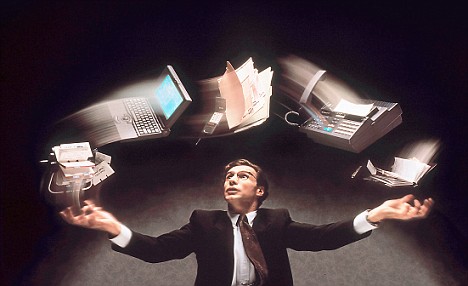
    100730 Technology Overload
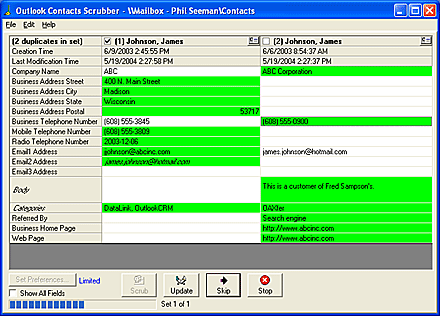
    The real issue was that not all the duplicate records were really "duplicates". Some of the information was the same, but other information was different. I wanted something that let me pick and choose what to keep, what to get rid of, and what to merge.

    100730 Contacts Scrubber

    It's not just duplicate records; lots of other things can go wrong too. For example, somehow many of the birthdays in my contacts database got shifted by one day. That meant someone whose birthday was July 27th, didn't show up on my calendar until July 28th. That defeats the purpose of setting birthday reminders, doesn't it?  I had an older backup saved on the hard disk; but what about all the additions and changes I made since then?

    100730 TeamScope Logo It turns out there is an application that neatly fixes things in situations like those. It's called Contact Scrubber for Outlook by TeamScope.

    I have used several versions of this software over time. Contacts Scrubber was already a fine solution to a messy problem; yet it keeps getting better. It handles most things automatically, while still giving you control (when you want it).

    I'm happy to say that it worked beautifully. If you ever run into this problem, I suggest you give Contacts Scrubber a try.  It might save you a lot of time.  Bottom-Line: it is the easiest way I've found to merge & purge and end-up with accurate Outlook 2010 contact records.

  • Contacts Scrubber for Outlook: A Neat Solution to a Messy Problem

    Your contact database is becoming an increasingly important hub linking your personal, professional, and social life.  So it's not fun when that data gets messed-up.

    If you are like me, over time, I combined contact records from different sources (e.g., cell phone, Microsoft Outlook, and web-mail accounts).  At some point, I ended up with more duplicate records than I wanted to handle manually.

    100730 Technology Overload
    The real issue was that not all the duplicate records were really "duplicates". Some of the information was the same, but other information was different. I wanted something that let me pick and choose what to keep, what to get rid of, and what to merge.

    100730 Contacts Scrubber

    It's not just duplicate records; lots of other things can go wrong too. For example, somehow many of the birthdays in my contacts database got shifted by one day. That meant someone whose birthday was July 27th, didn't show up on my calendar until July 28th. That defeats the purpose of setting birthday reminders, doesn't it?  I had an older backup saved on the hard disk; but what about all the additions and changes I made since then?

    100730 TeamScope Logo It turns out there is an application that neatly fixes things in situations like those. It's called Contact Scrubber for Outlook by TeamScope.

    I have used several versions of this software over time. Contacts Scrubber was already a fine solution to a messy problem; yet it keeps getting better. It handles most things automatically, while still giving you control (when you want it).

    I'm happy to say that it worked beautifully. If you ever run into this problem, I suggest you give Contacts Scrubber a try.  It might save you a lot of time.  Bottom-Line: it is the easiest way I've found to merge & purge and end-up with accurate Outlook 2010 contact records.

  • Interesting TedTalk with Nicholas Christakis About Our Modern, Connected Lives

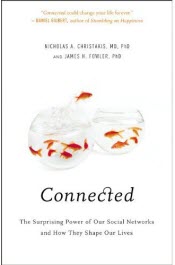
    100719 Connected Book We're all embedded in vast social networks of friends, family, co-workers and more. Nicholas Christakis tracks how a wide variety of traits — from happiness to obesity — can spread from person to person, showing how your location in the network might impact your life in ways you don't even know.

    His work shows how phenomena as diverse as obesity, smoking, emotions, ideas, germs, and altruism can spread through our social ties, and how genes can partially underlie our creation of social ties to begin with. His work also sheds light on how we might take advantage of an understanding of social networks to make the world a better place.

    Christakis explains that he and James Fowler (co-author of
    Connected) have become obsessed
    with trying to figure out how and why we form networks and how and why
    they affect us.

    Once you start mapping these networks — they’re so intricate and so beautiful and so interesting — you just can’t help but wonder why we humans make them. Why does a spider weave its web? Why does the web have a particular kind of shape? It’s not a coincidence. You look at these webs and you think, “My God, what purpose do they serve? And, how do they affect us?”

    Watch his TedTalk presentation, "The Hidden Influence of Social Networks".

    Here is the web site for their book Connected.  And here is a link to another interview.

    Enhanced by Zemanta
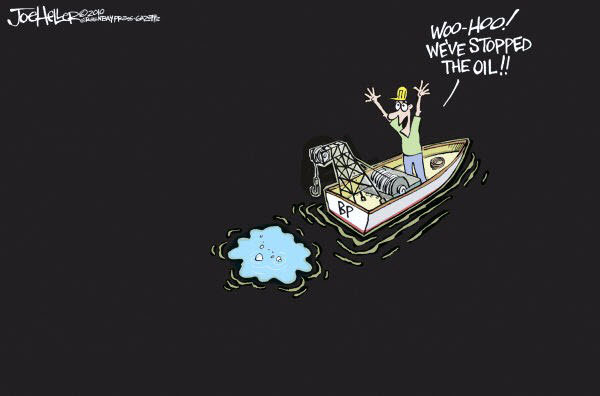
  • Cartoon: Woo-Hoo! We’ve Stopped the Oil!!

    100716 We Stopped the Oil Cartoon from Heller
    Is the glass half-empty, or is the glass half full?

    It's easy for cartoonists to make fun of how long it took to stop the oil leak.

    Nonetheless, it will certainly be a lot easier to clean up the mess now that were not making more of it.

    Here's to progress.

  • Cartoon: Woo-Hoo! We’ve Stopped the Oil!!

    100716 We Stopped the Oil Cartoon from Heller
    Is the glass half-empty, or is the glass half full?

    It's easy for cartoonists to make fun of how long it took to stop the oil leak.

    Nonetheless, it will certainly be a lot easier to clean up the mess now that were not making more of it.

    Here's to progress.

  • Starting to See More IPO and Merger & Acquisition Activity

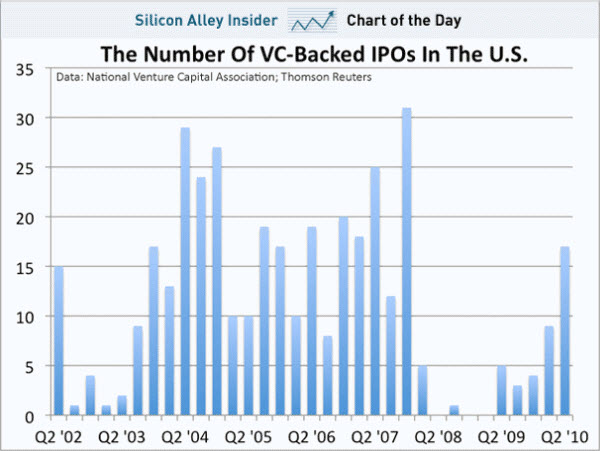
    Initial Public Offerings are an indicator of market health. Well, here is some good news.  More venture-backed companies have had IPOs this
    year than there were in the last two years combined.

    The bad news is that the market has not been kind to these newly
    public companies. Scott Austin at the WSJ notes that only six of this year's
    venture backed IPOs are above their first day of trading.

    100702 
chart-of-the-day-vc-backed-ipos-2002-2010

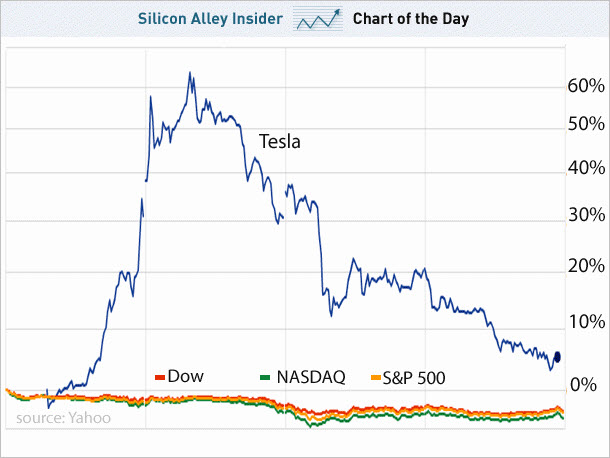
    For example, a recent IPO with a lot of "buzz" was Tesla.  The enthusiasm generated for Tesla's stock during its first day on the market has waned. After reaching almost $30, Tesla faded fast. It's back down to $17.40.  Here is the chart.

    Tesla

    Nonetheless, I'm starting to see more articles about M&A activity too.  I take the increase in IPO and M&A activity as a positive economic sign.  What about you?

    Enhanced by Zemanta