Business

  • Choosing To Be Mindful in the Age of AI

    In the age of AI, we’re obsessed with better answers. But the real leverage may come from better questions.

    It’s easier to solve someone else’s problem than your own. Why? Because your biases, emotions, and problem-solving frameworks become part of the problem. Likewise, your blind spots likely go unexamined when you’re both the observer and the subject.

    As an entrepreneur, I strive to be objective about the decisions I make. Towards that goal, using key performance indicators, getting different perspectives from trusted advisors, and relying on tried-and-true decision frameworks all help. 

    Mindfulness as a Decision Framework

    Combining all three creates a form of “mindfulness” that comes from dispassionately observing from a perspective of all perspectives.

    That almost-indifferent, objective approach is also where exponential technologies like AI excel. They amplify intelligence by helping make better decisions, take smarter actions, and continually improve performance. 

    In 2021, I shot a video about mindfulness and the future of AI. I think it has held up remarkably well.

    via YouTube

    When I shot this video, AI was still relatively limited.

    In just a few years, the technology has come so far. When I originally published the video, I suggested that:

    The future of AI will likely be based on swarm intelligence, where many specialist components communicate, coordinate, and collaborate to view a situation more objectively, better evaluate the possibilities, and determine the best outcome in a dynamic and adaptable way that adds a layer of objectivity and nuance to decision-making.

    Five years later, that prediction has largely materialized. Multi-agent frameworks, retrieval-augmented generation, and tool-using LLMs now orchestrate specialized components to tackle complex problems. The architecture isn’t identical to biological swarm intelligence, but the principle holds: better decisions emerge from coordinated, specialized perspectives, and from understanding the actual purpose of your tools.

    What Hasn’t Changed

    AI is a powerful solution for a seemingly infinite number of problems. But, much like the internet, it’s easy to get distracted by shiny objects, flashy intrusions, or compelling answers.

    It is important to stay mindful and diligent as you apply AI and AI agents to your business.

    Many of my friends are getting excited about these tools, and they’re using them for countless capabilities, but they’re not necessarily doing a good job of evaluating whether they should be.

    Sometimes, you shouldn’t even be looking for the right answer, you should be looking for the right question.

    The Importance of Better Questions

    One of the lessons I teach to our younger employees is that an answer is not THE answer. It’s intellectually lazy to think you’re done simply because you come up with a solution. There are often many ways to solve a problem, and the goal is to determine which yields the best results.

    Even if you find THE answer, it is likely only THE answer temporarily. It is a step in the right direction that buys you time to learn, improve, and re-evaluate.

    Mindfulness comes from slowing down, stepping back, and looking at something from multiple perspectives, and AI can be a powerful tool for that when used intentionally. It can help us explore different viewpoints, challenge assumptions, and think more broadly.

    But the greatest benefit of AI may not be in generating better answers. More often, it comes from helping us ask better questions.

    Used mindfully, AI becomes less of a shortcut to conclusions and more of a tool for deeper thinking.

    Recently, I’ve started using AI to sharpen my questions, and it’s changing the way I approach problems. At first, that sounds abstract, but in practice it forces a very different kind of thinking. Instead of immediately searching for conclusions, you start asking what actually makes a question “better” in the first place. How do you move from a vague sense of uncertainty to a question precise enough to reveal something useful?

    When I’m evaluating a project now, I rarely ask AI something broad like, “Is this a good opportunity?” Questions like that usually produce predictable answers. Instead, I use AI to pressure-test my own thinking. I’ll ask it to identify the assumptions underneath the idea, explore what would have to be true for the project to fail, or point out the questions I haven’t considered yet. The process feels less like outsourcing thought and more like refining it.

    That shift — from answer-seeking to question-sharpening — has changed how I handle ambiguity and make decisions. It has also changed what I consider trustworthy. I’ve started building what I think of as a “question pattern library”: prompts and frameworks that consistently help add structure to messy situations. Some questions help clarify the framing by forcing you to define the real decision being made rather than reacting to surface-level symptoms. Others establish criteria, helping determine how success should actually be measured before debating solutions. And some are designed to expose bottlenecks by identifying which assumption, if proven false, would completely change the next step.

    Over time, I’ve realized these questions work best when they build on each other. At important checkpoints, I’ll often run through a simple sequence: What became clearer? What does this change? Why does it matter? What’s the next best move? The answers themselves matter less than the way the questions force clearer thinking.

    The more I use AI this way, the more I think its greatest value may not be generating better answers at all. Used mindfully, its real strength is helping us examine our own thinking more carefully. Better questions create better distinctions, and better distinctions usually lead to better judgment. So before asking AI for an answer this week, it may be worth asking it to help you frame a better question first. You might discover that the most valuable part of the interaction isn’t the response, but the thinking process that led to it.
  • The End of Sora and the Future of OpenAI

    This week, OpenAI announced it would be shutting down Sora, its popular AI video app. This is not just about killing a video toy; it signals a strategic pivot at OpenAI.

    You probably weren’t Sora’s target user, but watching this montage of its top clips is a great way to see how far this impressive tech has come.

    Top Sora Clips Video via YouTube.

    It’s both fun and scary to think about how fast technologies like this have evolved … and what they will make possible.

    It’s easy to think Sora’s shutdown isn’t a big deal … but it’s a signal of OpenAI’s new playbook on infrastructure, partnerships, and profit.

    And with that new playbook, OpenAI announced several other important changes this week. Here are a few of the highlights.

    The End of Their Disney Partnership

    Shutting down Sora also forced the termination of a major $1 billion investment deal between OpenAI and Disney, as well as licensing agreements that allowed the use of Disney-owned characters in AI-generated video content.

    It’s a reminder that when OpenAI prunes products like Sora, it’s also pruning capital-intensive bets and risky content partnerships.

    Pushing Pause on “Adult Mode”

    Last October, Sam Altman announced plans for an erotica mode. However, the tension between boldness and caution shows up in the gap between OpenAI’s ‘not the morality police’ rhetoric and its quiet slowdown on controversial features.

    The Financial Times later reported that the pause is “indefinite,” with Cristina Criddle citing “sexual datasets and eliminating illegal content” as challenges for OpenAI. This reflects the growing regulatory and reputational risk around generative sexual content.

    ChatGPT Just Got More Reliable

    OpenAI updated ChatGPT with a 33% reduction in factual errors, plus a significantly expanded memory for longer conversations.

    Changes like these hint at where OpenAI wants to focus: scalable, everyday systems that drive recurring revenue.

    And it doesn’t stop there …

    The Great DRAM Over-Buy

    Originally, it was reported that OpenAI had secured forward commitments for up to 40% of the world’s DRAM supply. This was to help their future data center growth as AI demand increases.

    In plain English, DRAM is the short-term memory that lets these models think; if you want bigger, smarter models, you need a lot of it.

    As these announcements roll in, many are also scrutinizing how much RAM OpenAI locked up in advance.

    With this, I think the memory bull run (which began over 2 years ago) is coming to an end. Many of the large AI labs have secured more DRAM via forward contracts than what they will realistically need. This has created the sense of an artificial shortage supported by essentially FOMO on DRAM supply. Like in previous cycles, this will unwind.
    Seeking Alpha

    With Google’s new TurboQuant AI compression algorithm, and OpenAI switching focus, many see the drop in RAM prices as more than a blip — potentially a real change in the cycle.

    Where OpenAI Goes Next …

    From Owning to Orchestrating Infrastructure

    After initially pursuing massive, vertically integrated infrastructure through its multi-hundred-billion-dollar Stargate initiative, OpenAI has begun shifting toward a more flexible, capital-efficient model.

    If labs over-bought memory during the AI gold rush, then shifting from owning massive data centers to orchestrating capacity from partners starts to look less like backtracking and more like smart risk management.

    Instead of owning and operating the bulk of its global compute footprint, OpenAI is increasingly leaning on partnerships and leased capacity from cloud providers. Internally, this has been reflected in a restructuring that separates infrastructure design, partner management, and operations — signaling a shift from a “build everything” strategy to a “coordinate and optimize” approach (e.g., using multiple cloud providers, negotiating for power in different regions, etc.).

    At the same time, the company is clearly narrowing its product focus.

    Video apps like Sora are entertaining for users, but they’re also brutally compute-intensive for the providers. As you look at Anthropic’s revenue and those of other competitors, it’s clear that chat, code, and enterprise use are where the immediate growth and low-hanging fruit lie.

    How This Fits the Longer-Term Plan

    AI has already consumed massive funding to get here — and it will require even more to reach the next plateau.

    Rather than a retreat, this shift aligns with a longer-term strategy: preserving capital, accelerating deployment, and keeping options open in a rapidly evolving compute landscape. Leveraging partners allows OpenAI to scale faster while avoiding bottlenecks tied to financing, power availability, and hardware cycles.

    In that context, “Stargate” appears to be evolving—from a fixed set of owned assets into a broader, more modular strategy for bringing compute online wherever it is most efficient.

    The end goal hasn’t changed: securing enough compute to train and deploy increasingly powerful AI systems. What has changed is the path — shifting from infrastructure ownership to infrastructure orchestration, and from experimental breadth to commercial depth.

    This aligns with their move from non-profit to IPO. They’re clearly focused on profitability in the near term, not just the long term.

    But these shifts could also signal changes that open opportunities for more players to enter the space and carve out their little slice of the digital landscape.

    I’ll continue to watch how OpenAI manages the delicate balance between rapid innovation, financial pressures, and the broader public good. The story is still unfolding, and what happens next will shape the technological future we all live in.

    How It Shows Up in Everyday Use

    All of this might sound abstract, but you can feel these shifts in everyday usage too. If you’re curious, I use a paid version of ChatGPT throughout the day. I’ve gotten used to it; I understand when to listen and when to ignore it. With that said, I’ve also been happy to pay for Perplexity (but I use it in much more limited circumstances). It gives me access to different models, and I feel like it’s been a good value. However, today I finally decided to pay for Anthropic as well because the quality of the responses I’ve been getting has led me to change my usage behavior.

    Interestingly, if I ask different models a question and then show their answers to ChatGPT, ChatGPT often favors Claude’s responses as well.

    I know all of that is subject to change, and tools are leapfrogging one another with increasing frequency. With that said, I thought it was worth sharing.

    Let me know which tools you use and rely on most.

    Onwards!

  • Feast on This: A Look at the Big Mac Index

    We Crave Simple Signals

    With bombs dropping and policies whipsawing, it’s tempting to look for shortcuts.

    The complexity and noise of markets is overwhelming. As a result, human nature seeks simple signals that promise clarity.

    This is often an example of getting what you asked for, but not what you wanted.

    In the past, I’ve shared my thoughts on various market “indicators” that are silly or just don’t make sense — like the Super Bowl Indicator. They remind us how much we crave order and look for patterns that make markets feel more predictable — even when they aren’t. 

    Wall Street is inundated with theories that attempt to predict the stock market and the economy. Unfortunately, even the good ones are dangerous if you over-trust or over-use them.

    With that said, more people than you would hope (or guess) invest based on gut instinct, superstition, or even prayer.

    While hope and prayer are good things … they aren’t good trading strategies.

    What The Big Mac Index Really Measures

    Today, I want to look at an out-there indicator that is actually useful, from an economics standpoint.

    Remember, however, that the market ≠ the economy. So, while I do think it is useful, I don’t believe it should influence your trading decisions. 

    The Economist’s Big Mac Index seeks to make exchange-rate theory more digestible. They claim it is arguably the world’s most accurate financial indicator – based on a fast-food item.

    The Big Mac Index turns burger prices into a simple lens on currency valuation and purchasing-power parity (PPP). In simple terms, PPP says a dollar should buy you roughly the same goods and services everywhere (once you account for exchange rates). Supposedly, then, the price difference between Big Macs, adjusted for exchange rates, indicates whether a currency is over- or undervalued. 

    What the Charts Reveal

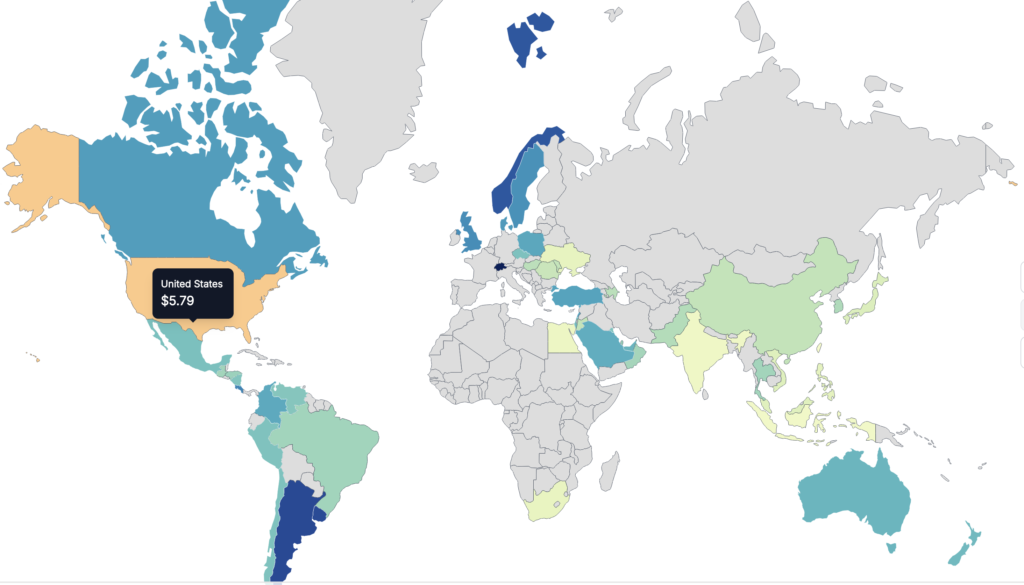
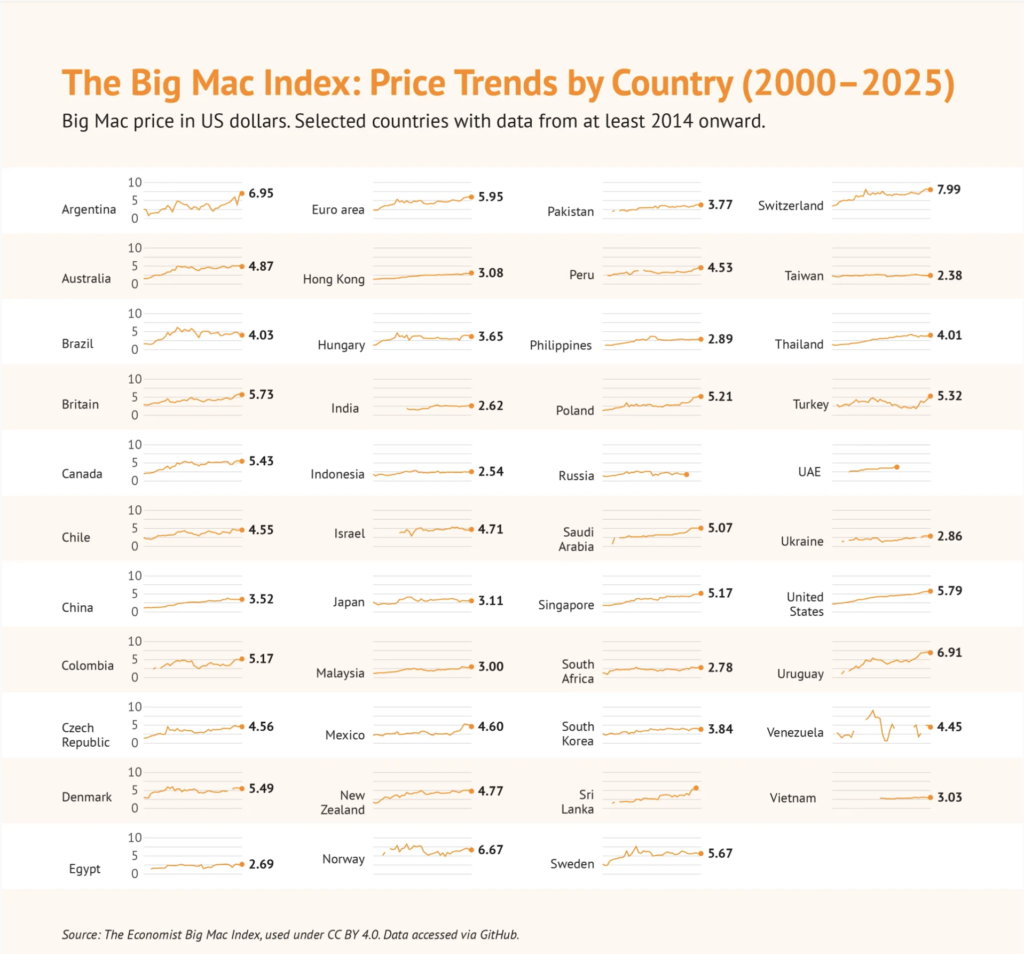
    Here’s a chart of Big Mac prices over the past 25 years by country, which highlights how far currencies can drift from ‘fair value’.

    Chart: Big Mac prices by country, 2000–2025
    via voronoi

    This chart shows just how far — and how long — currencies can drift from ‘fair value’.

    According to the Big Mac Index, the most overvalued major currency remains the Swiss franc. A Big Mac in Switzerland costs about $7.99, compared with about $5.79 in the United States. This implies a PPP exchange rate of roughly 1.19 francs per dollar, while the actual exchange rate is closer to 0.93 francs per dollar, suggesting the Swiss franc is about 38% overvalued relative to the dollar. Other starkly overvalued countries on this measure include Norway and Argentina.

    Big Mac Index by Country 2026
    via worldpopulationreview

    For contrast, several currencies remain sharply undervalued, based on this measure. In countries like India, Indonesia, and Japan, Big Mac prices imply currencies are 40–60% undervalued relative to purchasing power parity.

    Some Things Big Macs Can’t Tell You

    One of the main limitations of the index is that the price of a Big Mac reflects non-tradable elements, such as rent and labor, which vary widely across countries and can distort the index’s accuracy. This means that the index is most useful when comparing countries that are at roughly the same stage of development and have similar economic structures and cost of living. So while the index offers useful insight into exchange rates and currency values, it’s only a rough guide — especially when comparing very different economies.

    Another limitation of the index is that it does not consider factors such as taxes, trade barriers, and transportation costs, which can also affect the relative value of currencies. These factors can be especially important in countries highly dependent on imports or exports. They can lead to significant disparities in currency values that are not reflected in the Big Mac Index.

    How Investors Should Use It

    Despite its flaws, the Big Mac Index still sheds useful light on global economic trends and currency values. By using the index alongside other economic indicators and data sources, investors and economists can gain a more comprehensive understanding of the forces shaping the global economy and make more informed decisions about how to allocate capital.

    Use it to understand which currencies look stretched – not to time trades. There are clearly more forces at work if a currency can look over- or undervalued for years without obvious consequences. Remember that political risk, capital flows, and policy can outweigh PPP for years.

    It’s not meant to be precise, but it serves as a global yardstick because Big Macs are available everywhere and, for the most part, are made the same way. 

    You can read more about the Big Mac index here or read the methodology behind the index here.

    Pair fun indicators with hard data and robust systems. As traders, we pay attention to these distortions, but we don’t bet on them directly. Instead, we build systems that adapt as reality changes — no burger‑based strategies required.

  • How To Detect Baloney with Carl Sagan: Trust, Tests, and Tiny Bets

    Information can glitter like gold — and still turn out to be worthless fool’s gold.

    Too often, organizations chase compelling narratives, market buzz, or charismatic claims instead of rigorous evidence. Decisions that matter need more than persuasion … they need proof.

    Carl Sagan had a name for the tools that keep you from falling for fool’s gold. He called it the “Baloney Detection Kit.” Sagan originally outlined them in The Demon-Haunted World (and they were recently summarized in Big Think ).

    A photo of Carl Sagan on a black background

    Collectively, they are a set of critical thinking tools to help separate fact from fiction. These ideas aren’t just for science; they form a solid foundation for any high‑stakes business decision.

    This post shows how to turn Sagan’s Baloney Detection Kit into concrete workflows, metrics, and tiny bets that make your organization more trustworthy and anti-fragile.

    Here are the basics.

    The Baloney Detection Kit

    At its core, the baloney detection kit pushes you to:

    1. Demand independent confirmation. Check claims with sources that weren’t involved in making them, while encouraging debate by all relevant experts.
    2. Avoid reliance solely on authority or persuasion. Experts can be wrong; evidence matters more than credentials alone.
    3. Create multiple hypotheses and test them. Don’t fixate on the first explanation; try to disprove competing ideas.
    4. Be your own fiercest critic. The hypothesis you like most is often the one you must test hardest.
    5. Quantify where possible and ensure every link in a reasoning chain holds up.
    6. Favor simplicity (Occam’s Razor) and insist that ideas be falsifiable — that there is some way to test whether they are wrong. The simplest answer is often the truth.

    Sagan’s emphasis is clear: skepticism is not cynicism — it’s a disciplined, systematic evaluation of evidence. Countless cognitive biases make stories appealing, but rigorous scrutiny separates what’s reliable.

    That’s powerful when you’re evaluating a news story or a scientific claim. It’s even more powerful when you wire it into how your organization decides what to do next.

    From Personal Skepticism to Organizational Practice

    These ideas are powerful personal tools, but they’re also powerful organizational frameworks.

    1. Tag every substantive claim before it leaves the building.
    Each claim gets a status like:

    • VERIFIED — independently checked
    • PRELIMINARY — plausible but unconfirmed
    • UNVERIFIED — high uncertainty
      Require visible flags and named reviewers before high-impact claims go public.

    2. Ask the “Stop Question.”
    For every major decision, answer:

    “What single observation would make us reverse course?”

    If you can’t articulate that, treat the initiative as exploratory.

    3. Document provenance for numbers.
    Every quantitative claim must list source, method, scope, and uncertainty in one place. Without that, weight it less in decisions.

    4. Build a structured decision workflow.

    • Author fills verification details.
    • Reviewer assesses evidence quality.
    • Senior Approver signs off on high-stakes items.
    • Rotating External Reviewer audits samples regularly.

    Track metrics quarterly, such as: % verified vs. unverified claims, time to verification, and errors caught in adversarial review.

    Why You Need A Risk-First Lens

    Most businesses get so excited about what could go right that they ignore what is most likely to go wrong.

    What Could Go Wrong?“ is often a sarcastic throwaway, when it should be the most serious question you ask before any launch.

    We live in a speed-first world, but if speed is rewarded over accuracy, skepticism will be ignored.

    Culture and clear rules trump short‑term results, and prevent the attrition most ‘overnight successes’ experience.

    Can You Imagine …

    Imagine an organization where …

    Every bold claim carries its verified provenance …

    Where errors are corrected, not shamed, and publicly learned from …

    Where small but frequent probes guide larger tasks and keep them on the rails …

    Imagine the difference in the anti-fragility of that organization, or the longevity, or even just the trust and respect between employees.

    Ask yourself: What percentage of your important decisions are uncertain or unverified?

    The future rewards organizations that can quickly and reliably separate signal from noise.

    If you make testing basic, provenance visible, and tiny, reversible bets your default, you turn skepticism into a competitive edge — and persuasive stories into durable advantages.

  • From Chatbots to Coworkers: The Architecture of True Delegation in Agentic AI

    For the last decade, artificial intelligence has been framed as a breakthrough in conversational technology (generating smarter answers, faster summaries, and more fluent chats). That framing is already obsolete.

    The consequential shift underway is not about conversation at all. It’s about delegation.

    AI is transitioning from a reactive interface to an agentic coworker: systems that draft, schedule, purchase, reconcile, and execute across tools, files, and workflows — without waiting for permission or direction.

    At Capitalogix, we built an agentic system that autonomously trades financial markets. Others have deployed AI that wires funds, adjusts pricing, and communicates with customers. The results are transformative. The risks are material.

    The critical question is no longer “How smart is the model?” It’s “What architecture governs its ability to act?” Digging deeper, do you trust the process enough to let it execute decisions that shape your business, your reputation, and your competitive position?

    That trust isn’t earned through better algorithms. It’s engineered through better architecture.

    Let’s examine what that actually requires.

    Delegation Beats Conversation

    Early AI systems were like automated parrots (they could retrieve and generate), but remained safely boxed inside a conversation or process. Agentic systems break those boundaries. They operate across applications, invoke APIs, move money, and trigger downstream effects.

    As a result, the conversation around AI fundamentally shifts. It’s no longer defined by understanding or expression, but by the capacity to perform multi-step actions safely, auditably, and reversibly.

    Those distinctions matter. Acting systems require invisible scaffolding (permissions, guardrails, audit logs, and recovery paths) that conversational interfaces never needed.

    In other words, delegation demands more than better models. It demands better control systems. To help with that, here is a simple risk taxonomy framework to evaluate agent delegations:

    • Execution risk: Agent does the wrong thing
    • Visibility risk: You can’t see what the agent did
    • Reversibility risk: You can’t undo what the agent did
    • Liability risk: You own the consequences of agent actions.

    Organizations that treat agentic AI as “chat plus plugins” will underestimate both its upside and its risk. Those that treat it as a new layer of operational infrastructure (closer to an automation control plane than a productivity app) will be better positioned to scale it responsibly.

    Privacy’s Fork in the Road

    As agents gain autonomy, privacy becomes a paradox. Privacy-first designs (encrypted, device-keyed interactions where even vendors cannot access logs) unlock the potential for sensitive use cases like legal preparation, HR conversations, and personal counseling.

    But that same strength introduces tension. Encryption that protects users can also obstruct auditability, legal discovery, and incident response. When agents act on behalf of individuals or organizations, the absence of records is a major stumbling block.

    This forces a choice:

    • User-sovereign systems, where privacy is maximized and oversight is minimized.
    • Institutional systems, where compliance, accountability, and traceability are non-negotiable.

    Reconciling these paths will necessitate the development of new technical frameworks and policy requirements. Viewing privacy as an absolute good without addressing its trade-offs is no longer sustainable as systems become more autonomous.

    Standards Are Infrastructure, Not Plumbing

    History is clear on this point: standards create coordination, but they also concentrate power. Open governance can lower barriers and expand ecosystems. Vendor-controlled standards can just as easily become toll roads.

    Protocols like Google’s Universal Commerce Protocol (UCP) are not neutral technical conveniences; they are institutional levers.

    Who defines how agents authenticate, initiate payments, and complete transactions will shape:

    • Who captures margin
    • Who bears liability, and
    • Who can compete?

    For businesses, protocol choices are strategic choices. Interoperability today determines negotiating leverage tomorrow.

    Ignoring this dynamic doesn’t make it disappear—it just cedes influence to those who understand it better.

    APIs, standards bodies, and partnerships quietly determine who becomes a gatekeeper and who remains interchangeable. The question of “who runs the agent” is inseparable from pricing power, data access, and long-term market structure.

    Organizations that control payment protocols become the new Visa. Those who define authentication standards become the new OAuth. And companies that treat these choices as “technical decisions” will wake up to discover they’ve locked themselves into someone else’s ecosystem—with pricing power, data access, and competitive flexibility determined by whoever wrote the rules

    Last But Not Least: The UX Problem

    One of the most underestimated challenges in agentic AI is actually human understanding and adoption. Stated differently, Human trust is the most underestimated challenge in AI adoption.

    The key is calibrating trust: users must feel confident enough not to intervene prematurely, yet vigilant enough to catch genuine errors.

    A related issue (especially when the process exceeds the capabilities of humans to keep up or understand what the AI is doing in real-time) is that it becomes increasingly important that the answers are correct. Why? Because errors executed at machine speed compound exponentially.

    Another challenge is that users lack shared mental models for delegation. They don’t intuitively grasp what an agent can do, when it will act, or how to interrupt it when something goes wrong … and thus, the average user still fears it.

    Trust is not built on raw performance. It’s built on predictability, transparency, and reversibility.

    Organizations that ignore this will face slow adoption, misuse, or catastrophic over-trust. Those who design explicitly for trust calibration will create a durable competitive advantage.

    The Architecture of The Future

    As we look at these various issues (Privacy, UX, Infrastructure) one thing becomes clear.

    The real transformation in AI is architectural, not conversational.

    Delegation at scale requires three integrated systems:

    • Leashes (controls, limits, audits),
    • Keys (privacy, encryption, access), and
    • Rules (standards, governance, accountability).

    Design any one in isolation, and the system fails (becoming either unusable or dangerously concentrated).

    At Capitalogix, we treat agentic AI as a system design challenge and infrastructure (not as a productivity feature). We measure risk, align incentives, and build governance alongside capability.

    This requires constant vigilance: updating rules, parameters, data sources, and privacy settings as conditions evolve. Likewise, every architectural decision needs an expiration date … because, without them, outdated choices become invisible vulnerabilities.

    This approach isn’t defensive — it’s how we scale responsibly.

    The winners in this transition won’t be those with the smartest models. They’ll be those who engineer trustworthy apprentices that can act autonomously while remaining aligned with organizational goals.

    Three Questions Before Deploying Agentic AI

    1. Can you audit every action this agent takes?
    2. Can you explain its decisions to regulators, customers, or boards?
    3. Can you revoke its authority without breaking critical workflows?

    The future isn’t smarter chat. It’s delegation you can trust.

    And trust, as always, is not just given; it’s engineered … then earned

  • Generative AI’s Explosive Growth

    Generative AI has moved from novelty to necessity in under two years — and the data proves it.

    What started as a curiosity is now quietly rewiring how we work, create, and consume information. The result is an invisible revolution happening inside our apps, our workflows, and our daily decisions.

    The Invisible Revolution

    Gen AI apps are increasingly a part of my day.

    While I still supervise most AI tasks, these tools now touch nearly every aspect of my workflow.

    Gen AI also works quietly in the background — organizing and filtering emails, files, and news stories — even in places I’ve forgotten to ask it to help.

    That experience isn’t unique; it reflects a broad behavioral shift across age groups, industries, and geographies.

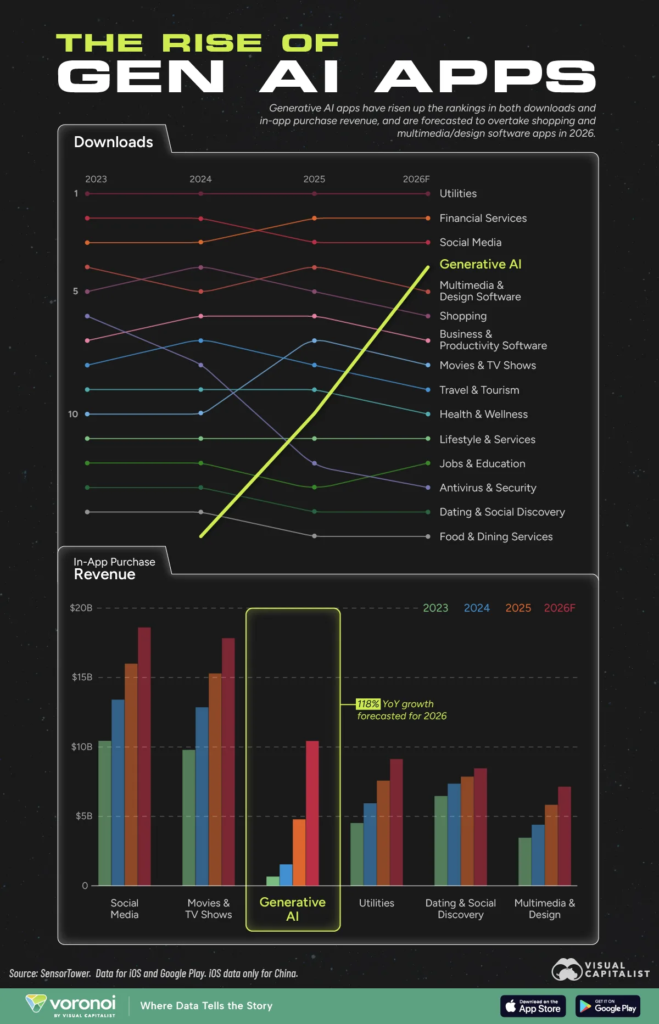
    Here’s a chart that shows the rise of generative AI apps compared to other app categories on popular platforms. There’s a phrase that captures what this chart reveals:

    One of these things is not like the others.

    Take a look.

    Chart showing generative AI app downloads vastly outpacing other mobile app categories on iOS and Google Play

    via visualcapitalist

    THE DATA: Growth Unlike Any Other Category 

    While this data covers the iOS and Google Play stores — which represent the majority of consumer app downloads — it doesn’t capture enterprise or web-based AI usage, where adoption may be even higher.

    AI‑generated text, images, and video have quickly become a major force in content creation and moderation. Many younger users may now consume a majority of their content through AI-mediated or AI-generated experiences (e.g., personalized feeds and AI‑curated playlists, as well as synthetic influencers and chat‑based companions).

    The trajectory becomes even more striking when you examine the financial projections.

    According to Sensor Tower, Generative AI apps are projected to reach 4 billion downloads, generate $4.8 billion in in-app purchase revenue, and account for 43 billion hours spent in 2025 alone. Generative AI applications are anticipated to reach over $10 billion in consumer spending by 2026. Additionally, by then, Gen AI is expected to be among the top five mobile app categories in terms of downloads, revenue, and user engagement.

    THE BEHAVIOR SHIFT: From Tools to Workflows

    Beyond installs and revenue, user engagement is accelerating, reflecting increased consumer willingness to pay for AI tools, subscriptions, and premium features as these apps become part of daily workflows.

    Key insight: This isn’t just another app category — it’s infrastructure. And, learning to work with AI is quickly becoming a baseline skill. Just as spreadsheets and email became non‑negotiable skills in earlier eras, fluency with AI tools will soon be assumed rather than optional.

    How to adapt, starting now

    • Audit where AI already touches your workflows—email, content, customer interactions—and identify obvious gaps or redundancies.
    • Pilot one or two Gen AI tools deeply rather than dabbling in many, and track the impact on time saved or output quality.
    • Establish simple guardrails for accuracy, privacy, and human review so AI becomes a reliable partner, not a blind spot.

    The momentum is undeniable. In the AI era, standing still means falling behind (but at an exponential pace). The question isn’t whether to adopt AI … it is how quickly you can adapt your workflows, teams, and strategies to use it well. Those who learn to partner with these tools now will define what ‘normal’ looks like in the years ahead.

    Onwards!

  • How Did Markets Perform In 2025?

    This is the time of year when many investors look back at 2025 and ask, ‘How did the markets do?’ It is not just about what made or lost money, but how each asset performed relative to the others.

    Studying past performance is interesting, but it is not always helpful for deciding what to do next. This post looks at how 2025’s returns set the stage for 2026.

    Because 2026 is a midterm election year, market performance is likely to matter even more to the party in power. With that said, the market is not the economy. Asset class performance reflects diverse economic forces (risk appetites, rate expectations, foreign growth, government interventions, and real asset demand), all interacting in a complex global backdrop.

    Before thinking about what comes next, it helps to look back at how we got here.

    A Look at Recent History

    2022 was the worst year for the U.S. stock market since the 2008 financial crisis.

    2023 was much better, but most of the gains came from a handful of highly concentrated sectors.  

    2024 saw nearly every sector post gains – driven primarily by AI enthusiasm and a robust U.S. economy. Bitcoin surged to an all-time high, and Gold saw its best performance in 14 years. On the other hand, bonds suffered amid reflationary concerns and fears of a growing deficit.

    For 2025, I predicted a bullish year (driven by AI), but expected more volatility and noise. That is what we got and what we wrote about in the post: The Seven Giants Carrying the Market: What the S&P 493 Tells Us About The Future.

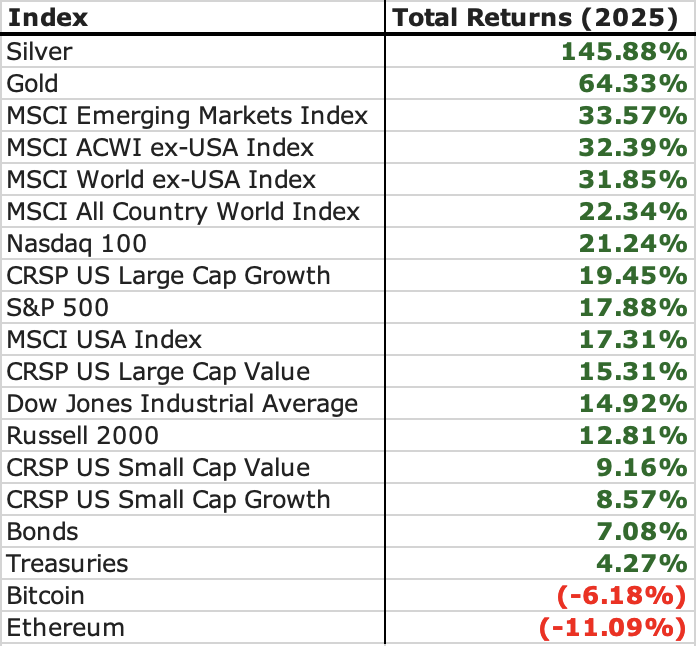
    So, looking back, how did markets actually perform in 2025? Here is a table showing global returns by asset class.

    A Global Look at 2025: Slowing, But Strong

    Table showing 2025 total returns across global asset classes, with silver and gold leading and crypto negative

    At a high level, 2025 was a year of solid gains, with diversification paying off: metals and international markets led, while crypto lagged.

    Here is a closer look at asset class performance (based on total return figures through the end of 2025):

    • Silver (+145.88%) and Gold (+64.33%) dominated returns, a rare year where precious metals outperformed traditional equities.
    • International equities surged, with the MSCI Emerging Markets Index (+33.57%) and MSCI World ex-USA Index (+31.85%) outpacing U.S. benchmarks.
    • U.S. major indices such as the Nasdaq 100 (+21.24%) and S&P 500 (+17.88%) remained strong.
    • Smaller U.S. stocks and value segments delivered respectable but more modest gains.
    • Fixed income and bonds produced positive but lower returns.
    • Cryptocurrencies — Bitcoin and Ethereum — ended the year with negative performance, illustrating ongoing volatility in digital assets.

    This split suggests that 2025 became a year of diversification returns, with non-U.S. equities and metals playing a larger role than in recent U.S. market-centric rallies.

    Diving Deeper Into Business Performance

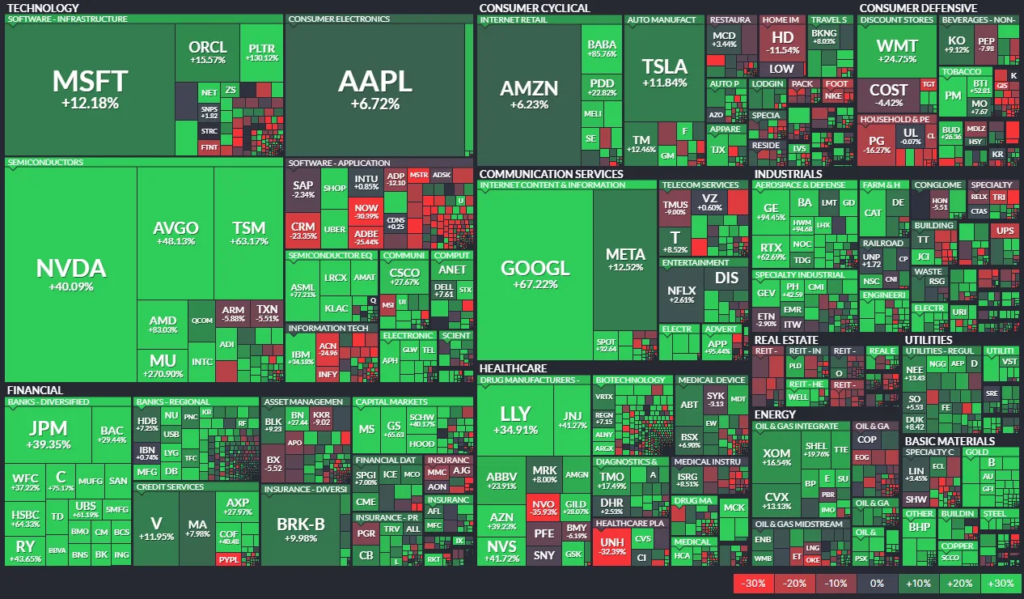
    via visualcapitalist

    One of the most striking themes in U.S. equities throughout 2025 was the pronounced divergence in performance across sectors and stocks, as illustrated by VisualCapitalist’s winners-and-losers visualization.

    Unsurprisingly, AI and data infrastructure companies were among the biggest winners of the year.

    Continuing the trend from our broader perspective, precious metal producers also saw gains, reflecting a wider appetite for inflation hedges and geopolitical safe havens.

    Meanwhile, real estate investment trusts (REITs) struggled amid elevated borrowing costs and high yields, which made alternative income assets more attractive. Non-AI software companies and oil & gas stocks also underperformed.

    In Closing

    None of this guarantees how 2026 will play out. It does suggest a few things to watch: whether the strength in metals persists, whether international markets can build on their leadership, and whether crypto’s drawdown turns into a reset or a renewed rally. It also reinforces a familiar lesson: diversified, rules‑based portfolios can thrive even when leadership rotates (did you read last week’s article?)

    On one level, a systematic, algorithmic approach means not spending too much time trying to predict markets. On another, it is hard not to think about what might come next — especially as AI becomes more influential and pervasive.

    What do you expect for 2026? Will cryptocurrencies recover, or will they continue to shake out? Will AI keep booming at this pace or begin to normalize? And which sectors do you believe have the potential for the biggest surprises?

    Onwards!

  • The End of an Era: Recognizing Warren Buffett’s Immutable Legacy

    With his final annual letter to Berkshire Hathaway investors, Warren Buffett has effectively written the last chapter of a six‑decade investing saga.

    Berkshire’s leadership is passing to Greg Abel as Buffett steps back at the remarkably young‑at‑heart age of 95.

    Abel inherits not just a portfolio, but a philosophy of disciplined capital allocation, conservative balance sheets, and a relentless focus on intrinsic value. The real question for investors is not whether Abel can be another Buffett, but whether Buffett’s playbook can outlast the man who wrote it.

    Buffett’s edge lasted across various eras because his focus was not on speed or exotic tools, but on patience, clarity, and a refusal to mistake volatility for risk. That mindset is still available to anyone willing to slow down and think in decades instead of days.

    Buffett’s Unmatched Track Record

    Buffett’s tenure produced extraordinary returns: roughly over 6,000,000% total appreciation for Berkshire Hathaway’s Class A shares from 1965 through the end of 2025. That works out to a compounded annual gain of roughly 19–20% for Berkshire versus about 10% for the S&P 500 — almost double the market’s annual return, sustained over six decades.

    Those numbers are hard to imagine (and even harder to replicate), which is why the mindset behind them matters more than the math.

    At a time when AI, algorithms, and noise dominate markets, Buffett’s true legacy isn’t his returns; it’s a playbook for thinking about risk, volatility, and human potential in an age of AI and uncertainty. 

    To understand how that philosophy shows up in practice, look at Berkshire’s positioning in 2025.

    Berkshire Hathaway’s 2025

    2025 drove home just how conservative Berkshire remains — and how consistently that conservatism has paid off.

    The company built over $350B in cash reserves, sold significant amounts of its Apple stock, increased its ownership in Japanese trading firms, and maintained its financial strength amid volatile market shifts.

    They held on to many of their core holdings (such as Coca-Cola and American Express) and still saw portfolio value growth despite the move toward cash. They’re one of the few businesses I can say I’m not surprised beat the market (again).

    Those decisions reflect themes Buffett underscored in his final annual letter.

    Lessons From His Final Letter

    ”Greatness does not come about through accumulating great amounts of money, great amounts of publicity or great power in government. When you help someone in any of thousands of ways, you help the world. Kindness is costless but also priceless. Whether you are religious or not, it’s hard to beat The Golden Rule as a guide to behavior.”

    It’s inspiring when a successful leader focuses on making things better for others, rather than simply winning. Perhaps that’s actually a healthy redefinition of what “winning” means.

    Readers of past letters will recognize familiar themes, now paired with a more reflective look back at an incredible career.

    In many ways, it reads as a love letter not only to America but also to humanity.

    He comes off as humble and down-to-earth … yet also proud of his achievements.

    Key takeaways?

    • Take a long-term perspective … stock price volatility (even large drops) is a normal and expected part of markets and should not derail long-term investing.
    • Acknowledge the role of luck … even when you’re as disciplined and effective as Buffett, luck always plays a role.
    • Don’t beat yourself up over mistakes … acknowledge them, learn from them, and do better.

    Berkshire’s 2025 decisions are simply the latest expression of habits Buffett has honed over a lifetime.

    A Look Back At Buffett’s Career

    Warren Buffett is a legend for many reasons. Foremost among them might be that he’s one of the few investors who clearly has an edge … and has for a long time. 

    Buffett didn’t chase lottery tickets; he stacked small, repeatable wins, and let compounding do the heavy lifting. There’s power in that. He also noted that as stock trading has become more accessible – it’s made daily buying and selling easier, but also more erratic. That, unfortunately, benefits the “house” more than individuals. 

    While most people label Buffett an investor, his story makes even more sense if you think of him as a scrappy entrepreneur.

    At the age of six, he started selling gum door-to-door.

    He made his first million at age 30 (in 1960). For context, a million dollars in 1960 would be worth about $10.4 million today.

    Buffett has always been honest about his bread-and-butter “trick”…  he buys quality companies at a discount and holds on to them.

    Sixty‑five years later, it is striking how dramatically the world has changed — and how little Buffett’s core playbook needed to.

    The Lesson Behind The Lesson

    Seeing Warren as an entrepreneur, rather than just as an investor, turns his ideas into axioms for life and business, not just trading.

    Money will always flow toward opportunity, and there is an abundance of that in America. Commentators today often talk of “great uncertainty.” … No matter how serene today may be, tomorrow is always uncertain.

    Don’t let that reality spook you. Throughout my lifetime, politicians and pundits have constantly moaned about terrifying problems facing America. Yet our citizens now live an astonishing six times better than when I was born. The prophets of doom have overlooked the all-important factor that is certain: Human potential is far from exhausted, and the American system for unleashing that potential – a system that has worked wonders for over two centuries despite frequent interruptions for recessions and even a Civil War – remains alive and effective.

    We are not natively smarter than we were when our country was founded nor do we work harder. But look around you and see a world beyond the dreams of any colonial citizen. Now, as in 1776, 1861, 1932 and 1941, America’s best days lie ahead

    This excerpt from his 2011 letter doesn’t just speak to America’s longevity; it speaks to our own capacity to keep reinventing ourselves.

    Few forces hold people back more than an outsized fear of failure.

    Fear, uncertainty, and greed are hallmarks of every year. The world will continuously cycle through ebbs and flows, but the long arc still bends toward greater possibility and greener pastures. 

    What This Means For Us

    Not every investor can (or should) copy Buffett, but everyone can borrow his mindset around patience, risk, and human potential.

    If you let yourself be persistently frightened into believing that the world is doomed, you’ll never take the risks that could change your life for the better. Worse still, if you never experience failure, you’ll never learn to get back up, brush yourself off, and grow stronger for future success.

    The game is not about the next year or even three; it is about a lifetime, and the generations that follow. 

    Buffett’s run may be ending, but the forces he trusted — human ingenuity, compounding, and long‑term thinking — are even more important.

    In an AI‑driven world, the edge won’t belong to whoever has the most models; it will belong to those who stay patient, take intelligent risks, and keep betting on human potential — starting with their own.

    Let’s continue to make our tomorrows bigger and better than our today. 

    Onwards!

  • Are These 2026 Predictions Worth Considering?

    Prediction is hard, especially about the future.”

    That quote is often attributed to physicist Niels Bohr or baseball legend Yogi Berra. Even though it sounds like a joke, it contains a real warning. In complex systems, the edge rarely comes from being right about the future. It comes from being ready when everyone else is wrong.

    Why Prediction Isn’t an Edge

    If you know predictions are flawed, is it still worth considering them carefully?

    Predictions make me uneasy. On some level, they’re fun and sometimes accurate — but I’d much rather know things than guess them.

    In my experience, there are simply too many variables and too much randomness in real‑world systems for prediction to be a reliable competitive edge. Instead, your edge often comes from how well you respond to surprises, not from calling them in advance. That is why signal‑finding and noise‑reduction are far more reliable to build around.

    While I don’t put too much faith in predictions, I enjoy looking at them. Some are vague enough that they’re almost guaranteed to be directionally correct. Others are so specific that they force a fresh way of looking at a subject, even if they never come true.

    Still, it is useful to know where the crowd is leaning. Consequently, seeing where smart people agree and disagree can be useful scaffolding for your own thinking, which is why this year’s prediction consensus is worth a look.

    A Consensus View of 2026

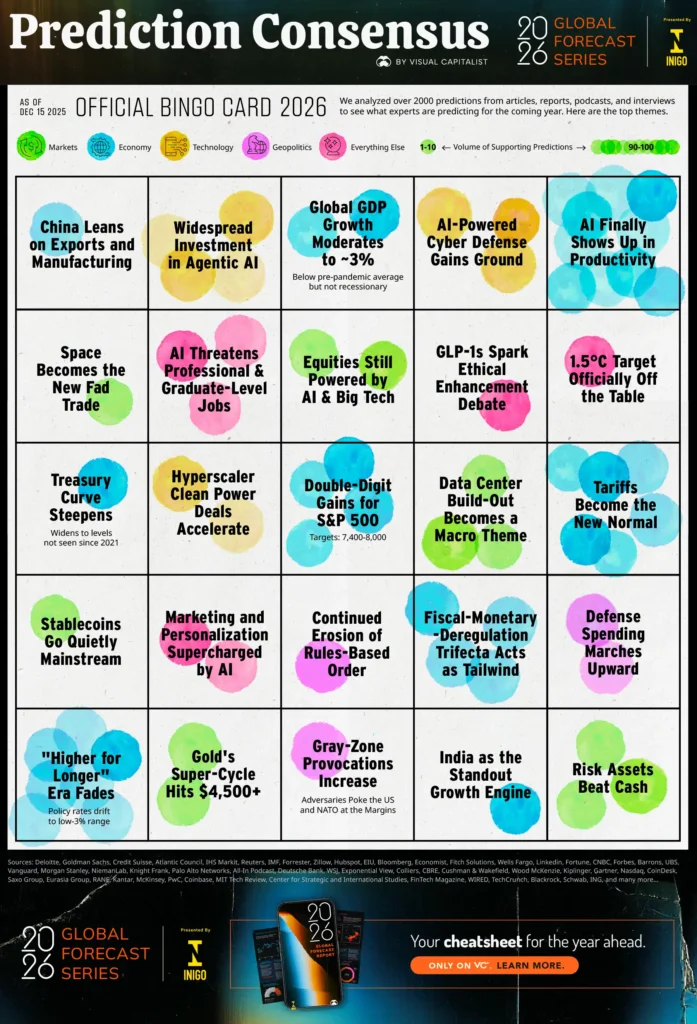
    Visual Capitalist puts out an infographic every year that tracks predictions from various publications. It’s fun to look at before the year starts, and revisit as the year comes to a close.

    To make these forecasts, they analyzed over 2,000 predictions from articles, reports, podcasts, and interviews from a wide variety of sources, including Morgan Stanley, Goldman Sachs, the IMF, The Economist, Deloitte, Microsoft, and Gartner Group.

    By mapping where these forecasts overlap, they distilled the noise into 25 high-conviction themes displayed in a “Bingo Card” format, with the number of color dabs reflecting the type and volume of supporting predictions.

    Infographic showing consensus predictions for 2026.

    via visualcapitalist

    This ‘bingo card’ shows where institutional predictions cluster — and where they are most likely to be wrong. Taken together, it is less a forecast and more a map of the assumptions currently shaping capital flows and corporate decisions.

    Looking back, 2025 was a year of adjustment: markets recalibrated to higher rates, geopolitics reshuffled around a second Trump administration and new tariffs, and AI moved from hype to deployment. Looking forward, 2026 is shaping up as a year of consolidation – and consequence. Nonetheless, based on their research, 2026 predictions seem cautiously optimistic.

    Their big takeaway? Risk assets may thrive, but the world beneath them remains turbulent.

    The Big Issues

    Unsurprisingly, AI is the dominant force in their prediction landscape. Their 2024 forecasts centered on whether AI hype was justified, and 2025 focused on deployment at scale. The 2026 conversation focuses on large-scale integration and its consequences.

    The central question posed is: “What happens when AI becomes a colleague instead of a tool?

    People worry about what AI agents mean for workforces, yet the consensus is clear: markets are expected to benefit.

    There are plenty of other themes on the card — from tariffs and gold to emerging markets.

    Take time to consider this chart carefully. The themes it surfaces are significant, while the impact and meaning remain open to discussion.

    Some of these themes will play out roughly as advertised; others will get blindsided by events no model had on its radar. Collectively, though, they outline the landscape that institutions, investors, and policymakers are navigating as they prepare for the year ahead.

    This consensus does not tell you what will happen; it tells you what most institutions are currently betting on. Your edge comes from how you prepare for the tiles no one expected to light up.

    The important questions do not change.

    What are you focusing on? What do you think will happen? What do you think it means? And what do you intend to do?

    As always, Onwards!

  • Getting To Know Yourself Better With Prompts

    As we approach year-end, my thoughts have been on finishing strong and planning for a great 2026.

    Last week, we looked at a prompt that created a new keystone habit. This week, I’m sharing another simple prompt that I found valuable and insightful. It’s designed to review your conversation history, conduct a mini-assessment, and give you a glimpse into your blind spot.

    Like last week’s prompt, as written, it’s somewhat generic and might hallucinate a little if it doesn’t have enough data. That’s easy to fix by improving the prompt. But for the purposes of getting started, this is good enough.

    Here is the base prompt to try in your primary AI tool.

    From all of our interactions, what is one thing that you can tell me about myself that I may not know about myself?”

    Sometimes, less is more.

    There are lots of ways to use something like this. For example, you can tell it to be “brutally honest” or to “roast you” so that you hear it in humorous terms. With that in mind, here are a bunch of copy/paste prompt variants that produce the same kind of “surprising but grounded” self-insight, each from a different angle.

    Pattern + Blind Spot Variants

    • Strength-with-a-Shadow

    From our interactions, name one strength I clearly have and the most likely downside of that strength when overused. Give 2 examples from our chats and 1 practical guardrail.

    • Default Operating System

    What is my “default mode” behavior, under pressure, based on our interactions? What does it protect me from, and what does it cost me?

    • Hidden Constraint

    Identify one hidden assumption I seem to carry. Explain how it helps me, how it limits me, and one experiment to test it.

    • Blind Spot That Looks Like a Virtue

    What’s a behavior of mine that most people would praise, but that could quietly create problems? Be specific and non-psychological.

    Decision-making + execution variants

    • Where I Over-Engineer

    Where do I tend to add unnecessary complexity? Give one example pattern, why I do it, and a “2-step simplification rule” I can apply.

    • Where I Under-Commit

    Based on our interactions, where might I stay in analysis longer than needed? Give a “commitment trigger” and a script for making the decision.

    • One Question I Avoid

    What is one question I rarely ask, but should, given my goals? Provide the exact wording and when to use it.

    • My “Next Constraint”

    If I had to improve only one constraint in my system (time, focus, delegation, communication, risk), which one is highest leverage and why?

    Communication + Relationships Variants

    • How I’m Experienced by Others

    Based on my writing and requests, how might teammates/investors experience me on a good day vs a stressed day? Give 3 traits each and 1 calibration move.

    • Trust Friction

    Identify one way my communication style could unintentionally reduce trust or clarity. Give a rewrite pattern I can apply.

    • Authority vs Warmth Dial

    Where do I sit on the authority↔warmth spectrum in my messages? What’s the risk at my current setting, and how do I adjust without becoming fake?

    Energy + Focus Variants

    • My Energy Signature

    Infer my likely “energy curve” and where I do my best thinking. Give a schedule template that matches it and one rule for protecting it.

    • My Procrastination Costume

    What form of “productive procrastination” do I use (based on our chats)? Give a 60-second interrupt and a 10-minute re-entry plan.

    Identity + Growth Variants (Grounded, Non-Therapy)

    • My Core Values in Disguise

    What values do my patterns suggest (not what I claim)? Give 3 values, the evidence, and one way each can be expressed more cleanly.

    • My Edge

    What’s one capability I’m unusually strong at that I might be underpricing? Give one way to productize it and one way to teach it.

    Tighter “One Thing” Variants

    • One Sentence, Then Proof

    Tell me one thing about myself I might not know in a single sentence. Then justify it with 3 specific signals from our interactions and 1 counter-signal.

    • If-Then Insight

    If I keep doing X, then Y will happen (good and bad). Identify X and Y from our interactions, and give one small change.

    • The Uncomfortable Gift

    Give me one insight that’s slightly uncomfortable but genuinely helpful. Be kind, direct, and practical. End with one question for me.

    Hopefully, you found something that helped you find what you were looking for.

    It’s a good reminder that AI is not supposed to replace you … It’s supposed to amplify the best parts of you.

    A lot of these exercises and thought patterns are based on activities I used to do in my own planning, or with trusted advisors. As I use AI more in my everyday life, it has collected enough data to be a powerful analysis tool (and that is a scary reminder of how much it knows and remembers).

    I believe in examining your thinking – and using those insights to choose smarter and better actions. Prompts like this are a powerful tool for building that habit … but only if you remember that it is still you choosing and acting!

    Don’t outsource what makes you human to the machines … but that doesn’t mean you can’t use a helping hand.