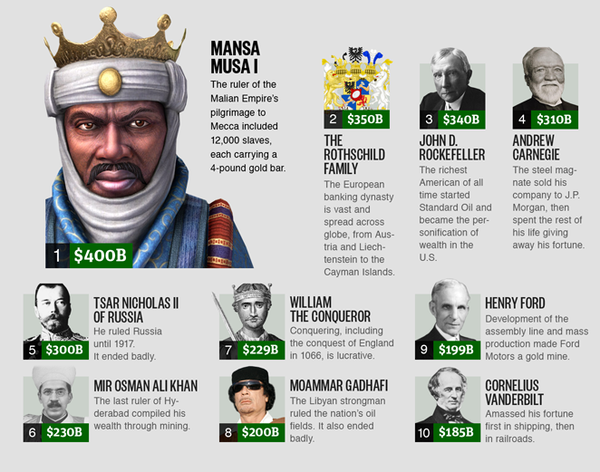
Topping the list is Mansa Musa I, ruler of the Malian Empire until 1337. His net worth of $400 billion was amassed through his empire’s production of more than half of the world’s supply of gold and salt.
Many of the others on the list will be more familiar. Interesting.
I spoke on a panel at "A New Beginning – Entrepreneurship and Business Innovation" event this week.
It was sponsored by the US Department of State and EO.
Several dozen countries sent entrepreneurs to attend the session. It was lively and fun.
In this picture, I am with fellow panelists, Stewart Youngblood from TechWildcatters, Tricia Bridges from Ciapas, and Greg Moore from Blackhill.
Great to see so many countries sending entrepreneurs to the United States to participate in programs like this.
The
World's First Vegetarian McDonald's. To capture more of India's $12 billion
fast-food market, the burger chain will jettison meat entirely in favor of the
McAloo Tikki burger and the McSpicy Paneer. (The Week)
Do
you want sprouts with that? A former McDonald's boss would like to welcome
you to his new restaurant. No butter, cream, white flour, or additives. (Wired)
Frank Partnoy ex-Wall Street derivative trader and self-confessed procrastinator, reveals the science behind our decision-making disasters and successes, and argues that decisions of all kinds, whether 'snap' or long-term, benefit from being made at the last possible moment.
The art of knowing how long you can afford to delay before committing is at the heart of many a great decision.
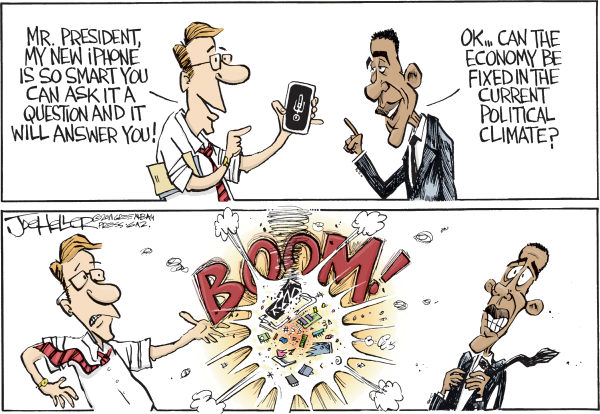
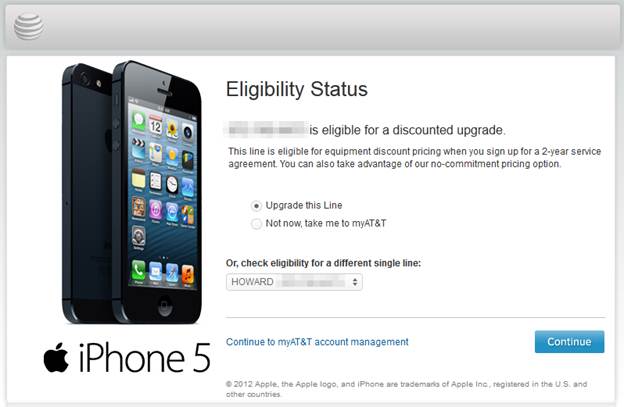
The iPhone 5 is cutting edge … and Siri is getting smarter. Too bad it can't answer the tough questions. Here's a cartoon that imagines what would happen if asked "Can the economy be fixed in the current political climate?"
Here are some of the posts that caught my eye. Hope you find something interesting.
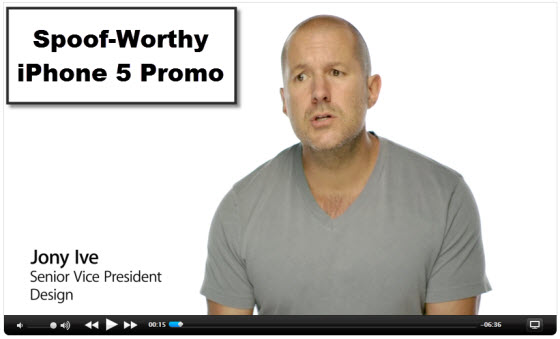
There is also a spoof of the video. It is very funny … worth watching
for a laugh and some perspective on how "big" the Apple brand promise
has become.
In many ways, the spoof made me want the phone even more.
As a side-note, wouldn't it be great to design a product that was spoof-worthy?
As
you think about what a spoof of your product or service would be,
perhaps the bit of "truth" in the humor points at the real competitive
advantage … or at least towards the roadmap that leads towards
creating one?
While talking with traders, one of the topics that keeps coming up is how much the markets and trading have changed recently.
One
of the primary catalysts to such change has been the amount and
frequency of government intervention and stimulus. Another big driver of
change has been the massive shift to algorithmic or program trading.
Recently, the piece of this getting the most press and attention
is high-frequency trading.
Below is an interesting video where Mark Cuban, Dallas Mavericks
owner and high-profile entrepreneur, shares some thoughts about why high-frequency trading
terrifies him.
Here is the video. The market related comments start about 30 seconds into the clip.
Some people may watch that video and assume that
high-frequency trading is a bad thing, or something to be regulated and minimized. However, there is another side to the argument.
Let me digress for a moment. If I talked to an entrepreneur, and asked them what the biggest constraint on their business was … some might say it's the Obama administration and their policies. This is absurd, because they don't have any control (or at least meaningful control) of that supposed constraint. Instead, that is simply a "reality" of the current competitive environment for them and others.
What that means is the thing they control is how they respond to that competitive environment. For some, what they perceive limits their options or thwarts their strategies. For others, it is a catalyst for new action, new strategies, and new ways to win.
So, why is Cuban afraid of high-frequency trading? First, he believes we are likely to see another "flash crash". Second, an increasing percentage of market action is a result of algorithms trying to outsmart algorithms (and he recognizes that the decisions they are making happen faster than humans can respond to our comprehend). As a result, human intervention isn't the answer because any actions would occur too late.
Some people recognize the advantage algorithmic traders are gaining and seek to weaken it (or at least slow it down), while others pull their money out of the market because of their disadvantage and the new risk. Contrast that with those that see the advantage and try to figure out how to extend it or get some of it for themselves.
It's like most things in life, it's not as much about what happens, it's about what you do.