
I recently saw a Reddit thread comparing McDonald’s and Hot Wheels in the 1990s with their modern counterparts. The images were meant to show how much color, character, and personality seemed to have disappeared.
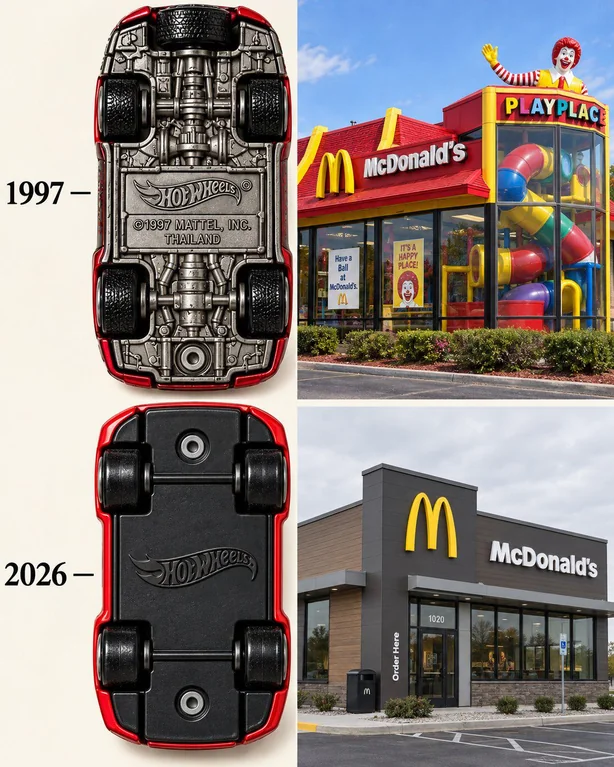
via r/SipsTea
Millennials tend to think everything was better in the ’90s, and while that’s demonstrably not true, corporate design was less brutalist.
The comparison felt a little nostalgic, but it got me thinking about a real business problem: What happens when companies focus so much on optimization that they lose sight of what made people love them in the first place?
Capitalism Rules
Capitalism is remarkably good at creating things people want. Competition gives entrepreneurs a reason to build better products, take risks, challenge established players, and find entirely new markets. McDonald’s made fast food an experience, not just a meal. Hot Wheels made a little toy car feel like an adventure.
But success changes the incentives.
Once a company has established its position, the challenge can shift from making a better product to making the existing product more efficiently. Can we reduce manufacturing costs? Simplify the experience? Remove a feature without hurting sales? Improve margins by another fraction of a percent?
Individually, these decisions can make perfect sense. Collectively, they can produce something that works just fine but feels like a shell of what it used to be. The magic fades, and trouble sits just off in the horizon, waiting for a disruptor to bring it to light.
You can see a similar pattern around town. Compared with much of the architecture and construction many of us remember from the 1990s, so much new development can feel repetitive and interchangeable. There are understandable reasons for that, from construction costs and zoning requirements to financing constraints and the economics of building at scale. Still, it’s worth asking what gets lost when efficiency and predictability dominate every decision.
You can even see it in trading. Over-optimize a strategy against its own backtest, and you can curve-fit your way to a beautiful equity curve that has nothing to do with how markets actually behave going forward.
Don’t Optimize On The Wrong Metrics …
The irony is that optimizing away these qualities may be the very things that once differentiated the business. Color. Character. Craftsmanship. Surprise. The little details that make someone choose your product even when a cheaper or more convenient alternative exists.
When every competitor follows the same playbook, optimization can become a race to the bottom. Everyone gets a little more efficient, but nobody gives customers a compelling reason to care.
That creates an opportunity, too. When established companies leave customers wanting more, a competitor can win by bringing back what was lost or by creating something entirely new that incumbents have stopped looking for.
For entrepreneurs, the question isn’t whether to optimize. Of course we should. The question is what we’re optimizing for, and whether our metrics capture the things customers actually value.
Are we measuring what matters, or just what’s easy to measure? Are we improving the experience, or simply reducing the cost of delivering it? And when we look at our own products five or ten years from now, will we see something more useful, more distinctive, and more valuable, or just more cheaper & more efficient?
The goal shouldn’t be to preserve everything the way it was. It should be to make progress without losing the spark.
As you continue to use exponential technologies, it becomes more important to decide how much you prioritize your ‘Why’ over your ‘What’ and ‘How’.
Leave a Reply