
The last time I drove in New York City, the traffic was so bad that I complained, “I didn’t understand why people came here.” It reminded me of a Yogi Berra quote about a restaurant he used to work at: “Nobody goes there anymore, it’s too crowded.”
The same is true in business. Opportunity draws a crowd … but the best opportunities are often in areas of less competition.
For entrepreneurs, oversaturation can turn products into commodities, reducing profit potential. Conversely, many shy away when a challenge seems insurmountable, creating unexpected opportunities for those willing to take the risk.
While Artificial Intelligence is becoming commoditized, that doesn’t mean every application is.
As an entrepreneur, I’m drawn to projects others might dismiss as science fiction. These are the challenges that often lead to the most groundbreaking and rewarding outcomes.
As a practical matter, exponential technologies are changing the game in many ways. First, based on what they make possible. Second, by how fast that can happen now. And third, by making it necessary to make the invisible visible (what I mean by that is you must focus on thinking about things that were previously inconceivable to you), and that results in mining a bucket of opportunities that used to get no thought given to them.
Moonshot Projects
Moonshot projects offer a unique advantage. While they may seem daunting, their audacious nature often means less competition and greater potential for transformative impact and extraordinary profits.
A moonshot project is a highly ambitious, transformative endeavor that seeks to solve a significant problem or create a revolutionary innovation. These projects are characterized by:
- Audacious Goals: They aim for breakthroughs that seem nearly impossible.
- Disruptive Impact: They strive to create solutions that are vastly superior to existing offerings, often by introducing entirely new paradigms.
- High-Risk, High-Reward: These projects embrace the potential for failure in pursuit of groundbreaking results.
- Long-Term Focus: They prioritize long-term impact over short-term gains.
- Technological Advancements: They leverage cutting-edge or even nascent technologies.
- Paradigm Shifts: They challenge conventional wisdom and industry norms.
Moonshot projects are inherently challenging. They demand significant resources, interdisciplinary collaboration, and a willingness to venture into the unknown. This perceived difficulty often deters potential competitors, creating a unique opportunity for those willing to take the risk.
When successful, they push the boundaries of what is possible and redefine the landscape of their respective fields.
For us here, autonomous trading happens in live markets amid power failures, pandemics, wars, and the President’s ability to post whatever he wants on social media at any time. What started out as the quest for a better algorithm led to a real-time decision-making process that dynamically adapts to what happens, audits itself, and continually learns and evolves. Literally science fiction from 20 years ago.
In part, that is why a 10X mindset is particularly well suited to Moonshot projects. By aiming for a tenfold improvement over existing solutions, you’re essentially operating in a space with little to no competition or opposition. This allows you to redefine the rules of the game and establish a sustainable competitive advantage.
Playing a New Game
Our strategy of moonshot thinking creates a unique, sustainable competitive advantage that aligns perfectly with the Moonshot approach. By choosing to play a different game (with an asymmetric edge), we’re not just competing; we’re fundamentally changing the playing field.
I’m not interested in going head-to-head with tech giants on their turf. Instead, the goal is to carve out our own niche, focused on our unique abilities to push the boundaries that extend our edge.
Quote from Howard Getson
Being slightly ahead of the competition can be a powerful attractor. It often leads potential competitors to seek collaboration rather than confrontation. They might approach you with ideas, money, or opportunities, aspiring to share in your advanced position and capabilities. This dynamic can create unexpected partnerships and accelerate progress in ways that benefit everyone involved.
When interviewing potential team members, I often share a crucial insight: if you’re seeking a job where you work 9-to-5 solving problems so you can go home feeling satisfied, this might not be the right fit.
We tackle challenges of a different magnitude. Our projects rarely have quick solutions. Instead, we focus on making steady progress towards ambitious goals. Because of that, I sometimes joke that our motto should be: “We suck less.” Nevertheless, the underlying truth is more profound. It’s about understanding your ultimate objective and recognizing that each step that moves you in the right direction, no matter how small, is still progress.
This approach aligns with our belief in playing a different game. We don’t just compete; we redefine the rules of engagement, creating our own metrics for success and pushing boundaries in ways that traditional thinking often overlooks. Kind of like this quote:
“I have not failed. I’ve just found 10,000 ways that won’t work.” – Thomas Edison
Play to Win!
Business does not happen in a vacuum. You have to be aware of the playing field, the players, and asymmetric advantages. In other words, don’t compete with giants at their own game.
Choose to play a game you both want and expect to win.
Playing a different game is a theme at Capitalogix. We believe that you control the game you’re playing, the rules, how you keep score, and even how you evaluate success. These things inform where to spend time, where to invest money, and even what you see as an opportunity.
Wouldn’t you rather compete in areas where you can create a unique, sustainable competitive advantage? Personally, I want to invest in the things that extend the edges that let us win.
Why? Because the alternative — competing on someone else’s terms — is expensive in ways that don’t show up until it’s too late.
Mediocrity Is Expensive!
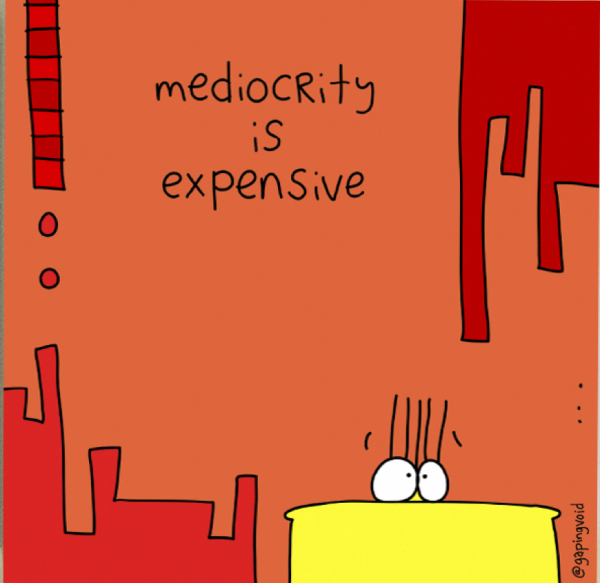
What you lack in size or computer power, you can make up for in creativity, agility, and innovation.
We built our edge in the investment industry through unique approaches to age-old problems, not raw computing power.
We have an incredibly narrow and consistent focus. Within that area, we are willing to take on problems others avoid and pursue goals that others say are impossible.
Our niche limits risk and lets us fail faster … and learn faster. This allows us to take confident action while others are tentative.
Most big companies – and most of our competitors – are afraid to be wrong. They have to protect their infrastructure, cash cows, and short-term performance metrics. It makes sense (from their perspective) that playing it safe means they’re secure. – but that’s not how it works.
You can’t challenge the status quo when you are the status quo.
10X vs. 10%
Pursuing moonshots (rather than incremental change) leads to a counterintuitive shift in belief … Improving something ten times is often easier than improving it ten percent. Astro Teller — who runs Alphabet’s moonshot factory, X — put it well in this TED talk:
Astro Teller via TED
“In 1962 at Rice University, JFK told the country about a dream he had, a dream to put a person on the moon by the end of the decade.The eponymous moonshot. No one knew if it was possible to do, but he made sure a plan was put in place to do it if it was possible.That’s how great dreams are. Great dreams aren’t just visions, they’re visions coupled to strategies for making them real.” – Astro Teller
Incremental change is hard – it’s finding new ways to do the same thing, and you often end up competing in very red oceans – saturated markets where you’re competing on price.
Moonshots sound harder, but you create your own niche, and the constraints of a new idea force creativity and energy. If you’re going after a goal that no one has accomplished before, it’s impossible to be in a red ocean, and it’s easier to mobilize a team around something exciting and new than decreasing some arbitrary metric by 2%.
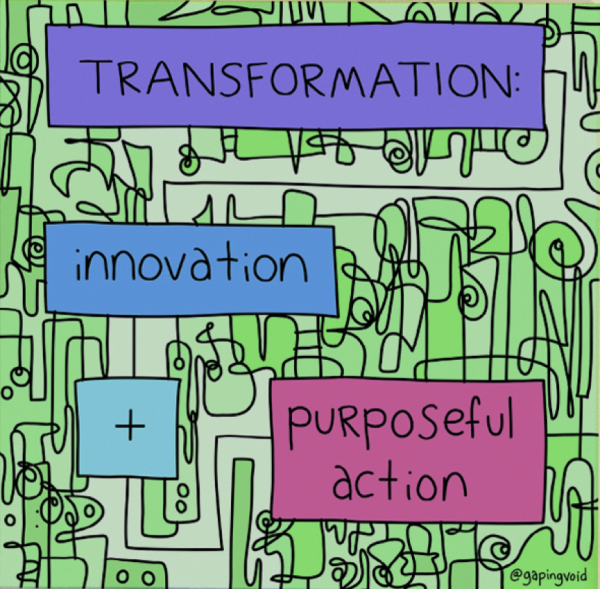
There are a couple of important lessons to keep in mind when pursuing the unknown. Usually I like to say that it’s better to have a map before you get lost in the woods, but in pursuing the unknown, you often don’t have a map. If that’s the case, the first thing I think of is to focus on process rather than outcomes. In the unknown, following a trusted framework is a good place to start. In addition, here are a few ideas to get you started.
- Forget what you know – self-reported “experts” are limited by their worldview. If you’re trying to get a different result, you won’t do it by playing by the same rules your predecessors followed. Heuristics are great for making life easier – but they’re very limiting when trying to create something new.
- Attack the hardest problems first – your biggest problems are your biggest opportunities. If you don’t deal with the big problems now, you’ll never get around to them, and you’ll waste time and energy, only to realize you have to pivot much too late.
- Be comfortable being uncomfortable – most people find failure taboo and are deathly afraid of it. Tony Robbins talks about our tendency to avoid pain more actively than we pursue pleasure, and it’s true in business. But failure is a part of business. The people I consider most successful got there through incredible pain tolerance and increasingly intense problems that they continued to conquer.
- Have a short memory for pain – Focus on the gain, not the pain. People often focus on not having enough money, not enough time, or simply not having enough. That scarcity mindset is dangerous and can lead to getting lost in pain and fear. Acknowledging the pain/fear and moving forward from a place of abundance and opportunity helps create opportunities.
A clear identity is also important. You have to understand what you’re pursuing and how you want to attack the problem. At Capitalogix, we’ve gotten very in tune with our goals.
We invent techniques that identify and adapt to what happens. We apply the lessons learned from past experiences, data science breakthroughs, and hard work to eliminate the fear, greed, and discretionary mistakes that are the downfall of most decision-makers.
Small businesses don’t have a monopoly on these mindsets and opportunities, but companies like Y Combinator, HeroX, or X (and no, I don’t mean the company formerly known as Twitter) are few and far between. Speaking of the other X, Elon Musk is famous for moonshots such as Tesla, SpaceX, Starlink, Neuralink, and XAI. Google and Microsoft pursue moonshots as well.
Good news … the future is big enough for them and you.
Choose something that lights you up and leverages what you already know and who you already are.
If you’re the one writing checks instead of the one in the arena, the question isn’t whether a team has an edge today — it’s whether they’re building one nobody else wants to build.
Sometimes the best opportunity is the one others don’t want to pursue, not because it’s crowded, but because it seems hard.
Yogi Berra was joking about a restaurant. He wasn’t wrong about markets. The crowded road is the one everyone already found.
So what’s your moonshot?
Leave a Reply