As conversations about AI and rapid technological change dominate headlines, it’s easy to forget something fundamental:
To have a business, you actually have to build a business.
Too often, entrepreneurs string together a series of short-lived promotions — chasing trends and pivoting from one idea to the next. They launch quickly, make a modest profit, and just as quickly move on. In their haste to stay “current”, they bypass critical business building steps like product management, developing infrastructure, and consistent execution.
That approach works — until it doesn’t. Businesses built on trends are fragile. They rarely weather the shocks of a market crash, a platform crackdown, or a pandemic-sized disruption.
Like most good lessons, this one’s fractal — you’ll see it everywhere once you start looking.
Selling Picks and Shovels
Most of us have heard the old adage about selling picks and shovels during the gold rush.
During the gold rush, many people rushed to the goldfields in the hope of striking it rich by finding valuable gold nuggets. However, many participants in the gold rush did not find enough gold to become rich.
Often, the people who make the most money are the ones selling picks and shovels (goods and services) to the speculators. Said differently, profits often flow to people who provide the systems and infrastructure that enable others to dream of a bigger and better future. It’s why it’s easier to count on the blockchain being successful, rather than any specific cryptocurrency.
It’s not sexy, but it’s reduced risk, consistent demand, and a long-term perspective. When the mine dries up, you move on to the next mine and patiently stack your gold nuggets.
And, there are plenty of opportunities that don’t involve selling picks and shovels. You can build temporary lodgings, open a bar, and, of course, you can’t forget the world’s oldest profession … trading.
Okay, But What About AI
The AI boom feels a lot like the gold rush — a wave of excitement, hype, and promise. Both attract ambitious early movers chasing big wins. And both are marked by uncertainty: the fear of missing out, the fear of being left behind, and the fear of not knowing which way is up.
That fear drives people to adopt every new app or feature that flashes across their feed — anything to stay afloat. But AI is the tool, not the goal.
Chasing every shiny object is like panning for flakes of gold while ignoring the deeper veins underground. The real value lies in building something enduring: a business or system that leverages technology with purpose and focus. It’s about extending the edge you already have or finding a new one that supplements or complements your current business.
And here’s the key difference: while the gold rush came and went, AI is reshaping industries, economies, and society itself. The winners won’t be those who chase tools … but those who build with them.
In My Own Business
As an entrepreneur, it’s easy to fall in love with technology and let the perfect get in the way of the good.
In addition, it’s easy to get distracted chasing shiny new things. Jeff Bezos tells a story about how everybody asks him about “What’s new?”… but a better line of inquiry would seek to identify “What remains constant?” In a sense, there will always be a new market or a new technique that’s exciting and promising. However, your real business is the part that remains the same.
Continuity and recurring revenue create the bandwidth for innovation and ideation.
Over the years, we’ve built fault-tolerant systems that have survived fires, floods, internet outages, bad data, and global chaos — from market crashes to “Snowpocalypse.” Every challenge strengthened the foundation we stand on.
Yes, we’ve evolved. But our why hasn’t changed. New technologies, partnerships, and ventures are part of the journey — not distractions from it.
When you’re exploring the Wild West, whether it’s in a gold rush, an AI boom, or in the world of e-commerce, your chances of success rise rapidly with a goal, a why, and a plan.
The goal is to be timeless … not timely.
The next gold rush is always just around the corner. Real success isn’t measured by how many trends you chase, but by how resilient and anti-fragile your business becomes in the face of change. The foundation you build today determines the heights you’ll reach tomorrow.
The future tends to scare people who’ve grown comfortable in the present. They hope tomorrow looks like yesterday — because if it does, they already have the answers.
But that’s not how progress works.
I often say, “Standing still is moving backward,” and “You’re either growing or dying.”
So when I hear people resist new technologies, I can’t help but cringe a little. Smart people don’t avoid innovation and new technologies — they find ways to harness them.
Think of it like surfing: it’s easier (and a lot more fun) to ride the wave than to fight it. A good surfer doesn’t chase every swell — they’re selective. Sometimes it’s better to skip a small wave and wait for the right one to build momentum. The same applies to technology adoption.
It’s a simple way to understand how innovation matures — from what’s possible to what’s profitable — as each stage expands in capability, audience, and monetization.
At the heart of adoption is human behavior. It’s not always the best technology that wins — it’s the one people actually use. Understanding what stays constant amid change is the real key to scaling innovation.
This idea keeps resurfacing in my presentations and in the book I’m writing, Turning Thoughts Into Things. With that in mind, in this post, I will share two models to help you explore this process more deeply.
Learning To Surf
The first is a framework I developed based on how people tend to adopt new technologies. It’s an internal-facing model that consists of these 4 stages:
Improve
Innovate
Redefine, and
Transform.
Here’s a video that explains the technology adoption framework and what to expect when applying it.
It’s similar to Maslow’s Hierarchy of Needs; you have to deal with things like food and shelter before you can address higher-level issues like affiliation or self-actualization.
The Improve phase is crucial because if you don’t pass this stage, you don’t get to the stuff beyond it. Said simply, the first stage is about helping somebody do what they already do, just better. Doing this increases efficiency, effectiveness, or certainty … buying you time and space to focus on what comes next. It’s also a way to show that you’re making progress in the right direction, increasing capabilities, and building confidence (which is the fuel you need to continue making progress).
Next, many try to jump straight to transformation, but that’s a mistake.
Transform is the big, hairy, audacious goal that you want to make possible. It’s the mountain top you’re trying to climb. It’s helpful to know what that is. But when trying to climb the mountain, you still have to take the steps in front of you.
The first step on the mountain is to Innovate. It’s about what you could do, and what you should do – instead of what you’re already doing.
Redefine is where you start climbing the mountain and adding new capabilities to your arsenal. You’re now at a stage where you can imagine a bigger future and grow your vision to match your new capabilities. In a sense, you’re playing the same game, but at a different level and with different expectations.
When you finally make it to Transform, you are playing a new game (often on a different playing field) and you’re likely influencing not just your company but other companies. At this point, it’s common for former competitors to approach you with ideas and resources, seeking to collaborate.
Another distinction I make about transform is that it’svery different from change. Changeis about bringing the past forward and hoping that minor adjustments yield desired outcomes. Transform is about committing to the outcome and accepting the fact that the process may change dramatically.
Another key mistake entrepreneurs make is that they pivot to something completely new. When you’re charting a path up a new mountain, you will find unstable ground or insurmountable peaks. At that point, many people give up and look for something new. They start wandering in different directions. That’s a lot of wasted movement.
My rule at Capitalogix is “This … or something better.” When we reach a roadblock, we’re allowed to go around it, but only if it’s an improvement on our current goals.
Riding The Waves
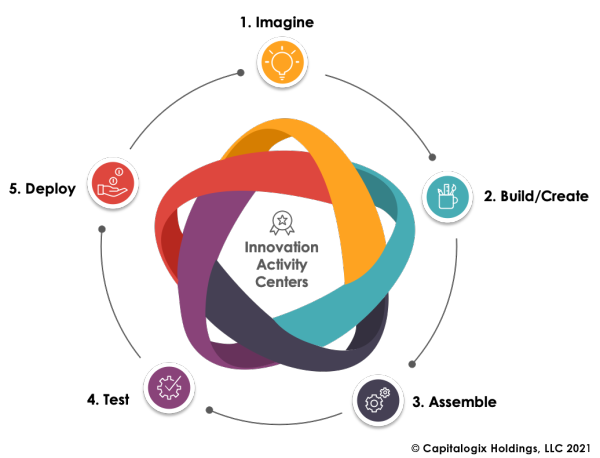
Within the technology adoption model, there’s an underlying concept that I don’t talk about as much. Innovation Activity Centers are the underpinning of each stage. This framework identifies the different unique abilities and temperaments required to get from start to finish at each stage.
It’s the framework within the framework that ensures you’re equipped to take decisive action and build momentum on your journey toward transformation.
Earlier, I mentioned you don’t have to ride every wave. You just have to skillfully ride the waves you choose. This concept is meant to help you do that.
While the stages and seasons of your business change, the activity centers and foci within your business don’t have to. That’s what allows you to stay steadfast in ever-changing currents.
Each of these activity centers requires a different type of person working on it, different KPIs, and different timelines.
I also shot a video going into more detail on these activity centers. There are many ideas worth considering in there. So, watch the video.
Understanding these models helps you anticipate the capabilities, constraints, and milestones that define the path forward — no matter how the world changes. They’re one proven path toward technology adoption, though certainly not the only one.
We’ve made significant progress refining these frameworks, and they continue to shape our plans for expanding the Amplified Intelligence Platform. I’m excited to keep improving them — and to share what we learn along the way.
Ultimately, frameworks only matter if you use them. Imperfect action beats perfect planning. My hope is that these ideas help you clear the path as you walk it.
If you have thoughts or questions about the model or how to apply i,— I’d love to hear from you.
As OpenAI shifts toward a platform-based model and prepares for a future IPO, it feels like we are at a transformative moment for both the company and the broader AI industry.
At their recent DevDay 2025 event, OpenAI unveiled a range of new tools and upgrades, including:
Apps in ChatGPT – Developers can now build and integrate apps directly in ChatGPT using a new SDK
AgentKit – a new toolkit to build production-grade AI agents
New and Cheaper Models, and
Codex updates – their AI coding/developer assistant model is now out of preview and integrated with enterprise controls.
These new tools signal more than incremental upgrades — they foreshadow OpenAI’s evolution into a technology platform with the capacity to shape industries well beyond artificial intelligence.
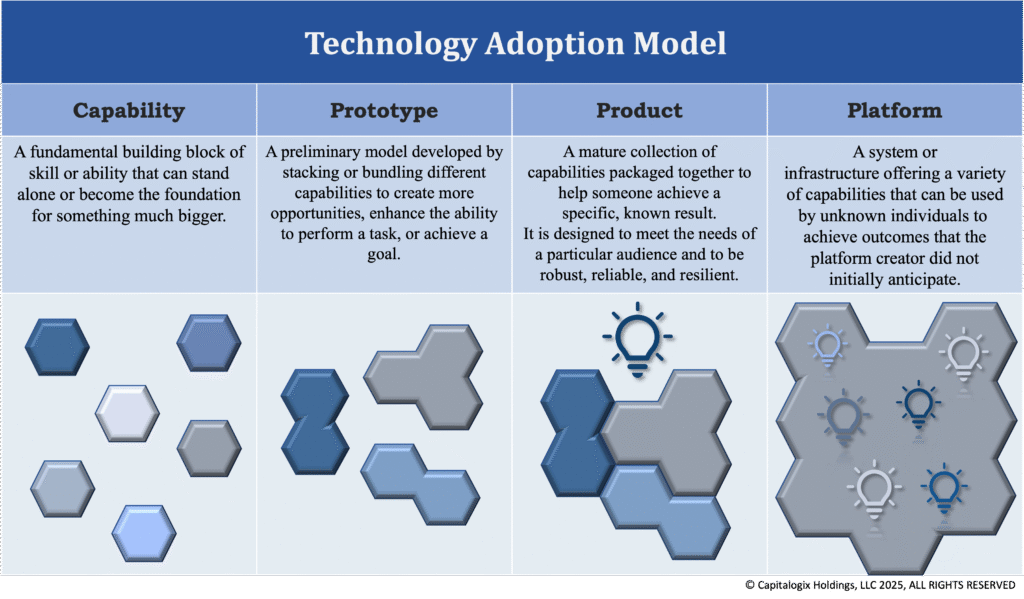
If you‘ve paid attention, this is a big concept within my Technology Adoption Model. The four base stages of this framework are: Capability, Prototype, Product, and Platform.
While the stages of the Technology Adoption Model Framework are important, the key point is that you don’t need to predict what’s coming; you just need to understand how human nature responds to the capabilities in front of them.
Desire fuels attention, talent, opportunities, and commerce. As money starts to flow, the path forward is relatively easy to imagine. As public interest and investment in advanced AI grow, opportunities for innovation and commercial breakthroughs become more accessible.
This model is fractal. It works on many levels of magnification or iteration.
What initially appears to be a Product is later revealed as a Prototype for something larger.
Likewise, as a Product transforms into a Platform, it becomes almost like an industry of its own. Consequently, it becomes the seed for a new set of Capabilities, Prototypes, and Products.
With OpenAI’s shift from product to platform, it’s unsurprising that both its infrastructure and corporate structure are evolving to meet new needs.
OpenAI’s Eventual IPO
On Tuesday, OpenAI announced the completion of a corporate restructuring that simplified its structure into a controlling non-profit entity and a reimagined for-profit subsidiary.
The umbrella non-profit organization will be rebranded as the OpenAI Foundation, and the for-profit entity will be called the OpenAI Group. The goal is likely to IPO before 2027.
The OpenAI Foundation organization will receive a 26% stake in the OpenAI Group, a share that would be worth $130 billion at the early-October valuation.
For now, the for-profit’s board will consist solely of the non-profit’s board members. However, the shift will enable investors and partners to more easily generate returns from their investments, paving the way for a potential public offering.
Sam Altman says they are committed to spending roughly $1.4 trillion on the chips and data centers needed to train and power their artificial intelligence systems.
The Former Non-Profit
When OpenAI launched in 2015, many were enamored with the non-profit status and its mission to ensure that artificial general intelligence (AGI) benefits all of humanity. That status was proof of a clear mission and a focus on helping humanity, rather than harming it in the pursuit of short-term profits.
This shift from the original mission has some worried about a new potential mission, weakened oversight, and increased risk, especially considering how much more powerful AGI is today compared to 10 years ago.
Like it or not, the hybrid model was the only “reasonable” path forward, since they decided to compete in this AGI race. If they fully abandoned their non-profit status, they would have had to buy their non-profit’s assets for “fair market value”, which likely would have meant a $500 billion price tag.
Meanwhile, companies like Google DeepMind, Microsoft, Amazon, Anthropic, and Mistral AI are already for-profit entities making massive strides (not to mention, Microsoft has invested billions into OpenAI, and will be receiving a 27% stake in the OpenAI Group).
Where OpenAI is Today
While it’s fun to think about the future – and what the restructuring will do for investment and innovation, it also helps to understand their current infrastructure.
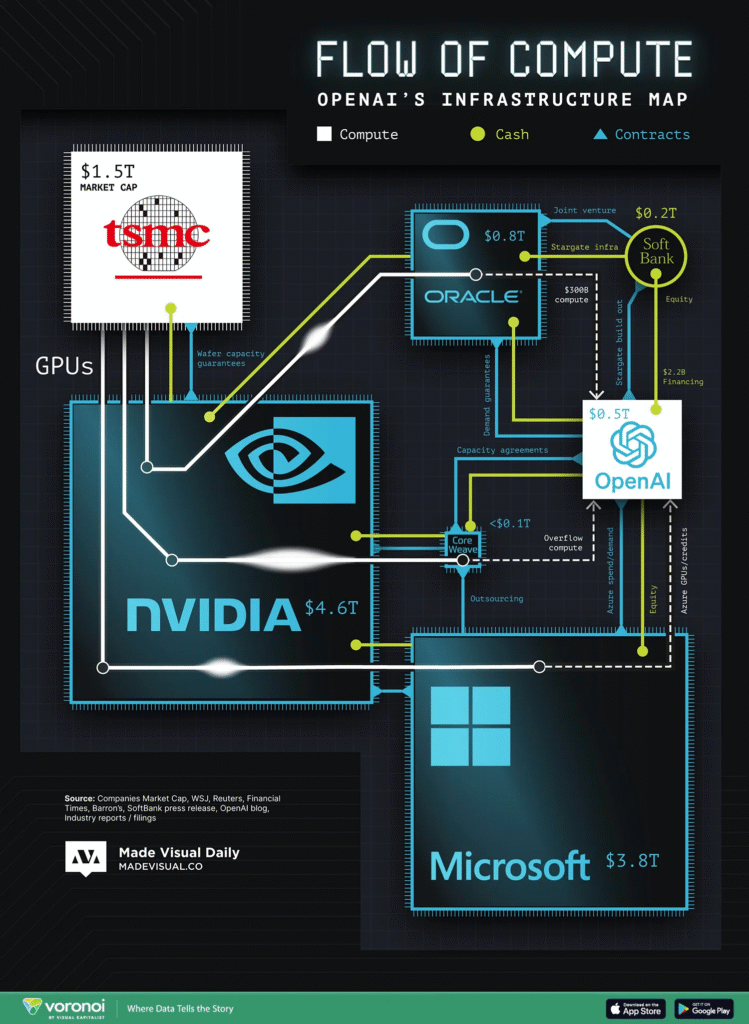
OpenAI has spawned a large, networked ecosystem comprising numerous major organizations, complex contracts, and substantial financial investments.
The chart above shows three separate flows: compute, cash, and contracts.
The biggest nodes in the diagram should look familiar. Microsoft not only provides compute through Azure, but also has invested capital and GPU credits back into OpenAI. Nvidia (now worth ~ $5 trillion) not only provides the mass majority of the GPUs to OpenAI, but accounts for around 16% of America’s current GDP,
Nvidia continues to dominate the semiconductor industry, with a market valuation nearly three times higher than its closest U.S. competitor, even as OpenAI begins to partner more deeply with AMD.
GPUs, Datacenters, and AGI, Oh My!
While OpenAI’s leadership and strategic partnerships are crucial, their future progress relies heavily on access to an increasing amount of advanced GPUs (Graphics Processing Units) — arguably the most strategic resource in today’s AI landscape.
But, GPUs are costly. Demand often outstrips supply, and their production depends on cutting-edge manufacturing. Consequently, the supply chain remains fragile due to limited materials, as well as geopolitical and logistical issues that could send shockwaves throughout the entire sector.
Demand has grown so intense that businesses are reserving capacity months or even years in advance. In rare cases, some even use GPUs as collateral to secure financing, reinforcing their role as a new strategic commodity.
Data centers — the facilities that house and power those GPUs — are also costly. They require substantial amounts of electricity, cooling, physical space, and high-speed networking to support AI workloads.
Together, these costs make scaling AI models (like those from OpenAI) very expensive. Even if OpenAI can build smarter models, it’s limited by the number of GPUs and data centers it can access or afford, creating a bottleneck in growth and deployment.
So, while some people are upset about this transition away from their non-profit status, I think it was inevitable and predictable.
We’re at a turning point in artificial intelligence as a whole.
OpenAI’s switch marks a clear swing in the pendulum. For users, businesses, and developers, it means faster innovation, better products, and a clearer path toward scaling powerful AI (we hope responsibly).
That said, there are still real challenges ahead. Finding equilibrium between commercial interests and mission-driven goals is challenging. Likewise, even well-intentioned oversight can strain under market pressures. Massive infrastructure investments can create higher barriers to entry for smaller players, potentially concentrating power among a few large companies. And while OpenAI’s scale and resources set it up for breakthroughs, they don’t guarantee them—execution, safety, and responsible deployment remain critical.
In short, OpenAI’s impending IPO and platform pivot mark a defining moment in AI history. While its scale and investment signal immense opportunities, they also invite crucial scrutiny. The road ahead will depend on how OpenAI manages the delicate balance between rapid innovation, financial pressures, and the broader public good. As this story unfolds, what happens next will shape the very fabric of our technological future.
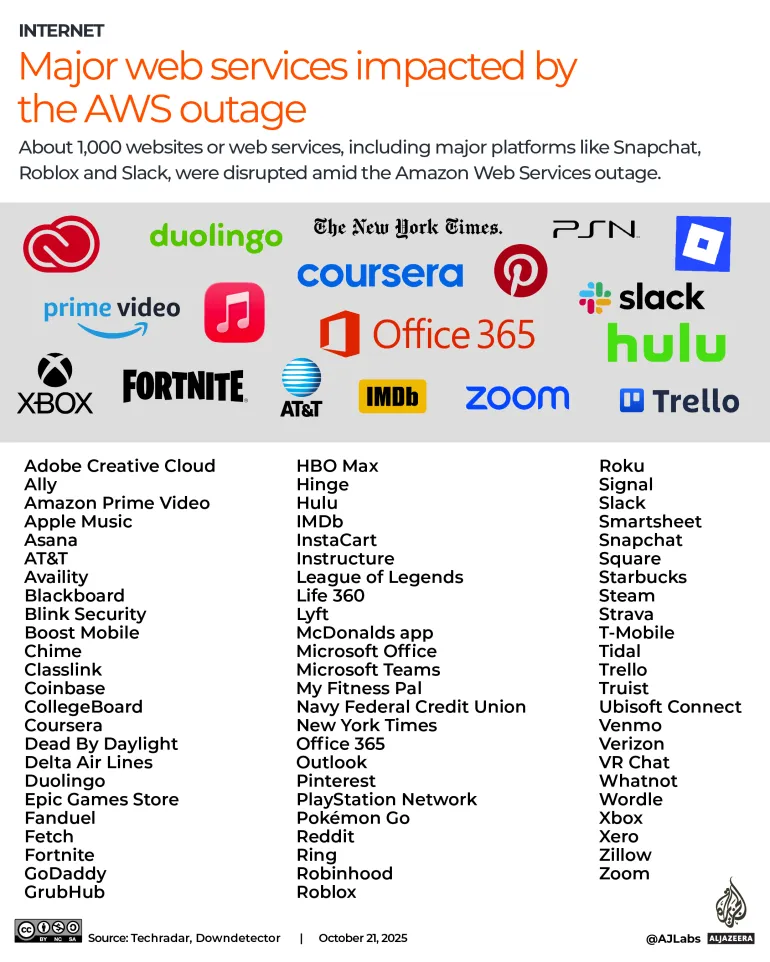
Cloud technology powers our daily lives — from workplace applications to smart beds. Just like AI, it‘s the underpinning for many technologies that are now largely unnoticed by the average consumer. Over the past two weeks, two major outages helped us realize how deeply connected — and vulnerable — our systems have become.
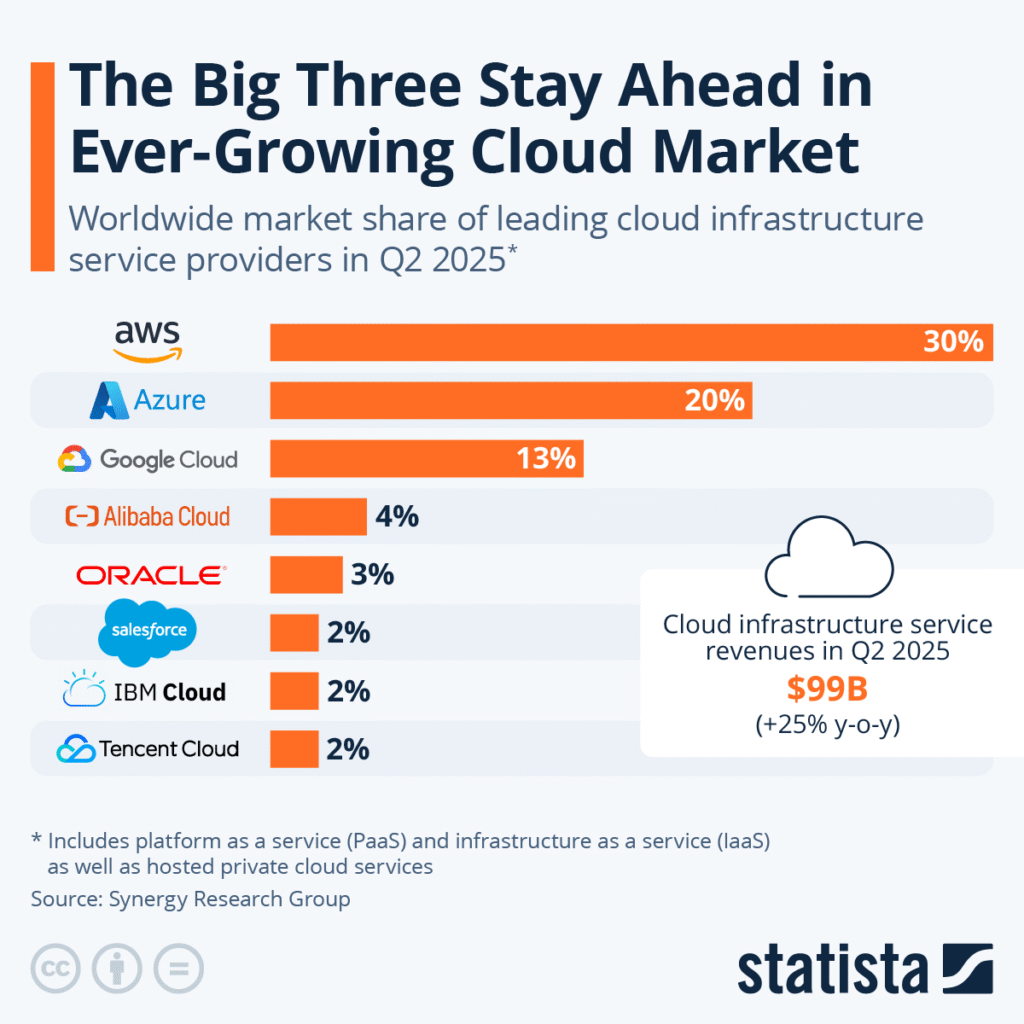
First, on October 20, Amazon‘s AWS US-EAST-1 region went down, and it felt like the world stopped, in part, because AWS powers over 30% of the cloud market.
Ironically, even 8Sleep users experienced outages. Why does a bed have a cloud dependency (and why does it send 16GB of data a month)? Because you can’t manage what you don’t measure. Part of that involves data, and another part involves updates and reporting. You can expect an increasing number of our household appliances to require cloud access.
Then, barely a week later, on October 29, Microsoft Azure experienced its own outage, affecting Microsoft 365, Kroger, Alaska Airlines, and even the Scottish Parliament.
A helpful reminder that when it rains, it pours, and even in the business of “uptime,” you should plan for downtime.
So, what happened?
Amazon AWS
The outage in the US-EAST-1 region (Northern Virginia) originated from a malfunction in an internal subsystem that monitors the health of network load balancers (within the Amazon DynamoDB API domain). This triggered Domain Name System (DNS) resolution failures, making key services unreachable or very slow.
AWS has 38 geographic regions (with plans to add 3 more). But US-EAST-1 was AWS’s first region, and is the largest, making it the default for documentation, new features, and cost-sensitive users. Additionally, some critical “global” AWS services have their control planes hosted in US-East-1, meaning an outage in this region can impact services in other regions too.
Microsoft Azure
Microsoft’s outage was triggered by an “inadvertent CDN configuration change” affecting the Azure Front Door (a global content-delivery / routing service), which resulted in widespread DNS and routing problems.
Both AWS and Azure experienced DNS issues, which anyone in tech should recognize as the most common point of failure in situations like this.
But, since Amazon and Microsoft account for over 50% of cloud infrastructure, errors become especially noticeable.
Is Centralization the Issue?
To many, this seems like a call to break up these powers and spread responsibility.
“If a company can break the entire internet, they are too big …”
Not only is this not how the internet works, but it’s not how business works. Breaking up these providers would make it harder and more expensive for small businesses to compete. Access makes things cheaper.
As we discuss these global “utility” providers, it is beneficial to have a few key vendors. You don’t want it to be one. Then you get into monopoly territory. But, scale lowers cost. Most people understand this.
The reality is that, when compared to previous issues, Amazon has significantly improved its resiliency. They’ve also made efforts to lower the global dependence on US-EAST-1.
Before I go forward, it’s worth reminding people that the cloud is ultimately just a computer that you don’t own. Granted, it’s a very large computer with incredible infrastructure. But it is still a glorified computer. It will never be invincible and 100% faultless.
What Should I Learn From This Situation?
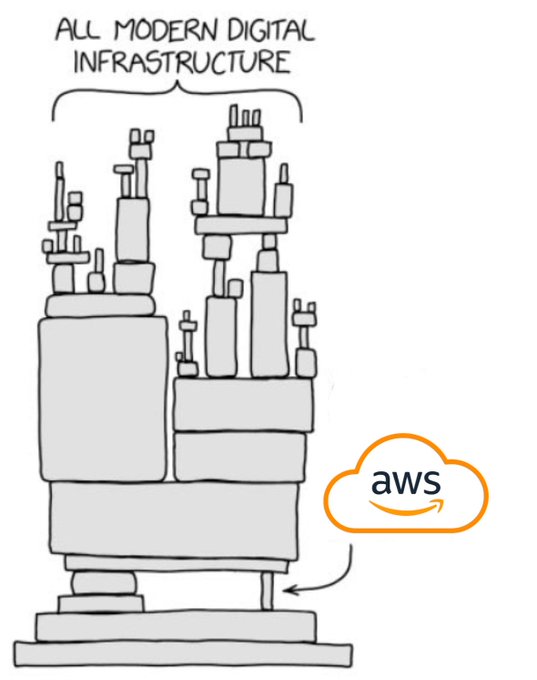
I am reminded of a great image from Randall Munroe and XKCD. It has been adapted to fit the current situation.
The reality is every system is fallible. Any sufficiently complex system will create bottlenecks and failure points.
The lesson isn’t decentralization, it’s redundancy.
One of the lessons a mentor taught me was thatplanning for failure is an important part of hoping for success.
It’s great to look toward the future and be proud of all that you’re doing things the right way. However, without a disaster recovery plan and redundancies for failures, you’ll eventually face consequences.
Without a plan, downtime can result in lost revenue, damaged trust, and data exposure. A good recovery strategy ensures that when your primary systems fail, you have a clear path to restore operations quickly and minimize disruption and business impact.
To be transparent, we were also affected by the AWS outage. AWS is one of our key providers. However, because we have systems on other platforms and strategies in place, we were able to navigate it without a significant impact on our business.
Building safeguards starts with redundancy — distributing workloads across regions, providers, and availability zones so no single failure can take you down. It can even be as simple as moving your main AWS region away from US-EAST-1.
Here are some other strategies to consider:
Combine automated backups with regular failover testing to ensure optimal system uptime.
Document your recovery playbook so your team isn’t scrambling in the dark.
Implement real-time monitoring, alerting, and security protocols that detect minor issues before they escalate into major problems.
Put expiration dates on decisions (especially automated ones) to make sure that it’s still the correct choice (long after you forget that you made the decision in the first place).
No system is immune to failure. That means that as exponential technologies power more of our world, mistakes and outages will happen (probably more often than they do now).
You can’t prevent every outage, but you can dramatically increase the odds that it’s a manageable inconvenience, rather than a potential catastrophe.
When Peter Thiel gives a talk, people listen — even when the topic sounds absurd. His recent four-part lecture series on “The Antichrist,” delivered quietly at San Francisco’s Commonwealth Club, wasn’t a theological confession. It was a strategy session hidden in plain sight.
Thiel, the billionaire co-founder of PayPal and Palantir, has always been more interested in shaping systems than following them. Despite the theological-sounding implications of “The Antichrist lectures, they were less about religion than about recruitment — turning controversy into capital, ideas into networks, and attention into influence. It was a masterclass in the the secret architecture of modern power.
This article is an opinion piece, but hopefully it provides some perspective and makes you think differently about his talks and the world we live in today.
The Power of the Spectacle
Thiel understands that spectacle builds infrastructure. What looks like provocation is often a mechanism for attracting talent, capital, and alignment.
When he labels critics like Greta Thunberg or AI safety advocates as part of a modern “Antichrist,” he isn’t preaching apocalypse. He’s reframing the narrative — turning complex policy debates into moral showdowns between “progress” and “stagnation”, “good” and “evil”, and “us” and “them”.
That framing does three things:
Rallies allies who see themselves as defenders of innovation.
Shuts down compromise by making opposition feel immoral.
Creates pipelines of sympathetic people into his orbit — whether as investors, engineers, or policymakers.
Thiel has used this playbook for decades. His contrarian campus newspaper at Stanford laid the groundwork for the early network that later became the PayPal Mafia. Each “provocation” seeds something lasting: an organization, a company, or a political foothold.
From Theater to Infrastructure
The cycle is predictable but powerful (and he isn’t the only one using this playbook)!
Make a bold statement that challenges an elite consensus.
Generate media attention — some mocking, some intrigued.
Convert that attention into loyalty, funding, or influence.
The “Antichrist” lectures follow that path. They signal to libertarian thinkers, anti-establishment technologists, and ambitious policy entrepreneurs that there’s an alternative network willing to reward dissent and action.
Over time, those recruits show up inside Thiel-backed ventures, think tanks, and government roles. The result is a quiet ecosystem of influence — people who share Thiel’s outlook but operate independently enough to give him plausible deniability.
Power by Proxy
Thiel rarely holds a formal title in politics, but his fingerprints are everywhere. His protégés hold key positions in the current administration, including Vice President JD Vance and tech policy advisor David Sacks.
The model is simple: invest early, cultivate loyalty, and let others hold the office. It’s a light form of proxy governance — influence routed through protégés, funds, and companies like Palantir.
That distance matters. Thiel can shape outcomes without being directly accountable for them. If things go wrong, the damage is absorbed by the proxy; if they go right, the structure persists and Theil’s systems endure and expand.
It’s the same logic that drives venture capital: spread bets, build leverage, exit before exposure.
Portfolio Politics
Thiel treats politics like a hedge fund manager treats a portfolio — invest when upside potential is high, step back when volatility rises, and re-enter when conditions are favorable.
He was one of the few Silicon Valley figures to back Donald Trump early in 2016. When that bet paid off, he quietly helped fill key tech roles in the administration. As scandals mounted, he withdrew from public view — protecting his brand while his network continued to grow.
That approach now defines a broader class of politically active billionaires. Rather than permanent loyalty, they practice situational alignment — entering and exiting political cycles the way investors trade around risk.
The result is a marketplace of influence that operates on financial logic, rather than ideological consistency.
Palantir: Power as Product
Nowhere is Thiel’s strategy clearer than in Palantir, his data analytics company that supplies intelligence systems to governments around the world.
Palantir’s tools merge disparate data sources into powerful surveillance and decision-making platforms. The irony is striking: Thiel often warns about government overreach, yet his company provides the very tools that enable it.
Palantir’s expansion shows how spectacle transforms into structure. While Thiel distracts critics with rhetorical fireworks, his firm embeds itself deeper into the machinery of government — turning influence into infrastructure.
By the time watchdogs notice, it’s not just a contract; it’s a dependency.
The Visibility Game
Thiel is a master of managing visibility — knowing when to provoke and when to disappear.
High-visibility moments (like the “Antichrist” lectures or his RNC speech) draw attention, attract recruits, and keep his ideas circulating. But he balances that with strategic opacity: dark-money nonprofits, off-the-record talks, and layers of intermediaries that make it difficult to trace influence directly back to him.
Visibility, for Thiel, is not about fame — it’s a control variable. When exposure threatens, he retreats into the shadows. When opportunity rises, he re-emerges to shape the conversation again.
Why It Works
The playbook works because it exploits how attention and trust now operate. In an era of fragmented media, a polarizing figure doesn’t need majority approval — only a committed minority who see opposition as proof of authenticity.
Mockery from one camp signals credibility to another. Every backlash becomes free marketing.
Thiel’s critics see demagoguery; his supporters see courage. Both drive the same outcome: a stronger network growing around him.
Hate it or love it, you’re playing into his hand.
The Broader Silicon Valley Pattern
Thiel isn’t alone in this model. Elon Musk, Marc Andreessen, and President Trump each use variations of the same pattern: build wealth, use contrarian rhetoric to shape public narratives, align with political movements that favor deregulation, and embed their companies into national infrastructure.
This isn’t traditional lobbying. It’s structural capture — designing systems so your interests and the public’s become indistinguishable. When a government depends on your software, influence no longer requires persuasion; it’s built in.
Implications for Business and Governance
For business leaders, there are three big takeaways from Thiel’s evolving strategy.
1. Spectacle Can Be Strategy
In the information age, attention is leverage. But attention only matters if it feeds a system — a company, a fund, a policy agenda. Thiel’s provocations aren’t distractions; they’re signals to attract like-minded talent and capital.
If your organization isn’t thinking about how to turn visibility into structure, you’re leaving value — and resilience — on the table.
2. Influence Flows Through Networks, Not Titles
Formal authority is less important than the networks that surround it. Whether in politics or business, power increasingly operates through proxies — advisors, think tanks, and companies that outlast any single election or CEO.
Understanding those relationships is now part of strategic due diligence. Who funds whom? Who sits on which board? Whose ideas are quietly shaping policy? Mapping those links can reveal more than any headline.
3. Transparency Is the Next Competitive Advantage
In a landscape built on strategic opacity, honesty becomes a differentiator. Companies that disclose their political relationships and governance structures early will earn trust faster than those forced into transparency later.
Building internal awareness — of funding sources, advisory roles, and ideological alignments — isn’t just ethics. It’s risk management.
What Comes Next
We’re watching a new architecture of power take shape. It’s decentralized, data-driven, and designed for anti-fragility. The traditional boundaries between business, politics, and media are dissolving.
Ten years from now, billionaire-funded policy ecosystems will be standard infrastructure. “Proxy governance” will be the norm. And moralized, apocalyptic rhetoric will be a mainstream political tool. Not that it‘s not already present.
That doesn’t mean the system is unstoppable. But it does mean leaders must adapt. Power today isn’t just about what you directly control; it’s about the systems you can influence, and the attention you can direct.
The Bottom Line
Peter Thiel’s “Antichrist” lectures weren’t really about religion. They were a masterclass in how modern influence works — how ideas, money, and media can align to shape the institutions that shape us.
It’s easy to dismiss such performances as fringe. It’s harder to recognize them as part of the operating system of 21st-century power.
For anyone running a business or managing capital, the lesson is simple:
Pay attention to the networks behind the noise.
Follow how spectacle feeds structure.
And when possible, build moats where they are least expected.
History is written by the winners … and the real contest isn’t over who gets the microphone, it’s about who designs the stage.
Behind the success of many thriving companies is a boardroom where decisions shape their future. But what really makes a corporate board effective — and who earns a seat at the table?
Company boards come in many shapes and sizes … boards can be powerful, they can be councilors, and they can be a sign of stability to potential investors (by having the right people on the board).
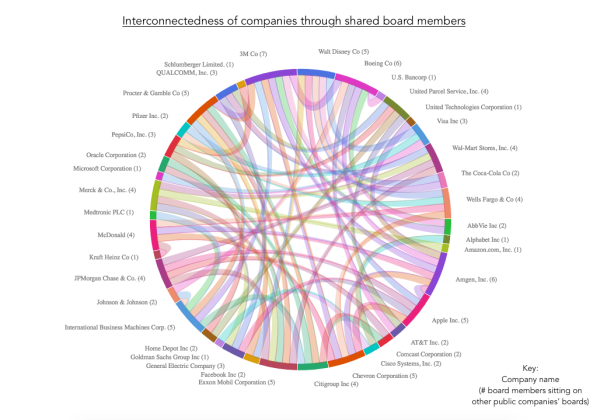
Interestingly, about 80% of the 50 largest public companies are linked by at least one shared board member, illustrating the influence and network effect of seasoned executives in corporate governance. To see the full list of board members for a company (or to see which board members are on the most boards) I suggest corporationwiki. However, even with significant overlap, 1,000 of the 1,100 board positions were held by unique individuals —indicating that direct duplication is relatively rare..
Notably, as you look beyond the top 50 companies, the web of interconnected board members expands significantly.
This raises a crucial question: How frequently does overlap among board members create conflicts of interest between competing companies?
Ultimately, it seems likely that they share board members due to the expertise of those members. There’s a small pool of people with the know-how and acumen to advise a company that big. While companies strive to recruit top-tier board talent to enhance efficiencies, real-world outcomes can be mixed — underscoring the importance of thorough vetting and diversified expertise.
During my own experience serving on various boards, I often collaborated with individuals who also sat on multiple boards—sometimes even within competing firms. Building a board that is both diverse in perspective and rich in expertise significantly elevates your organization’s strategic insight and adaptability.
From a small business standpoint, I think it’s important to surround yourself with a variety of viewpoints. Leaders often risk tunnel vision; actively seeking varied viewpoints helps break through these barriers and fosters innovative thinking.
While each leader is likely strong at their unique abilities, a hallmark of success is to create a unique abilities team that goes far beyond your strength.
Internally, I’ve surrounded myself with detail-oriented and technical support to let me focus on the big picture. From an advisory standpoint, I’ve done my best to surround myself with people whose business successes I can learn from.
As AI evolves, its influence will increasingly extend beyond daily operations to the boardroom, reshaping the way high-level decisions are made and governance is exercised
Ultimately, building the right board is not just about governance — it’s a strategic lever for long-term success. Whether launching a startup or steering a Fortune 500, prioritize assembling a team (both internal and external) that balances vision, expertise, and forward-thinking decision-making to drive sustainable success in an ever-evolving marketplace.
Does the size of a country’s workforce determine its wealthiest citizens?
Beyond Headcount—The Real Drivers of Wealth
In a world shaped by rapid technological change and evolving labor dynamics, this post explores which nations lead in workforce size, where millionaires reside, and why capital concentration often defies population trends.
Recent research by Visual Capitalist sheds light on both the world’s largest workforces and the distribution of wealth among its richest citizens.
Unsurprisingly, Asia dominates the global workforce, with China and India accounting for over 1.3 billion workers.
Although the U.S. trails far behind China and India in absolute workforce size, it maintains a strong position as the world’s third-largest labor force with 174 million workers.
Africa’s workforce is rapidly expanding – with potential to double by 2050.
Following the Wealth Flows
As we know, workforce isn’t the only factor that influences where wealth flows. For example:
Global trade & resource distribution,
Financial & governmental policies,
Urbanization & tech Infrastructure,
And, access to opportunities
Where Wealth Accumulates
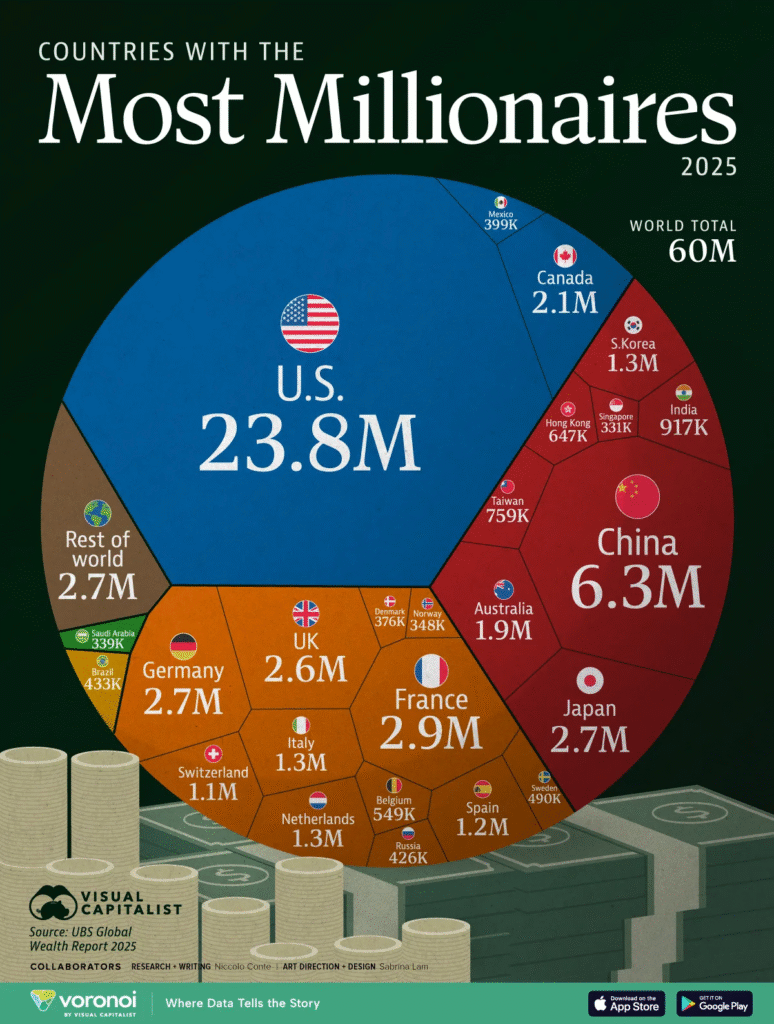
In 2025, we’ve surpassed 60 million millionaires worldwide.
Together, this group holds over $226 trillion in wealth.
America, China, and France top the list – holding over half the global total. If you were to imagine the list as 10 people, four would live in America, one would live in China, and the rest would be scattered across the globe.
France, Germany, and the UK, are relatively small populations boasting outsized ratios of millionaires.
Notably, almost 1/10 American adults are millionaires (Luxembourg and Switzerland top this ratio with 1/7). That surprises me.
Also, while major cities like New York, Los Angeles, and San Francisco remain millionaire hubs, Scottsdale, Arizona, actually boasts the fastest millionaire growth over the last decade.
Ultimately, I think it’s clear that a large labor force doesn’t necessarily translate into a large population of millionaires. Countries like India and Indonesia rank among the biggest contributors to the global workforce, yet their per capita wealth remains modest. Meanwhile, nations such as the United States, Japan, and Germany — home to far smaller workforces — consistently dominate global millionaire rankings.
Why Efficiency Beats Size
Countries like the United States demonstrate how access to markets and capital, combined with robust innovation ecosystems, drive wealth far beyond population scale.
The difference lies less in the number of workers and more in the structure of opportunity: productivity, access to capital, innovation, and financial markets create wealth far faster than population alone. In short, a big workforce builds economies — but efficient systems and upward mobility build millionaires.
Economic opportunity grows when connections (between people, ideas, and markets) multiply — think of a telephone network: one phone is useless, but as more connect, the system’s value rises exponentially.
Disruptive innovation often happens in small, focused markets before scaling. Early adoption, not just raw numbers, signals where outsized returns will come.
As AI continues to shift productivity from in-person humans to digital agents, the very nature of value, employment, and opportunity will likely undergo a profound transformation. It will also change what we believe is possible.
For example, I expect to see a one-person Unicorn as artificial agent technologies become more capable, scalable, and adaptive.
Conclusion: Building Pathways to Prosperity
In summary, a large labor force may grow economies, but upward mobility and innovation are the true engines of millionaire creation. For leaders aiming to foster national prosperity, the goal should be cultivating efficient, inclusive systems — not merely expanding the workforce.







 via
via