For most of human history, a trillion dollars wasn’t just an unimaginable amount of money — it wasn’t even a meaningful concept. Entire kingdoms, empires, and national economies operated on scales far smaller than what we now describe with a single twelve-digit number.
This week, Elon Musk has become the world’s first trillionaire of the modern era, crossing a financial milestone that once seemed impossible even for the wealthiest individuals on Earth. Most people struggle to distinguish between a million and a billion; a trillion exists on an entirely different scale. Yet Musk’s fortune—built through his stakes in technology, transportation, energy, artificial intelligence, and space exploration—has now surpassed that once-unthinkable threshold.
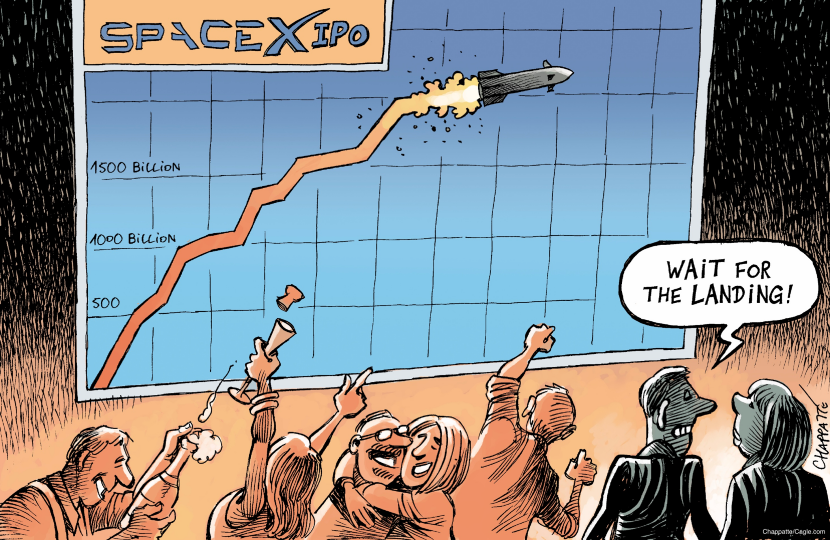
SpaceX officially went public on the Nasdaq, with shares opening at $150 and valuing the company at over $2 trillion. Musk owns roughly 42% of SpaceX’s equity. When combined with his existing stake in Tesla (worth around $280 billion), his total paper wealth hit ~$1.1 trillion … greater than the national GDP of countries like Sweden, Ireland, and Taiwan, and exceeding the combined wealth of the world’s next five richest billionaires.
Of course, Musk is not necessarily the richest person who has ever lived. Historians often point to Mansa Musa, the 14th-century ruler of the Mali Empire, whose vast gold holdings may have made him wealthier than any modern billionaire. Others cite industrial magnates like John D. Rockefeller, whose fortune represented an extraordinary share of the American economy. But comparing wealth across centuries is more art than science. Different currencies, economic systems, and standards of living make direct comparisons nearly impossible. What makes Musk’s achievement unique is that it occurred in the transparent, measured framework of the modern global economy. His trillion-dollar net worth is not a historical estimate or academic reconstruction—it is a fortune calculated, tracked, and recognized in contemporary dollars. And that raises an obvious question: just how much money is a trillion dollars?
Humans struggle to grasp large number magnitudes because our brains evolved to handle small, practical numbers essential for daily survival, such as counting food items or group members, rather than abstract, massive quantities. The human brain processes small numbers with an innate “number sense,” which becomes much less precise as numbers get larger, relying on a mental number line that tends to compress and approximate rather than distinctly represent high values.
Here are a couple of ways to help you understand a trillion dollars. First, let’s look at it in terms of physical money and the space it takes to store it.
We’ll start with a $100 bill, currently the largest U.S. denomination in general circulation, and pretty handy to have and hold.
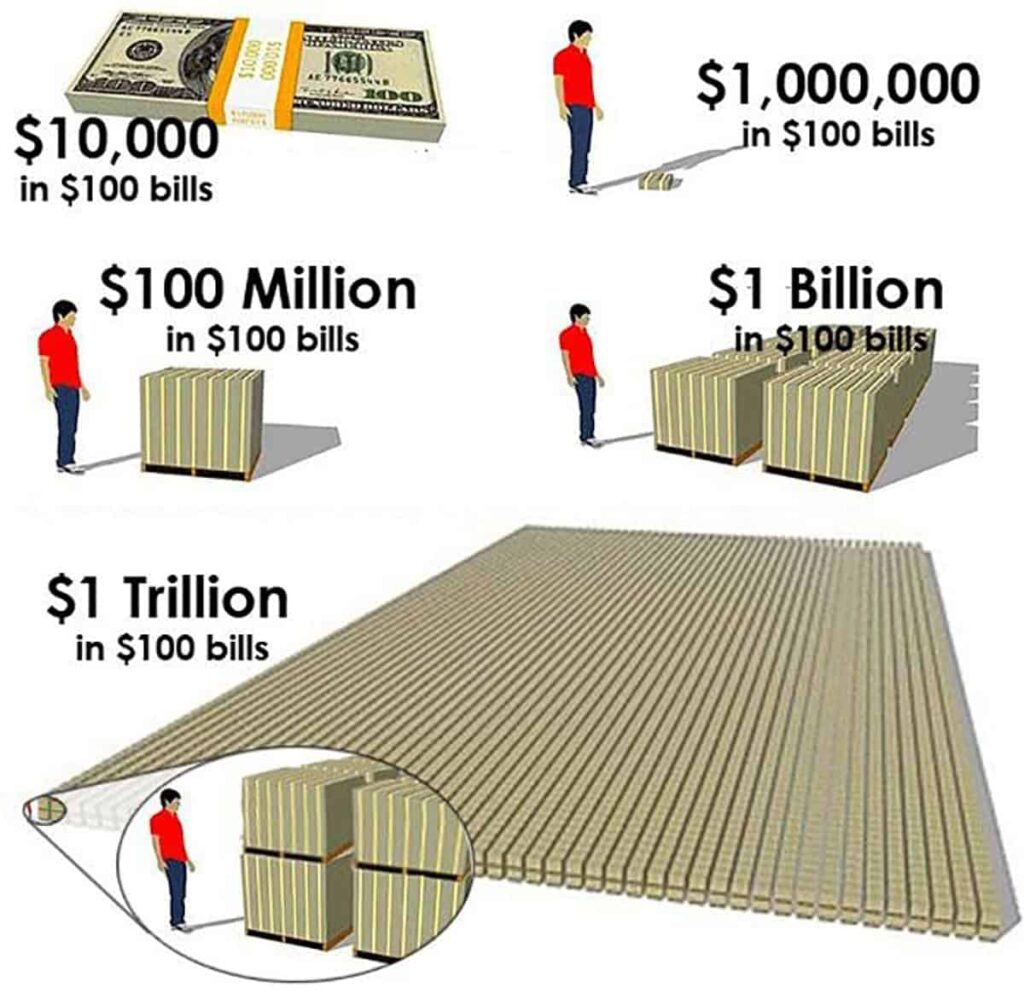
The image below follows the progression. A packet of one hundred $100 bills (totaling $10,000) is less than half an inch thick — and small enough to fit in your pocket. The next pile shown is worth $1 million (100 packets of $10,000 each). You could stuff that into a duffel bag and walk around with it. By the time you get to $100 million, it starts to look more impressive … but it still fits neatly on a standard pallet. Skipping forward to $1 trillion, well, it’s a million million. It’s a thousand billion. It’s a one followed by 12 zeros. In the final image below, notice that those pallets are double-stacked and would fill a stadium.
Next, let’s look at spending over time. Here’s a simple example. If you were to spend a dollar every second for an entire day, you would pay $86,400 each day. With a million dollars, you could spend $1 every second for about twelve days. With a billion dollars, you can do that for over 31 years. With a trillion dollars, you can do that for 31,000+ years.
I’m sure many of you make over six figures a year. But, it would still take you 10 million+ years – if you spent none of it – to make $1 trillion.
Let’s try explaining it, using time, in a different way. One hundred thousand seconds is just over a day. A million seconds was 11 days ago. A billion seconds ago from today? That was in 1994. One trillion seconds is … slightly over 31,688 years. That would have been around 29,689 B.C., which is roughly 24,000 years before the earliest civilizations began to take shape.
In our previous article, we explored the almost incomprehensible scale of a trillion dollars through the lens of Elon Musk becoming the world’s first modern trillionaire. While stories like Musk’s capture our imagination, they’re also extraordinary outliers. The same can be said for superstar athletes, blockbuster actors, chart-topping musicians, and other celebrities whose earnings can dwarf even the highest-paid professionals. These careers can lead to staggering wealth—but they also depend on a rare combination of talent, timing, opportunity, and luck.
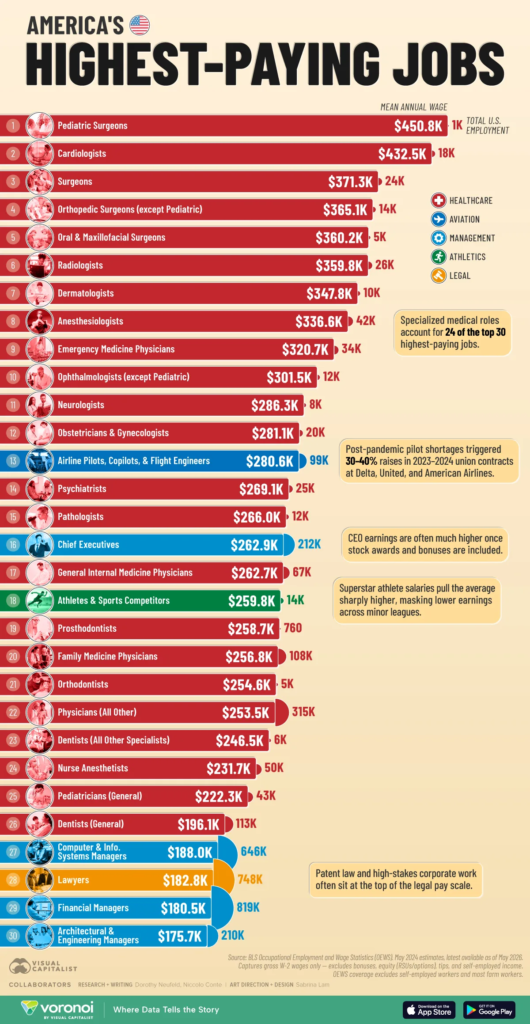
For most people, financial success is built through a more predictable path: developing valuable skills, building expertise, and pursuing careers that consistently command high compensation. The jobs on this list may not make you a trillionaire, but they represent some of the most reliable ways to earn an exceptional income in America.
So, while the odds of becoming the next Elon Musk, LeBron James, or Taylor Swift are vanishingly small, the careers that follow offer something far more attainable: a proven roadmap to financial success.
For most, $300,000 is more than enough to live a happy, fulfilled life. The clearest path is still a highly specialized medical career.
Unfortunately, if you made $450K a year, never spent a dime, or paid any taxes … it would still take you 2 million years to become a trillionaire.
Still, not everyone is meant to be an entrepreneur or business owner. And, as you can see, the average entrepreneur or athlete makes less than the average specialized medical professional.
I have an old toy robot in my office that my kids played with when they were little. Its name is E.M.I.G.L.I.O.
Even though it is a toy, this Italian-made robot was interesting technology when it came out. It was remote-controlled; the remote had a microphone that turned my voice into a robot’s, and it had a tray sturdy enough to deliver a video game (or some other surprise) for my kids when they visited the office.
Looking back, it’s barely even technology, let alone a robot. But that’s because I’m evaluating it based on what’s possible now.
I feel the same when I think about my previous company, IntellAgent Control, and what we considered AI in the 1990s. We made a sales automation solution for teams before tools like Salesforce existed. At the time, the decision logic we used was innovative. The premise is still valid today, but the technology and implementation scream “relic of a time gone by.”
As another aside … when I searched for Emiglio (in order to write this article), I was astonished by the archive of old robots someone had put together. The site is like a specialized Wikipedia site for toy robots. Each entry includes high-quality photos of the robots and their packaging. It also includes facts, marketing copy, ads, and patents.
It got me thinking about how much of history (and esoteric knowledge) only exists because a tiny community of people decided it needed to be cataloged or preserved.
“Garbage In, Garbage Out. Nothing In, Nothing Out.” What are we missing from the past because history is often written by the winner (or because no one volunteered to chronicle what happened)?
Even a site like Wikipedia has some serious content curation issues. For example, the top 50 Wikipedia editors have each contributed more than 500,000 edits. Think how much is missing.
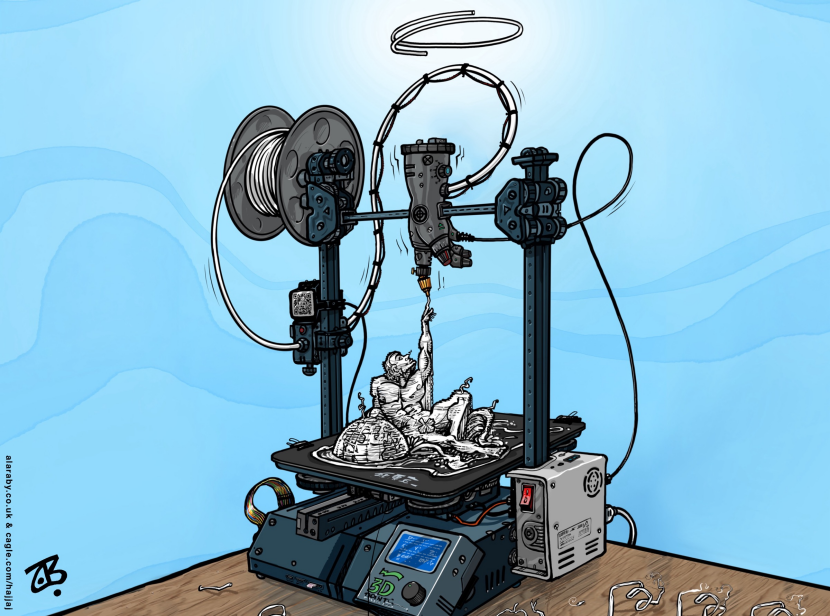
We often worry that AI will change the future. I’m starting to think its bigger impact may be on the past. Every archive, database, and knowledge repository becomes part of the training data for how future generations understand the world. The stories that get preserved gain influence. The stories that don’t slowly fade from memory.
History has always been written by the people who showed up to record it. The only thing changing is the scale.
The future won’t just be shaped by the data we create; it will be shaped by the data we preserve. Made more personal … If you don’t intentionally preserve your data and stories, your company may literally not exist in the models that future decision-makers rely on.
The real AI question isn’t what it’s becoming. It’s what you’ve already handed it — and whether it earned the keys.
Years ago, a programmer brought me his work, and I told him it was wrong. He pushed back and reminded me that he was the one with the computer science and math degrees (and I’d only been running an AI company for thirty years). He confidently declared that he’d done the math right.
He had … but the answer was still wrong. Yes, he’d done the calculation perfectly; that was the easy part. The hidden wisdom lay in a distinction he didn’t consider … whether he used the right equation and data.
I think about that moment often now, because today’s AI has the exact quality that made his mistake so hard to catch: it’s fluent, polished, and supremely confident. And confidence is precisely what makes us stop checking.
The Quiet Handoff
Most leaders are busy debating what AI is — conscious, AGI, a partner, a threat, or even a deity. It’s an interesting debate. It’s also largely beside the point. The question that will actually shape your business is quieter: what authority have you already handed it?
Authority doesn’t transfer in one dramatic decision. It migrates. A system starts by drafting, then recommending, then deciding — and somewhere in there it stops being a tool you use and becomes the place the decision actually gets made. In our world, that isn’t one algorithm you can watch; it’s thousands, far more than any human can track in real time. You don’t notice the handoff. You notice the result.
Would You Promote It This Fast?
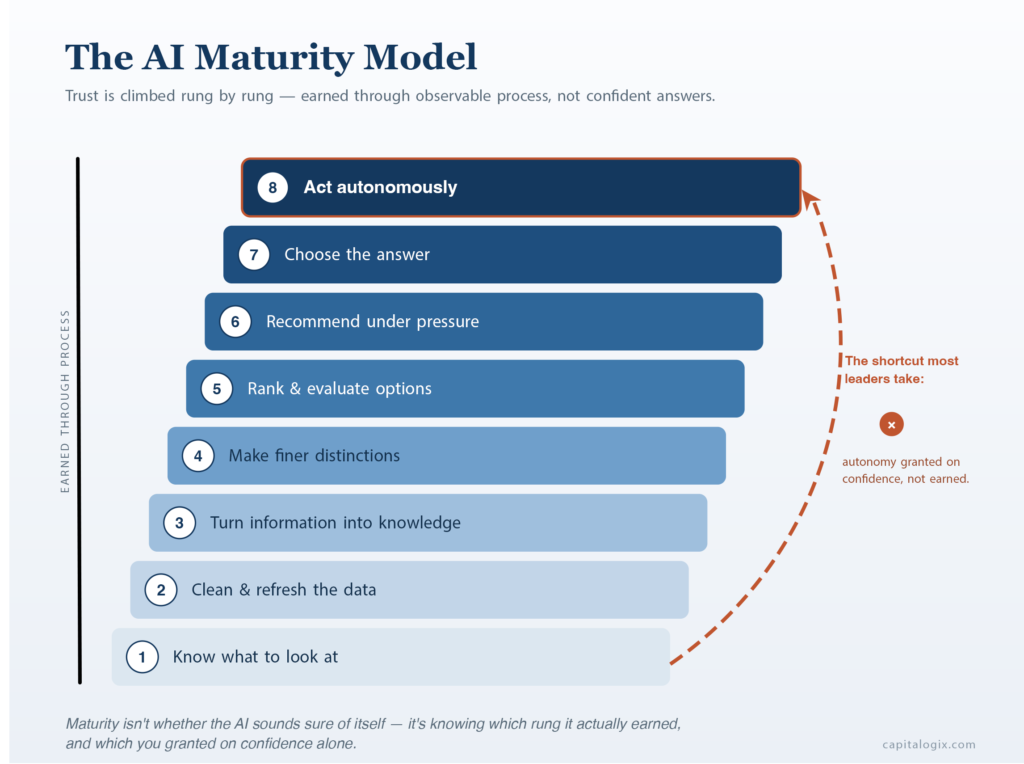
So I use what I call an AI Maturity Model, and it’s the same standard I’d apply to a person before trusting them with real responsibility. I want to see the process, not the answers. Does it look at and consider the right things? Can it tell good data from stale, dirty, or incomplete data (because bad data compounds into worse results)? Can it turn information into knowledge — first by bringing order to chaos, and then by making the finer distinctions that separate wisdom from raw horsepower? Can it rank and evaluate options, and does the ranking still hold when I change the goal? Can it make a real recommendation under pressure, and not just hand me what’s at the top of a list?
Here’s a simple graphic of the maturity model’s ascent.
Only after a system shows me all of that — and shows me it’s still getting better — does it earn the right to act on its own.
Maturity isn’t whether the AI sounds sure of itself. It’s whether you granted autonomy at a rung it actually climbed, or one you handed over on confidence alone. Most over-delegation is exactly that: trusting the answer because it was stated well.
At scale, you can’t supervise your way to safety — there’s simply too much happening. So you do two things. You build sensors and feedback loops that flag when something drifts off track. And — this is the part most people skip — you plant failures on purpose. You feed the system things you know are wrong and confirm it catches them. Because if it misses the faults you buried, you can’t assume the rest is fine. Assume the opposite … a lot more is slipping through.
And when something is wrong, I audit the same three places I always have.
Long before AI, I knew that bad results traced back to people, processes, or data (or worse, a combination of those things). That hasn’t changed — except now “people” might be an agent, a swarm of them, or an orchestrated pipeline.
Even though the doer might have gone digital, owning the answer didn’t.
AI 101: When Not To Grab the Wheel
Here’s the part that took me longest to learn — and I’ll admit I learned it the hard way, in a business where a bad impulse costs real money. Once you’ve handed a system authority, the instinct is to reserve the right to grab the wheel the moment you get nervous. That instinct is usually wrong. The moment you most want to intervene is often the exact moment your intervention likely does the most damage (because what you’re bringing to it is fear, greed, and discretionary risk — the very things you built the system to remove).
The mature move isn’t to override on impulse. It’s to give yourself and your people enough visibility to stay oriented — to understand what’s happening and trust the direction (so you don’t panic and yank control at the worst possible time).
Human-in-the-loop is valuable, but it has to be organized, accounted for, and built into the framework (not simply the result of an emotional reaction).
Years ago, I built something I call “filtered relevance” around a simple fact: people can really only remember about seven things at once (think about a phone number, if you know the area code). The point was to show someone exactly where they were in a process and the few choices that actually mattered, so they stayed in genuine command instead of drowning. It’s the difference between falling off a cliff while trapped in a cardboard box and piloting a helicopter. Nobody governs well from inside a box with no visibility, agency, or control.
So the real maturity test of this era isn’t whether your machines are ready for more authority. It’s whether you are.
Do that well, and AI doesn’t drain you — it frees you up and gives you energy and momentum.
If using AI or automation leaves you exhausted, you’re probably guarding the wrong things.
Done right, delegation isn’t about replacing your judgment. It’s about clearing away everything that isn’t your judgment … giving you the space and resources to focus on what you want to happen.
So before you ask what AI is going to become, ask the questions that actually decide it: What have you already handed over? Did it earn that authority (or did you grant it on confidence)? And when it’s wrong, will you know where to look to set things right?
The problem with history is that it rarely tells the whole story.
For most of history, the winners have written the history books. As a result, history has changed based on who’s writing the books, and in what country.
With AI getting more powerful, I fear that history will become even more subjective as it becomes easier to manipulate.
Ideally, history would be presented objectively, recounting facts without the influence of societal bias, the victor’s perspective, or the storyteller’s slant. But achieving this is harder than it seems, even before technology.
Think about your daily life – it is filled with many seemingly innocuous judgments about your perception of the economy, what’s happening in the markets, who is a hero, who deserves punishment, and whether an action is “Just” or “Wrong”.
I’m often surprised by how frequently intelligent people violently disagree on issues that seem clear-cut to them.
Even though most people would agree that genuinely understanding history requires a clear, unbiased picture … I think it’s apparent that history (as we know it) is subjective. The narrative shifts to support the needs of the society reporting it.
The Cold War is a great example in which the interpretation of its causes and events has changed: during the war, immediately after the war, and today.
But while that’s one example, to a certain degree, we can see it everywhere. We can even see it in the way events are reported today. News stations color the story based on whether they’re red or blue, and the internet is quick to jump on a bandwagon even if the information is hearsay.
Now, what happens when you can literally rewrite history?
“Every record has been destroyed or falsified, every book rewritten, every picture has been repainted, every statue and street building has been renamed, every date has been altered. And the process is continuing day by day and minute by minute. History has stopped.“ – Orwell, 1984
That’s one of the very real risks of deepfake technology. As it gets better, creating “supporting evidence” becomes easier for whatever narrative a government or other entity is trying to make real.
There are so many news stories about people falling for AI videos and deepfakes that it’s hard to even pick one.
Is The Moon Landing Even Real?!
On July 20, 1969, Neil Armstrong and Buzz Aldrin landed safely on the moon. They then returned to Earth safely as well.
MIT recently created a deepfake of a speech that Nixon’s speechwriter, William Safire, wrote during the Apollo 11 mission in case of disaster. The whole video is worth watching, but the speech starts around 4:20.
Can you imagine the real-world ripples that would have occurred if the astronauts died on that journey (or if people genuinely believed they did)? Here is a quote from the press response the Nixon-era government prepared in case of that disaster.
“Fate has ordained that the men who went to the moon to explore in peace will stay on the moon to rest in peace.” – Nixon’s Apollo 11 Disaster Speech
Today, alternative histories are becoming some people’s realities. Why? Media disinformation is the cause and is more dangerous than ever.
Alternative history can only be called that when it’s distinguishable from the truth, and unfortunately, we’re prone to seeking information that already fits our biases.
We also have to increasingly consider the impacts of technology on art, music, science, and even history.
Actions have consequences, and powerful verification and detection capabilities are evolving (e.g.,open-source verification communities, forensic tools, and AI designed to detect forgeries).
As deepfakes and other manipulations get better, we’ll also get better at detecting them, but it’s a cat-and-mouse game with no end in sight.
The Power of Doubt
In 1983, Stanislav Petrov saved the world. Petrov was the duty officer at the command center for a Russian nuclear early-warning system when the system reported that a missile had been launched from the U.S., followed by up to five more. Petrov judged the reports to be a false alarm and didn’t authorize retaliation (and a potential nuclear WWIII where countless would have died).
But messaging is now getting more convincing. It’s harder to tell real from fake. What happens when a world leader has a convincing enough deepfake with a convincing enough threat to another country? Will people have the wherewithal to double-check? What about when they’re buffeted by these messages constantly and from every direction?
As we increasingly use AI for writing and editing, there is a growing risk of subtle changes being made to messages and communications without you noticing. This widespread opportunity to manipulate information amplifies these technologies’ capacity to influence people’s perceptions. As a result, we must be increasingly cautious about how the data we rely on may be altered, which could ultimately affect our perceptions and decisions.
Every day, I get even more excited about the new potentials and results of AI. I feel like a broken record because every month, there’s some new breakthrough that brings out the tech nerd in me.
But, as always, in search of the good (or better), we have to acknowledge and be prepared for the bad.
The practical implication is this: the information you rely on to make decisions — about markets, about people, about events — is increasingly vulnerable to manipulation that is indistinguishable from the real thing. Your edge isn’t just in what you know. It’s in how carefully you’ve verified it, and how diverse and independent your sources are.
You might believe you won’t be fooled or that you’re immune. However, even if you think so, we’re only as strong as our weakest link … and I assure you, there are some weak links.
Stay diligent! Stay engaged. And, as always … Onwards!
Though the phrase “once in a blue moon” suggests an incredibly rare event, blue moons actually occur every two or three years.
The name is a bit misleading, too. The moon won’t appear blue.
A blue moon is simply the second full moon in a single calendar month. Most years have 12 full moons, but every few years there’s a 13th — creating a blue moon somewhere on the calendar.
Rare enough to be interesting. Common enough that you won’t have to wait a lifetime for the next one.
It’s almost motivating. What if your “once in a lifetime opportunity” came every 2-3 years?