
We often talk about innovation at the level of nations and global trends. But innovation is fractal: the same patterns play out inside smaller regional ‘innovation clusters’—and those clusters can help you understand where the future is being built.
Innovation clusters are geographic hubs where researchers, startups, investors, and established companies interact closely. They typically span multiple cities or even regions—so instead of ranking ‘San Francisco,’ the data looks at the broader Silicon Valley ecosystem, or the Research Triangle, rather than just Raleigh or Durham.
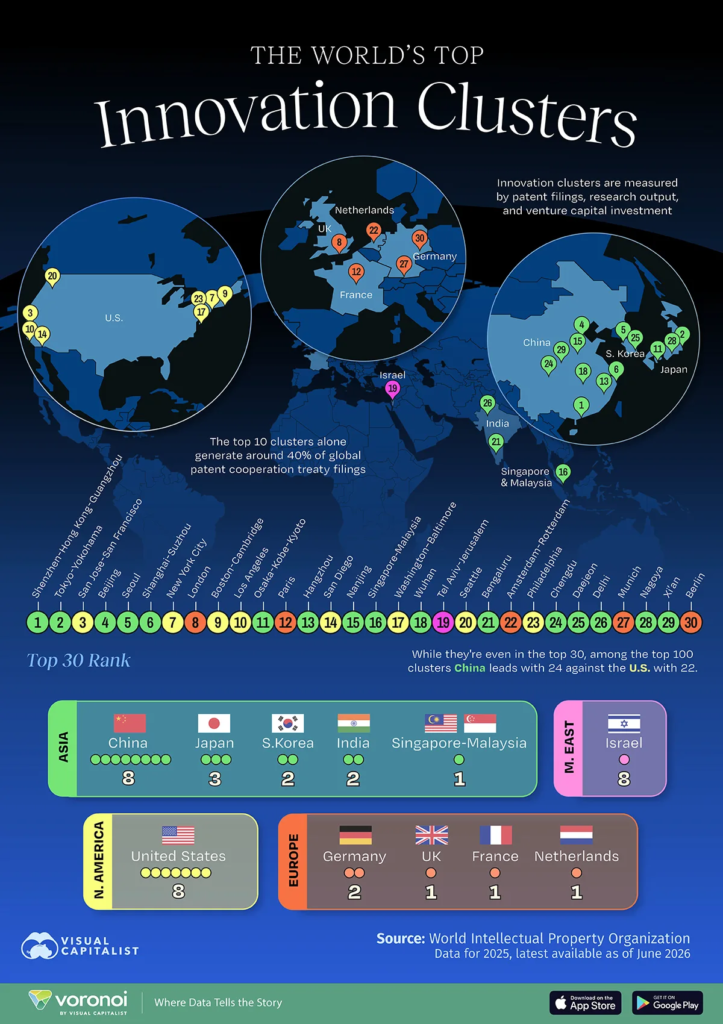
Using data from the World Intellectual Property Organization’s (WIPO) Global Innovation Index 2025, Visual Capitalist ranked the world’s top innovation clusters based on scientific publications, international patent filings, and venture capital activity.
via visualcapitalist
China and the US dominate the rankings, while innovation hotspots in Japan, South Korea, Europe, and India also feature prominently.
For context, Shenzhen–Hong Kong–Guangzhou ranks first globally, followed by Tokyo–Yokohama and Silicon Valley’s San Jose–San Francisco corridor.
Interestingly, WIPO’s clusters often span multiple metropolitan areas and even national borders. They identify regions with dense concentrations of inventors and scientific authors, rather than relying on political boundaries. As a result, clusters often represent entire innovation ecosystems rather than individual cities.
Innovation Breeds Innovation
Innovation clusters develop as talent, capital, and institutions strengthen each other. Top research universities attract scientists, successful startups attract investors, and large tech companies open doors to commercialization. These benefits grow more significant over time.
This dynamic explains why certain regions regularly lead in global innovation. Silicon Valley thrives due to top universities, robust venture capital, and an entrepreneurial culture. Likewise, China’s top clusters are bolstered by ongoing investments in research, advanced manufacturing, and technology commercialization.
While the US still dominates, China is growing fast, and you can expect India and other emerging countries to join them. I also expect regions in Europe to decide they need to build an ecosystem like this, to avoid over-dependence on technology from sources they perceive as less stable or trustworthy than they originally believed.
Like technology, you can expect the rate of innovation to increase exponentially. It’s never been easier to do more, better, and faster.
Onwards!
Leave a Reply