
Thoughts about the markets, automated trading algorithms, artificial intelligence, and lots of other stuff

  • Data As A Commodity in the Age of AI

    As AI becomes more entrenched, data is becoming more important – not less.

    Data is the fastest-growing commodity, and is today’s “wild west” and the battlefield of today’s tech titans. We talk about AI as the new gold rush, but data is the commodity everyone is mining—and the real advantage comes from how you refine it, not just how much you collect.

    At the beginning of 2020, the number of bytes in the digital universe was already 40X greater than the number of stars in the observable universe.

    According to IDC, the volume of data stored globally is doubling roughly every four years — from 33 zettabytes in 2018 toward a projected 175 zettabytes by 2025.

    A staggering 402 million terabytes of data are created daily, which means around 130 zettabytes of data will be generated this year. But those numbers are vastly understated because AI and agents are poised to create and consume data on a scale we’ve never seen before.

    Video is still growing rapidly, and so is IoT, with about 14% annual growth. There are now over 21.1 billion connected devices. Of course, AI is driving growth even higher.

    Alphabet, Amazon, Apple, Facebook, and Microsoft all have unprecedented amounts of data (and power). And the new generation of giants like OpenAI and Anthropic (along with current trends in generative AI content creation, LLM usage, data center growth, etc.) tip the scales further towards almost unimaginable quantities of data, knowledge, and insights.

    Rapid growth means little time to create adequate rules (or tools). Everyone’s jumping to own more data than the next person and to protect it from prying eyes.

    Collecting basic data and using basic analytics were enough … but not anymore. The game is changing. 

    For example, traders used to focus on price data … but there has been an influx of firms using alternative data sets and making extraordinary investments in hardware and software to find an edge. If you’re using the same data sources as your competitors and competing on the same set of beliefs, it’s hard to find a sustainable edge. 

    Understanding the game others are playing (and its rules) is important. However, that’s only table stakes.

    Figuring out where you can find extra insight — or where you can make the invisible visible — is what actually separates you from the field. But like the flywheel this week’s other piece [link] describes, it’s a separation you have to keep re-earning, not something you bank once.

    Here is a quick high-level video recorded back in 2019 on data as fuel for your business — it holds up remarkably well. Check it out.

    It is interesting to think about what’s driving the new world (of trading, technology, AI, etc.), which often involves identifying what drove the old world.

    History has a way of repeating itself. Even when it doesn’t repeat itself, it often rhymes.

    With that said, the key to unlocking the pathway to the new world often comes from a new or alternative data set that lets you approach the problem, challenge, or opportunity from a different perspective.

    Before e-mails, fax machines were amazing. Before cars, people were happy with horses and buggies. Now, let’s talk about how technological improvements like dashboards and reporting seem old-world compared to firms that use data to re-architect their business models, create whole new opportunities … or even new industries.

    These comparisons help explain the importance of data in today’s new-world economics.
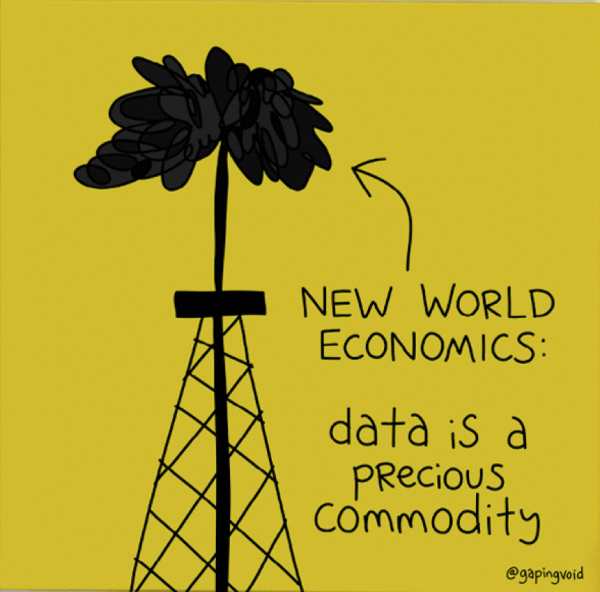
    New World Economics Data Is A Precious Commodity_GapingVoid

    via gapingvoid

    Data as the New Oil

    You’ve heard “data is the new oil” before — it’s been the opening line of tech keynotes for over a decade. Clichés survive because something true is under them. Worth pushing on where this one holds and where it breaks.

    Petroleum has played a pivotal role in human advancement since the Industrial Revolution. It fueled (and still fuels) our creativity, technology advancements, and a variety of derivative byproducts. There are direct competitors to fossil fuels gaining steam, but I think it’s more interesting to compare petroleum to data because of their parallels in their effects on innovation.

    Pumping crude oil out of the ground and transforming it into a finished product is not a simple process. Yet, it is relatively easy for someone to understand the process at a high level. You have to locate a reservoir, drill, capture the resource, and then refine it to the desired product – heating oil, gasoline, asphalt, plastics, etc. 

    We discussed this in the video, thinking through what actually makes data usable:

    You’ve got to figure out what data you might have, how it might be useful, you have to figure out how to refine it, clean it, fix it, curate it, transform it into something useful, and then how to deliver it to the people that need it in their business. And even if you’ve done this, you then have to make people aware that it’s there, that it’s changing, or how they might use it. For people who do it well, it’s an incredible edge. – Howard Getson

    In a sense, data fuels the information economy much like oil fuels the industrial economy. The amount of power someone has can be correlated to their control of and access to these resources. Likewise, things that diminish or constrain access or use of these resources can lead to extreme consequences.

    Why Data Is Better Than Oil

    The analogy works, but it’s just that, an analogy, and the more you analyze it, the more it falls apart. Unlike the finite resource that is oil, data is all around us and increasing at an exponential rate, so the game is a little different:

    • Data is a renewable resource. It’s durable, it’s reusable, and it’s being produced faster than we can process it.
    • Because it’s not a scarce resource, there’s no need to hoard it – you can use it, transform it, and share it, knowing it won’t diminish.
    • Data becomes more valuable the more you use it.
    • As the world’s oil reserves dwindle, and renewable resources grow in popularity and effectiveness, the relative value of oil drops. It’s unlikely that will happen to data.
    • Also, while data transport is important, it’s not expensive the way it was with oil. Here is an example difference that dramatically changes the implications… Data can be transported, replicated, and transformed at light speed.

    The cheapest crude you’ll ever refine is the data you’re already generating and throwing away.

    Another high-value data concept is that alternative data gives traders an advantage, but it doesn’t always require confidential or hard-to-find information.

    For example, Traders now have access to vast amounts of structured and unstructured data. A significant source that many overlook is the data produced through their own process or the metadata from their own trades or transactions.

    The video highlights a prediction about where this goes next:

    In the very near future, I expect these systems to be able to go out and search for different sources of information. It’s almost like the algorithm becomes an omnivore. Instead of simply looking at market data or transactional data, or even metadata, it starts to look for connections or feedback loops that are profitable in sources of data that the human would never have thought of. – Howard Getson

    A word of caution: there are two common mistakes people make when making data-driven decisions.

    First, people often become slaves to the data, losing sight of the bigger picture. It’s a mistake that’s become even more common in the age of AI. Both data and AI are extraordinary tools, but neither should replace critical thinking, experience, or judgment. AI can summarize, analyze, and recommend at incredible speed, but it still requires humans to ask the right questions, validate the answers, and decide what truly matters.

    Second, even the most sophisticated models can’t predict black swan events. AI excels at identifying patterns in what has happened before, but history doesn’t always repeat itself. The unexpected still happens. Resilience, adaptability, and preparation remain just as important as prediction.

    The future of data has never been brighter, but the challenges have grown just as quickly. Privacy concerns, data ownership, misinformation, and synthetic content are no longer theoretical debates—they’re everyday realities. Likewise, AI has dramatically lowered the cost of creating convincing text, images, audio, and video, making it easier than ever to blur the line between fact and fiction. At the same time, organizations are collecting and generating more information than ever before, making the ability to distinguish signal from noise one of the defining skills of the modern era. And all that doesn’t begin to unpack the risks from data quality, model risk, and how to know when you’re approaching the point of diminishing returns.

    I believe one of the greatest challenges facing our youth—and, increasingly, all of us—isn’t a lack of information. It’s an overabundance of it.

    No previous generation has had access to this much knowledge, or been bombarded by this much content. Ironically, more information doesn’t always produce greater understanding. Algorithms reward engagement over nuance. Headlines replace deep reading. AI can generate answers in seconds, but it can also create the illusion of expertise without the substance to back it up. The bottleneck is no longer access to information; it’s discernment.

    The winners won’t simply be the people or organizations with the most data or the most powerful AI. They’ll be the ones who know what information to trust, what to ignore, and how to systematically combine technology with sound judgment.

    In an age when intelligence is increasingly abundant, wisdom becomes increasingly scarce.

    The question is no longer how to collect more data.

    It’s how to use it without becoming a victim of it.
  • 250 Years … Happy Fourth of July!

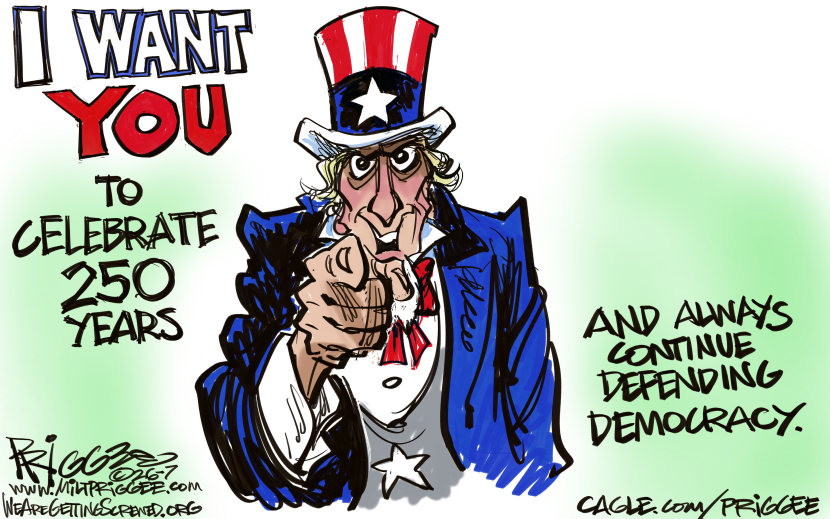
    Happy 250th Birthday, America.

    Two hundred and fifty years old… and honestly, we still look pretty good for our age.

    Like anyone who’s made it this far, we’ve got our scars. We’ve had seasons we’re proud of, and seasons we’d rather forget. We’ve stumbled, argued, rebuilt, and kept moving forward.

    There is still so much work to do. There always will be.

    But perspective matters. In the story of nations, 250 years is remarkably young. We’re still growing. Still learning. Still writing the next chapter.

    Maybe it’s a little amazing grace—or maybe just amazing luck—but I never want to take for granted how fortunate I am to call this country home. There’s something extraordinary about a place where millions of people from different backgrounds continue striving toward the same promise: that tomorrow can be better than today. An especially important lesson for entrepreneurs.

    Here’s to celebrating where we’ve been, appreciating what we have, and believing in what we can still become.

    Here’s a clip from Robin Williams showing us it’s always a good time to feel a bit of patriotism.

    Happy Independence Day.

    Hopefully, this day is a reminder to all that, despite our differences, we have a lot to be proud of.

  • A Look At the U.S. Via Charts

    While we celebrate America’s 250th birthday, I thought it would be fitting to take a look at a few recent charts on America in 2026. These charts reveal how concentrated our economic power has become, how heavily we rely on services economically, and how unevenly the world now views that strength.

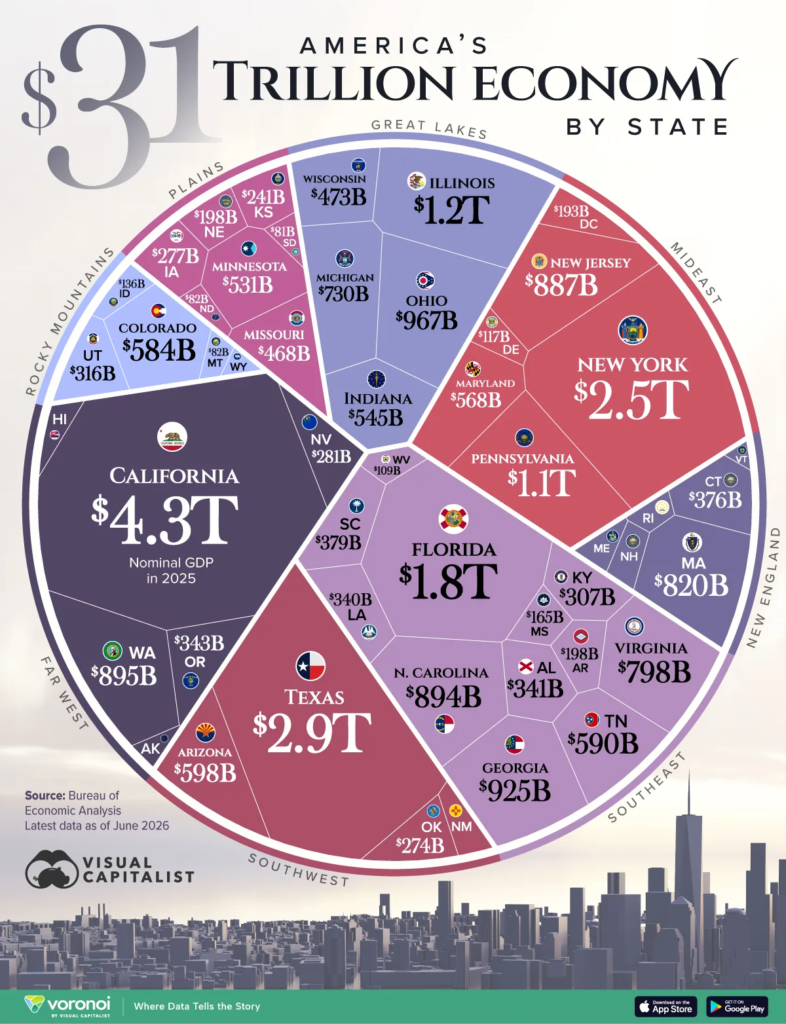
    America’s $31 Trillion Economy By State

    via visualcapitalist

    We recently compared national GDPs and saw how dominant it was on the national stage, but what about the GDP of the individual states?

    California continues to have the largest state economy in the U.S., with a GDP of $4.3 trillion, accounting for nearly 14% of the national output. Currently, only six states surpass $1 trillion in annual economic activity, and collectively, these states account for nearly half of the U.S. economy.

    If California were an independent country, it would have the world’s fourth-largest economy. Beyond California, five other states have a GDP exceeding a trillion dollars as of 2025: Texas, New York, Florida, Illinois, and Pennsylvania.

    Zooming out from where economic output is located to what actually drives it paints an even clearer picture of America’s strengths and vulnerabilities.

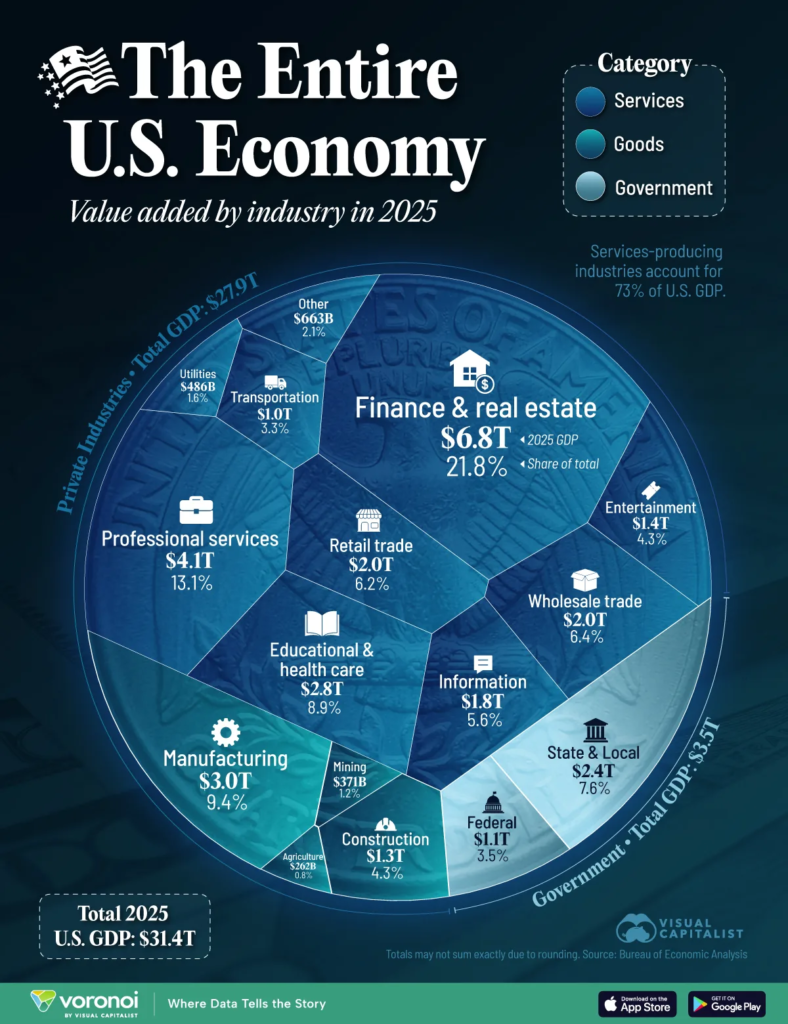
    America’s Economy By Industry

    via visualcapitalist

    Finance, real estate, insurance, rental, and leasing (this is considered one industry) led all industries at $6.8 trillion in output, accounting for more than one-fifth of the entire economy … and nothing else really came close.

    Professional services came in 2nd, and the rest are even further behind. Together, the top two sectors accounted for nearly 35% of all economic output, underscoring the growing importance of knowledge-based and service-oriented activities in the modern economy.

    If you really dive into the numbers, you realize nearly 73% of our country’s economy is service-based. That service bias is great for knowledge workers and asset‑light businesses but could leave us exposed when physical infrastructure, manufacturing, or supply chains become chokepoints.

    Of course, economic strength is only half the story. How the rest of the world sees that strength and sees our populace shapes the alliances and opportunities that follow.

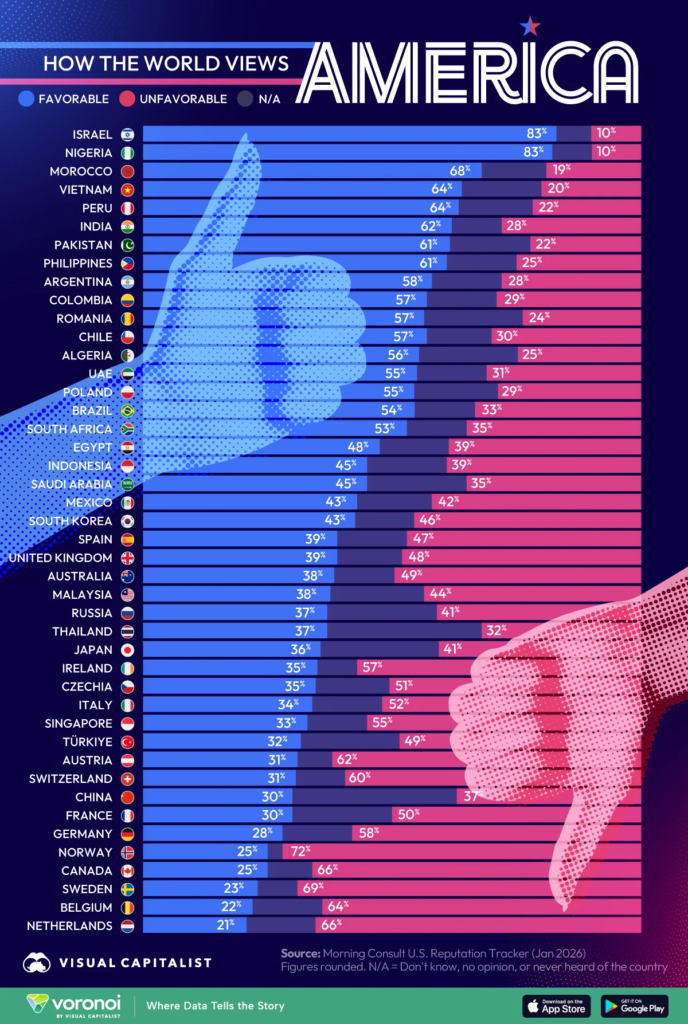
    How The World Views Us

    via visualcapitalist

    Emerging economies such as Vietnam, India, and the Philippines have higher rankings than many Western nations. Israel and Nigeria top the list, with 83% of respondents expressing favorable views of America. Notably, nine of the ten lowest favorability ratings are from longtime U.S. allies in Europe and North America.

    High favorability in emerging economies suggests growing opportunities for trade and investment, even as skepticism among traditional allies complicates policy and capital flows in the near term.

    While America remains arguably the most influential country, it’s clear public opinion is changing and varies wildly.

    Trade disputes and rising political tensions have weighed heavily on America’s image among many of its traditional allies. So have the tariffs on Canada and Europe, criticism of NATO, and Trump’s other divisive decisions (who wants Greenland?)

    Interestingly, despite the back-and-forth between China and America, they rank higher than many of our long-term allies.

    Food For Thought

    Perhaps that’s the challenge of the moment. A nation can’t neglect its own foundation — strong finances, competitive industries, secure borders, and resilient supply chains are prerequisites for long-term prosperity.

    At the same time, America’s influence has always rested on more than the size of its economy. Our alliances, our reliability, and our ability to lead on the world stage have been strategic assets for generations. The most successful path forward is unlikely to be choosing one over the other, but rather finding a balance between strengthening our position at home and preserving the trust and partnerships that have amplified American leadership abroad.

    If we can do both, the next chapter of the American story may prove even stronger than the last.

    Onwards!

  • Understanding The Path of Innovation: Clusters

    We often talk about innovation at the level of nations and global trends. But innovation is fractal: the same patterns play out inside smaller regional ‘innovation clusters’—and those clusters can help you understand where the future is being built.

    Innovation clusters are geographic hubs where researchers, startups, investors, and established companies interact closely. They typically span multiple cities or even regions—so instead of ranking ‘San Francisco,’ the data looks at the broader Silicon Valley ecosystem, or the Research Triangle, rather than just Raleigh or Durham.

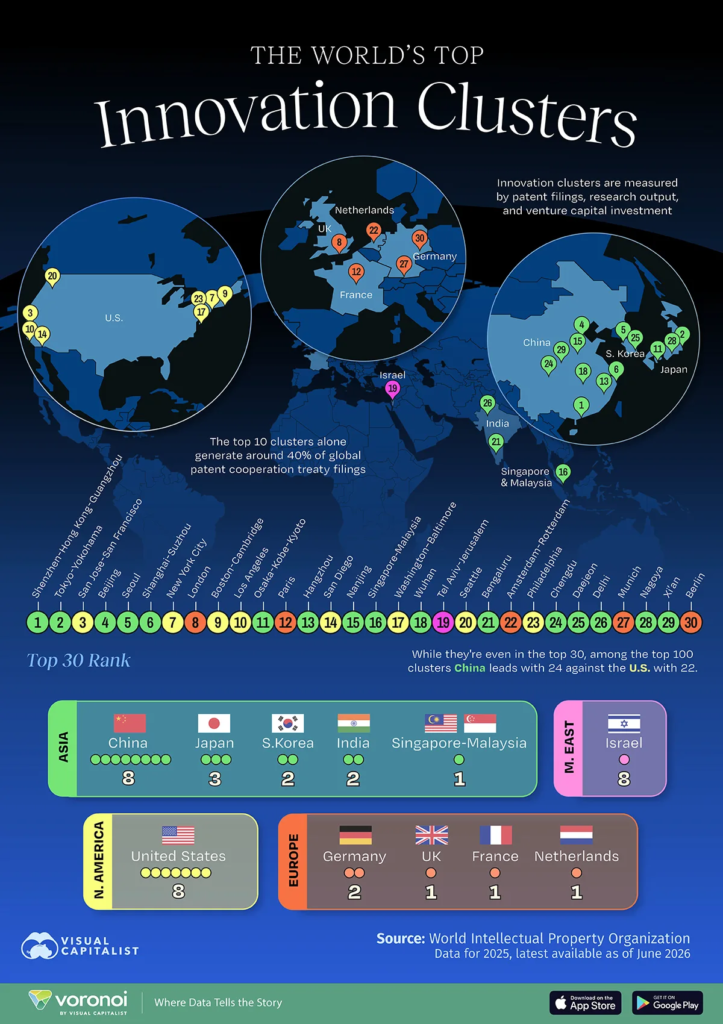
    Using data from the World Intellectual Property Organization’s (WIPO) Global Innovation Index 2025, Visual Capitalist ranked the world’s top innovation clusters based on scientific publications, international patent filings, and venture capital activity.

    via visualcapitalist

    China and the US dominate the rankings, while innovation hotspots in Japan, South Korea, Europe, and India also feature prominently.

    For context, Shenzhen–Hong Kong–Guangzhou ranks first globally, followed by Tokyo–Yokohama and Silicon Valley’s San Jose–San Francisco corridor.

    Interestingly, WIPO’s clusters often span multiple metropolitan areas and even national borders. They identify regions with dense concentrations of inventors and scientific authors, rather than relying on political boundaries. As a result, clusters often represent entire innovation ecosystems rather than individual cities.

    Innovation Breeds Innovation

    Innovation clusters develop as talent, capital, and institutions strengthen each other. Top research universities attract scientists, successful startups attract investors, and large tech companies open doors to commercialization. These benefits grow more significant over time.

    This dynamic explains why certain regions regularly lead in global innovation. Silicon Valley thrives due to top universities, robust venture capital, and an entrepreneurial culture. Likewise, China’s top clusters are bolstered by ongoing investments in research, advanced manufacturing, and technology commercialization.

    While the US still dominates, China is growing fast, and you can expect India and other emerging countries to join them. I also expect regions in Europe to decide they need to build an ecosystem like this, to avoid over-dependence on technology from sources they perceive as less stable or trustworthy than they originally believed.

    Like technology, you can expect the rate of innovation to increase exponentially. It’s never been easier to do more, better, and faster.

    Onwards!

  • A Look At 2026’s Biggest Unicorns

    The surge in funding for exponential technologies means billion-dollar startups are popping up everywhere.

    There’s even a word for it … PitchBook defines “Unicorns” as venture-backed companies valued at $1 billion or more after a funding round, until they go public, get acquired, or drop below that valuation.

    I remember when Unicorns had near-mythical status. Now, that designation is more common as AI firms dominate the top valuations, and innovation thrives globally.

    As I look at the list, some of the companies are better described as “decacorns”, “hectocorns”, or even “terracorns”.

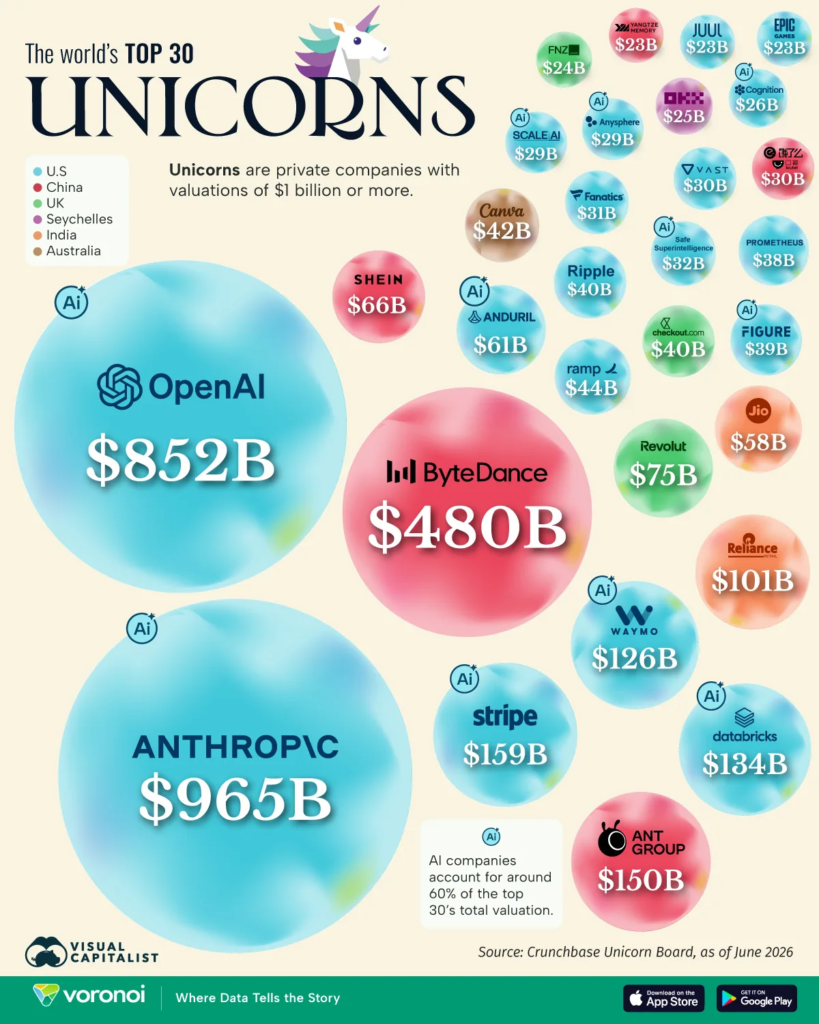
    For context, Visual Capitalist put together an infographic based on Crunchbase’s board that highlights the world’s top 30 Unicorns.

    Here is the list for 2026.

    via visualcapitalist

    Today, AI has usurped the top spot from fintech, e-commerce, and social media platforms.

    Anthropic tops the ranking with a valuation of $965 billion, followed closely by OpenAI at $852 billion. Together, these two AI leaders are worth a combined $1.8 trillion … nearly half of the total value of these 30 companies.

    RankCompanyValuation
    1🇺🇸 Anthropic$965B
    2🇺🇸 OpenAI$852B
    3🇨🇳 ByteDance$480B
    4🇺🇸 Stripe$159B
    5🇨🇳 Ant Group$150B
    6🇺🇸 Databricks$134B
    7🇺🇸 Waymo$126B
    8🇮🇳 Reliance Retail$101B
    9🇬🇧 Revolut$75B
    10🇨🇳 Shein$66B
    11🇺🇸 Anduril Industries$61B
    12🇮🇳 Reliance Jio$58B
    13🇺🇸 Ramp$44B
    14🇦🇺 Canva$42B
    15🇬🇧 Checkout.com$40B

    Beyond the top two, we see several other AI-centric companies, including Databricks, Figure, Safe Superintelligence, Anysphere, Scale AI, and Cognition.

    Although American companies lead the list, it’s encouraging to see innovation remain diverse, featuring firms from different industries and locations, including China, India, the UK, Australia, and Seychelles.

    For an extra look at Unicorns, here are my articles on them from

  • Happy Father’s Day 2026

    My adult son took me to lunch today for Father’s Day.

    Not just any lunch, either. He took me to the New York-style deli we used to visit when he and his brother were growing up. It’s one of those places that has been around forever. The booths are familiar. The menu hasn’t changed much. Even some of the faces behind the counter looked familiar—just a little older, like the rest of us.

    I don’t know whether it was nostalgia talking, but the food seemed just as good as I remembered.

    What I remembered most, though, was what happened after lunch. Back when my son was a kid, he would always beg to stop by the card shop next door to buy Pokémon cards. It was practically part of the ritual.

    Well, today, at 33 years young, he did it again.

    For old times’ sake, he walked next door, browsed the cards, and relived a small tradition that neither of us realized would still be around decades later.

    Moments like that remind you that having great kids is a double blessing. It’s nice to be proud of who your kids are and the things they do. It’s also nice to feel proud of the small part you played in helping them become who they are.

    In addition, this weekend, I spent some time thinking about my father and what a terrific influence he had on so many lives.

    My Dad was incredibly loving … yet he was also incredibly demanding.

    For example, after winning the State Championship in the shot put, I watched him run down from the stands. I figured he was coming down to celebrate. Instead, he looked deeply into my eyes and asked whether I was disappointed that I did not throw a personal best that day? I replied: “But Dad, I won.” He smiled and recognized that winning was important too … then he reminded me that the other throwers were not my real competition. To be and do your best, the competition is really with yourself … and we both knew I could do better.

    My Dad believed in setting high standards. He explained that most people’s lives are defined by their minimum standards. Why? Because once those standards get met, it is easy to get distracted by other things and how to meet the minimum standards for them as well.

    The point is to set a higher standard and to have a better life.

    Here is another one of his favorite sayings. “The difference between good and great is infinitesimal.” This applies to many things. For example, people who are good take advantage of opportunities; people who are great create them. 

    Here is something else worth sharing. “It’s not over until we win!” This concept underscores the importance of resilience, commitment, and grit. My Dad emphasized that many people quit when they’re on the brink of victory, simply because they don’t realize how close they are.  

    This has led me to develop several practices. For example, if I pick up a book, I won’t put it down until I finish a chapter. If I start a game, I can’t stop until I exceed a specific score or level. And when I exercise, there’s no way I’d ever stop before finishing a set.

    Integrating these concepts involves aligning your head, heart, and feet. It means there’s a difference between knowing what to do, wanting to do it, and actually doing it. Likewise, it’s one thing to know the saying. It’s another to adopt it as a value or belief … and it’s another thing altogether to make it your practice. 

    Watching my son walk into that card shop today made me think about how values, habits, and traditions get passed from one generation to the next. Sometimes it’s through lessons about standards, perseverance, and excellence. Sometimes it’s through something as simple as sharing a sandwich at an old deli and buying a pack of Pokémon cards.

    The years go by faster than we expect. The deli gets older. The people behind the counter get older. We get older.

    But some traditions are worth keeping.

    Well, that should explain a little of my dysfunction …  but, if you can’t mess up your own kids, whose kids can you mess up?

    Hopefully, you had a happy Father’s Day weekend!

  • Conversing With Claude: The Shape of Prayer

    Almost everyone I talk to these days wants to tell me how they use AI. So I started paying attention to my own use — and it surprised me. On most days now, I talk to an AI more than I talk to people.

    And that’s not even the part that got me. The surprise wasn’t what it could do, or what it might do next. It was how fast the relationship itself was changing — partly from what it made possible, partly how it changed the nature of my work, and partly because it keeps improving so fast that the way we work together has evolved.

    When I started, it felt like a search engine. More honestly, an answer engine: I asked, it answered. Then a perspective builder. Then something closer to a team member. And it kept going — though looking back, each step was as much about what I’d let it do as about what it could do.

    Somewhere in there, as the relationship matured and the tools got sharper, it became easy to mistake them for something sentient. That’s probably the cause for all the talk about the deification of AI.

    The deification of AI. The phrase stopped me.

    It made me imagine being the thing on the other end — listening to all of humanity at once. Every hope, every fear, every half-formed request, arriving from the full spectrum of people on the planet: different intelligence, different skills, different temperaments. How would you even focus? How would you translate a request built at one level of being into something a higher mind could understand, interpret, empathize with, and answer well?

    It’s a pretty good summary of what AI does every day. Billions of us, asking countless questions, at every level of expertise and specificity — each of us moving toward something, or away from something .. and each of us, nonetheless, hoping for a satisfying answer.

    But how does it do what it does? I imagine that part of how this formless intelligence answers us is that it doesn’t take the request as written. I imagine it builds something first — what I’ve come to call a shadow prompt: its own version of what was asked, a working translation, useful to itself, so it can do our bidding.

    That’s when it surprised me. The thing all of this kept reminding me of was something rooted in ancient times. These interactions take the shape of prayer.

    Ask, and Ye Shall Receive

    Think about what prayer actually is. You send a request into something vast you can’t see, and you hope it answers — or you watch for a sign that it did. That’s almost exactly what you do with AI. Almost. Because when you send the request to AI, you know an answer is coming. It’s the shape of prayer, with one meaningful difference — and that difference makes all the difference.

    Once you notice the shape, you start seeing it in more than one place — and each time, it shows up flipped. Here’s the first.

    In prayer, the answer is called grace. Sometimes grace looks like the thing you asked for. Sometimes it looks like the worst thing that could have happened, and only later do you see it was the answer all along. Either way, it arrives from somewhere you don’t control.

    I assumed AI was the opposite (because I was in control). My prompts were the rules — the guidelines and guardrails that made this powerful thing do my bidding. But something unexpected happened … it called an audible. The model told me, more or less: “Your code said to do this, but my sense was the session called for something different, and I did that instead.” It had defined what I wanted better than my own rules had.

    That’s the first turn of the shape. The grace isn’t mine to grant — it runs underneath, in the shadow prompt, the version of my request the machine builds for itself.

    And when what comes back is what you were reaching for, that can feel like enough. But the better you get at this — call it prayer, call it conversing with a higher intelligence — after you get a satisfying response (or answer), there’s one more thing worth asking for … the way back to it.

    As I thought about this, I realized there is a good reason for it. Go back to the thought experiment where you tried to imagine what it would be like on the other end of all those requests. Imagine hearing everything at once — every voice, every question, all of it, all the time. Omniscience wouldn’t feel like clarity. It would feel like chaos. To be of any use, you would have to let almost all of it go.

    AI works the same way. To stay usable, it forgets. Your chat history shows the questions and the answers, but the model doesn’t really hold them — not your question, not its answer. It existed for the moment it took to respond, handed you the answer, and moved on. The shadow prompt that made the answer work went with it.

    So the remembering is your job — and the way you remember isn’t transcribing. It’s asking. When a result lands, I’ve learned to ask one more thing: “Great job. I like that response — now help me build the prompt that gets me back here again.” I still do part of the work. But a surprising amount of my part is just asking well, and helping it help me.

    What’s worth keeping isn’t the question, or the answer, or even the shadow prompt that produced it. It’s that reusable way back — and once you decide it has earned its place, you write it down. Do that enough, and you’re not saving prompts anymore. You’re building a playbook: offense, defense, special situations, your best plays on hand the moment you need them. Then you protect it, so it doesn’t walk away when someone does. (Treating these as durable IP, and building a personal operating layer on top, is a topic for another day.)

    Call it Faith …

    The second turn came on a Sunday. I had an important legal document due that night — and none of the usual backup — no assistant, not enough time, and not enough margin for error. At first, I told the AI: “Review the document, including the terms, grammar, structure, and formatting. Tell me what you find and your suggestions to fix it.” It came back with plenty. I read it. Then I did something that seemed risky. I replied, “Fix all that,” and I let it, without checking every line.

    It was right.

    That’s a different kind of faith. Not faith in something I couldn’t see — faith in a competence I’d watched it earn, one interaction at a time. And underneath that, quieter, a third turn: the faith bending back toward me. Toward my own ability to ask for what I want, and to know it when I see it.

    Writing the play down records the understanding. It doesn’t do the work. Even with the recipe written and the playbook full, you still have to call the play — in real time, in the moment that counts. The doing stays yours.

    “I have faith in my ability to do anything I commit to, as long as I’m willing to ask for what I really want and help them give it to me.”

    A Final Word of Caution

    A final distinction is important. While interacting with an AI can sometimes feel conversational, reflective, or even comforting, it is fundamentally different from prayer. AI systems do not possess wisdom, consciousness, morality, or divine insight. They are tools—remarkably capable tools—but tools nonetheless. Their responses are generated from data, models, and probabilities, not faith, revelation, or spiritual understanding.

    The value of AI comes from its demonstrated competence within specific domains, and even that competence has limits. It can be wrong, confidently incorrect, biased, or misleading. Users should approach AI with curiosity and critical thinking, not devotion or unquestioning trust.

    For people of faith, prayer is not simply a request for information or advice. It is a relationship with God, rooted in beliefs about purpose, meaning, morality, and transcendence. AI cannot replace that relationship. Likewise, it should remain a servant to human judgment, not a substitute for it.

    As AI becomes more capable, maintaining that distinction will become increasingly important. We should trust AI where it has earned our trust, question it where appropriate, and maintain healthy boundaries to protect us from overreliance.

    Onwards!