With Facebook's IPO set to happen soon, I was thinking about some of the other big tech IPOs.
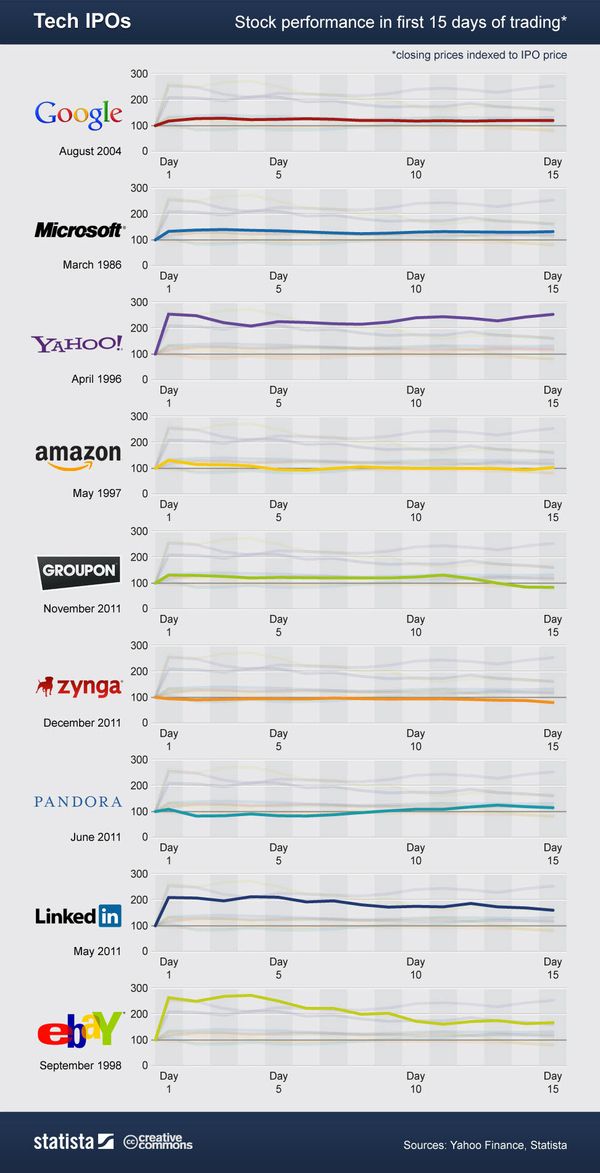
The first few weeks of trading may not be a good estimate of how successful a company will be over time. The charts below, from a Mashable post showing how nine tech giants did after going public, highlight that point.
First, here is a normalized index chart showing the initial 15 days of trading for each company.
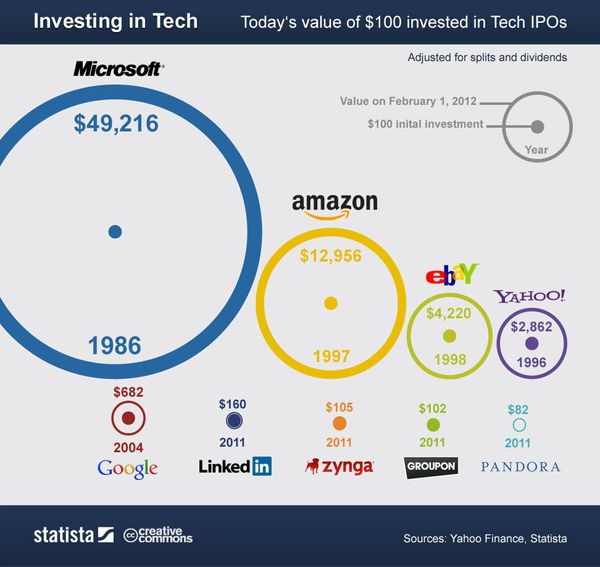
Second, here is a chart showing growth to date. This chart illustrates how much a $100 investment, at the IPO price, would be worth today.
Some of those returns are surprising, aren't they?
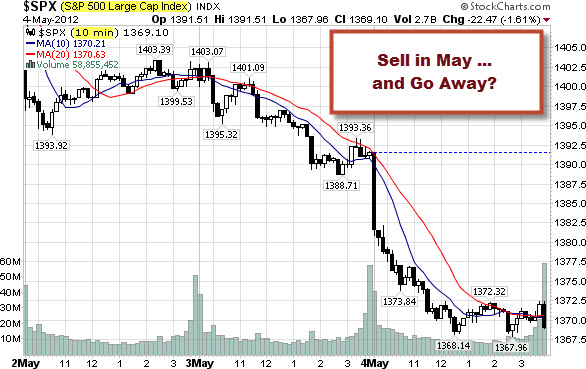
A close look at trading in May shows a pretty clear negative bias. Here is a 10-minute bar chart of what's happened since May 1st on the S&P 500 Index.
May 1 marked the beginning of a 6-month period of unfavorable seasonality. Research published by Yale Hirsch in the Trader's Almanac shows that the market year is broken into two six-month seasonality periods. From May 1 through October 31, seasonality is unfavorable, and the market most often finishes lower than it was at the beginning of the period.
The period from November 1 through April 30 is seasonally favorable, and the market most often finishes the period higher.
… While the statistical average results for these two periods are quite compelling, trying to ride the market in real-time in hopes of capturing these results is not always as easy as it sounds.
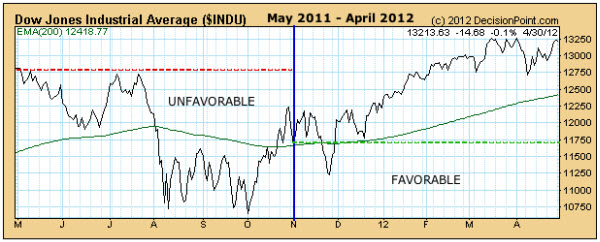
Below is the one-year chart that that shows the most recent two six-month periods. It begins on May 1, 2011 and ends on April 30, 2012.
The left half of the chart shows the unfavorable May through October period, and the right half shows the favorable November through April period. The green line marks the beginning of the favorable period. The red line marks the beginning of the unfavorable period.
Historically, the seasonality expected by 'Sell in May' has provided a trading edge.
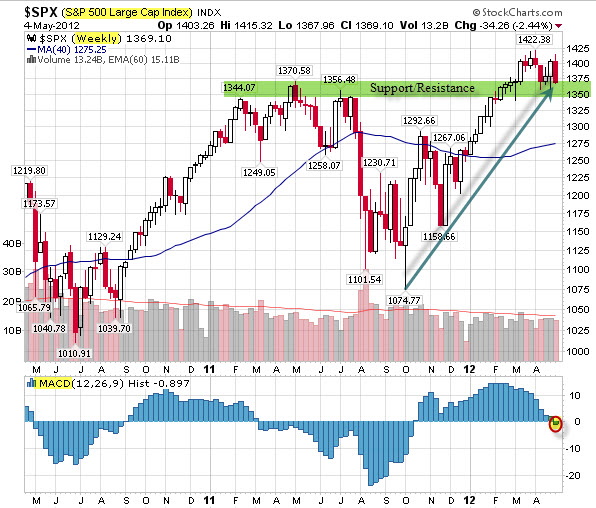
However, scale and perspective do matter. For example, here is a weekly chart of the S&P 500 Index. From this perspective, the markets are arguably in an up-trend – and sitting on top of a pretty strong support.
While the MACD is testing a move beneath the zero line, price is the primary indicator … and is in a reasonably defensible buying area.
If the bulls hope to push things higher, this is where you would expect buying to occur.
A close look at trading in May shows a pretty clear negative bias. Here is a 10-minute bar chart of what's happened since May 1st on the S&P 500 Index.
May 1 marked the beginning of a 6-month period of unfavorable seasonality. Research published by Yale Hirsch in the Trader's Almanac shows that the market year is broken into two six-month seasonality periods. From May 1 through October 31, seasonality is unfavorable, and the market most often finishes lower than it was at the beginning of the period.
The period from November 1 through April 30 is seasonally favorable, and the market most often finishes the period higher.
… While the statistical average results for these two periods are quite compelling, trying to ride the market in real-time in hopes of capturing these results is not always as easy as it sounds.
Below is the one-year chart that that shows the most recent two six-month periods. It begins on May 1, 2011 and ends on April 30, 2012.
The left half of the chart shows the unfavorable May through October period, and the right half shows the favorable November through April period. The green line marks the beginning of the favorable period. The red line marks the beginning of the unfavorable period.
Historically, the seasonality expected by 'Sell in May' has provided a trading edge.
However, scale and perspective do matter. For example, here is a weekly chart of the S&P 500 Index. From this perspective, the markets are arguably in an up-trend – and sitting on top of a pretty strong support.
While the MACD is testing a move beneath the zero line, price is the primary indicator … and is in a reasonably defensible buying area.
If the bulls hope to push things higher, this is where you would expect buying to occur.
As a trader, I'm surprised by how different the market can look on different time-frames.
Getting a sense of scale is important. Sometimes the difference is bigger than you think.
Click the picture to launch a fascinating data visualisation created by Michael and Cary Huang. It is an interactive virtual scale of our universe that allows you to zoom in and out through space comparing the size and scale of everything from the smallest particles to immense nebulae.
Covel has made a name for himself as a chronicler of the Turtle Trading experiment and an outspoken proponent of trend following. Here is a photo of him and me at the Symposium.
Truth be told, I often sit through presentations at a trading conference feeling skeptical, and looking for an idea that rings true or at least seems worth investigating further.
This was much better than that.
Covel claims that market profit is about the right mentoring and practice, not genetic gifts, inborn talents, or Asperger's memory brilliance. You simply need a winning philosophy and strategy, backed by proven positive results that you can execute.
Unlike some industry experts who hint at elusive secrets, Covel's unabashedly open about what he believes works and the things that he's learned from winning traders. He also sprinkles in wisdom from the ages, like this quote from the ancient Greek trend follower, Epictetus.
Do not strive for things occurring to occur as you wish, but wish the things occurring as they occur, and you will flow well.
The audience at an MTA event is filled with an impressive group of people … you'll meet portfolio managers, strategists, analysts, quants, and traders who rely on technical analysis. Talk of oscillators, histograms and regression testing fills the air. So, it was refreshing to hear Covel challenge the room. Covel loves to poke technicians who talk about quant trading; he claims that systematic trend following is the only quant strategy that actually works.
He said that what he does is real technical analysis because despite what anyone else thinks, he's skeptical that any of the complex strategies being discussed consistently beats the technique he's talking about. The proof, he says, is in the evidence. In this case, it's the detailed trading records of dozens of systematic trend traders who have produced consistent results that dramatically outperform the markets, year-in-and-year-out for decades.
Simple Is Often Better.
If you asked someone who builds trading systems to describe a trading system, they'd probably focus on inputs and technique (e.g., what indicators does it use; is it a momentum strategy; does it seek to profit from artbitrage, reversion to the mean; does it use a simple crossover technique?). In contrast, Covel starts with a proverb:
If you must play, decide upon three things at the start: the rules of the game, the stakes, and quitting time.
Going a little deeper, Covel says a system should confidently deal with these questions.
What market do you buy or sell at any time?
How much of a market do you buy or sell at any time?
When do you buy or sell a market?
When do you get out of a losing position?
When do you get out of a winning position?
However, he cautions that trend following starts with knowing when to do nothing. If the market is screaming like a spoiled brat … Step to the side. That’s your first play. Cash is a legitimate position.
Learning More.
Covel is an engaging speaker and writer. In addition to the keynote, I had an opportunity to sit down with him and have a real conversation. I'm happy to say that he has a terrific grasp on trading, traders, and an interesting perspective on what works.
Covel has a new book called Trend Commandments: Trading for Exceptional Returns. He claims it is for those who know deep down that there is a real way to make money in the markets, but just do not know how yet.
As a result of our conversation, I bought a copy. Since I had already read several of his other books, including Trend Following and The Complete Turtle Trader, I didn't expect much new information. However, just as he promised, this book has a different tone and is chock-full of insights and tradable ideas.
Covel has made a name for himself as a chronicler of the Turtle Trading experiment and an outspoken proponent of trend following. Here is a photo of him and me at the Symposium.
Truth be told, I often sit through presentations at a trading conference feeling skeptical, and looking for an idea that rings true or at least seems worth investigating further.
This was much better than that.
Covel claims that market profit is about the right mentoring and practice, not genetic gifts, inborn talents, or Asperger's memory brilliance. You simply need a winning philosophy and strategy, backed by proven positive results that you can execute.
Unlike some industry experts who hint at elusive secrets, Covel's unabashedly open about what he believes works and the things that he's learned from winning traders. He also sprinkles in wisdom from the ages, like this quote from the ancient Greek trend follower, Epictetus.
Do not strive for things occurring to occur as you wish, but wish the things occurring as they occur, and you will flow well.
The audience at an MTA event is filled with an impressive group of people … you'll meet portfolio managers, strategists, analysts, quants, and traders who rely on technical analysis. Talk of oscillators, histograms and regression testing fills the air. So, it was refreshing to hear Covel challenge the room. Covel loves to poke technicians who talk about quant trading; he claims that systematic trend following is the only quant strategy that actually works.
He said that what he does is real technical analysis because despite what anyone else thinks, he's skeptical that any of the complex strategies being discussed consistently beats the technique he's talking about. The proof, he says, is in the evidence. In this case, it's the detailed trading records of dozens of systematic trend traders who have produced consistent results that dramatically outperform the markets, year-in-and-year-out for decades.
Simple Is Often Better.
If you asked someone who builds trading systems to describe a trading system, they'd probably focus on inputs and technique (e.g., what indicators does it use; is it a momentum strategy; does it seek to profit from artbitrage, reversion to the mean; does it use a simple crossover technique?). In contrast, Covel starts with a proverb:
If you must play, decide upon three things at the start: the rules of the game, the stakes, and quitting time.
Going a little deeper, Covel says a system should confidently deal with these questions.
What market do you buy or sell at any time?
How much of a market do you buy or sell at any time?
When do you buy or sell a market?
When do you get out of a losing position?
When do you get out of a winning position?
However, he cautions that trend following starts with knowing when to do nothing. If the market is screaming like a spoiled brat … Step to the side. That’s your first play. Cash is a legitimate position.
Learning More.
Covel is an engaging speaker and writer. In addition to the keynote, I had an opportunity to sit down with him and have a real conversation. I'm happy to say that he has a terrific grasp on trading, traders, and an interesting perspective on what works.
Covel has a new book called Trend Commandments: Trading for Exceptional Returns. He claims it is for those who know deep down that there is a real way to make money in the markets, but just do not know how yet.
As a result of our conversation, I bought a copy. Since I had already read several of his other books, including Trend Following and The Complete Turtle Trader, I didn't expect much new information. However, just as he promised, this book has a different tone and is chock-full of insights and tradable ideas.