Business

  • Does Crisis Really Mean Chaos and Opportunity?

    Is the glass half-full, or is the glass half-empty?

    It is all a matter of perspectives, isn't it.

    Let's look at one of the positives.  Some companies are doing fantastic. 

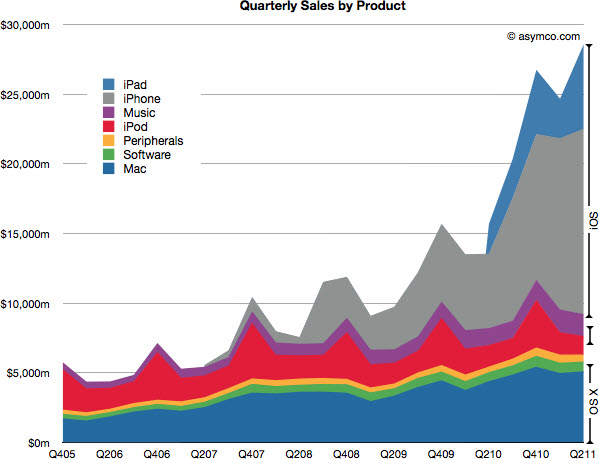
    Here is a chart of Apple's quarterly sales, by product.
     

    110723 apple-revenue 

    Apple grew revenues by 82 percent last quarter, which is remarkable growth for a company of its size ($28.6 billion in quarterly revenues).

    Can you remember another company, that size, growing revenue that fast?  I can't.

    You can talk about consumers having less money to spend, negative sentiment, etc.  It didn't matter.  Apple is showing that cream rises to the top.  If you make something people want, they will find a way to get it.

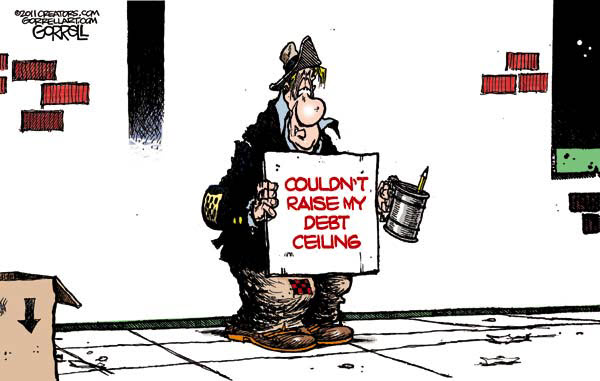
    How about the negative?  America isn't the only country with debt problems. 

    Deficit, National Debt and Government Borrowing – How Has It Changed?

    How has it changed?  It has gotten worse. 

    Here in the U.S., we talk about deficits, debt-ceilings, and government borrowing, as if we are the only country suffering.  But the news shows that this disease has spread through the world (and not just Greece either).

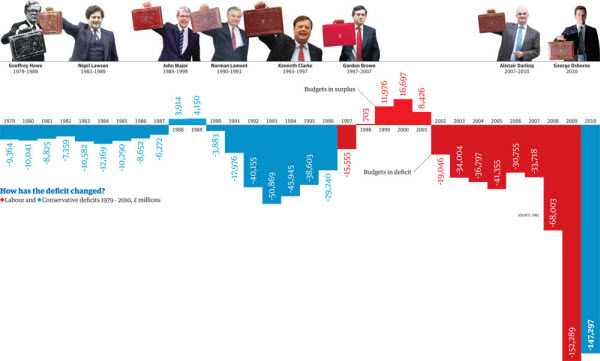
    For example, the chart below shows the United Kingdoms deficit over time.
     

    110723 UK Budget-deficits-graphic

    Does it look like a mirror of Apple's success to you?  Wonder what that means?

    At some point, a crisis is likely.  However, the chaos surrounding crisis often results in tremendous opportunity.

    Ultimately, it doesn't matter what happens … it is what you do. 

    Many opportunities present themselves every day in the markets.  The goal is to identify what is working, and to trade it while it is working.

    Niccolo Machiavelli said: "Whosoever desires constant success must change his conduct with the times."

    Perhaps it is time to make some plans so you respond intelligently to what happens.

    HMG Note: As I write this, there is still a failure to agree about the debt ceiling.

    If it isn't resolved before morning, international response should be telling.  Will it spark fear, or will the markets shrug it off?  The answer will probably tell you a lot more than the news did.

    Enhanced by Zemanta
  • Leadership Lessons of a Shirtless Dancing Guy

    You don't need a formal setting to learn about leadership.

    Derek Sivers gave this 3-minute talk at a TED conference.

    You can watch a movement happen, start to finish, in under 3 minutes, while he points-out some of the lessons.


    A leader needs the guts to stand alone and look ridiculous. But what he's doing is so simple, it's almost instructional. This is key. You must be easy to follow!

    Now comes the first follower with a crucial role: he publicly shows everyone how to follow. Notice the leader embraces him as an equal, so it's not about the leader anymore – it's about them, plural. Notice he's calling to his friends to join in. It takes guts to be a first follower! You stand out and brave ridicule, yourself. Being a first follower is an under-appreciated form of leadership. The first follower transforms a lone nut into a leader. If the leader is the flint, the first follower is the spark that makes the fire.

    The 2nd follower is a turning point: it's proof the first has done well. Now it's not a lone nut, and it's not two nuts. Three is a crowd and a crowd is news.

    A movement must be public. Make sure outsiders see more than just the leader. Everyone needs to see the followers, because new followers emulate followers – not the leader.

    Now here come 2 more, then 3 more. Now we've got momentum. This is the tipping point! Now we've got a movement!

    As more people jump in, it's no longer risky. If they were on the fence before, there's no reason not to join now. They won't be ridiculed, they won't stand out, and they will be part of the in-crowd, if they hurry. Over the next minute you'll see the rest who prefer to be part of the crowd, because eventually they'd be ridiculed for not joining.

    And ladies and gentlemen that is how a movement is made! Let's recap what we learned:

    If you are a version of the shirtless dancing guy, all alone, remember the importance of nurturing your first few followers as equals, making everything clearly about the movement, not you.

    Be public. Be easy to follow!

    But the biggest lesson here – did you catch it?

    Leadership is over-glorified.

    Yes it started with the shirtless guy, and he'll get all the credit, but you saw what really happened:

    It was the first follower that transformed a lone nut into a leader.

    There is no movement without the first follower.

    We're told we all need to be leaders, but that would be really ineffective.

    The best way to make a movement, if you really care, is to courageously follow and show others how to follow.

    When you find a lone nut doing something great, have the guts to be the first person to stand up and join in.

    Original video at http://www.youtube.com/watch?v=GA8z7f7a2Pk

    Official transcript at http://sivers.org/ff

    Enhanced by Zemanta
  • Leadership Lessons of a Shirtless Dancing Guy

    You don't need a formal setting to learn about leadership.

    Derek Sivers gave this 3-minute talk at a TED conference.

    You can watch a movement happen, start to finish, in under 3 minutes, while he points-out some of the lessons.


    A leader needs the guts to stand alone and look ridiculous. But what he's doing is so simple, it's almost instructional. This is key. You must be easy to follow!

    Now comes the first follower with a crucial role: he publicly shows everyone how to follow. Notice the leader embraces him as an equal, so it's not about the leader anymore – it's about them, plural. Notice he's calling to his friends to join in. It takes guts to be a first follower! You stand out and brave ridicule, yourself. Being a first follower is an under-appreciated form of leadership. The first follower transforms a lone nut into a leader. If the leader is the flint, the first follower is the spark that makes the fire.

    The 2nd follower is a turning point: it's proof the first has done well. Now it's not a lone nut, and it's not two nuts. Three is a crowd and a crowd is news.

    A movement must be public. Make sure outsiders see more than just the leader. Everyone needs to see the followers, because new followers emulate followers – not the leader.

    Now here come 2 more, then 3 more. Now we've got momentum. This is the tipping point! Now we've got a movement!

    As more people jump in, it's no longer risky. If they were on the fence before, there's no reason not to join now. They won't be ridiculed, they won't stand out, and they will be part of the in-crowd, if they hurry. Over the next minute you'll see the rest who prefer to be part of the crowd, because eventually they'd be ridiculed for not joining.

    And ladies and gentlemen that is how a movement is made! Let's recap what we learned:

    If you are a version of the shirtless dancing guy, all alone, remember the importance of nurturing your first few followers as equals, making everything clearly about the movement, not you.

    Be public. Be easy to follow!

    But the biggest lesson here – did you catch it?

    Leadership is over-glorified.

    Yes it started with the shirtless guy, and he'll get all the credit, but you saw what really happened:

    It was the first follower that transformed a lone nut into a leader.

    There is no movement without the first follower.

    We're told we all need to be leaders, but that would be really ineffective.

    The best way to make a movement, if you really care, is to courageously follow and show others how to follow.

    When you find a lone nut doing something great, have the guts to be the first person to stand up and join in.

    Original video at http://www.youtube.com/watch?v=GA8z7f7a2Pk

    Official transcript at http://sivers.org/ff

    Enhanced by Zemanta
  • The Magic of Creating Potter

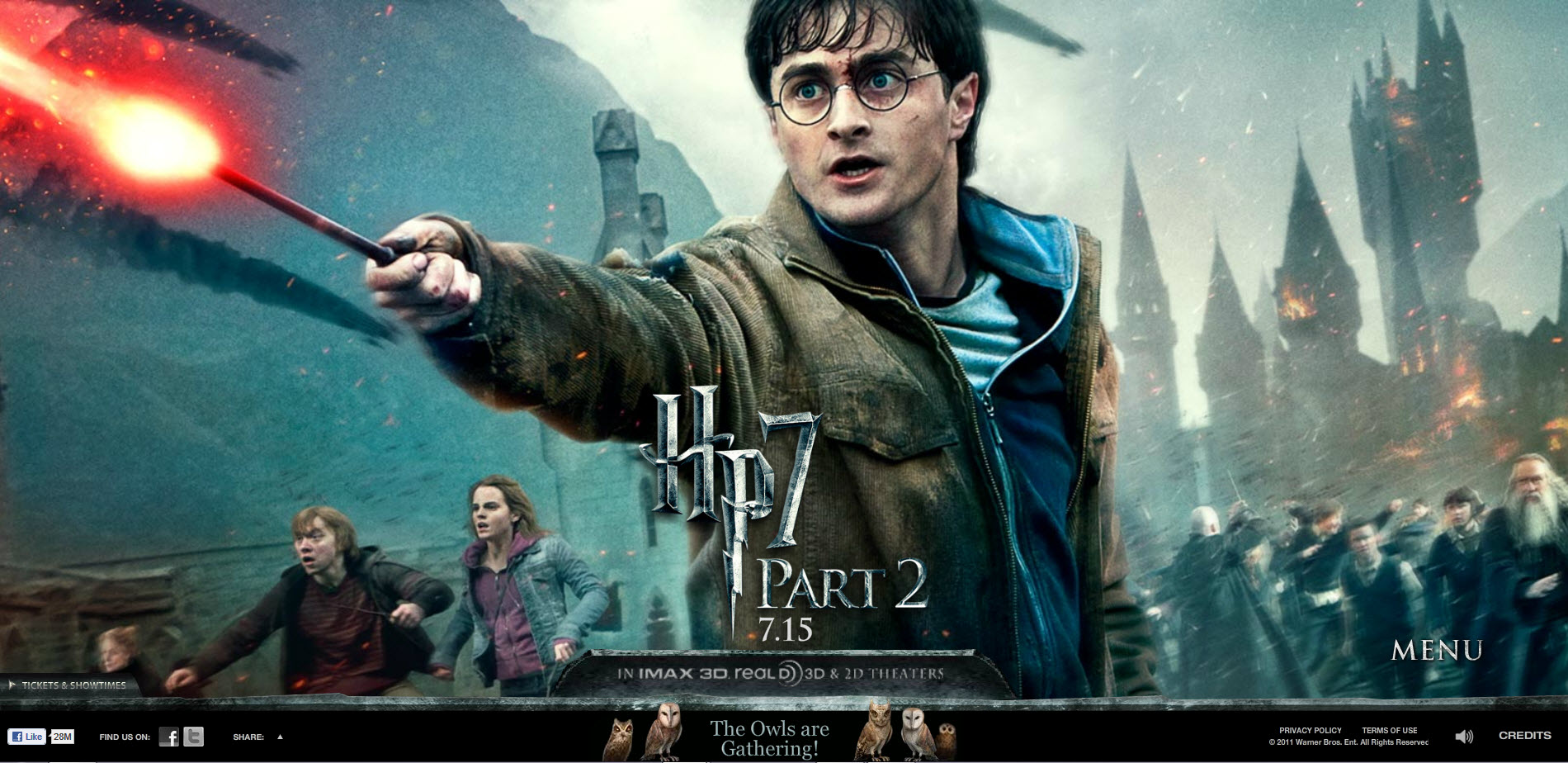
    I went to see the newest Harry Potter movie this weekend.  Apparently a bunch of other people went too, because it conjured up box office records.


    110710 Harry Potter Movie Poster 

    The movie was great.  But what left me in wonder was thinking about how it came to be.  The scope and scale of the series is literally amazing.

    Even just for this movie, the number of people listed on the credits was astounding. 

    Yet, think about how many people were involved in producing the movies, books, and merchandising.  And that's not including the theme parks, promotion, and the eco-system that forms to support a project of this magnitude.

    When did it become real ?

    • Was it when the first book came out?
    • Perhaps it was when J.K. Rowling got a contract to have the book published?
    • Even earlier … how about when she finished writing the book … or
    • Did it happen when she started writing it?

    It is arguable that it became real when she started thinking about it.

    On some level, Rowling probably agrees.  Here is a quote she wrote from Dumbledore, in response to Harry asking whether something was real or happening in his head.

    "Of course it is happening inside your head, Harry; but why on earth should that mean that it is not real?"

    The real magic of creation happens in the mind.

    In a very real sense, there is "infinite possibility" … because in every moment there are an infinite number of possibilities.  To a great extent, though, our automatic habits preclude seeing them.  This may seem to make it is easier to focus on the path taken; but it unconsciously limits the future.

    What would have happened if, back in the early 1990s, J.K. Rowling had the idea for Harry Potter … but thought she couldn't write a book (or even if she did, who would read it?).  Her "new world" didn't exist yet, while her "old world" didn't have a path from there-to-here.

    Einstein460x276Einstein spoke to this. He said:

    You cannot solve a problem from the same consciousness that created it. You must learn to see the world anew.”

    There's magic in choosing a path that energizes you.  Reality is what you bring to it, and what you hold in awareness.

    If you are interested in this, pick up a copy of "Do You QuantumThink? New Thinking That Will Rock Your World" by Dianne Collins. I've been reading it and have found a bunch of interesting concepts and useful tools.

    Enhanced by Zemanta
  • The Magic of Creating Potter

    I went to see the newest Harry Potter movie this weekend.  Apparently a bunch of other people went too, because it conjured up box office records.


    110710 Harry Potter Movie Poster 

    The movie was great.  But what left me in wonder was thinking about how it came to be.  The scope and scale of the series is literally amazing.

    Even just for this movie, the number of people listed on the credits was astounding. 

    Yet, think about how many people were involved in producing the movies, books, and merchandising.  And that's not including the theme parks, promotion, and the eco-system that forms to support a project of this magnitude.

    When did it become real ?

    • Was it when the first book came out?
    • Perhaps it was when J.K. Rowling got a contract to have the book published?
    • Even earlier … how about when she finished writing the book … or
    • Did it happen when she started writing it?

    It is arguable that it became real when she started thinking about it.

    On some level, Rowling probably agrees.  Here is a quote she wrote from Dumbledore, in response to Harry asking whether something was real or happening in his head.

    "Of course it is happening inside your head, Harry; but why on earth should that mean that it is not real?"

    The real magic of creation happens in the mind.

    In a very real sense, there is "infinite possibility" … because in every moment there are an infinite number of possibilities.  To a great extent, though, our automatic habits preclude seeing them.  This may seem to make it is easier to focus on the path taken; but it unconsciously limits the future.

    What would have happened if, back in the early 1990s, J.K. Rowling had the idea for Harry Potter … but thought she couldn't write a book (or even if she did, who would read it?).  Her "new world" didn't exist yet, while her "old world" didn't have a path from there-to-here.

    Einstein460x276Einstein spoke to this. He said:

    You cannot solve a problem from the same consciousness that created it. You must learn to see the world anew.”

    There's magic in choosing a path that energizes you.  Reality is what you bring to it, and what you hold in awareness.

    If you are interested in this, pick up a copy of "Do You QuantumThink? New Thinking That Will Rock Your World" by Dianne Collins. I've been reading it and have found a bunch of interesting concepts and useful tools.

    Enhanced by Zemanta
  • Here a Few Links for Your Weekend Reading

    Here are some of the posts that caught my eye. Hope you find something interesting.

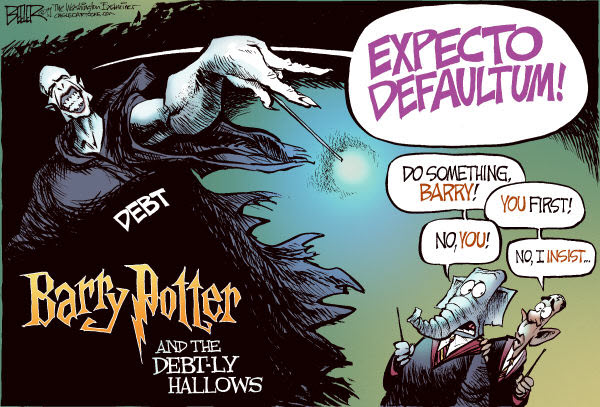
    Two scary things stood out.  U.S. debt is growing to magical proportions … and the final installment of the Harry Potter series, The Deathly Hallows, set box office records.


    Barry Potter and the Debtly Hallows - Beeler 

    Trading Links:

    Lighter Links:

  • Here a Few Links for Your Weekend Reading

    Here are some of the posts that caught my eye. Hope you find something interesting.

    Two scary things stood out.  U.S. debt is growing to magical proportions … and the final installment of the Harry Potter series, The Deathly Hallows, set box office records.


    Barry Potter and the Debtly Hallows - Beeler 

    Trading Links:

    Lighter Links:

  • Expectations are Low for 2nd-Quarter Results

    Recently, corporate earnings and the stock market have thrived, even as the economy has lagged.

    Meanwhile, we continue to get negative Jobs reports.

    Employment Numbers.

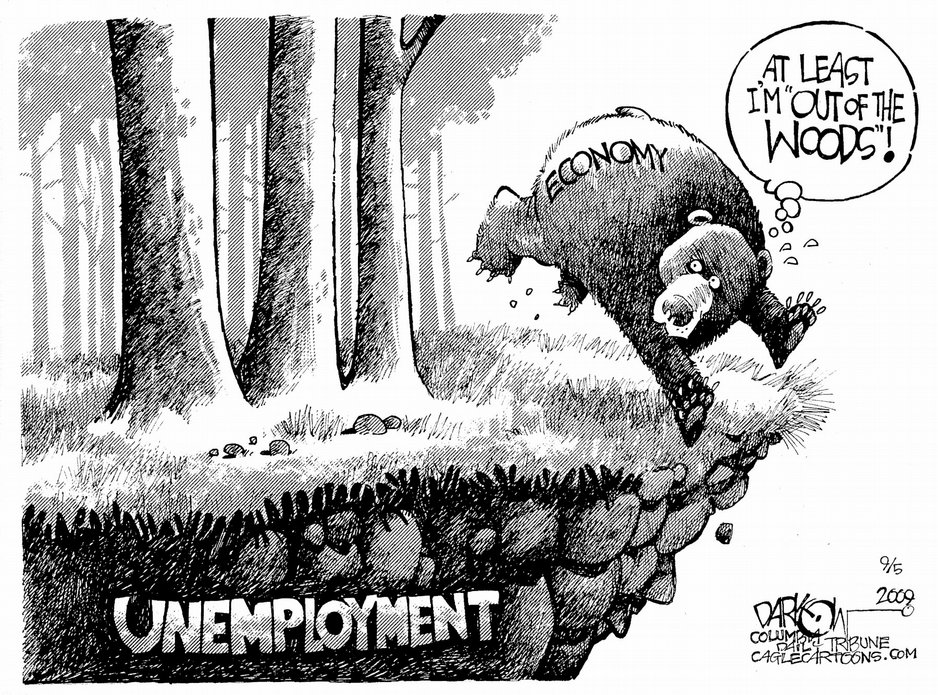
    Troubling unemployment numbers weaken the hopes of economic recovery.  It is worth pointing out that more companies seem to be hiring now.  Nonetheless, the numbers haven't been improving as fast as many would like (especially those still out of work).

     Sat_Edit_Darkow_090509_t938

    Have recent quarterly results (showing corporate profits) been based on cost-cutting, rather than real revenue growth?  If so, the results may not prove sustainable.

    As we move towards Q2 results, revenue will likely be a more telling indicator. This is something that bears watching.

    The Implications of Cost-Cutting.

    Jon Talton put out an interesting post; here is a small excerpt.

    If you missed the news, the new San Francisco-Oakland Bay Bridge is being built in China as modules to be assembled in California. Fourteen million Americans are officially unemployed and the U-6 (real) rate of unemployment in the Golden State is 22 percent.

    The project is, according to the New York Times, "part of China’s continual move up the global economic value chain — from cheap toys to Apple iPads to commercial jetliners — as it aims to become the world’s civil engineer."

    Whatever it is for China, it represents the "Catch-22" many companies (and governments) find themselves facing … how to save money, short-term, even if it has negative long-term consequences.

    Do You Expect to Hear Weak 2nd Quarter Results?

    Bespoke posted some research showing how pessimistic analysts are becoming about earnings.

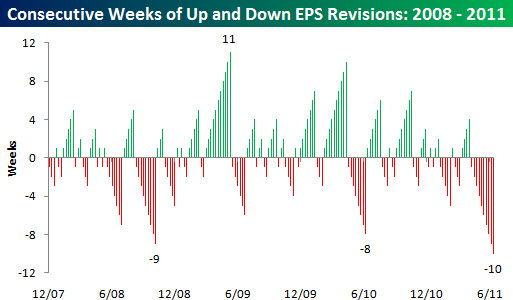
    They track the the number of companies in the S&P 1500 seeing positive and negative EPS revisions in a given week.  In the chart below they calculated the number of consecutive weeks that the net earnings revisions ratio increased or decreased.  

    Green bars indicate consecutive weeks where the revisions ratio increased, while Red bars indicate streaks where the earnings revisions ratio decreased.


    110710 EPS Revisions Up or Down
     

    As shown in the chart, the net earnings revisions ratio has now decreased for 10 consecutive weeks.

    This is the longest such streak of declining analyst sentiment, going back to the end of 2007.  It surpasses even the nine week streak seen in the aftermath of the Lehman bankruptcy.  

    Looking at this data, it is hard to argue that analysts are positive heading into this earnings season.

    Let's Look Under the Surface at Market Breadth.

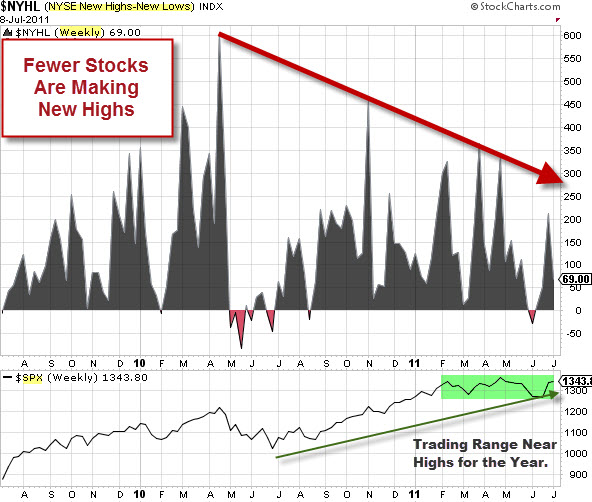
    This chart looks at NSYSE stocks making new 52-week highs, and subtracts the number of NYSE stocks making new 52-week lows. That means we get more Net New Highs when the markets are doing better.


    110710 New Highs Minus New Lows

    As it stands, even though the S&P 500 Index is making highs for the year, there are considerably less Net New Highs than we earlier in the year. While this is a little picky, it does constitute a negative divergence. Consequently, I'm watching what happen in this measure as a potential early indicator of market change.

    Enhanced by Zemanta