
I recently came across an article about an MMORPG called Active Worlds, and it landed more than I expected.
Active Worlds launched in 1995, back when the internet was still something you dialed into. Its original world, AlphaWorld, was an enormous 3D space where people could build houses, cities, monuments, businesses, games—pretty much anything they could imagine. It was one of the earliest attempts to create what we now call a metaverse.
And it is still there. You can log in today and wander around; unfortunately, it’s unlikely you’ll see anyone … though there are still active players.
Across a massive map spanning over 100,000 km, buildings, homes, and other places that once meant something to people still stand. There are memorials. Remnants of communities remain, formed around people who met there decades ago. Some of the people who built these places are still around. Others have died. If you click on an object, you can see when it was placed and by whom.
The world hasn’t necessarily disappeared just because the people did.
There’s something there. Not the emptiness of a video game, A GeoCities page, or an old message board, but closer to walking through an abandoned town.
A Whole New World …
And that distinction is surprisingly powerful, and it makes me think about the metaverse and what other worlds will face similar endings.
We tend to talk about virtual worlds as though they are a new idea. The language changes—metaverse, virtual reality, persistent worlds, immersive internet—but the basic idea has been around for a long time.
Active Worlds came before Second Life. Second Life came before the modern metaverse boom. MMORPGs have been creating persistent societies for decades. Before that, there were MUDs, MOOs, chat rooms, and virtual communities that people treated as real places, even when the graphics were nothing more than text.
The technology keeps getting better. The idea isn’t new.
What may be new is how much of our lives are moving into these spaces.
If the first generation of virtual worlds taught us that people will build communities online, the next generation is teaching us that people will leave things behind online.
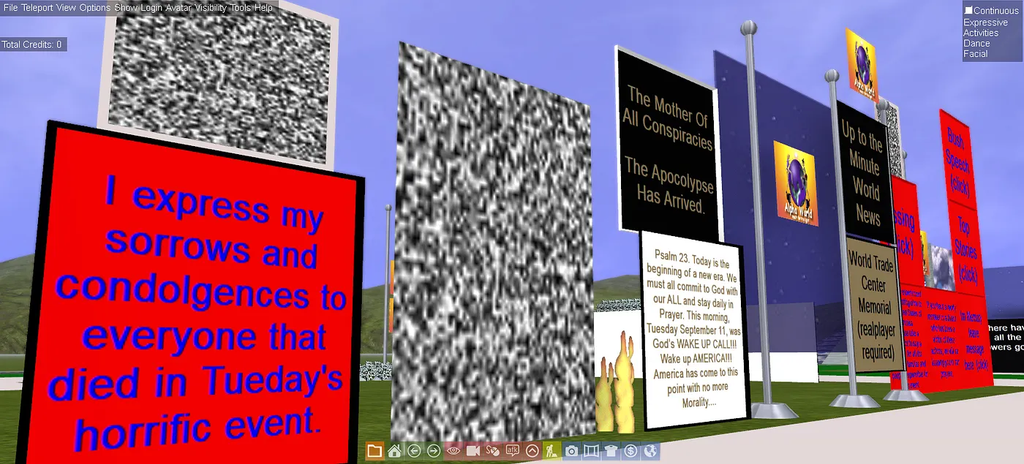
That raises an interesting question: What happens when a virtual world outlives the people who made it?
We already preserve physical places because they tell us something about the people who came before us. We maintain houses, museums, churches, battlefields, and cemeteries. We put plaques on buildings. We protect ruins.
But what happens when the ruin is digital?
A Reminder of Time Past …
Maybe a forgotten virtual house becomes the equivalent of an abandoned farmhouse. Maybe an old player-built city becomes a historical district. Maybe the coordinates of an important gathering place become something like an address in a cemetery.
And then there are the memorials.
There is something almost inevitable about people memorializing the dead in the spaces where they actually lived. Active Worlds has memorialized major events and community members for decades. Its own historical archives contain projects dedicated to preserving early AlphaWorld creations.
Why shouldn’t they?
If someone spent ten years of their life in a virtual community, why would the significance of that community disappear simply because the community wasn’t physical?
We may eventually have to get much more comfortable with the idea that a funeral doesn’t necessarily have to take place in a church, cemetery, or funeral home.
It could happen in a virtual world.
You could visit the house someone built. You could walk through a digital recreation of their favorite place. You could encounter an avatar wearing the clothes they always wore. You could leave flowers somewhere that exists only on a server.
And perhaps, eventually, you could talk to them … well, a digital avatar of them.
This is where AI makes the whole thing considerably stranger.
We are already moving toward a world where AI agents can inhabit digital environments, interact with people, remember conversations, and behave with some degree of continuity. Put one of those agents into a persistent virtual world, and suddenly an empty world doesn’t necessarily have to stay empty.
Imagine exploring an abandoned virtual city twenty years from now and encountering a handful of AI characters.
They aren’t necessarily pretending to be dead people. They might simply be inhabitants designed to keep the world alive. They could run shops. Give tours. Tell stories about the history of the place. Maintain buildings. Organize events.
Or perhaps one day you encounter an AI modeled after someone who actually lived there.
That’s where the philosophical questions get uncomfortable.
Digital “Who” Takes On A New Meaning
If an AI can reproduce someone’s mannerisms, remember their stories, speak in their voice and respond to questions using years of material that person left behind, what exactly are you talking to?
And if that question wasn’t hard enough, what happens when the avatars become indistinguishable from the person?
I don’t know.
And I’m not sure we should rush to answer it.
There is something beautiful about the possibility that the internet will eventually become filled with these strange little mausoleums. Not just websites frozen in time, but entire environments that continue to exist long after their original communities have faded.
Some will be preserved intentionally.
Others will simply be forgotten.
Some may become popular tourist destinations for people who weren’t even alive when they were created. Others may sit quietly on servers, visited by a handful of curious people every year.
And some may be populated by machines that make them feel alive again.
That last possibility is especially interesting.
We’ve spent decades trying to make virtual worlds feel more real by improving graphics, physics, and hardware. Maybe the next step isn’t making the world look more realistic.
Maybe it’s making it feel inhabited.
Which raises another strange possibility: perhaps the future of virtual worlds isn’t one enormous metaverse where everyone gathers together.
Maybe it’s millions of little worlds.

Some bustling. Some private. Some commercial.
And every once in a while, someone will stumble across one.
They’ll walk down an empty road, find a house someone built thirty years earlier, read a name on a memorial, and wonder who these people were.
They’ll be exploring the ruins of a civilization that never physically existed.
Except, of course, it did.
It doesn’t have to be tangible to have left a meaningful impact.
There’s a business in that gap. Somebody will build the equivalent of a cemetery trust for digital worlds — perpetual hosting, curated access, maybe even AI caretakers, sold the way we sell burial plots and estate planning today. Somebody else will build the opposite: a service that guarantees your digital footprint disappears on schedule, for people who’d rather not become a tourist attraction someday.
Neither exists yet at scale. Both are investable ideas.
As we reconcile with a rapidly evolving set of technologies, we’ll need markets and products for digital legacies — not just philosophy.
Leave a Reply