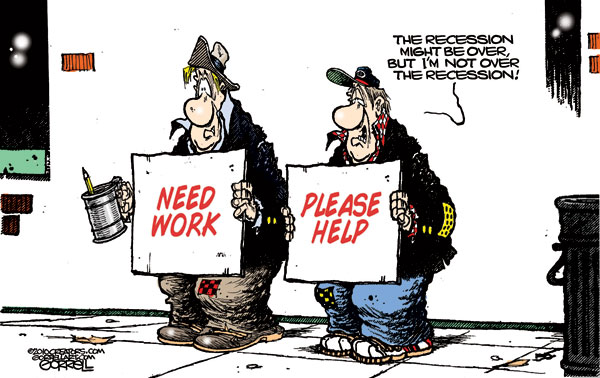
Earlier this week, the National Bureau of Economic Research (the official arbiter of recession dates) declared that the recession that began in December 2007, ended in June 2009.
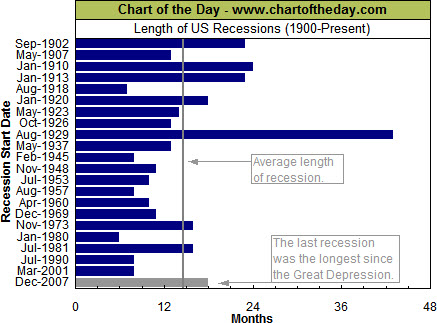
For some perspective on the recession just past (a.k.a. the "Great Recession"), Chart of the Day illustrates the duration of all US recessions since 1900. There are a couple points of interest. Of the 22 recessions that occurred over the past 110 years, the most recent recession is tied for fifth in terms of duration. It is also worth noting that the recession just passed was above average in duration and the longest since the Great Depression.
Well, now that the Great Recession is over, the rest should be easy … right?
What About the Economy – How Did It Do in the Third Quarter?
Clearly, unemployment and housing are two issues that need to improve to kickstart the economy. Moreover, economic growth in the second quarter slowed to an anemic 1.6% from 5.0% in the December quarter, and 3.7% in the first quarter.
Because of this, the Fed has now signaled next round of Quantitative Easing, which likely will send the U.S. Dollar and bond yields to new lows, while sending stock and commodity prices materially higher.
Do You Care if the Market Moves Because of Intervention?
From my perspective, it doesn't matter that intervention is taking the place of the invisible hand and free-market pricing. From a traders perspectives, price is price. And, as I've discussed before, it also makes sense from a practical standpoint. If intervention is the policy, then it is best for it to happen during periods of slow market activity (because it's easier and cheaper to accomplish with less resistance).
Nonetheless, it's also interesting to note how little organic buying and selling is happening in the equity markets. If you remove the moves made by (or on behalf of) governments, the trading required by ETF's or indexes, and the volume that simply comes from program trading or high-frequency trading … there's really not a lot of interest in the equity market right now.
In contrast, however, asset classes like gold and bonds are seeing a lot of interest.
But, if you are looking for something positive, remember that the "powers that be" officially declared the recession over.
Earlier this week, the National Bureau of Economic Research (the official arbiter of recession dates) declared that the recession that began in December 2007, ended in June 2009.
For some perspective on the recession just past (a.k.a. the "Great Recession"), Chart of the Day illustrates the duration of all US recessions since 1900. There are a couple points of interest. Of the 22 recessions that occurred over the past 110 years, the most recent recession is tied for fifth in terms of duration. It is also worth noting that the recession just passed was above average in duration and the longest since the Great Depression.
Well, now that the Great Recession is over, the rest should be easy … right?
What About the Economy – How Did It Do in the Third Quarter?
Clearly, unemployment and housing are two issues that need to improve to kickstart the economy. Moreover, economic growth in the second quarter slowed to an anemic 1.6% from 5.0% in the December quarter, and 3.7% in the first quarter.
Because of this, the Fed has now signaled next round of Quantitative Easing, which likely will send the U.S. Dollar and bond yields to new lows, while sending stock and commodity prices materially higher.
Do You Care if the Market Moves Because of Intervention?
From my perspective, it doesn't matter that intervention is taking the place of the invisible hand and free-market pricing. From a traders perspectives, price is price. And, as I've discussed before, it also makes sense from a practical standpoint. If intervention is the policy, then it is best for it to happen during periods of slow market activity (because it's easier and cheaper to accomplish with less resistance).
Nonetheless, it's also interesting to note how little organic buying and selling is happening in the equity markets. If you remove the moves made by (or on behalf of) governments, the trading required by ETF's or indexes, and the volume that simply comes from program trading or high-frequency trading … there's really not a lot of interest in the equity market right now.
In contrast, however, asset classes like gold and bonds are seeing a lot of interest.
But, if you are looking for something positive, remember that the "powers that be" officially declared the recession over.
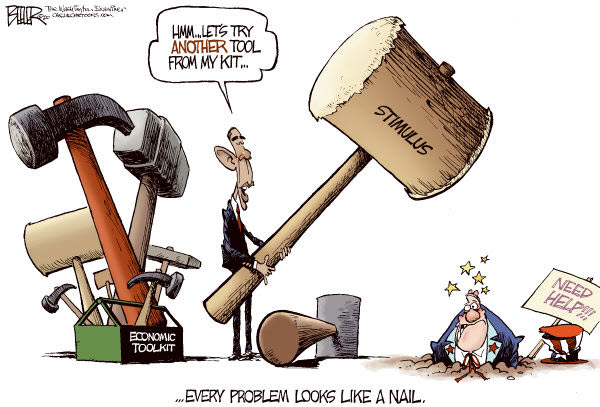
When you have a hammer … every problem looks like a nail.
Why Do the Big Gains Come on Monday Mornings?
Bespoke posted an interesting piece that points out that much of the market gains this year occurred on Monday morning gaps. Since the start of the year, there have been 11 times that the S&P 500 index gapped higher by at least 0.5% to start the week. Looking at the equity market's performance for the rest of the day and the rest of the week shows a mixed picture.
How can you explain the government's continued interventions? If the government believes that intervening in the market is in the public's best interest, then the best way to push the market higher is to do it during light futures trading periods (like weekends or after-hours). Why? Because it takes less capital (and thus costs less to do it) after-hours than it would have during periods of thicker trading.
Remember, this is a free market; so if the market "disagrees" with the push higher, then sellers can freely take their profits or positions. The bigger issue, here, is that even though the markets have been pushed higher, we still haven't gotten to the point that triggers selling volume.
Monday seems like a good time to expect the next gap up. It would likely get prices above the clearly drawn line in the sand.
What Do the Charts Show?
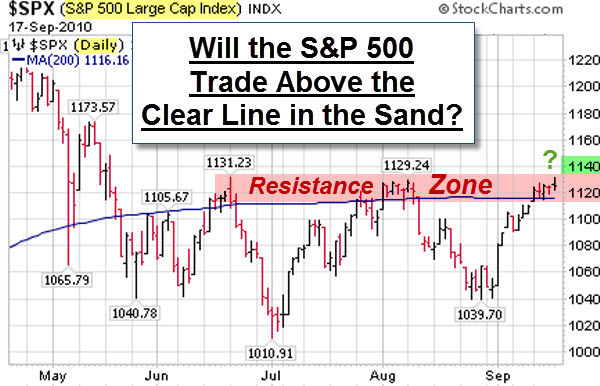
The S&P 500 is testing the top of its four month trading range, sitting just under resistance. Will the third time be the charm, or will there be a sell-off from this triple-top ?
The past two times we saw failed rally attempts on declining volume before the market cratered. A sustained move above the 1140 level will likely give the index plenty of room to rally. We'll see.
Sentiment Has Flipped to Bullish.
The American Association of Individual Investors (AAII) sentiment survey is interesting to watch. Retail investors are notoriously wrong at market turning points. Consequently, many look at extreme readings of the AAII Sentiment Survey as a contrary indicator. So, where is it now?
Bullish sentiment (meaning expectations that stock prices will rise over the next six months) rose 7.0 percentage points to 50.9%. This is the highest level of optimism since August 13, 2009. The historical average is 39%.
Bearish sentiment (meaning expectations that stock prices will fall over the next six months) fell 7.4 percentage points to 24.3%. This is the lowest level of pessimism since December 31, 2009.
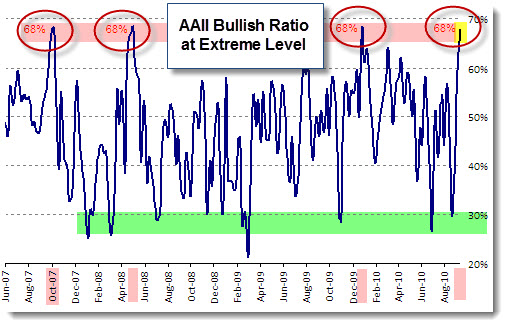
Not only is the data at extreme levels, it also represents an abrupt sentiment reversal. Just four weeks ago in the late August reading of the AAII Bull Ratio (the percentage of bulls divided by the percentage of bulls and bear) fell below 30%. That level of pessimism is often seen at the turning point of significant market bottoms.
In contrast, now we are seeing the opposite side of the sentiment spectrum. The current reading of 51% bulls and only 24% bears, results in a bull ratio of 68% – the highest for the whole year. That level of optimism is often seen at the turning point of significant market tops.
As you can see on the chart, in recent years, we’ve seen this level reached only a handful of times: in late December 2009, May 2008, and October 2007. A quick glance at the chart of the S&P 500 will tell you that all of those instances were much better times for selling rather than buying.
Another market getting a lot of attention lately is Gold.
Soros: Gold "Not Safe".
Billionaire financier George Soros said last week that while gold prices might continue to rise after hitting record highs, he renewed a warning that gold is the "ultimate bubble". With economic and fiscal weakness crimping the developed world, Soros said all investments are at risk because "this is a period of great uncertainty so nothing is very safe." For more of his observations, watch this video.
When you have a hammer … every problem looks like a nail.
Why Do the Big Gains Come on Monday Mornings?
Bespoke posted an interesting piece that points out that much of the market gains this year occurred on Monday morning gaps. Since the start of the year, there have been 11 times that the S&P 500 index gapped higher by at least 0.5% to start the week. Looking at the equity market's performance for the rest of the day and the rest of the week shows a mixed picture.
How can you explain the government's continued interventions? If the government believes that intervening in the market is in the public's best interest, then the best way to push the market higher is to do it during light futures trading periods (like weekends or after-hours). Why? Because it takes less capital (and thus costs less to do it) after-hours than it would have during periods of thicker trading.
Remember, this is a free market; so if the market "disagrees" with the push higher, then sellers can freely take their profits or positions. The bigger issue, here, is that even though the markets have been pushed higher, we still haven't gotten to the point that triggers selling volume.
Monday seems like a good time to expect the next gap up. It would likely get prices above the clearly drawn line in the sand.
What Do the Charts Show?
The S&P 500 is testing the top of its four month trading range, sitting just under resistance. Will the third time be the charm, or will there be a sell-off from this triple-top ?
The past two times we saw failed rally attempts on declining volume before the market cratered. A sustained move above the 1140 level will likely give the index plenty of room to rally. We'll see.
Sentiment Has Flipped to Bullish.
The American Association of Individual Investors (AAII) sentiment survey is interesting to watch. Retail investors are notoriously wrong at market turning points. Consequently, many look at extreme readings of the AAII Sentiment Survey as a contrary indicator. So, where is it now?
Bullish sentiment (meaning expectations that stock prices will rise over the next six months) rose 7.0 percentage points to 50.9%. This is the highest level of optimism since August 13, 2009. The historical average is 39%.
Bearish sentiment (meaning expectations that stock prices will fall over the next six months) fell 7.4 percentage points to 24.3%. This is the lowest level of pessimism since December 31, 2009.
Not only is the data at extreme levels, it also represents an abrupt sentiment reversal. Just four weeks ago in the late August reading of the AAII Bull Ratio (the percentage of bulls divided by the percentage of bulls and bear) fell below 30%. That level of pessimism is often seen at the turning point of significant market bottoms.
In contrast, now we are seeing the opposite side of the sentiment spectrum. The current reading of 51% bulls and only 24% bears, results in a bull ratio of 68% – the highest for the whole year. That level of optimism is often seen at the turning point of significant market tops.
As you can see on the chart, in recent years, we’ve seen this level reached only a handful of times: in late December 2009, May 2008, and October 2007. A quick glance at the chart of the S&P 500 will tell you that all of those instances were much better times for selling rather than buying.
Another market getting a lot of attention lately is Gold.
Soros: Gold "Not Safe".
Billionaire financier George Soros said last week that while gold prices might continue to rise after hitting record highs, he renewed a warning that gold is the "ultimate bubble". With economic and fiscal weakness crimping the developed world, Soros said all investments are at risk because "this is a period of great uncertainty so nothing is very safe." For more of his observations, watch this video.
Even my dog understands when I give him certain commands. Shouldn’t my computer be at least that smart?
I'm always on the lookout for software that promises to reduce repetitive tasks and save time. Lately, I’ve been using PhraseExpress from Bartels Media. With it, my computer behaves the way I want it to, and acts smarter than it did before.
First things first … the obvious use of PhraseExpress is to create shortcuts for commonly used words and phrases.
There are certain phrases that you probably type over-and-over again. Some of them are short, like your name; others are little longer, like the name of your website or the way you sign your name at the end of an e-mail. Then there are phrases that are considerably longer than that, yet are still something that you end up using considerably more often than you like typing it. Well, it turns out you don't have to type it anymore.
For example, if I type "fyit", PhraseExpress replaces that with "for your information, I thought you might want to see this …" and then adds my signature. Another one I use often is “ttc”, which expands to "Thank you for your time and consideration." Realize, though, that you can add whatever phrases work for you. During the course of a week, PhraseExpress saves me thousands of keystrokes and a considerable amount of time.
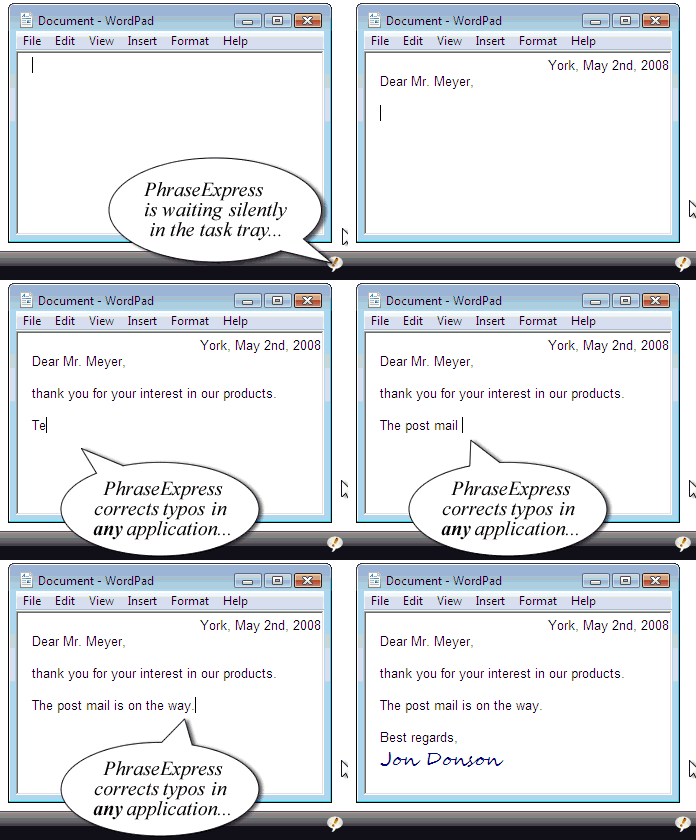
A related feature is to create replacement text to correct certain words that I commonly mistype or misspell. My fingers don't always go where they should, but at least I'm consistent about it. That means if I somehow transpose a letter, the correct spelling ends up in the document without me having to slow down, backup, or lose focus.
It Starts Saving You Time As Soon As You Install It.
PhraseExpress works as soon as you install it, because it comes with thousands of pre-built text replacements and phrases. The real power, however, is that you can add your own information and customize what's there as much as you want.
In addition to the phrases that come with the software, Bartels also offers several free add-on modules for you to download and install. One of these allows you to do math. So if you type “20+80 =” that will pop up a box letting you replace that with the answer — or you can ignore it and keep typing. Another feature can translate date math; so, "two days from now" could convert and insert the correct day and date into your document. I created a phrase so that "dd" inserts the current date; frankly, I use that considerably more than I thought I would. For practical puproses, your imagination is the only limit.
I See You, I Know You … And I Can Guess Your Command.
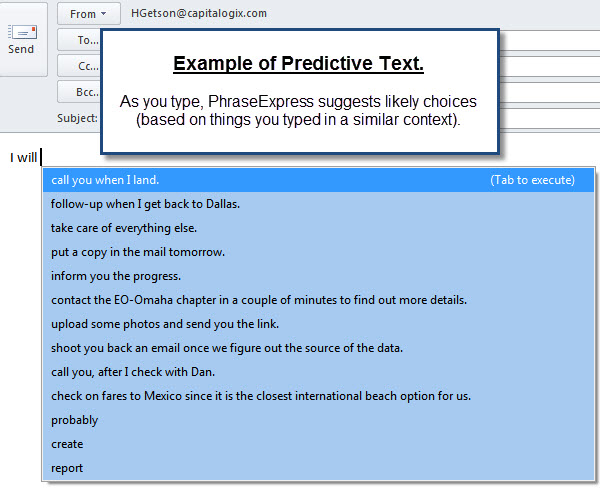
The second major feature that PhraseExpress offers is a predictive text capability that remembers what you typed before, and suggests a word or phrase that you've typed several times in that situation.
At first, I was skeptical that I would appreciate that feature. Now, it's something I look forward to and appreciate each time it pops up. The predictive text feature continues to get smarter the more you use it. Here is an example captured while using e-mail.
Taking Automation to the Next Level.
Another PhraseExpress feature worth noting is its surprisingly full-featured scripting language. This allows you to automate a repetitive task, even if it contains multiple steps. It can be as simple as forwarding an e-mail to a certain group of people, or something that reduces a series of tasks that used to take me close to half an hour – but with the PhraseExpress script now gets done in about a minute without any intervention on my part.
Another way I use scripting is to add a random thought to ponder to my e-mail signature. Any time I see a quote or idea that I want to save, it only takes a few keystrokes to add it to my collection. And then a simple script allows me to randomly add one of those "thoughts to ponder" to my e-mail signature.
Words Are Powerful.
Words are powerful, and they're easier to remember than complex commands like “Control-Shift-F5”. So, I like that I can assign short words or phrases to trigger the actions I want. I'm way more likely to remember it, and that means I'm way more likely to use it.
You can use the basic version of PhraseExpress at no cost. However, a quick trial will easily justify the purchase of a more powerful version.
The best thing about PhraseExpress is that I forget it's there … and it continues to work saving time, money, and frustration. Another great thing about it is that it's easy to add phrases or customize the way it works. After it is broken in, it naturally fits you and the way you work. Finally, I appreciate how responsive the company has been in providing support and listening to feature requests.
Bottom-Line: PhraseExpress is a terrific piece of software. It is a very well designed and intuitive program that removes many of the frustrations you face sitting in front of your computer each day.
Even my dog understands when I give him certain commands. Shouldn’t my computer be at least that smart?
I'm always on the lookout for software that promises to reduce repetitive tasks and save time. Lately, I’ve been using PhraseExpress from Bartels Media. With it, my computer behaves the way I want it to, and acts smarter than it did before.
First things first … the obvious use of PhraseExpress is to create shortcuts for commonly used words and phrases.
There are certain phrases that you probably type over-and-over again. Some of them are short, like your name; others are little longer, like the name of your website or the way you sign your name at the end of an e-mail. Then there are phrases that are considerably longer than that, yet are still something that you end up using considerably more often than you like typing it. Well, it turns out you don't have to type it anymore.
For example, if I type "fyit", PhraseExpress replaces that with "for your information, I thought you might want to see this …" and then adds my signature. Another one I use often is “ttc”, which expands to "Thank you for your time and consideration." Realize, though, that you can add whatever phrases work for you. During the course of a week, PhraseExpress saves me thousands of keystrokes and a considerable amount of time.
A related feature is to create replacement text to correct certain words that I commonly mistype or misspell. My fingers don't always go where they should, but at least I'm consistent about it. That means if I somehow transpose a letter, the correct spelling ends up in the document without me having to slow down, backup, or lose focus.
It Starts Saving You Time As Soon As You Install It.
PhraseExpress works as soon as you install it, because it comes with thousands of pre-built text replacements and phrases. The real power, however, is that you can add your own information and customize what's there as much as you want.
In addition to the phrases that come with the software, Bartels also offers several free add-on modules for you to download and install. One of these allows you to do math. So if you type “20+80 =” that will pop up a box letting you replace that with the answer — or you can ignore it and keep typing. Another feature can translate date math; so, "two days from now" could convert and insert the correct day and date into your document. I created a phrase so that "dd" inserts the current date; frankly, I use that considerably more than I thought I would. For practical puproses, your imagination is the only limit.
I See You, I Know You … And I Can Guess Your Command.
The second major feature that PhraseExpress offers is a predictive text capability that remembers what you typed before, and suggests a word or phrase that you've typed several times in that situation.
At first, I was skeptical that I would appreciate that feature. Now, it's something I look forward to and appreciate each time it pops up. The predictive text feature continues to get smarter the more you use it. Here is an example captured while using e-mail.
Taking Automation to the Next Level.
Another PhraseExpress feature worth noting is its surprisingly full-featured scripting language. This allows you to automate a repetitive task, even if it contains multiple steps. It can be as simple as forwarding an e-mail to a certain group of people, or something that reduces a series of tasks that used to take me close to half an hour – but with the PhraseExpress script now gets done in about a minute without any intervention on my part.
Another way I use scripting is to add a random thought to ponder to my e-mail signature. Any time I see a quote or idea that I want to save, it only takes a few keystrokes to add it to my collection. And then a simple script allows me to randomly add one of those "thoughts to ponder" to my e-mail signature.
Words Are Powerful.
Words are powerful, and they're easier to remember than complex commands like “Control-Shift-F5”. So, I like that I can assign short words or phrases to trigger the actions I want. I'm way more likely to remember it, and that means I'm way more likely to use it.
You can use the basic version of PhraseExpress at no cost. However, a quick trial will easily justify the purchase of a more powerful version.
The best thing about PhraseExpress is that I forget it's there … and it continues to work saving time, money, and frustration. Another great thing about it is that it's easy to add phrases or customize the way it works. After it is broken in, it naturally fits you and the way you work. Finally, I appreciate how responsive the company has been in providing support and listening to feature requests.
Bottom-Line: PhraseExpress is a terrific piece of software. It is a very well designed and intuitive program that removes many of the frustrations you face sitting in front of your computer each day.
President Obama promised to roll-out “new ideas” to boost growth and spur hiring during an economy-focused trip to the Midwest. He says the economy is moving in “the right direction; we just have to speed it up.”
Consequently, the President is asking Congress to help small businesses by passing legislation that includes $12 billion in tax breaks and $30 billion worth of aid to free up credit. The question, of course, is whether the White House can turn these ideas into a political reality.
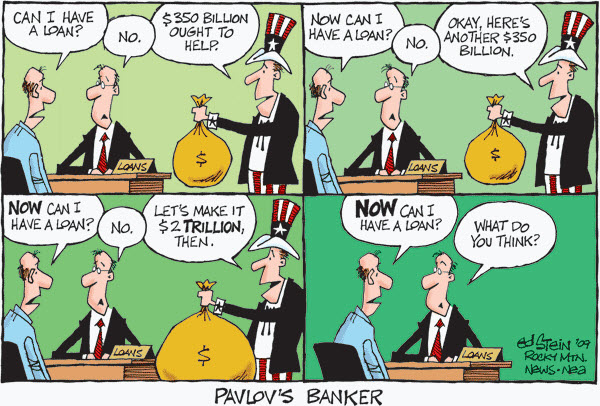
Seems to me I've seen this play a few times.
Ed Stein reminds: "Every time these guys refuse to lend money, the government ponies up more billions. If it were me, I'd keep playing that game until the Treasury was empty, which apparently is exactly what the bankers are doing. There's a reason why they're rich."
Market Commentary
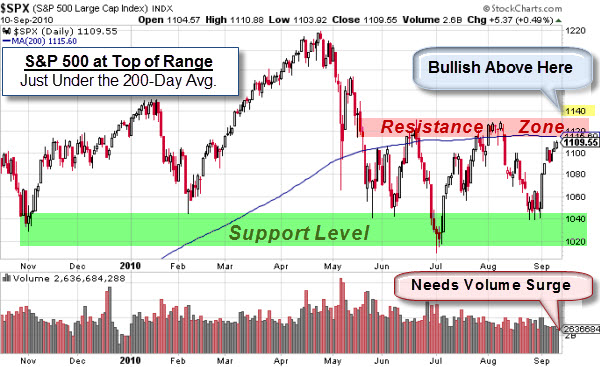
The markets continued higher on light trading. We are coming into the top of the consolidation zone.
There is not much to say, other than we are approaching a clear decision-zone. A sustained move above the 1040 level will most likely trigger some real buying.
Sign of the Times: McDonalds Hitting All-Time High.
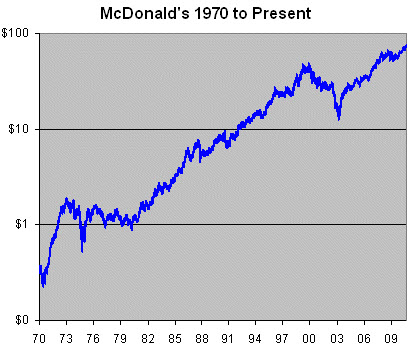
Here is something we haven't seen often lately, a stock hitting all-time highs. Well, McDonalds recently hit $75.13 which is a long way from the $13 it hit in 2003. Must be the special sauce?
Successful Patterns.
Why do patterns work?
Elephants leave tracks … and smart traders follow the big money.
Large traders like governments, sovereign wealth funds, or a mutual fund can affect markets while they buy or sell; however, when they're done, some other group's strategy becomes the dominant force.
It is important to understand "who is in control" … not necessarily why they are trading.
That means you don't have to figure out every bit of information or rationale behind their strategy in order to make money.
For example, if you were about to walk into a movie theater, but were suddenly confronted with hundreds of people running in the other direction screaming, you don't have to understand exactly why it's happening in order to respond intelligently.
On a superficial level, that's the basis of trend following. It is also an example of pattern recognition.
President Obama promised to roll-out “new ideas” to boost growth and spur hiring during an economy-focused trip to the Midwest. He says the economy is moving in “the right direction; we just have to speed it up.”
Consequently, the President is asking Congress to help small businesses by passing legislation that includes $12 billion in tax breaks and $30 billion worth of aid to free up credit. The question, of course, is whether the White House can turn these ideas into a political reality.
Seems to me I've seen this play a few times.
Ed Stein reminds: "Every time these guys refuse to lend money, the government ponies up more billions. If it were me, I'd keep playing that game until the Treasury was empty, which apparently is exactly what the bankers are doing. There's a reason why they're rich."
Market Commentary
The markets continued higher on light trading. We are coming into the top of the consolidation zone.
There is not much to say, other than we are approaching a clear decision-zone. A sustained move above the 1040 level will most likely trigger some real buying.
Sign of the Times: McDonalds Hitting All-Time High.
Here is something we haven't seen often lately, a stock hitting all-time highs. Well, McDonalds recently hit $75.13 which is a long way from the $13 it hit in 2003. Must be the special sauce?
Successful Patterns.
Why do patterns work?
Elephants leave tracks … and smart traders follow the big money.
Large traders like governments, sovereign wealth funds, or a mutual fund can affect markets while they buy or sell; however, when they're done, some other group's strategy becomes the dominant force.
It is important to understand "who is in control" … not necessarily why they are trading.
That means you don't have to figure out every bit of information or rationale behind their strategy in order to make money.
For example, if you were about to walk into a movie theater, but were suddenly confronted with hundreds of people running in the other direction screaming, you don't have to understand exactly why it's happening in order to respond intelligently.
On a superficial level, that's the basis of trend following. It is also an example of pattern recognition.
The "invisible hand" is becoming replaced with a much more easily seen and felt version, and I suspect people are not only noticing … but adjusting.
At this point, I'm not sure if people (or the "market") want more or less intervention. For example, The Financial Times reports that the Fed minutes released last week fueled recovery fears because the meeting notes raise questions about whether the Fed has ruled out large-scale asset purchases. (FT)
Apparently, the powers-that-be still have some things in their bag-of-tricks. Early last week I posted a Tweet saying that big market drops on low volume have been the trigger for Plunge Protection activity. Not to disappoint, we got the requisite ramp-up. The question is whether we'll get real follow-on buying?
Market Commentary.
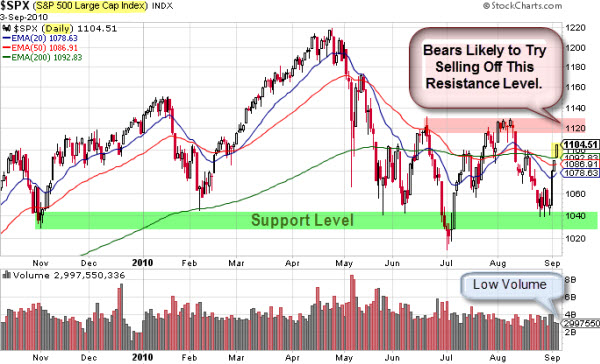
Last week was technically stronger than I originally thought. Why? Because both the S&P 500 and Nasdaq indices moved above their 20-, 50- and 200-day exponential moving averages. That isn't a common technical happening. Getting through a single moving average often proves difficult; so getting through all three major moving averages at once is something worth noting. Now let's see the reaction.
The short-term average is below the mid-term average, which is still below the long-term average. In English, that means we are probably still in a down-trend. Consequently, I'll be watching the resistance zone market by the pink highlight. If bears mount a challenge to the recent push higher, that would be a likely spot for the reversal. Otherwise, a break above that level could easily test the May highs.
How Does Employment Effect the Outlook?
It is a little ironic to talk about this on Labor Day weekend; nonetheless, we got more bad employment data last week. The best I can say about it is that it wasn't met with selling.
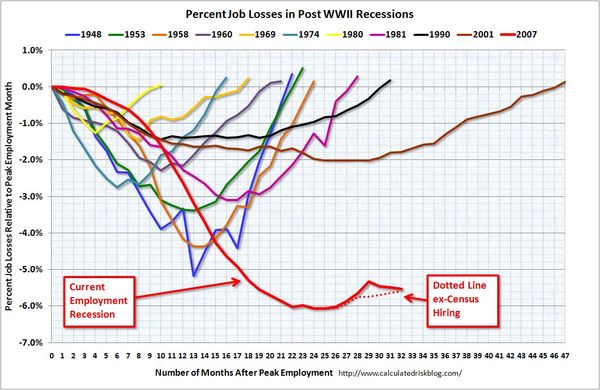
First, we'll look at the percent of job losses during various recession. The following chart shows that our current job situation stands out and speaks for itself. This chart also highlights the effects of census hiring as well as the extremely weak hiring in this recovery.
The dotted lines tell the real story about how pathetic the jobs recovery has been so far. Bear in mind it has taken $$ Trillions in stimulus to produce this.
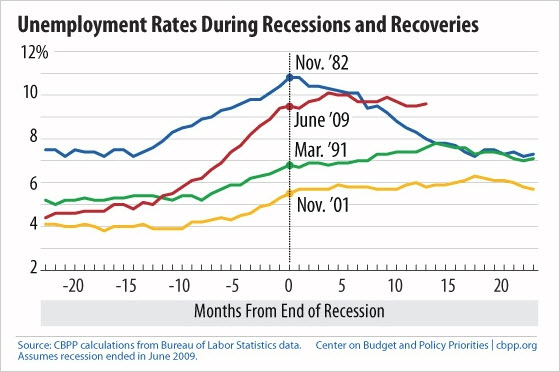
Second, the chart below shows the unemployment rates during recessions and recoveries. Notice that there has not been any recovery in the labor market. Unemployment has actually deteriorated when compared to the end of past recessions.
According to the Pragmatic Capitalist, without a recovery in the labor markets, it’s impossible to say that the economy is rebounding. As of now, the outlook remains negative.
However, without sellers, that increasingly visible hand can continue to push the markets higher. As summer (and slow trading) comes to an end, it will be interesting to see what happens next.
The "invisible hand" is becoming replaced with a much more easily seen and felt version, and I suspect people are not only noticing … but adjusting.
At this point, I'm not sure if people (or the "market") want more or less intervention. For example, The Financial Times reports that the Fed minutes released last week fueled recovery fears because the meeting notes raise questions about whether the Fed has ruled out large-scale asset purchases. (FT)
Apparently, the powers-that-be still have some things in their bag-of-tricks. Early last week I posted a Tweet saying that big market drops on low volume have been the trigger for Plunge Protection activity. Not to disappoint, we got the requisite ramp-up. The question is whether we'll get real follow-on buying?
Market Commentary.
Last week was technically stronger than I originally thought. Why? Because both the S&P 500 and Nasdaq indices moved above their 20-, 50- and 200-day exponential moving averages. That isn't a common technical happening. Getting through a single moving average often proves difficult; so getting through all three major moving averages at once is something worth noting. Now let's see the reaction.
The short-term average is below the mid-term average, which is still below the long-term average. In English, that means we are probably still in a down-trend. Consequently, I'll be watching the resistance zone market by the pink highlight. If bears mount a challenge to the recent push higher, that would be a likely spot for the reversal. Otherwise, a break above that level could easily test the May highs.
How Does Employment Effect the Outlook?
It is a little ironic to talk about this on Labor Day weekend; nonetheless, we got more bad employment data last week. The best I can say about it is that it wasn't met with selling.
First, we'll look at the percent of job losses during various recession. The following chart shows that our current job situation stands out and speaks for itself. This chart also highlights the effects of census hiring as well as the extremely weak hiring in this recovery.
The dotted lines tell the real story about how pathetic the jobs recovery has been so far. Bear in mind it has taken $$ Trillions in stimulus to produce this.
Second, the chart below shows the unemployment rates during recessions and recoveries. Notice that there has not been any recovery in the labor market. Unemployment has actually deteriorated when compared to the end of past recessions.
According to the Pragmatic Capitalist, without a recovery in the labor markets, it’s impossible to say that the economy is rebounding. As of now, the outlook remains negative.
However, without sellers, that increasingly visible hand can continue to push the markets higher. As summer (and slow trading) comes to an end, it will be interesting to see what happens next.