This is a cool video. Watch as boiled water is thrown into the -30°Celsius air … where it instantly "freezes" and transforms into a snowy fog. Clearly this is one of the joys of living in the Northwest Territories of Canada.
In contrast, one of the joys of living in Dallas is that water usually splashes rather than freezes.
Usually.
Nonetheless, on Super Bowl weekend, we have a "man plans while God laughs" kind of situation. With everyone in town for the big event, we're at a virtual stand-still because ice is so rare, here, that we don’t have sanding, salting or scraping capabilities.
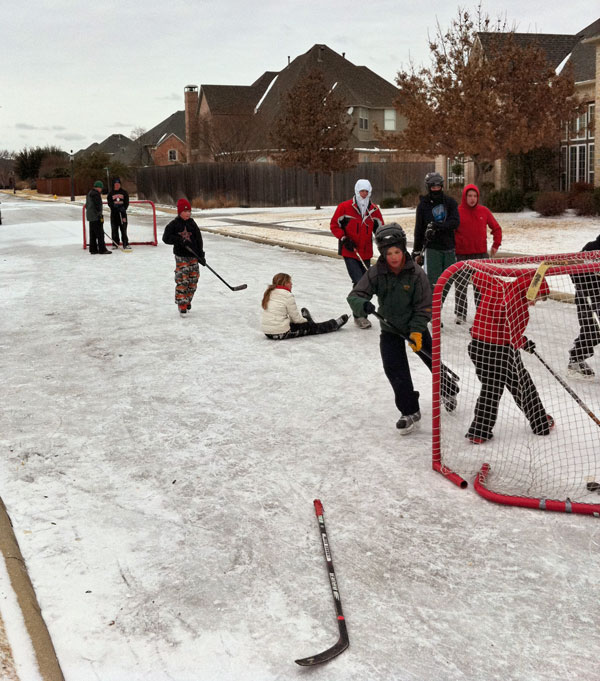
Here is a picture of kids playing Street Hockey on ice skates in front of my house in a Dallas suburb.
This is a cool video. Watch as boiled water is thrown into the -30°Celsius air … where it instantly "freezes" and transforms into a snowy fog. Clearly this is one of the joys of living in the Northwest Territories of Canada.
In contrast, one of the joys of living in Dallas is that water usually splashes rather than freezes.
Usually.
Nonetheless, on Super Bowl weekend, we have a "man plans while God laughs" kind of situation. With everyone in town for the big event, we're at a virtual stand-still because ice is so rare, here, that we don’t have sanding, salting or scraping capabilities.
Here is a picture of kids playing Street Hockey on ice skates in front of my house in a Dallas suburb.
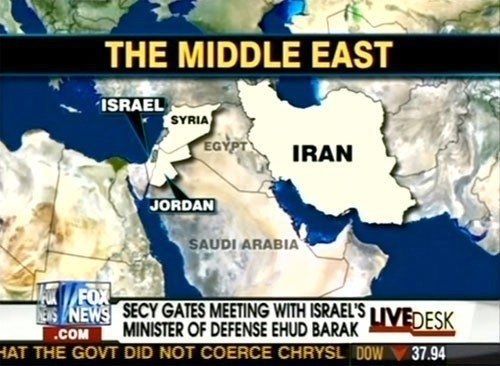
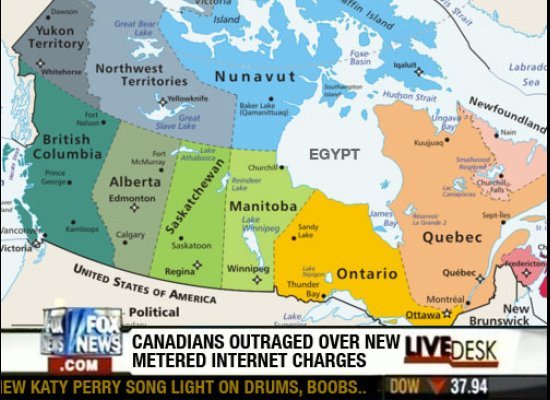
That country is actually Iraq. Egypt is in Africa. That's not even the same continent. Granted, most of us wouldn't know that either. That's why we occasionally watch the news — in the hopes that they know where countries are. (via SomeEcards)
That country is actually Iraq. Egypt is in Africa. That's not even the same continent. Granted, most of us wouldn't know that either. That's why we occasionally watch the news — in the hopes that they know where countries are. (via SomeEcards)
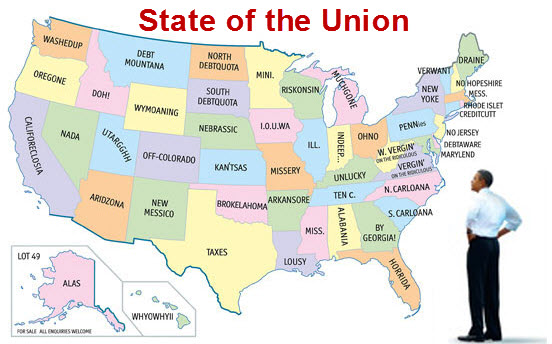
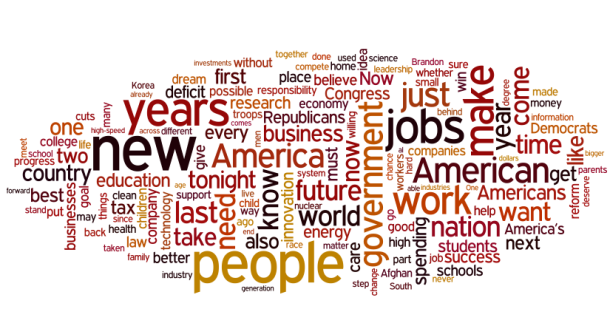
President Obama used different words to describe the State of the Union from his perspective. Here is a Word Cloud.
According to CBS News, President Obama's State of the Union speech included more than 6,500 words, led by variations on "America," "people," "new" and "jobs," with "future," "work" and "years" also high in the word count. While word repetition doesn't offer any deep analysis of the speech, the broad message is clear: "American people need new jobs and work in future years."
Market Commentary
The Markets were ripe for a pull-back. I say that only because the climb higher has seemed un-relenting, in the face of good or bad news. Recently, technical indicators showed some underlying weakness, but price marched forward. Finally, this past week, we saw some selling pressure.
The real question isn't whether buyers will step back in, rather, it is whether sellers will apply some pressure.
Last week we got a GDP number that wasn't great, but it wasn't terrible either. Combine that with the political unrest in Egypt, and some less than stellar earnings reports … and the pull-back seems mild.
Let's look at the Volatility Using Bollinger Bands.
Bollinger Bands are a technical trading tool created by John Bollinger in the early 1980s. They arose from the need for adaptive trading bands and the observation that volatility was dynamic, not static as was widely believed at the time.
The purpose of Bollinger Bands is to provide a relative definition of high and low.
Bollinger Bands consist of a set of three curves drawn in relation to securities prices. The middle band is a measure of the intermediate-term trend, usually a simple moving average, that serves as the base for the upper band and lower band. The interval between the upper and lower bands and the middle band is determined by volatility, typically the standard deviation of the same data that were used for the average.
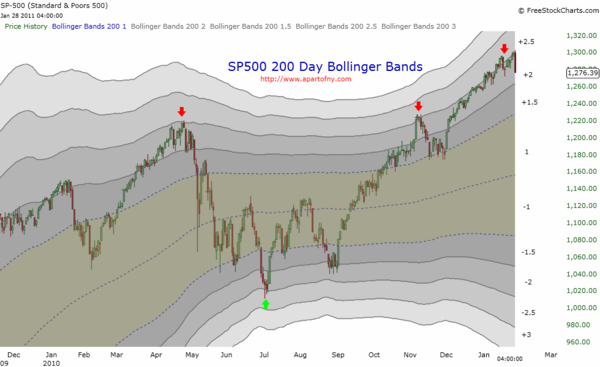
This chart shows that when price tests the 2 SD Band of the S&P 500 Index and comes back down … the move can be significant.
Price is still the primary indicator. This chart is just an early warning to pay attention.
So, What is Jim Rogers' Advice? … One Word: "Commodities".
“If the world economy gets better, commodities are going to make a fortune. If the world economy does not get better, commodities are the place to be because they are going to print more money, and that’s how you protect yourself,” investor Jim Rogers told Larry Kudlow on CNBC.
“This is the time when you should own real assets, not stocks and bonds. Throughout history, go back and look, you know we had huge inflation in the 70s, stocks were not in a good place to be,” he said.
"Given the uncertainties surrounding the global economy, investing in commodities is your safest bet," says Rogers.
From my perspective, I'm watching where smart money asset flows point. There is always something working in the markets. Our job is to find what's working and avoid the rest. Easy, right?
President Obama used different words to describe the State of the Union from his perspective. Here is a Word Cloud.
According to CBS News, President Obama's State of the Union speech included more than 6,500 words, led by variations on "America," "people," "new" and "jobs," with "future," "work" and "years" also high in the word count. While word repetition doesn't offer any deep analysis of the speech, the broad message is clear: "American people need new jobs and work in future years."
Market Commentary
The Markets were ripe for a pull-back. I say that only because the climb higher has seemed un-relenting, in the face of good or bad news. Recently, technical indicators showed some underlying weakness, but price marched forward. Finally, this past week, we saw some selling pressure.
The real question isn't whether buyers will step back in, rather, it is whether sellers will apply some pressure.
Last week we got a GDP number that wasn't great, but it wasn't terrible either. Combine that with the political unrest in Egypt, and some less than stellar earnings reports … and the pull-back seems mild.
Let's look at the Volatility Using Bollinger Bands.
Bollinger Bands are a technical trading tool created by John Bollinger in the early 1980s. They arose from the need for adaptive trading bands and the observation that volatility was dynamic, not static as was widely believed at the time.
The purpose of Bollinger Bands is to provide a relative definition of high and low.
Bollinger Bands consist of a set of three curves drawn in relation to securities prices. The middle band is a measure of the intermediate-term trend, usually a simple moving average, that serves as the base for the upper band and lower band. The interval between the upper and lower bands and the middle band is determined by volatility, typically the standard deviation of the same data that were used for the average.
This chart shows that when price tests the 2 SD Band of the S&P 500 Index and comes back down … the move can be significant.
Price is still the primary indicator. This chart is just an early warning to pay attention.
So, What is Jim Rogers' Advice? … One Word: "Commodities".
“If the world economy gets better, commodities are going to make a fortune. If the world economy does not get better, commodities are the place to be because they are going to print more money, and that’s how you protect yourself,” investor Jim Rogers told Larry Kudlow on CNBC.
“This is the time when you should own real assets, not stocks and bonds. Throughout history, go back and look, you know we had huge inflation in the 70s, stocks were not in a good place to be,” he said.
"Given the uncertainties surrounding the global economy, investing in commodities is your safest bet," says Rogers.
From my perspective, I'm watching where smart money asset flows point. There is always something working in the markets. Our job is to find what's working and avoid the rest. Easy, right?
With a little help from some friends whose palettes are a little more up-scale than mine, they dined at Charlie Palmer's at the Hotel Joule.
You Know It's Fancy When …
Notice the tablet computer.
That is an interactive wine-list called the eWinebook. It sorts and sifts by type, country, region, vintage, or price.
Once you narrow down your selections to a few choices, a live person is available to help you make your decision.
On one hand, it helps the consumer feel better about their choice; and on the other, it increases the restaurants average wine bill. To a "Win – Win" proposition. Cheers.
There is a new version of Google Goggles that is faster and smarter than ever before.
How fast and smart? Google's image-based search app is now powerful enough to finish your Sunday morning Sudoku. Literally.
Take a picture of the puzzle, and the app does the rest. Check out the video below to see Google Goggles in action.
This same tool lets you take a picture of a location and Google will return relevant search results after recognizing where you are and inferring what you might be searching for.
This seems like a pretty big leap towards Jetsons-like living.
Word Lens instantly translates printed words from one language to another using the video camera on your iPhone. You've got to see this.
In a sense, Word Lens is an new form of dictionary. It looks up words for you, and shows them in context. You can use Word Lens on your vacations to translate restaurant menus, street signs, and other things that have clearly printed words.
There is a new version of Google Goggles that is faster and smarter than ever before.
How fast and smart? Google's image-based search app is now powerful enough to finish your Sunday morning Sudoku. Literally.
Take a picture of the puzzle, and the app does the rest. Check out the video below to see Google Goggles in action.
This same tool lets you take a picture of a location and Google will return relevant search results after recognizing where you are and inferring what you might be searching for.
This seems like a pretty big leap towards Jetsons-like living.
Word Lens instantly translates printed words from one language to another using the video camera on your iPhone. You've got to see this.
In a sense, Word Lens is an new form of dictionary. It looks up words for you, and shows them in context. You can use Word Lens on your vacations to translate restaurant menus, street signs, and other things that have clearly printed words.