In it, he speaks of opportunity. For example, he informs: “Our elephant gun has been reloaded, and my trigger finger is itchy”.
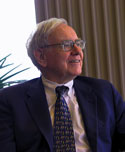
Buffett's annual letter is always an interesting read … even if you don’t agree with everything he says. There is a reason he is called “the Oracle of Omaha.” Even the introduction had a few of the ideas that jumped off the page.
“Money will always flow toward opportunity, and there is an abundance of that in America. Commentators today often talk of “great uncertainty.” … No matter how serene today may be, tomorrow is always uncertain.
Don’t let that reality spook you. Throughout my lifetime, politicians and pundits have constantly moaned about terrifying problems facing America. Yet our citizens now live an astonishing six times better than when I was born. The prophets of doom have overlooked the all-important factor that is certain: Human potential is far from exhausted, and the American system for unleashing that potential – a system that has worked wonders for over two centuries despite frequent interruptions for recessions and even a Civil War – remains alive and effective.
We are not natively smarter than we were when our country was founded nor do we work harder. But look around you and see a world beyond the dreams of any colonial citizen. Now, as in 1776, 1861, 1932 and 1941, America’s best days lie ahead.”
He later reminds: "At Berkshire, our time horizon is forever". That perspective makes it a lot easier for the game not to end until you've won.
Nothing stopped so many innovators and entrepreneurs more than the fear of failure. If you allow yourself to be constantly scared into thinking that the world is doomed you will never take that risk which might result in great reward. And perhaps worse, if you never fail you will never learn to get up, brush yourself off, move on and succeed in the future. This does not mean you should wander through this world with great complacency and blind optimism, but if you deny yourself the ability to maximize your full potential, you will always come up short.
In it, he speaks of opportunity. For example, he informs: “Our elephant gun has been reloaded, and my trigger finger is itchy”.
Buffett's annual letter is always an interesting read … even if you don’t agree with everything he says. There is a reason he is called “the Oracle of Omaha.” Even the introduction had a few of the ideas that jumped off the page.
“Money will always flow toward opportunity, and there is an abundance of that in America. Commentators today often talk of “great uncertainty.” … No matter how serene today may be, tomorrow is always uncertain.
Don’t let that reality spook you. Throughout my lifetime, politicians and pundits have constantly moaned about terrifying problems facing America. Yet our citizens now live an astonishing six times better than when I was born. The prophets of doom have overlooked the all-important factor that is certain: Human potential is far from exhausted, and the American system for unleashing that potential – a system that has worked wonders for over two centuries despite frequent interruptions for recessions and even a Civil War – remains alive and effective.
We are not natively smarter than we were when our country was founded nor do we work harder. But look around you and see a world beyond the dreams of any colonial citizen. Now, as in 1776, 1861, 1932 and 1941, America’s best days lie ahead.”
He later reminds: "At Berkshire, our time horizon is forever". That perspective makes it a lot easier for the game not to end until you've won.
Nothing stopped so many innovators and entrepreneurs more than the fear of failure. If you allow yourself to be constantly scared into thinking that the world is doomed you will never take that risk which might result in great reward. And perhaps worse, if you never fail you will never learn to get up, brush yourself off, move on and succeed in the future. This does not mean you should wander through this world with great complacency and blind optimism, but if you deny yourself the ability to maximize your full potential, you will always come up short.
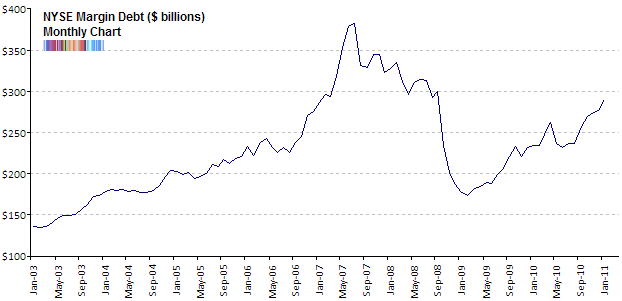
NYSE Margin Debt Gives a Clue As To How Bullish Traders Have Become.
This week's Trader's Narrative Sentiment Overview notes that margin debt is rising sharply as traders and investors increasingly take a more aggressive posture.
Every month, the New York Stock Exchange (NYSE) releases numbers showing how much money was borrowed on margin to buy stocks on the NYSE. As you can imagine, the amount of stock bought on margin is extremely large, but the total number fluctuates quite a bit based on how confident traders are. When stock traders are confident, they borrow more on margin. When stock traders are less confident, they borrow less on margin. Clearly traders are becoming more confident.
Historically, How Does the Market Handle Doubling Within Two Years?
Confidence is good, right?
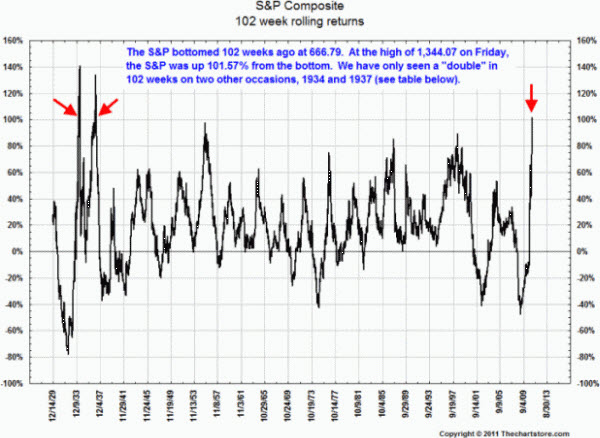
Mark Faber, the author of the Gloom, Boom and Doom Report, explained to CNBC that the US stock market has now doubled from its low. Moreover, he points out that there have been only three occasions in the last hundred years when the stock market in the US doubled within two years.
One such occasion was in 1934, coming off a "very deeply oversold condition" in 1932 and the other one was in 1937. After 1937 and 1934, the 12 months return were both negative, Faber said.
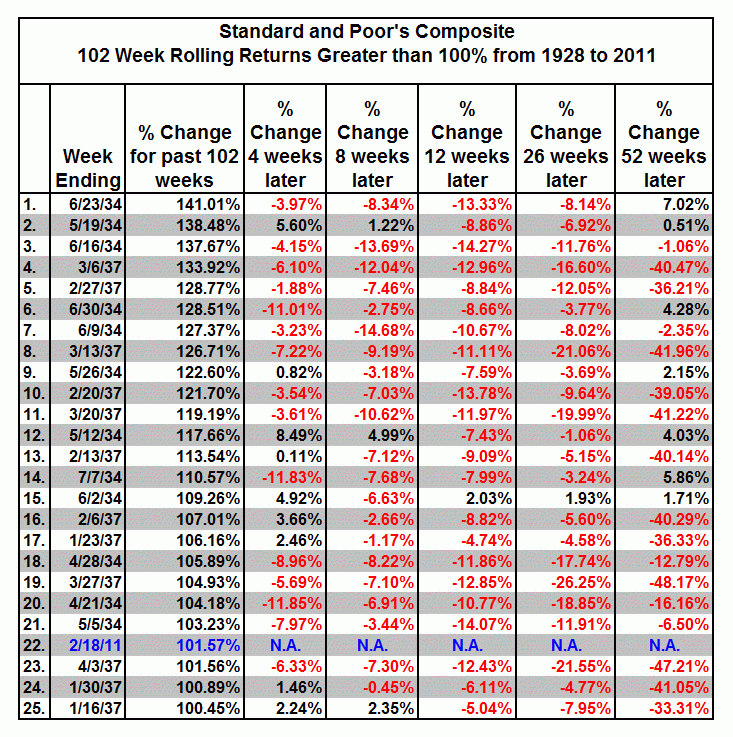
These levels of gains have preceded significant pullbacks. Here is a table showing the detail.
This is simply a historical look at similar rally intensities. Nonetheless, Faber warns: "I would be a little bit careful here to just buy the US because investor sentiment is very positive. The volume has been relatively sluggish and the market is extremely overbought by any statistical model".
Price is still the primary indicator. Let's see if traders buy the pull-back?
NYSE Margin Debt Gives a Clue As To How Bullish Traders Have Become.
This week's Trader's Narrative Sentiment Overview notes that margin debt is rising sharply as traders and investors increasingly take a more aggressive posture.
Every month, the New York Stock Exchange (NYSE) releases numbers showing how much money was borrowed on margin to buy stocks on the NYSE. As you can imagine, the amount of stock bought on margin is extremely large, but the total number fluctuates quite a bit based on how confident traders are. When stock traders are confident, they borrow more on margin. When stock traders are less confident, they borrow less on margin. Clearly traders are becoming more confident.
Historically, How Does the Market Handle Doubling Within Two Years?
Confidence is good, right?
Mark Faber, the author of the Gloom, Boom and Doom Report, explained to CNBC that the US stock market has now doubled from its low. Moreover, he points out that there have been only three occasions in the last hundred years when the stock market in the US doubled within two years.
One such occasion was in 1934, coming off a "very deeply oversold condition" in 1932 and the other one was in 1937. After 1937 and 1934, the 12 months return were both negative, Faber said.
These levels of gains have preceded significant pullbacks. Here is a table showing the detail.
This is simply a historical look at similar rally intensities. Nonetheless, Faber warns: "I would be a little bit careful here to just buy the US because investor sentiment is very positive. The volume has been relatively sluggish and the market is extremely overbought by any statistical model".
Price is still the primary indicator. Let's see if traders buy the pull-back?
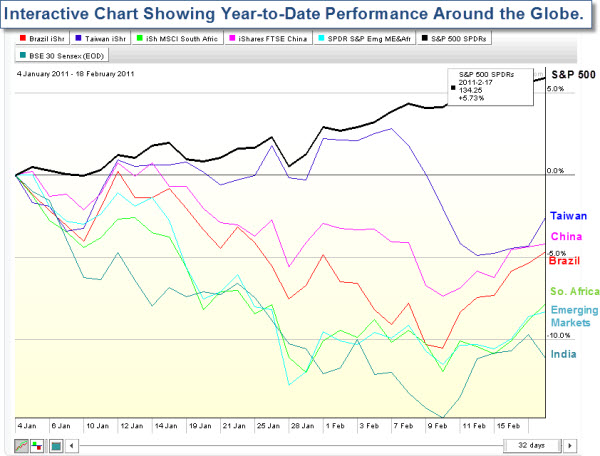
Clearly, the European and U.S. Markets have done better than the BRIC markets and other emerging markets so far this year.
After the crisis, world markets seemed to move in lock-step with each other. It is interesting to see how Central Bank Policy is de-coupling. Something to watch.
Clearly, the European and U.S. Markets have done better than the BRIC markets and other emerging markets so far this year.
After the crisis, world markets seemed to move in lock-step with each other. It is interesting to see how Central Bank Policy is de-coupling. Something to watch.