
Fraud isn’t new. But it is evolving.
In May, we talked about social engineering and how far it had come. That’s only the tip of the iceberg.
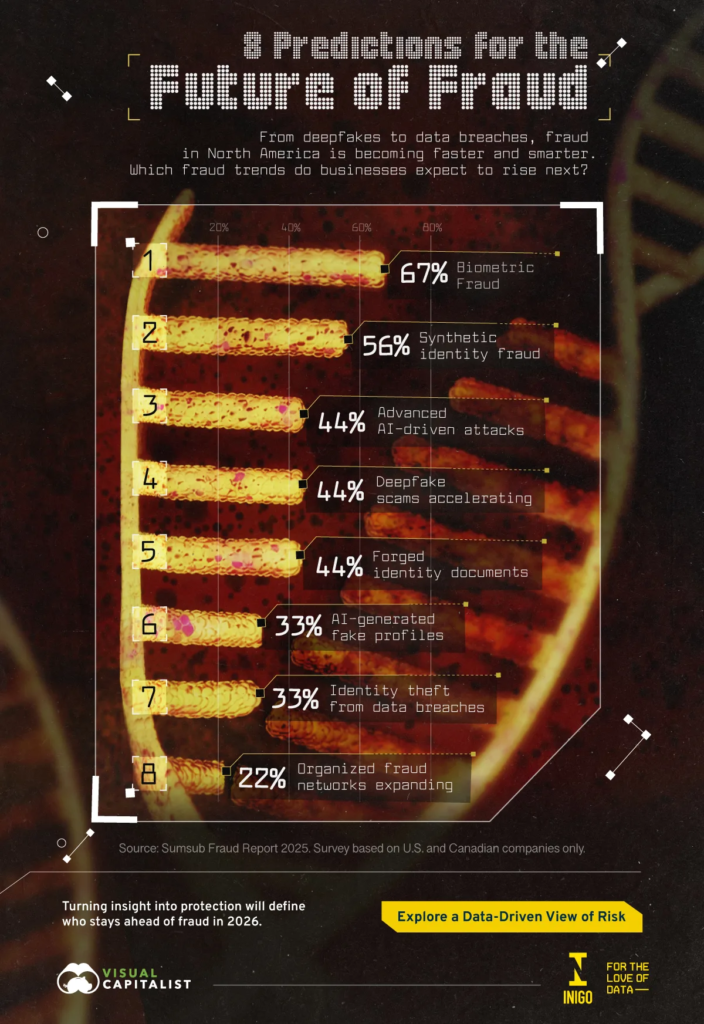
Visual Capitalist put together a chart on the fraud trends businesses expect to shape the future of digital risk.
You may think this isn’t important to you, but the costs of even one incident can be world-changing, especially to a small business.
Where The Risk Is Growing Fastest
While many of these are associated with social engineering, it’s worth delving deeper into specific mechanisms and the risks they pose.
- Biometric Fraud – The surveyed businesses anticipate the largest increase in biometric fraud, with 67% forecasting a rise. As organizations increasingly depend on facial recognition, voice authentication, and remote onboarding, bad actors are continuously discovering new methods to exploit these systems.
- Synthetic Fraud – 56% of surveyed businesses expect a rise in this category. Synthetic identity fraud occurs when criminals combine real data, such as a stolen Social Security number, with fake details, such as a made-up name or address, to create a brand-new, non-existent persona. Fraudsters use this fake profile to open bank accounts, apply for credit cards, and build up a fake credit history before maxing out loans and disappearing.
- AI-Driven Attacks and AI-Generated Fake Profiles – 33% of surveyed businesses expect a rise in AI-generated fake profiles, as fraudsters use generative tools to impersonate real users online. The mechanism: bad actors train AI on scraped photos, videos, and voice clips — pulled from social media, webinars, even a company’s own marketing content — to clone a real person’s face or voice convincingly enough to pass remote verification or authorize a transaction, or to fabricate an entirely synthetic persona from scratch.
It’s no longer enough for most businesses to be reactive; real-time risk monitoring and active protection are necessary.
From Reactive To Proactive
Even as technology improves, the basics stay the same: data breaches and criminal networks are permanent fixtures of this ecosystem — they have to be accounted for, and they’ll keep posing major threats
The first move isn’t a new tool — it’s an assumption change. Treat every biometric check, every new account, and every unsolicited video or voice call as unverified until proven otherwise. The businesses that build that assumption into their processes now will spend far less time (and money) cleaning up after the ones that don’t.
Are you prepared? If not, what’s the first step you’ll take to safeguard your business and assets?
Leave a Reply