Web/Tech

  • What The Perseverance Rover Reminded Me About

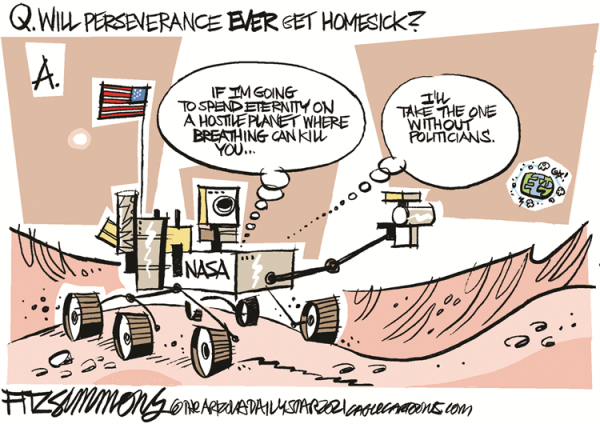
    Last week, the Perseverance rover landed on Mars. It's not the first time we've landed a rover on Mars, but it's still incredible to see. 

    via NASA Jet Propulsion Laboratory 

    It's a feat of engineering and human will. It's also a good reminder. 

    History is littered with tales of once-rare resources made plentiful by innovation. The reason is pretty straightforward … scarcity is often contextual.

    Imagine a giant orange tree packed with fruit. If you pluck all the oranges from the lower branches, you are effectively out of accessible fruit. From that limited perspective, oranges are now scarce. But once someone invents a piece of technology called a ladder, the problem is solved.

    When we first went to the moon, calculators referred to people charged with doing the complex math needed for the Rocket to make it into Space (rather than the device that could do the math instantly with no errors) and the computing power it took to get to the moon took up many rooms at NASA. 

    In comparison, you now have dramatically more computing power in your pocket than NASA used to get to the moon. 

    Likewise, we now have people living in space, posting videos from the ISS, and the ability to stream high-resolution images (and even movies) of space and galaxies near and far. 

    What was once scarce and unobtainable has become abundant and accessible.   It is a story repeated countless times.

    Still, as humans, we're wired to think locally and linearly. We evolved to live our lives in small groups, to fear outsiders, and to stay in a general region until we die. We're not wired to think about the billions and billions of individuals on our planet, or the rate of technological growth – or the minuteness of all that in contrast to the expanse of space. 

    Nonetheless, we have created better and faster ways to travel, we've created instantaneous communication networks across vast distances, and we've created megacities. Our tribes have gotten much bigger – and with that, our ability to envision and enact massive change has grown as well. 

    Our quest to conquer Space became the poster child for a type of innovation we now call "moon shots".  While 'moon shot' originally meant "long shot," it's increasingly being used to describe a monumental effort towards a lofty goal — in other words, a "giant leap."

    Today, with technology as a catalyst, we see those leaps happen in many areas (like A.I., medicine, longevity, space exploration, etc.). 

    It's hard to comprehend the scale of the universe or the scale of our potential … but that's what makes it worth exploring.

    Pretty cool!

    Onwards!!


  • When Texas Freezes Over

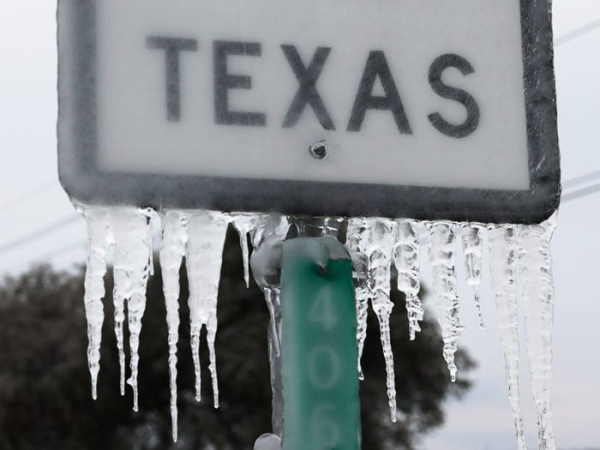
    As I write this, Texas has already cleared up and is warm again … but the effects of a week spent below freezing (with temperatures reaching below zero) will be felt for a long time. 


    210221 Texas Freeze_1via Joe Raedle/Getty Images

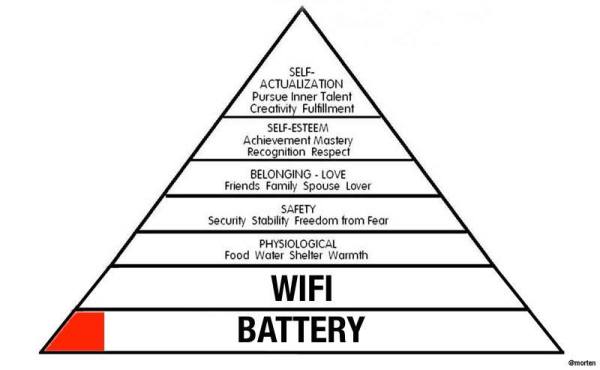
    Even though it had not snowed here in for several days, the Rolling Blackouts continued through the end of the week.  It is hard to believe Texas does not know how to handle six inches of snow.  Having grown up near Boston, I recognize that with no plows, no sanding, and no salt … you stand little chance of keeping the roads clear. At some level, it is just idiots slipping, sliding, and waiting for the sun to come out.  But who would have thought that would describe top leaders of the State and its ability to provide basic human needs like power, water, and heating (let alone WiFi and battery power)?


    210221 WiFi and Battery Power on Maslow's Hierarchy of Needs

    The ice storm and cold snap weren’t so bad for me (compared to some of the stories I’m hearing from other people in our office). Yes, we lost power, water, and the Internet … but only for a few isolated hours.  I was lucky (and so was our data center), but millions (including several Capitalogix employees) suffered due to lack of water, electricity, or heat, and to add insult to injury – burst pipes. 

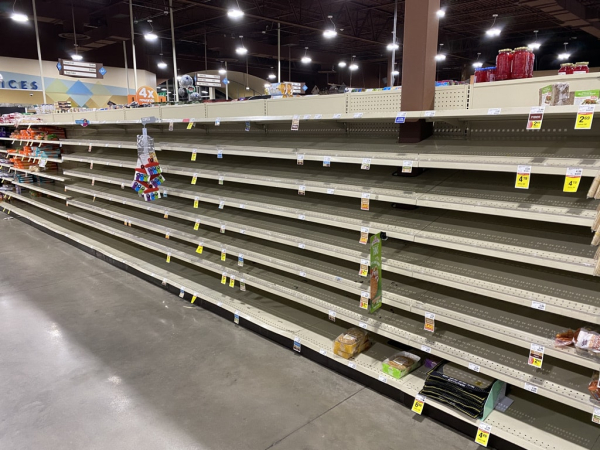
    Despite the fact that the temperature is back in the high 50s, here is a photo I took at our local supermarket this weekend.  Let's say things aren't quite back to normal yet.


    210221 Empty Store Shelves

    I've seen a lot of political mudslinging from both sides trying to avoid blame.  The reality is that this mess is a disaster that doesn't need to be politicized (and should be used as the raw material to make sure that something like this doesn't happen again). While Texas rarely sees weather like this, this wasn't the first time we have, and it won't be the last. 

    Two major factors came into play.

    First, Texas chose to stay off the national grid to avoid federal regulation. The Texas grid is called ERCOT, and it is run by an agency of the same name — the Electric Reliability Council of Texas. We joke about Texas seceding from the Union, but the reality is that many Texans are fiercely independent and crave less federal regulation (which is a discussion for another day) so the choice resonated with constituents.  Especially since Texas is a very energy-rich state.  Unfortunately, not being on the national grid means that when our grid is overtaxed, we're mostly on our own. In the winter of 2011, when our power sources couldn't keep up with needs we imported energy from Mexico to keep up, but this year much of Northern Mexico was struggling as well. 

    Second, Texas chose not to winterize its power sources. After 2011, a proposal was floated to winterize energy plants by adding insulation, heating pipes, etc. but it was very costly and wasn't adopted.   Many Texans (including politicians) were quick to blame it on the underperformance of renewables, but in this case, according to ERCOT,  natural gas, coal, and nuclear were affected. 

    All of these energy sources can be winterized, and renewables work fine even in Antarctica. This isn't an argument for renewables or for joining the national grid. Just an acknowledgment of the current situation. 

    ERCOT claimed that they were ready for the storm, and warned their plants to "winterize" how they could, but clearly, it wasn't enough. With more preparation locally and on the state level, Texans should be fine to handle these types of episodes in the future. With that said, it shouldn't take episodes like this to enact change. 

    Regardless, crises like this are opportunities to come together, and I've been very happy to see how many people have offered food, water, and their homes to people in need.

    Thank you to all who reached out to check in on us. 

     
  • The Return of The SPACs

    I've shared several links about SPACs, in the past few months, as they have gotten increasingly popular and relevant.

    SPAC stands for Special Purpose Acquisition Company. A SPAC is a company with no commercial operations, formed to raise capital through an IPO to acquire existing companies, technologies.

    A typical IPO creates new public shares of a formerly private company while a SPAC merges a private shell company with an already existing public company. 

    It's basically a backdoor way to turn a private company public overnight. Click here to see popular SPACs from 2020

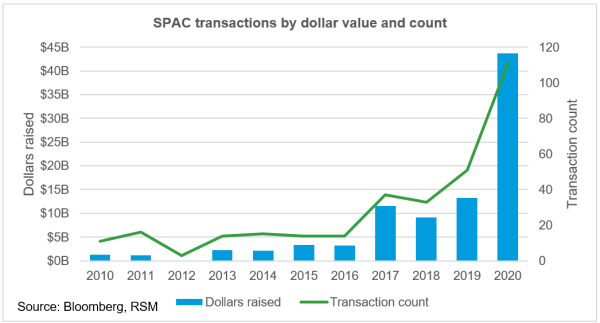
    They've been around for decades – but SPACs have been increasingly popular recently. Making that point, according to Bloomberg, SPAC dollars raised in 2020 beat the total from the previous 10 years combined.

    10_6_2020_COID_chart_subvia RSM

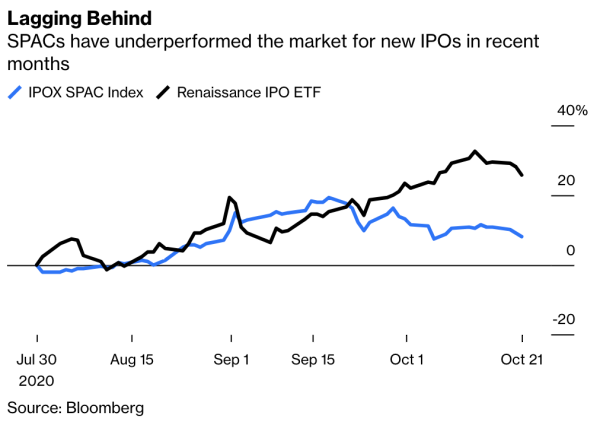
    SPACs are becoming popular to businesses because they're seen as a safer way to go public in a volatile environment. They're also becoming popular to investors because the stock value often jumps pre-acquisition.  Nevertheless, the reality is that the average SPAC underperforms the S&P 500 on any given timeframe.

    Screen Shot 2021-02-14 at 4.27.36 PMvia Bloomberg

    The reality is that most "buzz" products underperform the S&P – and most things that become too popular ultimately end up losing their edge. 

    Barry Ritholtz put it well in his opinion piece:

    The successful products we encounter every day are the result of initial failure. While positive outcomes are all around us, hidden from view is the iterative process of repeated failed attempts that lead to improvement. The world is filled with fantastic products from wildly successful companies, making it easy to overlook the many small gains and occasional big breakthroughs that helped them achieve this success.

    For businesses looking for access to capital, SPACs are a legitimate option worth considering.  However, for investors looking for the next new alternative asset class to invest in, SPACs may not be what you are looking for in the longer term. 

    What do you think?


  • Wolves of r/wallstreetbets: What Happened With Gamestop & Robinhood

    GameStop has been on a steady decline (both as a stock and a company) for many years. It has been like watching Blockbuster get replaced with Netflix all over again.  Why would people go to a retail store when they can consume a wider range of products from the comfort of their home?  Obviously, the pandemic made things worse for them.  As a result, short sellers lined up to bet on their demise.

    So, how can you explain the jump in GameStop's share price from $17.50 at the beginning of 2020, to almost $400 on Thursday?

    You could argue it started with new leadership from Ryan Cohen and their surprisingly stable financials despite the turmoil. Nonetheless, it would be hard to justify a sudden $28 Billion dollar valuation based on that alone. 

    The real reason for the price jump, and the story everyone is talking about, is the war of the retail investor (fueled primarily by a Reddit forum called r/wallstreetbets) on Wall Street. 
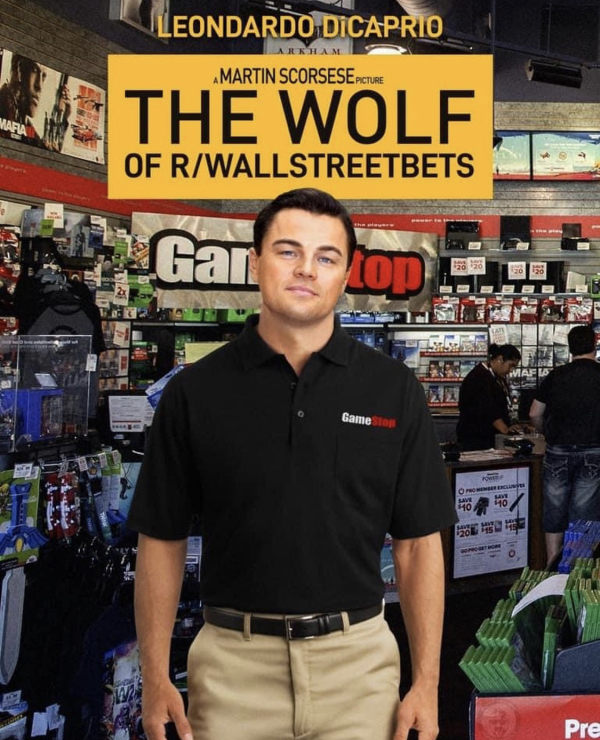
     

    IMG_6818

    It's a complicated situation, and news stories tend to have their own biases and agendas, so I thought I would bring you up to speed on what happened, the legality, and the potential ramifications.

    What Happened?

    Earlier this month, Redditors realized that GameStop's stock ($GME) was shorted to 140% of tradable shares due to positions by several funds including Melvin Capital. Most of those positions are passively held, so the short-interest accounted for 300-500% of the float (actively traded shares).  Theoretically, this shouldn't be possible – but it was allowed by the brokerages and market makers. 

    This allowed the Redditors, and other retail investors, to buy the stock aggressively, raising the stock price, and forcing the shorts to cover. This is called a short squeeze

    By Wednesday, retail investors' actions raised the price 700% to over $300. Melvin Capital was out ~3 Billion dollars and ultimately got bailed out by Citadel and Point 72

    On Thursday, after calls for help from Wall Street grew louder, several online brokers blocked the buying of GameStop and other stocks that were trending on Reddit (like $AMC, $NOK, and $NAKD) and canceled some trades. Those brokers still allowed users to sell their shares.
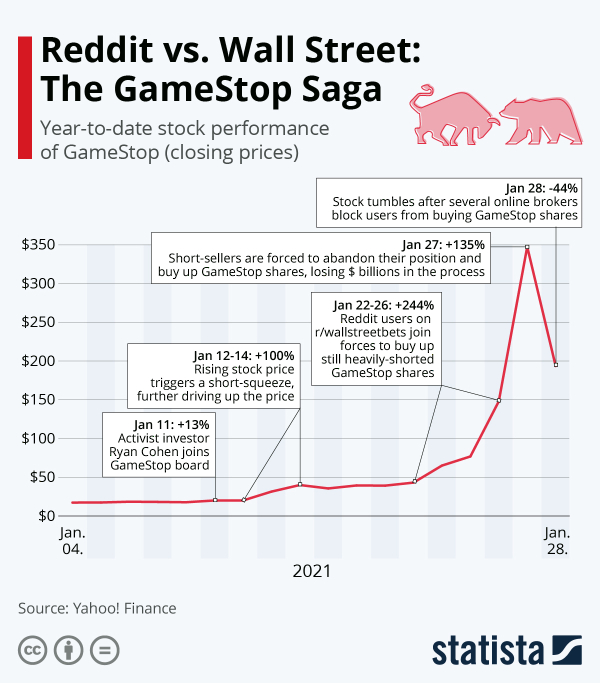
     

    24054via Statista

    The stock price of GameStop and AMC tumbled as a result and the media went into an uproar.

    Questions of legality were raised toward the potential market manipulation of Robinhood, but also r/wallstreetbets. 

    Were Robinhood's Actions legal?

    Separate from legality, the optics of the situation are very bad for Robinhood. First, Citadel, who bailed out Melvin Capital, is one of Robinhood's vendors. Second, Robinhood's motto is about access to all, and it heavily markets brand beliefs consistent with the ideals of the fictional heroic outlaw, Robin Hood (who took from the rich to give to the poor).

    Voices like Mark Cuban, Elon Musk, AOC, and Ben Shapiro all came out against Robinhood for limiting retail's ability to trade. An odd show of unity in these divisive times. There are also several class-action lawsuits and the SEC is reviewing the situation.

    Robinhood justified its actions by claiming they were forced due to increased volatility, and risk management with their brokers. Both Robinhood and Citadel strongly denied any market manipulation claims.

    Legally, these brokers state in their contracts that they are allowed to restrict trades for almost any reason. As well, they have liability and protection obligations to their consumers, market makers, and clearinghouses.  

    The situation with $GME is undeniably risky. Trading is a zero-sum game, and for every crazy win story you see of someone paying their mortgage, someone is losing their house. As $GME gains popularity, or r/wallstreetbets tries to replicate this success with other securities, the late majority are (almost by definition) going to be the least qualified and the most at risk of losing money they probably can't afford to invest. 

    This episode shined a light on clear issues with the Stock Market. 

    However: 

    • Robinhood only limited the ability to buy these stocks, which by design lowers stock prices.
    • Before retail investors capitalized on the situation, these same brokerages let institutions short 140% which would have been a death sentence for GameStop. 
    • It's on the NYSE (in this case) to shut down the trading of a security, and they only do it for fraud or if there is material information a company hasn't disclosed yet.
    • The timing and relationships bring good reason to question the validity of Robinhood's statements.

    While the theoretical action of limiting trading is legal for Robinhood – this specific case is questionable at best. 

    Were r/wallstreetbets actions legal?

    Many big-time bankers have been arrested for market manipulation in the past. It's a point of many of the regulations in Wall Street today. 

    This specific example is very complicated. On Reddit, a public forum, many users urged each other to buy stock and to hold in the face of adversity. The initial logic behind buying $GME was based on solid fundamentals, and the observation about Melvin Capital's position – but quickly became a momentum play capitalizing on the mania. You could argue it was collusion, which is bolstered by the disparity between the future value of GameStop as a business and its current stock price.

    It's hard to prove that there was a coordinated effort to manipulate stock prices here. To me, it looks like a mob of uninformed investors following the advice of an educated investor and creating a trend. A common theme. Some claim it resembles a classic "pump-and-dump" scheme that you would find by the likes of Jordan Belfort and the penny stock market.

    I think it's very unlikely you see anyone charged here – but I do think it's likely you see new regulations as a result of this. 

    While the industry is already heavily regulated, the world is changing, and we have to keep up or deal with the consequences. 

    New strategies or capabilities push boundaries and test limits in new ways.  In the short term, someone has a new advantage, but in the long term, the system evolves and gets stronger.

    The Bigger Picture

    I've seen many people concerned with the decision-making behind retail's investment in $GME.  As a practical matter, it doesn't really matter. 

    The initial posts on Reddit showed a good understanding of fundamental trading, but most traders who followed that advice wouldn't know the difference. 

    I'd argue it's not that different from most of Wall Street. Many don't have an edge, they simply piggyback off of the success of the ones that do, whether by following their trades or starting a new firm with the lessons they learned at a bigger firm. 

    The market is not the economy, and while GameStop is a great case study to prove that, at its core, it's not really a unique or new phenomenon. 

    Value is an important part of a stock price.  But for many speculators, it is only part of the calculation. And beyond speculators, there are many types of market participants (e.g., governments, institutions, hedgers, etc.) and reasons to buy or sell things (including fun, excitement, a social belief, etc.), and rationales for their decisions (including systematic approaches, momentum, reversion to the mean, etc.) that combine to form the free market. 

    A free market isn't necessarily a smart market … and it doesn't need to be. But, part of what creates a growing and thriving market is the belief that it is safe, reasonably transparent, and reasonably regulated. Consequently, I would expect regulators to re-visit this and for them to re-look at the regulation of margin and other things. 

    Expect increased volatility and noise. Expect more runs like this. Plan accordingly. 
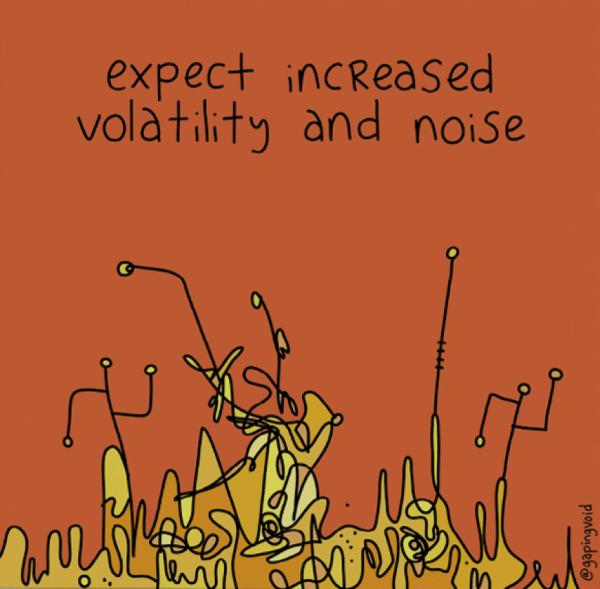
    Expect Increased Volatility and Noise_GapingVoid

    Conclusion

    Helping the average person take advantage of the Stock Market is a good thing. With that said, the "democratization of access" comes at a time when tech asymmetry is growing. The advantages to Hedge Funds and Institutional Investors are growing – regardless of regulation – due to better tech stacks, smarter algorithms, and teams of PhDs. Information asymmetry is decreasing, but data is only valuable if you can digest it.

    The Stock Market is not just a game, and some believe it's worrisome that some retail investors feel like it is

    In trading, there is a rule of thumb that says a trend continues until it stops.  Well, expect the bubble to pop for $GME (and the other stocks that may follow this pattern).  Why, because trends do stop … and to quote Stein's Law – if something can't continue it won't.

    Actions have consequences.  Many intelligent investors will be fine, but many other investors will be hurt.  To some extent, that is the consequence of a zero-sum market.  But with Democrats in power, I expect to hear more about this.

    Perhaps it shouldn't have taken Wall Street getting hurt to start this discussion. Now the discussion has started.  At some level, it's not about what happened … it is about what you do. 

    It's unclear whether r/wallstreetbets will have the win they're looking for or whether Robinhood will get penalized. 

    What do you expect to happen?

  • Jim Simons and Renaissance Technologies

    Jim Simons is a mathematician and cryptographer who realized that the complex math he used to break codes could help explain financial patterns – and he made billions with those ideas in his notoriously secretive hedge fund firm called Renaissance Technologies

    As of January 2021, He has stepped down as chairman. Now, Peter Brown, the former CEO of the fund, has stepped up as chairman.

    With Jim stepping down, I thought it was worth looking at the legacy he has left on not just the Hedge Fund industry – but on trading as a whole. 

    He is famous not only for the duration of his success and the size of his results … but also for the way he made his money (with much lower volatility and risk than his peers and competitors). 

    His background is impressive.  Simons taught at Harvard and MIT and worked with the NSA.  Here is a video where he shares some thoughts in a 2015 TED talk interview.  It's worth a watch

    TED via Youtube

    Despite advanced math still being a mystery to many,  we rely on it more than ever as the foundation of many exponential technologies.

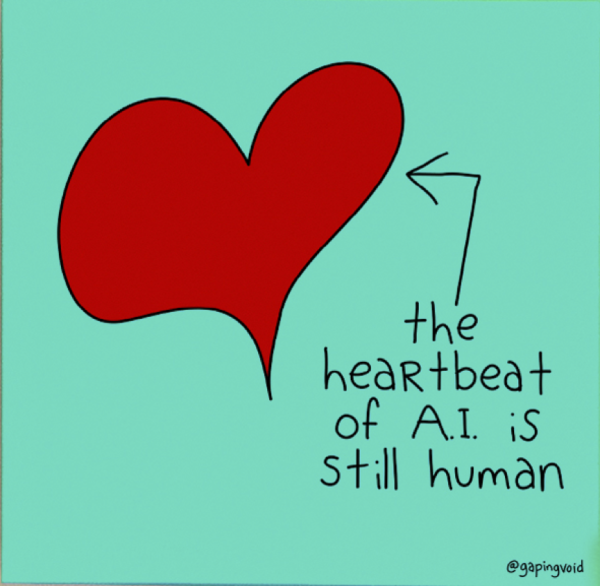
    The Heart of AI is Still in Humans

    Simons built a team of mathematicians whose motivation was doing exciting mathematics and science (rather than hired guns who could be lured away by money or pure trading quants, biased by the industry).

    This hits on something important. 

    The Heartbeat of AI is Still Human_GapingVoid

    Humans are still important … and companies that pursue exponential thinking and exponential technologies still have to champion integrity, culture, and purpose.


    Better Math is a Competitive Advantage – So is More and Better Data

    We stayed ahead of the pack by finding other approaches and shorter-term approaches to some extent … but the real thing was to gather a tremendous amount of data

    – Jim Simons

    On top of his intelligent hiring and novel approach to trading, Jim Simons recognized that an impressive data pipeline – and the technological infrastructure to digest and analyze that data was a moat to competitors. 

    It is hard to have an edge if you use the same process and the same data as your competitors.

    As the flywheels of commerce spin faster, edges will emerge and decay faster.  Finding a solution is only a step in an ongoing process.  

    Robust, reliable, and repeatable innovation at scale is a meaningful competitive advantage.  That implies that idea factories will become as important (if not more so) than factories that produce material products.  Likewise, innovation funnels will become more important than sales funnels. 

    The world changes at the speed of thought … and as technology continues to improve … even faster.

    Onwards!