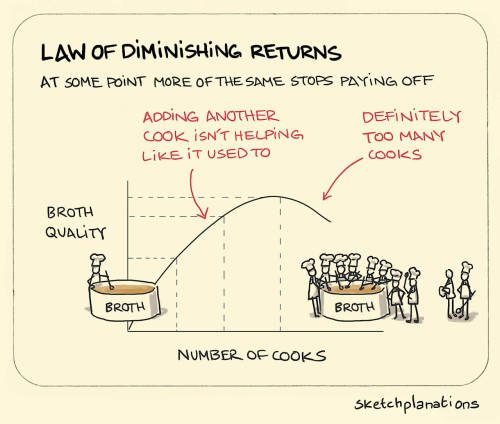
Nature (and common sense) reminds us that equilibrium is important. For example, when you exercise too much, you get injured; when you drink too much water, you get poisoned; etc.
This concept applies almost everywhere.
It's why diversification is so important in portfolio construction theory.
Or, why you don't want to put all your eggs in one basket (concentrating your risk).
And, my favorite, it's also why you shouldn't only eat vegetables.
A related nugget of wisdom from the extreme … Too much of a good thing is a bad thing!
To be fair, we shot this video BCGPT (before ChatGPT). Since then, AI has become much more accessible and useful.
It was the start of the golden age of AI,machine learning, and process automation … but in the last seven years, AI's effects and impact have become radically more widespread.
While marketing relies on data, analytics, and automation, Ryan believes it also needs a personal touch. He suggested that the best AI should make conversations feel more human (particularly in marketing and selling) and allow humans to be more human. In other words, as technology frees people up, they can focus on more valuable things.
Today, more marketers – including Ryan – use generative AI tools to streamline their process and improve their output.
His points about using tools like ChatGPT remain valid.
The saying is trite, but AI won't replace your job … a human with AI will.
This has happened many times in society. Fewer people work in farming or manufacturing, yet more people are doing more jobs. However, many of these new jobs didn't exist – or couldn't have been imagined – before people were freed up to contemplate what they could or should do. This shift in perspective is what truly matters and adds the most value to society, the economy, and people's lives.
Just as mechanization freed up workforces for better jobs, AI can do the same.
When I first examined the chart, I focused on the state-by-state differences. Honestly, I was taken aback that some states scored higher than others. And by that, I mean it wasn't necessarily the states I would've predicted. But then I took a closer look at the scale and realized these differences are probably insignificant. The results essentially show that, on average, states' intelligence levels are… well, average.
I know a lot of smart people.
I also know many people who think they're smarter than they are (even the smart ones … or, perhaps, especially the smart ones).
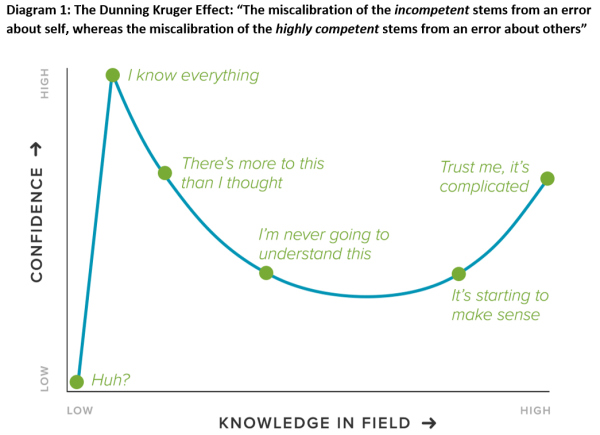
Have you ever met someone who's so confident about what they think that they believe they know more than an expert in a field? That's the Dunning-Kruger effect. It's defined as a cognitive bias where a lack of self-awareness prevents someone from accurately assessing their skills.
Here's a graph that shows the general path a person takes on their journey towards mastery of a subject.
The funny thing about the above image… it's not actually a part of the paper on the Dunning-Kruger Effect. But it's now so commonplace that people report that chart as fact—a fitting example of the effect.
Recognizing the "victims" of this effect in our daily lives can often be funny or frustrating. But we're all prone to this; it's a sign of ignorance, not stupidity.
This is a problem with all groups and all people. You're not immune to it, even if you already know about the cognitive bias resulting from the Dunning-Kruger Effect.
It should be a reminder to reflect inward – not cast aspersions outward.
Two different ways that people get it wrong, first is to think about other people and it’s not about me. The second is thinking that incompetent people are the most confident people in the room, that’s not necessarily true.
Usually, that shows up in our data, but they are usually less confident than the really competent people but not that much… - David Dunning
To close out, even this article on the Dunning-Kruger presents a simplification of its findings. The U-shape in the graph isn't seen in the paper, the connection that lack of ability precludes meta-cognitive ability on a task is intuitive, but not the only potential takeaway from the paper.
Regardless, I think it's clear we are all victims of an amalgam of different cognitive biases.
We judge ourselves situationally and assume "the best". Meanwhile, we often assume "the worst" of others.
On September 28th, 1997 (almost exactly 17 years ago today), Apple released perhaps one of the most recognizable commercials of all time. I remember being mesmerized the first time I saw Apple Computer's iconic "Crazy Ones" video as part of their Think Different campaign.
The same is true in business. Opportunity draws a crowd … but the best opportunities are often in areas of less competition.
For entrepreneurs, oversaturation can turn products into commodities, reducing profit potential. Conversely, many shy away when a challenge seems insurmountable, creating unexpected opportunities for those willing to take the risk.
As an entrepreneur, I’m drawn to projects others might dismiss as science fiction. These are the challenges that often lead to the most groundbreaking and rewarding outcomes.
Moonshot Projects
Moonshot projects offer a unique advantage. While they may seem daunting, their audacious nature often means less competition and greater potential for transformative impact and extraordinary profits.
A moonshot project is a highly ambitious, transformative endeavor that seeks to solve a significant problem or create a revolutionary innovation. These projects are characterized by:
Audacious Goals: They aim for breakthroughs that seem nearly impossible to achieve.
Disruptive Impact: They strive to create solutions that are vastly superior to existing offerings, often by introducing entirely new paradigms.
High-Risk, High-Reward: These projects embrace the potential for failure in pursuit of groundbreaking results.
Long-Term Focus: They prioritize long-term impact over short-term gains.
Technological Advancements: They leverage cutting-edge or even nascent technologies.
Paradigm Shifts: They challenge conventional wisdom and industry norms.
Moonshot projects are inherently challenging. They demand significant resources, interdisciplinary collaboration, and a willingness to venture into the unknown. This perceived difficulty often deters potential competitors, creating a unique opportunity for those willing to take the risk.
When successful, they push the boundaries of what is possible and redefine the landscape of their respective fields.
In part, that is why a 10X mindset is particularly well-suited for Moonshot projects. By aiming for a tenfold improvement over existing solutions, you’re essentially operating in a space with little to no competition or opposition. This allows you to redefine the rules of the game and establish a sustainable competitive advantage.
Our strategy of creating a unique, sustainable competitive advantage aligns perfectly with the Moonshot approach. By choosing to play a different game (with an asymmetric edge), we’re not just competing; we’re fundamentally changing the playing field.
I’m not interested in going head-to-head with tech giants on their turf. Instead, the goal is to carve out our own niche, focused on using our unique abilities to push boundaries and extend our edge. Being slightly ahead of the competition can be a powerful attractor. It often leads potential competitors to seek collaboration rather than confrontation. They might approach you with ideas, money, or opportunities, aspiring to share in your advanced position and capabilities. This dynamic can create unexpected partnerships and accelerate progress in ways that benefit everyone involved.
When interviewing potential team members, I often share a crucial insight: if you’re seeking a job where you work 9-to-5 solving problems so you can go home feeling satisfied, this might not be the right fit.
We tackle challenges of a different magnitude. Our projects rarely have quick solutions. Instead, we focus on making steady progress towards ambitious goals.
I sometimes joke that our motto should be: “We suck less.” Nevertheless, the underlying truth is more profound. It’s about understanding your ultimate objective and recognizing that each step moves you in the right direction, no matter how small.
This approach aligns with our belief in playing a different game. We don’t just compete; we redefine the rules of engagement, creating our own metrics for success and pushing boundaries in ways that traditional thinking often overlooks. Kind of like this quote:
“I have not failed. I've just found 10,000 ways that won't work.” - Thomas Edison
It doesn’t make sense to challenge a bigger and better-funded competitor in an area where they have an asymmetric advantage. In other words, don’t compete with giants at their own game.
Choose to play a game you expect to win.
Playing a different game is a theme at Capitalogix. We believe that you control the game you’re playing, the rules, how you keep score, and even how you evaluate success. These things inform where to spend time, where to invest money, and even what looks like an opportunity to you.
Wouldn’t you rather compete in areas where you can create a unique, sustainable competitive advantage? Personally, I want to invest in the things that extend the edges that let us win.
Why? Because … Mediocrity Is Expensive!
What you lack in size or computer power, you can make up for in creativity, agility, and innovation.
We sought to create a niche in the investment industry, not through computing power, but through unique approaches to age-old problems. We use AI and data science to enhance decision-making.
We have an incredibly narrow and consistent focus. Within that area, we are willing to take on problems others avoid and pursue goals that others say are impossible.
Our niche limits risk and lets us fail faster … and learn faster. This allows us to take confident action while others are tentative.
Most big companies – and most of our competitors – are afraid to be wrong. They have to protect their infrastructure, cash cows, and short-term performance metrics. It makes sense (from their perspective) that playing it safe means they’re secure. – but that’s not how it works.
You can’t challenge the status quo when you are the status quo.
10x Improvement Is Often Easier To Achieve Than 10%
Incremental change is hard – it’s finding new ways to do the same thing, and you often end up competing in very red oceans – saturated markets where you’re competing on price.
Moonshots sound harder, but you create your own niche, and the constraints of a new idea force creativity and energy. If you’re going after a goal that no one has accomplished before, it’s impossible to be in a red ocean, and it’s easier to mobilize a team around something exciting and new than decreasing some arbitrary metric by 2%.
There are a couple of important lessons to keep in mind when pursuing the unknown.
Forget what you know – self-reported “experts” are limited by their worldview. If you’re trying to get a different result, you won’t do it by playing by the same rules your predecessors followed. Heuristics are great for making life easier – but they’re very limiting when trying to create something new.
Attack the hardest problems first – your biggest problems are your biggest opportunities. If you don’t deal with the big problems now, you’ll never get around to it, and you’ll waste time, energy, and potentially realize you have to pivot much too late.
Be comfortable being uncomfortable – Most people find failure taboo, and they’re deathly afraid of it. Tony Robbins talks about our tendency to avoid pain more actively than we pursue pleasure, and it’s true in business. But failure is a part of business. The people I consider most successful got there through incredible pain tolerance and increasingly intense problems that they continued to conquer.
Have a short memory for pain – Focus on the gain, not the pain. People often focus on not having enough money, not enough time, or simply not having enough. That scarcity mindset is dangerous and can lead to getting lost in pain and fear. Acknowledging the pain/fear and moving forward from a place of abundance and opportunity helps create opportunities.
As well, a clear identity is important. You have to understand what you’re pursuing and how you want to attack the problem. At Capitalogix, we’ve gotten very in tune with our goals.
We invent techniques that identify and adapt to what happens in markets. We apply the lessons learned from past experiences, data science breakthroughs, and hard work to eliminate the fear, greed, and discretionary mistakes that are the downfall of most traders and decision-makers.
Small businesses don’t have a monopoly on these mindsets and these opportunities, but companies like Y Combinator, X(and no, I don't mean the company formerly known as Twitter), or HeroX are few and far between … Elon Musk is famous for moonshots like Tesla, SpaceX, Starlink, Neuralink, Xai, etc. Google and Microsoft pursue moonshots as well.
Good news … the future is big enough for them and you.
Choose something that lights you up and leverages what you already know and who you already are.
Studying historical changes in human population trends offers valuable insights into the factors that have propelled or hindered human development throughout time.
From ancient civilizations to modern metropolises, population dynamics have influenced everything from economic prosperity to social structures.
A Window Into Our Past Gives Us a Glimpse at Our Future.
By studying this critical aspect of human history, we can gain valuable insights into the past, present, and future of societies.
Population growth is a complex and multifaceted phenomenon with far-reaching implications. It offers a fascinating glimpse into the demographic trends that have shaped our world and continue to influence our trajectory.
Historically, human populations grew steadily but relatively slowly … until something changed that.
Scientists estimate that humans have existed for over 130,000 years. However, it took until 1804 for us to reach 1 Billion. We doubled that population by 1927 (123 years later) and then doubled it again only 47 years later (which was 1974).
Looking back, early population growth was driven by the agricultural revolution. Since 1804, the Industrial Revolution, health and safety advances, along with technology, have significantly improved quality of life, spurring the rapid population growth. Here is a quick overview of some of the key factors.
Shaping the Future
It’s hard to predict some things accurately. So, one goal in data science is to figure out what we can “know” in order to “guess” less.
Population growth is a prime example. One of the easiest ways to predict how many 60-year-olds there will be in 40 years is to look at how many 20-year-olds there are today. Obviously, the number won’t be exact, but it’s a pretty good head start.
This principle of using known data to make educated predictions applies to many aspects of future planning, including urban development and resource allocation. By leveraging current demographic information, we can better prepare for the challenges and opportunities that will likely impact the cities of tomorrow.
Economic Implications: A growing population can expand the workforce, fueling economic growth. However, it can also strain resources, requiring increased investment in infrastructure, education, and healthcare.
Social and Environmental Pressures: Demographic shifts, such as aging populations or youth bulges, can profoundly affect social structures, healthcare systems, and the environment.
Why It Matters
Population growth is more than just a numerical metric. It is a fundamental lens through which we can analyze:
Historical Development: By understanding past population trends, we can better appreciate the factors that have shaped human civilizations.
Future Planning: Governments, businesses, and organizations can use population data to make informed decisions about resource allocation, infrastructure development, and social policies.
Have World Population Growth Numbers Peaked?
World population growth rates peaked in the late 1960s and have declined sharply in the past four decades, but we’re still on a positive trend. We’re expected to reach 9 billion people by 2050, but a lot of that growth comes from developing countries – they also almost exclusively come from urban areas.
In the 1800’s, about 10% of the population lived in urban areas. Since 2014, over 50% of the world’s population has lived in urban areas – today it’s approximately 55%. That number is growing.
Ironically, as we grow more digitally connected, our world is shrinking, and our populations are concentrating.
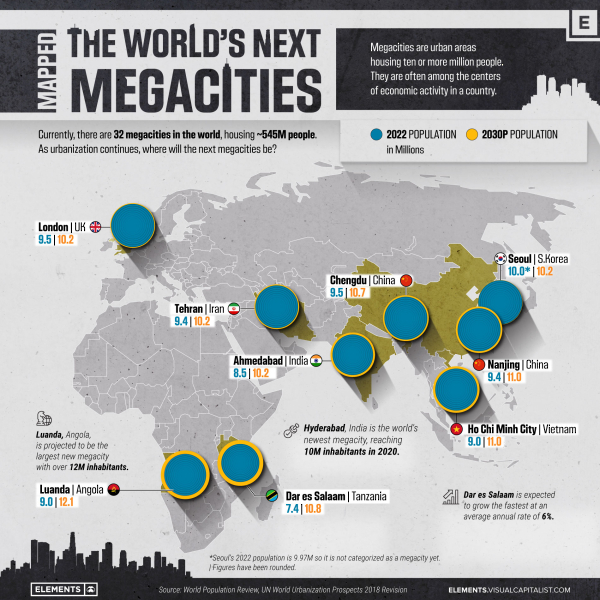
An interesting consequence of this rapid urbanization and population growth in developing countries has been the increased development of Megacities – defined as cities with populations greater than 10 million. Today, there are 33 megacities – more than triple the number in the 1990s.
This creates a set of interesting opportunities and challenges.
For example, how will these cities deal with infrastructure – sanitation, transportation, etc?
Today, in most high-income countries, about 80% of the population lives in urban areas – contrasting the primarily rural populations of lower-income countries.
As a result, we see many of these megacities forming in developing countries. As a side note, we’re also seeing countries like China making substantial investments and alliances in these developing areas. This is likely done to profit from the expected growth and also to shift the future balance of power in their favor. Sometimes, it makes sense to focus on the marathon and not just the sprint.
It’s interesting how the world can become more decentralized – and more globalized – amidst a contraction of where people live.
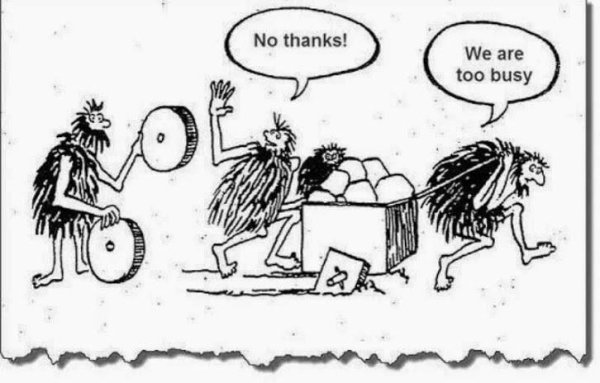
While simple, the wheel worked well (and still does). Consequently, “reinventing the wheel” is often used derogatorily to depict needless or inefficient efforts.
Nonetheless, there are good reasons to reinvent the wheel. Scientists recently developed an innovative shape-shifting wheel that can adapt its form depending on the terrain, enhancing mobility for vehicles like wheelchairs and robots. This new design addresses the limitations of traditional wheels, allowing for real-time adjustments to navigate uneven surfaces.
But how does that compare to sliced bread (which was also a significant invention)?
Even though the wheel is considered a symbol of innovation, it took over 300 years for it to be used for travel. Upon closer examination, this delay is understandable. In order for a wheel to be used for travel, it needs to have an axle and must be durable and strong enough to bear heavy loads, which requires advanced woodworking and engineering skills.
All the aforementioned products created before the wheel (except for the flute) were necessary for survival. That’s why they came first.
As new problems arose, so did new solutions.
Necessity is the mother of invention.
Unpacking that phrase is a good reminder that inventions (and innovation) are often solution-centric.
Too many entrepreneurs are attracted to an idea because it sounds cool. They get attracted to their ideas and neglect their ideal customers’ needs. You see it often with people slapping “AI” onto their product and pretending it’s more helpful.
If you want to be disruptive, cool isn’t enough … your invention has to be functional and fix a problem people have (even if they don’t know they have it.) The more central the complaint is to their daily lives, the better.
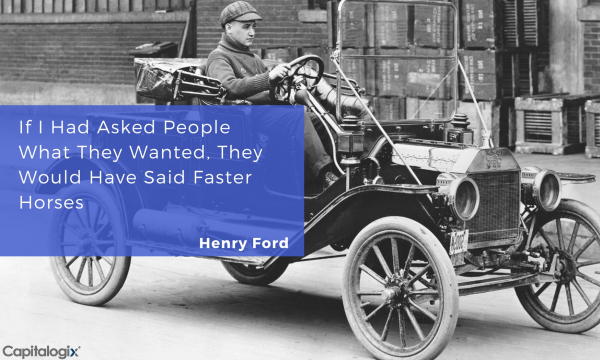
Henry Ford famously said: “If I had asked people what they wanted, they would have said faster horses.”
Innovation means thinking about and anticipating wants and future needs.
Your customers may not even need something radically new. Your innovation may be a better application of existing technology or a reframing of best practices.
Uber didn’t reinvent a new car; they created a new way to get from where you want with existing infrastructure and less friction. Netflix didn’t reinvent the movie; they made it easier for you to watch one.
As an entrepreneur, the trick is to build for human nature (meaning, give people what they crave or eliminate the constraint they are trying to avoid) rather than the cool new tech you are excited about.
Human nature doesn’t change much … Meanwhile, the pace of innovation continues to accelerate.
The challenge is to focus on what people want rather than the distraction of possibility. That gets harder as more things become possible.
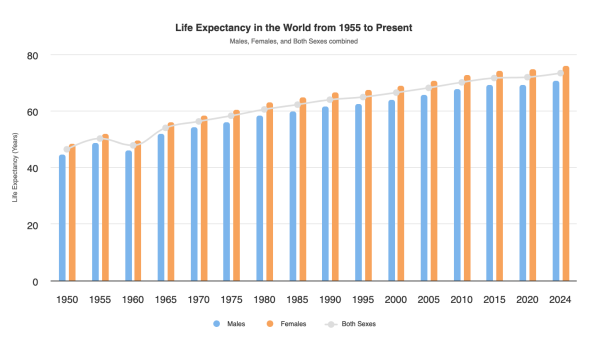
Meanwhile … the United States has fallen to 48th on the list of countries with the highest life expectancy.
Hong Kong tops the list with an average life expectancy of 85.63 overall – and 88.26 years for females.
For comparison, the U.S.'s average life expectancy is only 79.46.
Many factors potentially impact the findings, for example, the average height and weight of a population (with shorter & lighter people tending to live longer), diet, healthcare system, and work/life balance.
While some of this is out of your control (OK, a lot of it is) – there are definitely things you can do to increase your healthy lifespan. Meanwhile, some people like Bryan Johnson are doing everything they can to live forever.
Popular Mechanics put together a video series called How to Live Forever, or Die Trying, where they interview scientists and anti-aging gurus to give you insight into pursuing a future without death.
Unfortunately, recent science has shown that adults in their mid-40s to early 60s begin to experience significant changes in their alcohol, caffeine, and lipid metabolism, an increase in risk of cardiovascular disease, and a noticeable decrease in their skin and muscle health. When you hit your 60s, you also begin to see negative changes in carbohydrate metabolism, immune regulation, kidney function, and a further decline in the previously mentioned factors.
Here's the good news. Not only is science and technology getting better, but you're always in control. You can make lifestyle changes to increase your longevity, and you can also find supplements, treatments, and protocols that can reverse those factors of aging. Even simple measures like increasing your physical activity or avoiding alcohol before bed can make a massive difference.
They say a healthy person has thousands of dreams, but an unhealthy person only has one.
That is one of the reasons I spend so much time and energy thinking about staying healthy, fit, and vital.
Focusing on the positive is important … But to extend your healthy lifespan, you have to start by telling the truth and finding out what you and your body struggle with the most.
A doctor friend gave me some advice. He said it doesn't matter if you are on top of 9 out of 10 things … it's the 10th that kills you.
Despite our best efforts, Mother Nature remains undefeated.
With that said, here are some of my previous articles on longevity and health:
The goal isn't just to stay alive longer; it's to live life to its fullest for as long as possible.
I recently joined a fantastic mastermind group called DaVinci 50, run by Lisa and Richard Rossi. It brings together a remarkable collection of medical professionals and entrepreneurs focused on the latest research, treatments, and opportunities in health and longevity.
Another great tool I rely on is Advanced Body Scan. Early detection is crucial, but so is tracking the history of your scans to monitor changes over time. In my opinion, the most valuable scan is always the next one.
Additionally, I use a growing list of trackers and biometric devices to measure my heart rate, along with apps and tools for mindfulness, breathwork, and journaling. Together, these practices recognize that mind, body, and spirit combine to define how you live your life.
To end this post, I'll use a farewell phrase I heard often while growing up … it translates roughly to "go in health, come in health, and be healthy." It's a beautiful way to wish someone well on their journey, emphasizing the importance of health and well-being.
I hope you found something interesting. Let me know what things and practices work best for you.

 via Sketchplanations