Personal Development

  • The Human Experience Is An Endurance Sport …

    Life can be hard. For most of our existence, even 'living' was difficult. But humans survived and multiplied not because of their speed or their ferocity … nor their comparatively flabby bodies or bipedal motion.

    It was endurance.

    In history, it wasn't the strongest that survived but the most adaptable and the most enduring. 

    Some take that to impossible heights. 

    That's where Ultrarunner Nedd Brockman comes in. 

    You might have heard of Ultramarathons. Ned took it a bit further. He managed to run 1000 miles in 12 days … and he did it around a single track. Since he's Australian, we'll call it 1600 kilometers. 


    via 7NEWS Australia 

    Nedd is an electrician turned ultrarunner in Australia who raises funds for good causes. In this case, he raised funds to support homeless Australians. 

    While he was originally trying to beat a world record in his attempt to run 1000 miles, even when he missed that mark, he kept running. Through swollen feet, hip issues, injured toes, and more … he kept running. 

    As a result, he raised over $600,000. He ran for 12 days, 13 hours, 16 minutes, and 45 seconds. He averaged 79 miles of running a day. 

    Over the course of Nedd's Uncomfortable Challenge series, he's raised over $1.9M for charity.

    Though this may teeter on the "stupid" side of endurance, this is clearly a testament to the indomitable human spirit and challenging our limits. 

    “I just never could have imagined it to be this bad. And I’m forever grateful for it all. Wouldn’t change a … thing. Post traumatic growth coming right up.”

    How are you challenging yourself today?!


  • Multi-Tasking with ChatGPT’s Advanced Voice Interface ‘or’ Unlocking the Power of Voice Agents: A New Frontier in Content Creation

    This article was created using a unique process compared to our usual approach. To test ChatGPT’s Advanced Voice capabilities, I decided to talk with it while walking around my neighborhood. I wanted to explore if it could help me be productive while getting fresh air and exercise.

     

    Gettyimages-918789438-1585262043

    What follows is the transcript, with only some light editing and formatting to better provide insight into the process and its outputs.

    The embedded mini-article that ChatGPT produced isn’t the main takeaway here. What interests me is the quality of the article, considering how little effort went into creating it. It was so painless and quick that I found myself contemplating how easily I could use this process for other types of productive output. In fact, that concept is a key focus of the mini-article below.

    That said, this is just a snapshot of AI’s current capabilities. If I were to repeat this experiment in six months or a year, I’m confident the results would be even more impressive. I'm also confident that if I'd asked it to flesh out the article, I would have been more impressed as well.

    I’d probably consider this article “good enough” if I weren’t someone who takes pride in my writing and thinking. Nonetheless, I believe it’s a solid starting point. For the record, my son (who helps write these weekly commentaries) disagrees. He liked our article and its premise – but "hated" what ChatGPT produced.

    Sure, some additional work and deeper reflection could make it meaningfully better … but it’s impressive how quickly and easily we came up with something valuable (that could become even more valuable with a little extra effort).

    In conclusion, these content creation capabilities represent a key shift: the content bar will rise, and the minimum standard for what’s acceptable will get higher. But as the bar for “acceptable” rises, I think fewer people will strive for greatness. That’s where you can extend your edge … if you’re willing to do the extra work.


    Here is the Chat.

    “Hello.”

    00:00

    Hey there! How’s it going?

    “Going pretty well. Today, I want to work on a blog post.”

    00:06

    That sounds great! What topic are you thinking about for your blog post?

    “How voice agents like you can help to create articles in a new way.”

    00:07

    That’s a fascinating topic! Exploring how voice agents can revolutionize content creation could really capture readers’ imaginations. You could delve into how it streamlines the writing process, adds a conversational tone, and even opens up new possibilities for interactive or personalized content. What angle are you thinking of taking?

    “Everything you just said, but I also want to add a piece on instant feedback.”

    00:01

    Fantastic! So, you could structure the blog post around how voice agents enhance the writing process by making brainstorming more dynamic, offering immediate feedback, and allowing for a more fluid, conversational tone. Is there anything else you want to explore in the post?

    “An example where I’m walking around the neighborhood, but instead of simply walking, I talk to the AI agent and have it even ask me questions.”

    00:16

    So, while strolling through the neighborhood, you engage in a productive dialogue with the AI agent instead of just walking. It can prompt you with questions …

    “And help me consider and refine the post; yes.”

    00:020

    So, while strolling through the neighborhood, instead of just walking, you engage in a productive dialogue with the AI agent. It can prompt you with questions, helping you refine your ideas and shape your article, all while you’re getting some fresh air and exercise. It’s a great way to maximize productivity in otherwise idle moments. Want to include anything else?

    “Yes, a couple of other examples and challenges for the reader to think about other uses of this technology that open up AI and exponential progress in ways that they haven’t thought of before.”

    00:21

    Great idea! You could include examples like using voice agents for language learning, where they act as conversation partners, or for project management, where they help organize tasks and deadlines through natural conversation. For challenges, invite readers to think about how voice agents might transform areas like mental health support, creative collaborations, or even scientific research. This approach could really spark some innovative thinking!

    “Great. Please come up with a detailed outline for what you’re thinking.”

    00:08

    1. Introduction
      • Brief overview of how voice agents are changing content creation.
      • Mention of the growing role of AI in everyday life.
    2. Voice Agents: A New Way to Write
      • How voice agents can turn walking time into productive writing sessions.
      • The ease of having a conversation with an AI to generate content.
    3. Benefits of Voice Agents in Content Creation
      • Brainstorming: How voice agents can help generate ideas.
      • Instant Feedback: Getting immediate responses to refine ideas.
      • Conversational Tone: How speaking thoughts out loud can create a more natural writing flow.
    4. Examples of Voice Agent Applications
      • Language Learning: Acting as a conversation partner.
      • Project Management: Organizing tasks through dialogue.
      • Mindfulness and Mental Health Support: Providing an outlet for expression and guidance.
      • Creative Collaborations: Assisting in the co-creation of stories or projects.
    5. Challenges for the Reader
      • Encourage readers to think of other areas where voice agents could be transformative.
      • Provoke thought on the broader implications of AI in accelerating exponential progress.
    6. Conclusion
      • Summarize the key points discussed.


    “Okay, please write that blog post for an executive or entrepreneur audience, making it simple, engaging, and relevant to their interests.”

    00:15

    …Got it. Here’s the blog post:


    Unlocking the Power of Voice Agents: A New Frontier in Content Creation

    In today’s fast-paced world, efficiency and innovation are essential, especially for executives and entrepreneurs. One of the most exciting developments in this arena is the rise of voice agents — AI-powered assistants that are transforming how we create content. Imagine turning a simple walk around the neighborhood into a dynamic brainstorming session or a full-fledged article creation process. Let’s explore how voice agents can open up new horizons for you.
     

    A7f1fa55-67b2-48ae-af46-297621450debThis image was created using X’s Grok AI to pair with this article.

    Voice Agents: A New Way to Write

    Picture this: you’re out for your morning walk, and instead of just enjoying the scenery, you’re also creating content. With a voice agent, you can do just that. Engage in a conversation with your AI assistant, and the spoken ideas seamlessly transform into written words.

    Benefits of Voice Agents in Content Creation

    • Brainstorming

    Voice agents excel at helping you brainstorm. Throw ideas at them, and they’ll help you explore different angles, often sparking new thoughts in the process.

    • Instant Feedback

    Gone are the days of waiting for feedback. With a voice agent, you get instant responses. As you articulate your thoughts, the AI provides real-time feedback, helping you refine your ideas on the fly. It’s like having an editor by your side, 24/7.

    • Conversational Tone

    Speaking your thoughts can lead to a more natural, conversational tone in your writing. This style is increasingly popular, as it engages readers and makes complex topics more accessible.

    Examples of Voice Agent Applications

    • Language Learning

    Voice agents can act as conversation partners, helping you practice new languages in a low-pressure environment. They can introduce vocabulary, correct pronunciation, and even engage in dialogue, making language learning more interactive and fun.

    • Project Management

    Organizing tasks and deadlines through natural conversation is another strength of voice agents. Discuss your project needs, and let the AI help you prioritize tasks, set reminders, and keep you on track.

    • Mindfulness and Mental Health Support

    Voice agents can offer a safe space for expression and reflection. They can guide you through mindfulness exercises, provide mood trackers, or simply lend an empathetic ear, offering support whenever you need it.

    • Creative Collaborations

    Imagine co-writing a story or developing a project with your AI assistant. Voice agents can contribute ideas, help you overcome creative blocks, and add a new dimension to collaborative efforts.

    Some Challenges to Consider

    As you consider these applications, think about other areas where voice agents could revolutionize your work or personal life. Could they streamline your decision-making processes? Might they open up new avenues for customer engagement? The potential is vast, limited only by our imagination.

    Conclusion

    Voice agents are changing how we create content, offering benefits beyond simple convenience. From brainstorming to project management, and from language learning to mental health support, the possibilities are endless. As we continue to integrate AI into our daily lives, voice agents will evolve into increasingly powerful tools for innovation and growth. So, the next time you head out for a walk, consider inviting your AI assistant along — you might just discover your next big idea.


    “Okay, thanks.”

    00:01

    You’re welcome! If you need any more help, just let me know.


    I’d love your feedback on this … and I’m curious to learn how you’re using AI or want to use AI.

    As I’ve said before – we live in interesting times.

    Onwards!
  • Atoning & Rebuilding

    Yesterday was Yom Kippur, which translates to “Day of Atonement” and is one of the High Holy Days in the Jewish religion.

    As part of the holiday, participants read a list of sins (available here), apologize for those committed, and ask for forgiveness. Read the list … even though much has changed in the World… apparently, human nature hasn’t changed much.  

    Even if you have managed to stay on the right side of the Ten Commandments and haven’t killed or stolen … you have most likely been frivolous, stubborn, hurtful, dismissive, or judgmental (I know I have …).  

    I’ve had a reasonably challenging year. Instead of feeling like a victim or using the struggles as excuses, Yom Kippur is a day to look back honestly, reflect, and choose to be better.

    To help mark the day’s importance, participants read a prayer called the Unetaneh Tokef. Below is a brief excerpt that captures the spirit. 

    Who will rest and who will wander, who will live in harmony and who will be harried, who will enjoy tranquillity and who will suffer, who will be impoverished and who will be enriched, who will be degraded and who will be exalted.

    On one hand, you can read that and pray for Divine intervention (or perhaps favor), or you can recognize that we each have a choice about who we want to be, how we show up, and what we make things mean. Your choices about these things have real power to create the experience and environment you will live in next year.

    This time of year, we can also learn from many other cultures. For example, the Japanese art of Kintsugi. In Kintsugi, the Japanese mend broken pottery by gilding the fractures with gold, silver, or platinum. This treats the breaks and damage as an element that adds value and enhances the beauty of an object (preserving a part of its history) – rather than something that diminishes the object. 

    Diapositive5

    This concept is an excellent reminder as we unpack the “trauma” of shootings, culture wars, actual wars, and more. Our steps backward are just as much a part of our journey as our steps forward. As you heal, it is also important to remember to heal the World around you. In the Jewish faith, that concept is called Tikkun Olam

    One of the themes of Yom Kippur is that you’re only one good deed from tipping the scale towards good for yourself and others. As you recognize and repent for your sins, it’s also important to appreciate the good you did (and do) as well. 

    As I look at my year, atone, and look forward, I'm reminded of two definitions I heard recently. 

    One is that “intelligence” can be defined as the ability to get or move towards what you want … and the second is that “learning” is the ability to get a better result in the same situation.

    I choose to look at going forward as a chance to clear the slate and Be and Do better … personally, professionally, in the business, and in relationships. I know that there’s lots of room for improvement, opportunities for growth, and the ability to simply put the past behind me and focus on a better future.

    Initially, I looked at Capitalogix as a technology company that built trading and fund management capabilities. Over time, I realized that the team, our tools, and the things we do backstage are more valuable than the front-stage results that we produce. We can leverage these to amplify intelligence in virtually any industry.

    The future is going to be about making better decisions, taking better actions, and continually improving performance. That won’t really change. Almost everything else will. So, the business is really about the things that don’t change.

    I think this is probably true in life as well. Many parts of you change … but the part of you that doesn’t is really the core of who you are.

    There are Less Than 100 Days Left in 2024.

    There are only 80 days left until 2025. Many will spend those days stressing about the upcoming election, grumbling about inflation, and pretending it’s the universe’s fault they didn’t accomplish what they set their mind to … yet, it’s also enough time to sprint, to make a change, and to end the year on a high note. 

    There is plenty of time to make this your best year yet. What can you do? What will you do?

    What could you do to make the life of someone around you better? Likewise, how can you let others know you’re thankful for them?

    To reference a book by Ben Hardy and Dan Sullivan, transformational change is often easier than incremental change (because you don’t have to drag the past forward).

    So, what can you do that would trigger 10X results?   Will you?

    I hope you all experience growth in your mental state, your relationships, and your businesses.  

    Best wishes for a great day and an even better year!

  • The Law Of Diminishing Returns

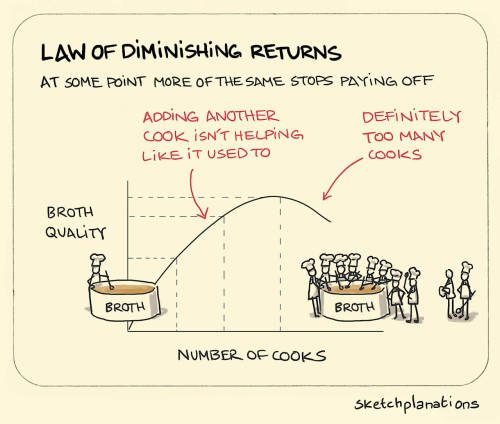
    At some point, more of the same stops paying off … it is called the law of diminishing returns.


    Law of Diminishing Returnsvia Sketchplanations

    Nature (and common sense) reminds us that equilibrium is important. For example, when you exercise too much, you get injured; when you drink too much water, you get poisoned; etc. 

    This concept applies almost everywhere.

    • It's why diversification is so important in portfolio construction theory. 
    • Or, why you don't want to put all your eggs in one basket (concentrating your risk).
    • And, my favorite, it's also why you shouldn't only eat vegetables.

    A related nugget of wisdom from the extreme … Too much of a good thing is a bad thing! 

    And of course … Be moderate in everything, including moderation.

  • Looking Back on Ryan Deiss’s Thoughts on AI & Humanity

    In 2017, I asked Ryan Deiss – a famous digital marketer – about his perspective on AI


    via YouTube

    How do you think his thoughts held up?

    To be fair, we shot this video BCGPT (before ChatGPT). Since then, AI has become much more accessible and useful.

    It was the start of the golden age of AI, machine learning, and process automation … but in the last seven years, AI's effects and impact have become radically more widespread.

    While marketing relies on data, analytics, and automation, Ryan believes it also needs a personal touch. He suggested that the best AI should make conversations feel more human (particularly in marketing and selling) and allow humans to be more human. In other words, as technology frees people up, they can focus on more valuable things.

    Today, more marketers – including Ryan – use generative AI tools to streamline their process and improve their output.

    His points about using tools like ChatGPT remain valid.

    The saying is trite, but AI won't replace your job … a human with AI will.

    This has happened many times in society. Fewer people work in farming or manufacturing, yet more people are doing more jobs. However, many of these new jobs didn't exist – or couldn't have been imagined – before people were freed up to contemplate what they could or should do. This shift in perspective is what truly matters and adds the most value to society, the economy, and people's lives.

    Just as mechanization freed up workforces for better jobs, AI can do the same.

    What do you think?

  • Are You As Smart As You Think You Are?

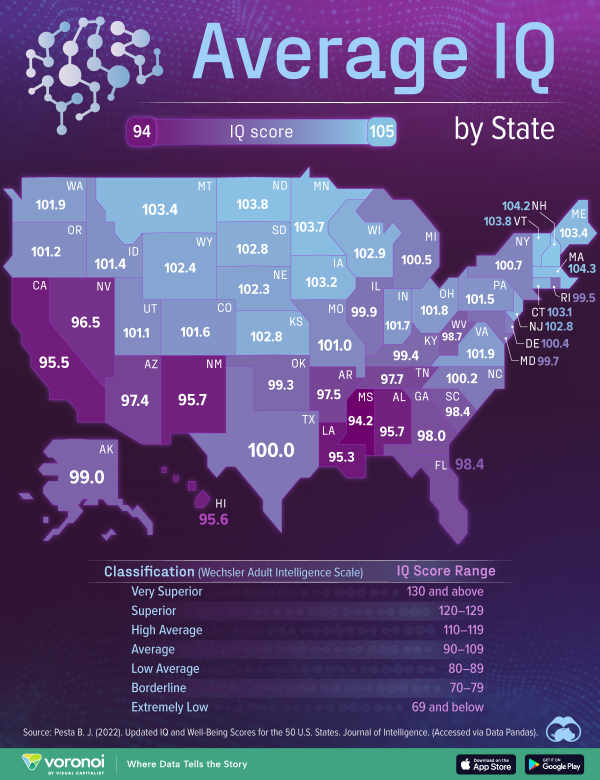
    VisualCapitalist just shared an infographic showing the Average IQ by state. It caught my eye and my interest.  Here it is.


    AverageIQbyState_web

    via VisualCapitalist.

    When I first examined the chart, I focused on the state-by-state differences. Honestly, I was taken aback that some states scored higher than others. And by that, I mean it wasn't necessarily the states I would've predicted. But then I took a closer look at the scale and realized these differences are probably insignificant. The results essentially show that, on average, states' intelligence levels are… well, average.

    I know a lot of smart people.

    I also know many people who think they're smarter than they are (even the smart ones … or, perhaps, especially the smart ones). 

    It's common. It's so common that there's a name for it—the Dunning-Kruger Effect.

    Have you ever met someone who's so confident about what they think that they believe they know more than an expert in a field? That's the Dunning-Kruger effect. It's defined as a cognitive bias where a lack of self-awareness prevents someone from accurately assessing their skills. 

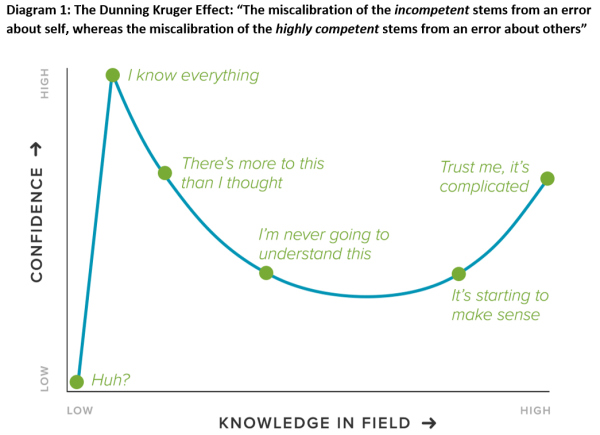
    Here's a graph that shows the general path a person takes on their journey towards mastery of a subject. 

    Dunning-w-caption

    via NC Soy

    The funny thing about the above image… it's not actually a part of the paper on the Dunning-Kruger Effect. But it's now so commonplace that people report that chart as fact—a fitting example of the effect. 

    244667

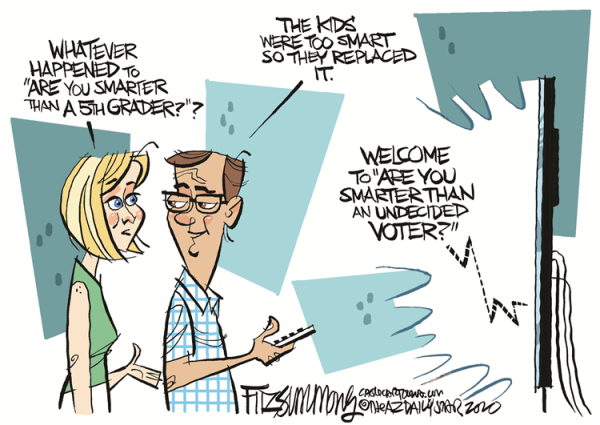
    David Fitzsimmons via Cagle Cartoons

    Recognizing the "victims" of this effect in our daily lives can often be funny or frustrating. But we're all prone to this; it's a sign of ignorance, not stupidity

    This is a problem with all groups and all people. You're not immune to it, even if you already know about the cognitive bias resulting from the Dunning-Kruger Effect. 

    It should be a reminder to reflect inward – not cast aspersions outward. 

    Two different ways that people get it wrong, first is to think about other people and it’s not about me. The second is thinking that incompetent people are the most confident people in the room, that’s not necessarily true.

    Usually, that shows up in our data, but they are usually less confident than the really competent people but not that much… - David Dunning

    To close out, even this article on the Dunning-Kruger presents a simplification of its findings. The U-shape in the graph isn't seen in the paper, the connection that lack of ability precludes meta-cognitive ability on a task is intuitive, but not the only potential takeaway from the paper. 

    Regardless, I think it's clear we are all victims of an amalgam of different cognitive biases. 

    We judge ourselves situationally and assume "the best". Meanwhile, we often assume "the worst" of others. 

    We can do better … it starts with awareness.

    Progress starts by telling the truth.

  • Remembering The ‘Crazy Ones’

    On September 28th, 1997 (almost exactly 17 years ago today), Apple released perhaps one of the most recognizable commercials of all time. I remember being mesmerized the first time I saw Apple Computer's iconic "Crazy Ones" video as part of their Think Different campaign.

    Steve Jobs originally recorded a version of "The Crazy Ones" himself, but chose to release the Richard Dreyfuss narrated version


    via Youtube

    Here is the text version of the script.

    Here's to the crazy ones.
    The misfits.
    The rebels.
    The troublemakers.
    The round pegs in the square holes.

    The ones who see things differently.

    They're not fond of rules.
    And they have no respect for the status quo.

    You can quote them, disagree with them,
    glorify or vilify them.
    About the only thing you can't do is ignore them.

    Because they change things.

    They push the human race forward.

    While some may see them as the crazy ones,
    we see genius.

    Because the people who are crazy enough to think
    they can change the world, are the ones who do.

        –     © 1997 Apple Computer, Inc.

    Click here for extra material about the video and campaign

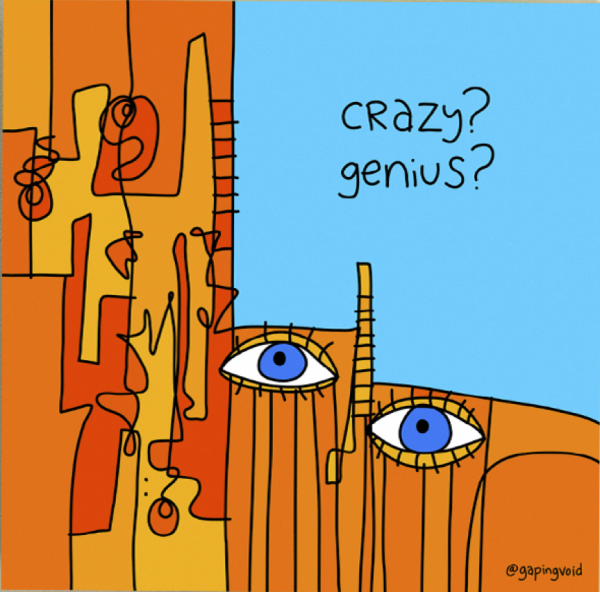
    I think it has held up pretty well, and I had this piece of art commissioned for my office. 

    Crazy Genius_GapingVoid

    There's a lot to be said for carving your own path, pushing past perceived limits, and accomplishing something hard to ignore. 

  • Imaginary Centenarians: An Ig Nobel Pursuit

    The 34th Annual Ig Nobel Prize ceremony took place last Thursday at MIT. Every year since 1991, around the time the recipients of the genuine Novel Prizes are announced,  the Ig Nobel Prize awards the ten achievements that "first make people laugh, and then make them think. They're meant to celebrate the imaginative and encourage more interest in the sciences. 

    The first award for Biology was awarded to Robert Klark Graham, for pioneering development of the Repository for Germinal Choice, a sperm bank that accepted donations only from Nobellians and Olympians. While I jokingly tell my kids they have "superior genetic potential," this type of research and belief can have serious consequences

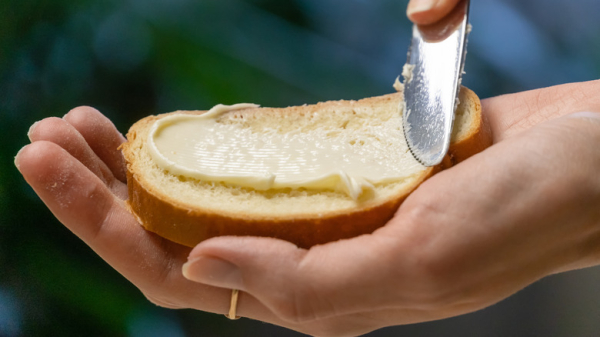
    In 1996, Physicist Robert Matthews earned a prize for his paper "Tumbling Toast, Murphy's Law and the Fundamental Constants," which sought to explain why toast tends to fall buttered-side down.

      
    Buttering-your-bread-before-toasting-it-cooks-butter-into-the-bread-1676209460


    In 2002, another physicist, Arnd Leike, earned the honor after using the law of exponential decay to explain the behavior of beer foam

    And in 2017, Marc-Antoine Fardin earned the honor for using fluid dynamics to finally answer the eternal question: "Can a cat be both a solid and a liquid?" In case you are squeamish, no blender was involved in that experiment.

    While these are funny examples, they're rooted in real science. As is the focus of this article, this year's Ig Nobel Prize for Demography

    In my circles, it is becoming more common to discuss how to live past 100 — and not just how to live beyond that number … but to do so with a high quality of life.

    A popular concept around that subject is Blue Zones – areas where people seem to live longer and healthier. There's even a Netflix documentary on the subject. Notable places include Sardinia, Italy; Okinawa, Japan; and Ikaria, Greece. 

    Saul Justin Newman challenged that belief with his research, which found that extreme age records tend to come from areas with no birth certificates, rampant clerical errors, pension fraud … and even short life spans. 

    While longevity in the zones has primarily been attributed to diet, community, and genetics, Newman found that many of these claims were based on errors – or outright fraud. Instead, these regions are actually characterized by the opposite of what you would expect … low incomes, low literacy, high crime, and short lifespans. 

    To a certain extent, it makes sense. In areas where you're struggling to make ends meet … why wouldn't you commit pension fraud? In fact, in 2010, the Japanese government realized that over 80% of the people aged over 100 were actually dead. Part of what made this possible was that America bombed the halls of records in that area during the war. 

    Here's an interview with Saul Justin Newman on the subject. He's tracked over 80% of the people aged over 110 worldwide. Almost none of them have a birth certificate. Only about 10% have a death certificate. 

    What does this mean for human longevity?

    While the stories of these 110-year-olds may mostly be fake – as mentioned in my recent article – longevity is on the rise, and there are many modalities to increase your lifespan. 


    Longevity-expanding-quest-lifespan-futurist-speaker


    The goal isn't just to stay alive longer; it's to live life to its fullest for as long as possible.

    There are people living to 100, and there are plenty of people living healthily into their 70s, 80s, and 90s. 

    We're taking steps in the right direction. Technology and medicine are both evolving quickly. 

    But, like with longevity data, improvements in any space need to be met with a grain of salt. 

    If it sounds too good to be true … it generally is. Not always. But, generally.