Personal Development

  • You Focus On What You Measure

    090410 One Day at a Time AttackedI have the privilege of knowing many fine entrepreneurs. Some of them are doing surprisingly well. Others are licking their wounds and struggling with the loss of confidence in their business, their business model, or even themselves.

     On some level, recent events could represent the biggest failure that some of these people ever have in their lives.

    There are several ways to take that. Here's one to think about.

    What would you do if you knew your worst failure was behind you and everything from this point forward was a move upwards or at least provides an opportunity to make progress?

    I Sense A Lot of Pain.

    If you look at
    things based on cycles or seasons, then this probably has been winter.  Still, periods like this can teach you a lot about yourself.

    I got a phone call this week from a friend who asked where I've been hiding. I was surprised because I hadn't thought about it like that.  Yet, it didn't take much reflection to see that many people I know, including me, have been hiding in one way or another.

    For example, one of my closest friends hasn't been returning phone calls. That is one of his early warning signs that tells me he is having a tough time. And several unquestionably smart, resourceful, and successful businessmen have broken down into tears recently while talking to me about the circumstances in which they find themselves.  I get it; there is a lot of pain out there right now.

    It affects me too.  A business group that I've participated in for almost 10 years is going on its annual retreat this week. It's designed to be fun and a vehicle to reconnect with ourselves and each other. It's a time for reflection, sharing and hopefully for new insight. Yet, there's a part of me that doesn't want to go.

    If I'm honest with myself, it is probably because I don't want to re-examine what happened during the past year.  In other words, I don't want to reflect on what went wrong, again, because I've done that enough already.

    But going to the retreat doesn't have to be about that at all. In fact, instead of it being an unpleasant exercise focusing on what I don't want … it easily can be when I focus on what I do want, and how I'm going to get there in a way that's best for everyone involved. The only difference in those two retreats is what I make it mean – and of course what happens because of that.

    You Focus on What You Measure.

    So, it occurs to me that I might be measuring the wrong things in several areas. Just because I used to keep score one way, doesn't mean that it's a helpful measure for me now.

    Measurement is supposed to give you a sense of your momentum towards your target. Done right, it helps you feel more confident and in-control. Sure it tells you what to do less of … more importantly, though, it highlights what we can and should do more of.

    Cleansing Or Clogging?

    I remember being in a Tony Robbins seminar about health and hearing a simple rule that made sense to me about eating. He said: before you put something in your mouth think about whether it's cleansing or clogging. That made sense to me, and it was helpful. The same could hold true for deciding which things to focus on in business or life. Will focusing on this create momentum and energy, or not? 

    On some level pain is inevitable.  Yet, for the most part, suffering is optional.

    Choose what makes you strong and more likely to take actions that make progress.
  • A Breath of Fresh Air

    Do gadgets that help you focus on conscious breathing work?  I found three that worked for me: Resperate, Helicor's StressEraser, and Heart Math's emWave.

    My biggest complaint is that once I learned the relaxation techniques each of these devices teach,  I didn't need the device to get the results.  That also is a positive, isn't it?

    I think, feel, and communicate better when I'm calm.  Learning to access that state at will is an important skill … in business and personal life. 

    So, with that in mind, here are my impressions and experience with each.

    090403 Resperate
    Resperate
    .

    The Resperate unit is a little bigger than a portable CD-ROM player, with a built-in elastic strap that goes around your ribcage to monitor your breathing.  The concept behind this tool is very simple.  It relaxes you by helping you slow your breathing down. 

    Resperate starts by pacing your in-and-out breaths with higher and lower pitched sound cues.  Over time it moves these tones farther apart, leading you to breathe slower and more deeply.

    How did it work?  It helped me move easily from 6 to 10 breaths-per-minute, down to two or three breaths-per-minute.  This promotes much deeper breathing and relaxes the body and mind.  I find that I enjoy using this tool for about 10-minutes at a time; and I definitely feel relaxed after using it.  

    While Resperate provided the most relaxation, it is the one I use least.  Perhaps because it is a little bigger and requires the belt.  Not big hurdles; but apparently big enough.

    090403 StressEraser
    Helicor's StressEraser

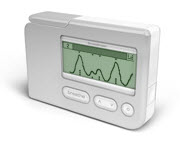
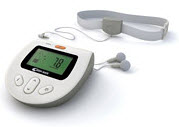
    The StressEraser is a portable biofeedback device, smaller than a deck of cards.  On the top, there is a hinged slot to put your finger.  The finger reader measures your pulse and galvanic skin response. There is also an LED screen on this device that helps you pace your breathing, and shows your level of stress or relaxation.

    Without focusing, the line is erratic and jagged.

    However, with only a little bit of training, it's easy to create a very smooth sign wave that indicates a steady breathing and a healthy heart rate pattern.

    With this tool, I get the best (most relaxing) results with an
    in-breath of about five seconds and an out-breath of about the same length. I like doing this for five minutes or so; it is a nice break in the middle of the day, before an important phone call, or a decision-making session. 

    I
    find that it
    helps me focus. Of the three tools, this is the one I find myself using most often.  This might be because I like the graph and how it gives me instantaneous feedback about my breathing and focus.

    090403 emWave
    HeartMath's emWave
    .

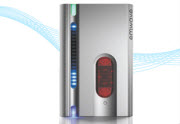
    This is the smallest of the tools.  The emWave relies on either a thumb sensor or, my preference, a clip that attaches to your earlobe. The technique is very similar to what you learn with the StressEraser. It involves steady breathing and a focus on reducing heart beat variability.  It has four levels of challenge.

    It sounds strange, and I don't claim to understand the science behind it, however focusing your attention on your heart while doing the breathing exercise seems to make a difference.  Somehow, when you focus your attention on your heart, that is when the machine changes color to indicate that there is "coherence". And, in my experience, this is the most relaxing part of the exercise. More coherence equals less stress.

    I tend to use this tool less than five minutes at a time to feel calm and refreshed.  It was also the easiest for me to have success with (in this case, to get the "green light" to come on).  So, the emWave is the smallest, easiest and quickest of the three … and it works.  I'm going to use this more often.

    So why did I use one that is more challenging?  Habit, or perhaps that defines part of the reason I need to relax?

  • A Breath of Fresh Air

    Do gadgets that help you focus on conscious breathing work?  I found three that worked for me: Resperate, Helicor's StressEraser, and Heart Math's emWave.

    My biggest complaint is that once I learned the relaxation techniques each of these devices teach,  I didn't need the device to get the results.  That also is a positive, isn't it?

    I think, feel, and communicate better when I'm calm.  Learning to access that state at will is an important skill … in business and personal life. 

    So, with that in mind, here are my impressions and experience with each.

    090403 Resperate
    Resperate
    .

    The Resperate unit is a little bigger than a portable CD-ROM player, with a built-in elastic strap that goes around your ribcage to monitor your breathing.  The concept behind this tool is very simple.  It relaxes you by helping you slow your breathing down. 

    Resperate starts by pacing your in-and-out breaths with higher and lower pitched sound cues.  Over time it moves these tones farther apart, leading you to breathe slower and more deeply.

    How did it work?  It helped me move easily from 6 to 10 breaths-per-minute, down to two or three breaths-per-minute.  This promotes much deeper breathing and relaxes the body and mind.  I find that I enjoy using this tool for about 10-minutes at a time; and I definitely feel relaxed after using it.  

    While Resperate provided the most relaxation, it is the one I use least.  Perhaps because it is a little bigger and requires the belt.  Not big hurdles; but apparently big enough.

    090403 StressEraser
    Helicor's StressEraser

    The StressEraser is a portable biofeedback device, smaller than a deck of cards.  On the top, there is a hinged slot to put your finger.  The finger reader measures your pulse and galvanic skin response. There is also an LED screen on this device that helps you pace your breathing, and shows your level of stress or relaxation.

    Without focusing, the line is erratic and jagged.

    However, with only a little bit of training, it's easy to create a very smooth sign wave that indicates a steady breathing and a healthy heart rate pattern.

    With this tool, I get the best (most relaxing) results with an
    in-breath of about five seconds and an out-breath of about the same length. I like doing this for five minutes or so; it is a nice break in the middle of the day, before an important phone call, or a decision-making session. 

    I
    find that it
    helps me focus. Of the three tools, this is the one I find myself using most often.  This might be because I like the graph and how it gives me instantaneous feedback about my breathing and focus.

    090403 emWave
    HeartMath's emWave
    .

    This is the smallest of the tools.  The emWave relies on either a thumb sensor or, my preference, a clip that attaches to your earlobe. The technique is very similar to what you learn with the StressEraser. It involves steady breathing and a focus on reducing heart beat variability.  It has four levels of challenge.

    It sounds strange, and I don't claim to understand the science behind it, however focusing your attention on your heart while doing the breathing exercise seems to make a difference.  Somehow, when you focus your attention on your heart, that is when the machine changes color to indicate that there is "coherence". And, in my experience, this is the most relaxing part of the exercise. More coherence equals less stress.

    I tend to use this tool less than five minutes at a time to feel calm and refreshed.  It was also the easiest for me to have success with (in this case, to get the "green light" to come on).  So, the emWave is the smallest, easiest and quickest of the three … and it works.  I'm going to use this more often.

    So why did I use one that is more challenging?  Habit, or perhaps that defines part of the reason I need to relax?

  • The Anxiety Antitidote

    090227 Pigs at Trough

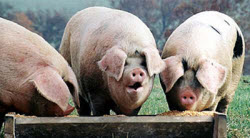
    "When the trough gets smaller … the pigs get meaner."

         – Dan Sullivan


    Likewise, in uncertain times, it is natural for people to worry that there will be less for them. 

    But it doesn't have to be that way.

    All We Have To Fear Is Fear Itself.  I keep talking about market psychology and human nature. The reason is that markets are really a reflection of the collective fear and greed of its participants. And people tend to get paralyzed during scary times like these.

    But it's not the economy that makes people feel paralyzed.
    People feel paralyzed because of their reactions and their beliefs
    about the economy.

    A little examination reveals that most fear is based on a "general" rather than a "specific" trigger. In other words people are afraid of all the things that could happen and are paralyzed by the sheer scope of possibilities. These things don't even have to be probabilities in order to scare them.

    Your Antidote to Anxiety.  You gain a competitive advantage as soon as you recognize that it's
    simply human nature when you "make things up" to scare yourself.  Why? 
    Because as soon as you distinguish that fear is just an automatic
    response and not necessarily "true", you can re-use your energy and
    insights to focus on things that move you forward.

    It's easy to be a lot more resourceful by simply dealing with the specific items, and coming up with a plan to deal with them or transform them into opportunities.

    Even a tough environment, like this, presents you with opportunities if you watch for them … or even better, if you create them.

  • The Anxiety Antitidote

    090227 Pigs at Trough

    "When the trough gets smaller … the pigs get meaner."

         – Dan Sullivan


    Likewise, in uncertain times, it is natural for people to worry that there will be less for them. 

    But it doesn't have to be that way.

    All We Have To Fear Is Fear Itself.  I keep talking about market psychology and human nature. The reason is that markets are really a reflection of the collective fear and greed of its participants. And people tend to get paralyzed during scary times like these.

    But it's not the economy that makes people feel paralyzed.
    People feel paralyzed because of their reactions and their beliefs
    about the economy.

    A little examination reveals that most fear is based on a "general" rather than a "specific" trigger. In other words people are afraid of all the things that could happen and are paralyzed by the sheer scope of possibilities. These things don't even have to be probabilities in order to scare them.

    Your Antidote to Anxiety.  You gain a competitive advantage as soon as you recognize that it's
    simply human nature when you "make things up" to scare yourself.  Why? 
    Because as soon as you distinguish that fear is just an automatic
    response and not necessarily "true", you can re-use your energy and
    insights to focus on things that move you forward.

    It's easy to be a lot more resourceful by simply dealing with the specific items, and coming up with a plan to deal with them or transform them into opportunities.

    Even a tough environment, like this, presents you with opportunities if you watch for them … or even better, if you create them.

  • Is Genius Something You Have or Something You Are?

    090220 Light of Inspiration Framed By Hands
    Some of my greatest accomplishments seemed almost effortless when they happened.

    Some people call it "Flow" while others call it "Being-In-The-Zone". You've probably experienced the same thing.

    Genius may be related to that. As I think of it, some of my best ideas seemingly came to me fully-formed.

    For example, in 2003 I had a breakthrough discovery resulting in an algorithm now used in a series of trading systems. Leading up to that point, I had spent quite a long time thinking about every little aspect in detail; and the progress had come slowly and painfully. Then, whoosh, it's like the whole thing came all at once.  I say (and I believe) that it came to me, through me, and from me.  But I still don't know how or why it happened.  It is almost like I was television
    or radio receiver that somehow got turned into a channel broadcasting something worthwhile.

    Since then, I've tried to re-create the environment, my work process, anything to bring back that feeling of inspiration, innovation and progress.  And I have had moments like that from time-to-time.

    The Ted Talk Video on Genius:

    This video is about the process I described above.  It is about "Genius" and whether it's something you "Have" or something you "Are".

    While this video does not provide answers, hopefully it will stimulate a thought process and provoke some ideas and discussions that you find helpful and enjoyable. I know it did for me.

    Here is the direct link.

    Elizabeth Gilbert, the author of Eat, Pray, Love, muses on the impossible things we expect from artists and geniuses — and shares the idea that, instead of the rare person "being" a genius, all of us "have" a genius.

    Also, here's a link to a website that lists the daily routines and work process that
    various famous people have used. I found some interesting things there.

  • Is Genius Something You Have or Something You Are?

    090220 Light of Inspiration Framed By Hands
    Some of my greatest accomplishments seemed almost effortless when they happened.

    Some people call it "Flow" while others call it "Being-In-The-Zone". You've probably experienced the same thing.

    Genius may be related to that. As I think of it, some of my best ideas seemingly came to me fully-formed.

    For example, in 2003 I had a breakthrough discovery resulting in an algorithm now used in a series of trading systems. Leading up to that point, I had spent quite a long time thinking about every little aspect in detail; and the progress had come slowly and painfully. Then, whoosh, it's like the whole thing came all at once.  I say (and I believe) that it came to me, through me, and from me.  But I still don't know how or why it happened.  It is almost like I was television
    or radio receiver that somehow got turned into a channel broadcasting something worthwhile.

    Since then, I've tried to re-create the environment, my work process, anything to bring back that feeling of inspiration, innovation and progress.  And I have had moments like that from time-to-time.

    The Ted Talk Video on Genius:

    This video is about the process I described above.  It is about "Genius" and whether it's something you "Have" or something you "Are".

    While this video does not provide answers, hopefully it will stimulate a thought process and provoke some ideas and discussions that you find helpful and enjoyable. I know it did for me.

    Here is the direct link.

    Elizabeth Gilbert, the author of Eat, Pray, Love, muses on the impossible things we expect from artists and geniuses — and shares the idea that, instead of the rare person "being" a genius, all of us "have" a genius.

    Also, here's a link to a website that lists the daily routines and work process that
    various famous people have used. I found some interesting things there.

  • Best Practices For These Uncertain Times

    090212 ChicagoTrading Pit 250p
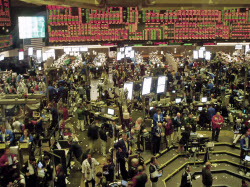
    I spent part of the week in Chicago, and had had the privilege of spending some quality time discussing the current situation with a group of experienced traders and industry professionals. A couple of things struck me immediately.

    • First, even these pros were rattled by the state of the economy and the prospect of recovery taking longer than expected or wanted.
    • Second, even for those in the room who had well-crafted theories about why they were expecting an intermediate-term rally, it didn't take much discussion for them to admit the same sense of uncertainty that others have expressed.
    • Finally, and most importantly, once the obligatory fear, uncertainty, and doubt talk was on the table – the conversation quickly turned to the best ways to make money in this environment.

    Are Times Uncertain – Or Is It You?

    I also went to a Strategic Coach quarterly planning session this week. Not surprisingly, the topic was primarily about best practices during uncertain times. Dan Sullivan recounted that many of his clients expected a tough year, but still expected a recovery to follow that. Then, he posed these questions.

    • How long will this turmoil last? 
    • What if the recovery doesn't come as quickly or as fully as you hope or expect?
    • What if things stay like this?
    • Who do I have to become for this to be okay?

    090212 Solutions Change EverythingGood questions, and it made me think:

    Mastery isn't measured by the number of bad things you eliminate …
    but by the number of times you eliminate calling them bad
    .

    Many of our biggest innovations or course corrections took place after a seemingly disastrous occurrence or bad thing happened. That's why lots of psychologists and self-help gurus encourage people to focus on the hidden gift that many of these experiences provide.

    Examining several instances from my past, I came up with this list of the seven steps I use to transform almost any situation.

    Seven Best Practices for Uncertain Times.

    1. Accept Reality: We are where we are. Focus on being complete with what happened before this; and think about this as a new beginning with an even bigger future.
    2. Do Something Positive: Take action and build momentum and confidence. Big wins are great. Yet, in scary times, even small items are worth noting and building upon.
    3. Take Care of Yourself: Increase your physical activity, meditation and massage. This is the time to eat and sleep well. Many studies show decision-making suffers when you're stressed. Taking care of yourself goes a long way to making a lot of other things better.
    4. Communicate More: The natural tendency is to hide or to recuperate in private. Instead, be open and receptive to help and ideas from friends, partners, or wherever it comes from.
    5. Creative Destruction: The old game and the old ways of thinking are over.  Shift energies to what is working.
    6. Increase Your Options: It often takes a different level of thinking to solve a problem than the level of thinking that got you into the problem. So, be open to new opportunities and new possibilities.
    7. Choose a Bigger Future: Instead of resigning yourself to playing small and doing with less, recognize that the clearing creates the space for something even better. Choose what you want, plan it and stick to your process.

    They say everything happens for a reason. The secret is that you get to choose the reason, what it means to you, and what you're going to about it. Choose well, and someday you could look back on this time as one of the best things that ever happened to you.

  • Best Practices For These Uncertain Times

    090212 ChicagoTrading Pit 250p
    I spent part of the week in Chicago, and had had the privilege of spending some quality time discussing the current situation with a group of experienced traders and industry professionals. A couple of things struck me immediately.

    • First, even these pros were rattled by the state of the economy and the prospect of recovery taking longer than expected or wanted.
    • Second, even for those in the room who had well-crafted theories about why they were expecting an intermediate-term rally, it didn't take much discussion for them to admit the same sense of uncertainty that others have expressed.
    • Finally, and most importantly, once the obligatory fear, uncertainty, and doubt talk was on the table – the conversation quickly turned to the best ways to make money in this environment.

    Are Times Uncertain – Or Is It You?

    I also went to a Strategic Coach quarterly planning session this week. Not surprisingly, the topic was primarily about best practices during uncertain times. Dan Sullivan recounted that many of his clients expected a tough year, but still expected a recovery to follow that. Then, he posed these questions.

    • How long will this turmoil last? 
    • What if the recovery doesn't come as quickly or as fully as you hope or expect?
    • What if things stay like this?
    • Who do I have to become for this to be okay?

    090212 Solutions Change EverythingGood questions, and it made me think:

    Mastery isn't measured by the number of bad things you eliminate …
    but by the number of times you eliminate calling them bad
    .

    Many of our biggest innovations or course corrections took place after a seemingly disastrous occurrence or bad thing happened. That's why lots of psychologists and self-help gurus encourage people to focus on the hidden gift that many of these experiences provide.

    Examining several instances from my past, I came up with this list of the seven steps I use to transform almost any situation.

    Seven Best Practices for Uncertain Times.

    1. Accept Reality: We are where we are. Focus on being complete with what happened before this; and think about this as a new beginning with an even bigger future.
    2. Do Something Positive: Take action and build momentum and confidence. Big wins are great. Yet, in scary times, even small items are worth noting and building upon.
    3. Take Care of Yourself: Increase your physical activity, meditation and massage. This is the time to eat and sleep well. Many studies show decision-making suffers when you're stressed. Taking care of yourself goes a long way to making a lot of other things better.
    4. Communicate More: The natural tendency is to hide or to recuperate in private. Instead, be open and receptive to help and ideas from friends, partners, or wherever it comes from.
    5. Creative Destruction: The old game and the old ways of thinking are over.  Shift energies to what is working.
    6. Increase Your Options: It often takes a different level of thinking to solve a problem than the level of thinking that got you into the problem. So, be open to new opportunities and new possibilities.
    7. Choose a Bigger Future: Instead of resigning yourself to playing small and doing with less, recognize that the clearing creates the space for something even better. Choose what you want, plan it and stick to your process.

    They say everything happens for a reason. The secret is that you get to choose the reason, what it means to you, and what you're going to about it. Choose well, and someday you could look back on this time as one of the best things that ever happened to you.

  • Attitude

    I got the following story in an e-mail, several times this year.  It has a nice message.  The thing that interested me, though, was that I got it in several different forms. 

    Jerry is the hero in this version.  It was Mike in another.  Sometimes he got shot, and was allergic to bullets … other times he fell off a tower and was allergic to gravity.  Sometimes it was a plain text mail, other times it was in a PowerPoint attachment.

    Made to Stick:  Clearly it is a "sticky" story that people like to re-shape and re-tell.  So, with no further ado, here it is for you to read for yourself.

    Jerry was the kind of guy you love to hate. He was always in a good mood and always had something positive to say. When someone asked him how he was doing, he would reply, "If I were any better, I would be twins!"

    He was a unique manager because he had several waiters who had followed him around from restaurant to restaurant. The reason the waiters followed Jerry was because of his attitude. He was a natural motivator. If an employee was having a bad day, Jerry was there telling the employee how to look on the positive side of the situation.

    Seeing this style really made me curious, so one day I went up to Jerry and asked him, "I don't get it! You can't be a positive person all of the time. How do you do it?"

    Jerry replied, "Each morning I wake up and say to myself, Jerry, you have two choices today. You can choose to be in a good mood or you can choose to be in a bad mood.' I choose to be in a good mood.

    Each time something bad happens, I can choose to be a victim or I can choose to learn from it. I choose to learn from it.

    Every time someone comes to me complaining, I can choose to accept their complaining or I can point out the positive side of life. I choose the positive side of life."

    "Yeah, right, it's not that easy," I protested.

    "Yes it is," Jerry said. "Life is all about choices. When you cut away all the junk, every situation is a choice. You choose how you react to situations. You choose how people will affect your mood. You choose to be in a good or bad mood. The bottom line: It's your choice how you live life."

    I reflected on what Jerry said. Soon thereafter, I left the restaurant industry to start my own business.

    We lost touch, but I often thought about him when I made a choice about life instead of reacting to it.

    Several years later, I heard that Jerry did something you are never supposed to do in a restaurant business: he left the back door open one morning and was held up at gunpoint by three armed robbers. While trying to open the safe, his hand, shaking from nervousness, slipped off the combination.

    The robbers panicked and shot him.

    Luckily, Jerry was found relatively quickly and rushed to the local trauma center.

    After 18 hours of surgery and weeks of intensive care, Jerry was released from the hospital with fragments of the bullets still in his body.

    I saw Jerry about six months after the accident. When I asked him how he was, he replied, "If I were any better, I'd be twins. Wanna see my scars?"

    I declined to see his wounds, but did ask him what had gone through his mind as the robbery took place.

    "The first thing that went through my mind was that I should have locked the back door," Jerry replied. "Then, as I lay on the floor, I remembered that I had two choices: I could choose to live, or I could choose to die. I chose to live."

    "Weren't you scared? Did you lose consciousness?" I asked.

    Jerry continued, "The paramedics were great. They kept telling me I was going to be fine. But when they wheeled me into the emergency room and I saw the expressions on the faces of the doctors and nurses, I got really scared. In their eyes, I read, 'He's a dead man.' I knew I needed to take action."

    "What did you do?" I asked.

    "Well, there was a big, burly nurse shouting questions at me," said Jerry. "She asked if I was allergic to anything. 'Yes,' I replied. The doctors and nurses stopped working as they waited for my reply. I took a deep breath and yelled, 'Bullets!' Over their laughter, I told them, 'I am choosing to live. Operate on me as if I am alive, not dead."

    Jerry lived thanks to the skill of his doctors, but also because of his amazing attitude. I learned from him that every day we have the choice to live fully.

    Attitude, after all, is everything.

    Triumphant Man on Water 250pIt's Really About Resilience

    Lots of articles stress that how we react to challenges can dramatically affect the outcome, influence our health and the quality and length of our lives.

    A new branch of medicine – psychoneuroimmunology – studies the relationship between mental attitude and health. Physicians have found that a positive attitude can result in faster recovery from surgery and burns, more resistance to arthritis and cancer and improved immune function.

    For example, Yale University researchers conducted a 23-year-long study which showed that those who had a positive attitude towards aging lived roughly seven and a half years longer than participants who were dreading reaching their twilight years.

    In "The Survivor Personality," Al Siebert has some interesting insights into why some people are stronger and more skillful at handling life’s difficulties. Interestingly Dr. Siebert says that survivor qualities can be learned, but they can't be taught.

    Are life's best survivors different from other people?  No; they survive, cope, and thrive better because they are better at using the inborn abilities possessed by all humans.

    Will it be easy to think positively and look for the good when things are going bad? Not always; yet cost-benefit analysis indicates that the rewards are well worth the effort.  I have two choices: I could choose to focus on what makes me strong, or I could focus on what makes me weak. I choose to focus on what makes me strong.  I hope you do too.