Personal Development

  • Socrates’ Triple Filter Test and the Modern World

    Small distinctions separate wise men from fools.  Perhaps one of them has to do with what the wise man deems important.
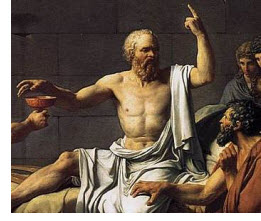
     

    090501 Socrates Socrates' Triple Filter.

    In ancient Greece, Socrates was reputed to hold knowledge in high esteem.  One day an acquaintance met the great philosopher and said, "Do you know what I just heard about your friend?"

    "Hold on a minute," Socrates replied. "Before telling me anything, I'd like you to pass a little test. It's called the Triple Filter Test."

    "Triple filter?"

    "That's right," Socrates continued.  "Before you talk to me about my friend, it might be a good idea to take a moment and filter what you're going to say. That's why I call it the triple filter test.

    The first filter is Truth.  Have you made absolutely sure that what you are about to tell me is true?"

    "No," the man said, "Actually I just heard about it and…"

    "All right," said Socrates. "So you don't really know if it's true or not. Now let's try the second filter, the filter of Goodness.  Is what you are about to tell me about my friend something good?"

    "No, on the contrary…"

    "So," Socrates continued, "You want to tell me something bad about him, but you're not certain it's true.  You may still pass the test though, because there's one filter left.  The third filter is Usefulness.  Is what you want to tell me about my friend going to be useful to me?"

    "No, not really."

    "Well," concluded Socrates, "If what you want to tell me is neither true, nor good, nor even useful … then why tell it to me at all?"


    How Does That Apply to Me or Trading?
     090501 Glasses Pen and Paper 200p The concept of Socrates' Triple Filter applies to trading as well.

    As a technical trader, rather than looking at fundamental data and scouring the news daily, I focus on developing dynamic and adaptive systems and processes to look at the universe of trading algorithms to identify which are in-phase and likely to perform well in the current market environment.

    One of the arguments in favor of technical analysis is that fundamental data, news, and sentiment are already built-in to the chart.


    Filter Out What Isn't Good For You.
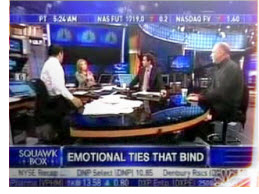
    Cnbc_sqawkbox In contrast, there are too many ways that the media (meaning the techniques, graphics, music, etc.), the people reporting it, and even the news itself, appeals to the fear and greed of human nature.

    This is the main reason that I don't watch CNBC during the trading day.  Even though I like it on several levels … I don't think it helps me.  So I filter it and get the news in other ways.

    Likewise, I don't watch TV news anymore either. It seems like story after story is about terrible things. For example during a recent visit with my mother, I listened to her watch the news.  There was a constant stream of "oh no," or "oh my," and "that's terrible". You don't even have to watch the news to know what it says.

     
    Focus On What You Want.

    Instead, I get the news I need a different way that is more efficient and productive for me. I subscribe to certain things via e-mail, and other things via RSS feeds.  Then I supplement those with a series of search services that alert me to items that match the criteria I set. An example would be Google Alerts.  Two other nice alert services are from the Financial Times and the New York Times.  Recently I've also been using two great iPad apps – one is called Flipboard, the other is called Zite.

    Check them out.  It will save you a lot of time and effort.

    Personally, I care about the source of my news. It helps me identify and account for potential bias. So using subscriptions, feed readers, and alert services help here too.

    Another reason I like these tools is that I can use different filters for different purposes.


    What's The Purpose Of News For You?

    My purpose changes what I'm looking for and the amount of attention I pay to different types of information. Am I reading or watching the news for entertainment, to learn something new, or to find something relevant and actionable?

    Getting back to Socrates' three filters and the business of trading, I ask might: is it important, does it affect our edge, or can I use it as a catalyst for innovation?

  • The Too True Story of the Nail in the Fence.

    This is a good one.  It hit home for me.  Hopefully you'll like it too.

    Nail In The Fence:

    Nail in wood There once was a little boy who had a bad temper. His Father gave him a bag of nails and told him that every time he lost his temper, he must hammer a nail into the back of the fence.

    The first day the boy had driven 37 nails into the fence. Over the next few weeks, as he learned to control his anger, the number of nails hammered daily gradually dwindled down.

    He discovered it was easier to hold his temper than to drive those nails into the fence.

    Finally the day came when the boy didn't lose his temper at all. He told his father about it; and the father suggested that the boy now pull out one nail for each day that he was able to hold his temper.

    The days passed and the young boy was finally able to tell his father that all the nails were gone.

    The father took his son by the hand and led him to the fence. He said, "You have done well, my son, but look at the holes in the fence. The fence will never be the same. When you say things in anger, they leave a scar just like this one. You can put a knife in a man and draw it out. It won't matter how many times you say I'm sorry, the wound is still there." A verbal wound is as bad as a physical one.

    My Note:

    Sometimes I am harsh, and more hurtful than I intend.  Anger and fear cause some of it.  Sometimes it happens because I want to be funny (even at someone's expense).  Other times it happens because I want to help someone — and I choose to be direct — regardless of how they will "feel it" when I deliver the message.

    For the most part, I never intend to leave a "hole". This story was a good reminder to be mindful of cause and intent.  Hope it helps.

    Enhanced by Zemanta
  • Alone Together – Instant Gratification & Shortening Attention Spans

    Instant Gratification & Shortening Attention Spans.

    I was showing my son a web video — and in less than a minute he was texting someone. 

    Let me make that more clear … it was Less-Than-A-Minute! … while he was standing with me … and he did it without hesitation, apology, or sense that shifting his attention to the phone was in any way a bad thing.

    I know "get over it".  He was probably texting before we spoke, anyway; right?

    You're probably seeing similar behavior more often too.
      

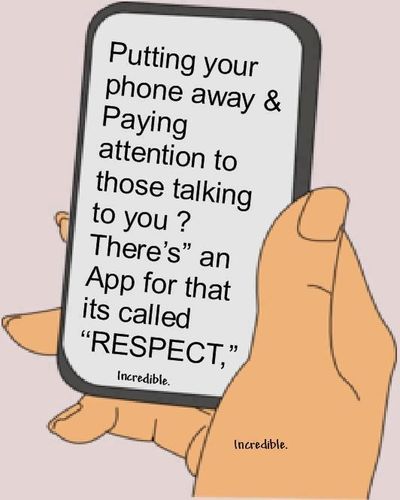
    120622 Put the Phone Away


    It is scary to realize how easy it is to focus on a phone, iPad or e-mail rather than a person.

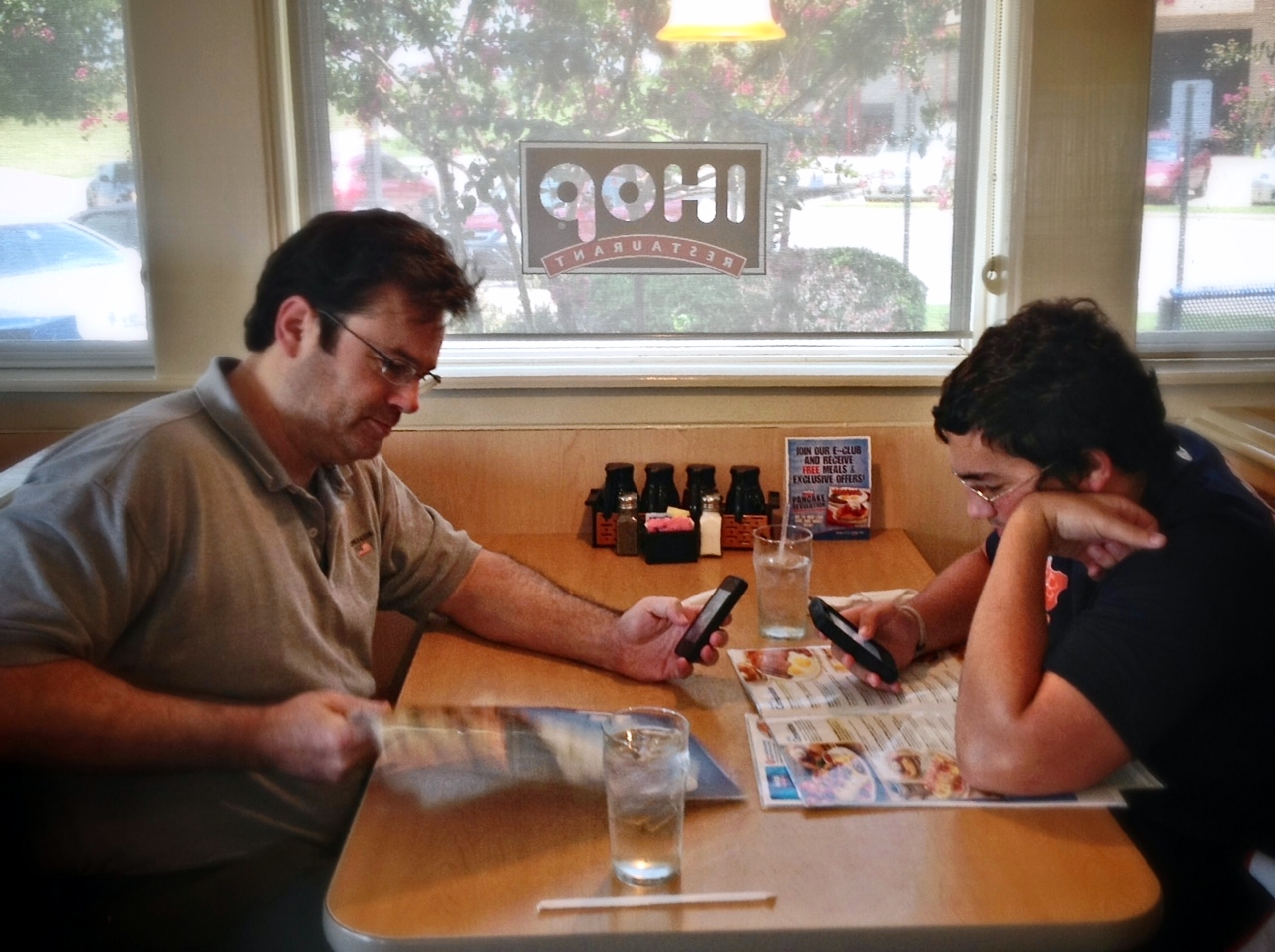
    Upon reflection, we spend a lot of time alone together.

    There is a difference between physical presence and being present.


    120623 Alone Together at IHOP


    Focus can be pretty fragile if it isn't a conscious choice.

    To demonstrate this, here is a seemingly easy challenge … simply listen to a favorite song.

    The challenge is how you can truly do that without losing focus and having other thoughts intrude (for example, without thinking about your to-do list or other songs that you like, or who you're going to meet with later in the day, etc.)?  For me, the answer was not that long.

    Sometimes it feels like modern life causes attention deficit disorder.

    Attention Deficit Can Be Dangerous If You Aren't Aware of It.

    110625 focusYet, losing focus while trading, in business, or even during a simple conversation – can have serious consequences.

    When you are not aware of your focus, I bet it wanders.  Mine does; I get distracted easily. 

    It didn't take long for me to realize that this happened to me while talking to my wife, while listening to a telephone call, even when ordering food at a restaurant. How can I lose focus on the waitress while I was ordering? Apparently, quite easily.

    How about you?  When you're listening to someone talk to you, are you really listening to them – or are you checking e-mail, texting, browsing a website, watching TV, playing a game, or thinking about what you're going to say? 

    Be honest with yourself; how often are you fully present?  For me, the answer was not nearly enough.


    Enhanced by Zemanta
  • Here Are Some Interesting Links to Read This Weekend

    Ah, the joys of over-thinking.

    120616 Diagram_ToDo


    Here are some of the posts that caught my eye. Hope you find something interesting.

    Lighter Links:


    Trading Links:

  • Great Visual Metaphor for a Bigger Future

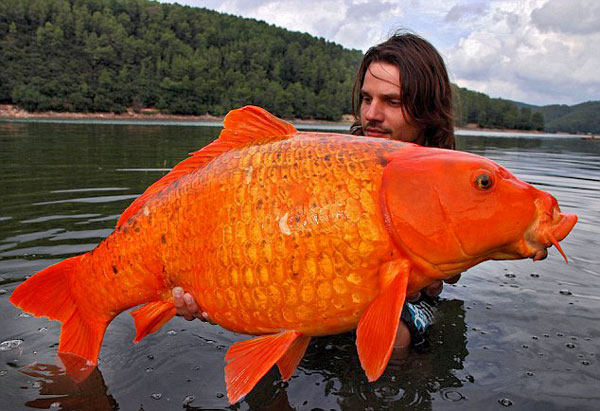
    "Interestingly, koi, when put in a fish bowl, will only grow up to three inches.

    When this same fish is placed in a large tank, it will grow to about nine inches long.


    Goldfish jumping to new bowl


    In a pond koi can reach lengths of eighteen inches. Amazingly, when placed in a lake, koi can grow to three feet long.


    101126-Koi-Potential 
    The metaphor is obvious. You are limited by how you see the world."

    –via Vince Poscente

    Enhanced by Zemanta

  • At the End of Pain, You’ll Often Find Success

    Do you know why you find your keys in the last place you look?  It is because it doesn't make sense to keep looking for them after you find them.
     
    Ultimately, the key is to focus on the goal (not how you got to where you are), and to keep moving forward.
     
     
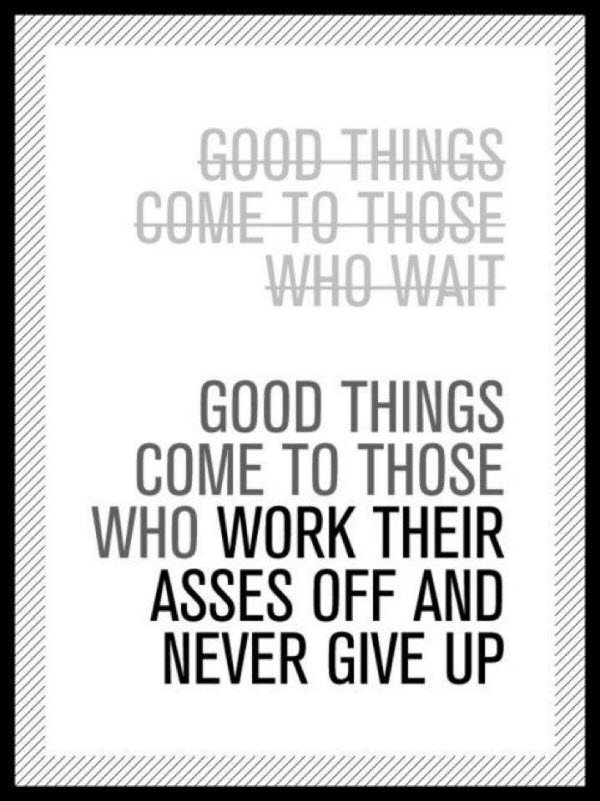
    120317 Reminder of How Good Things Come
       hat tip to Cliff Michaels


    Finally, here is a small reminder:
    People often say that motivation doesn’t last.  Well, neither does bathing – that’s why we recommend it daily.”  ~Zig Ziglar
    Enhanced by Zemanta
  • At the End of Pain, You’ll Often Find Success

    Do you know why you find your keys in the last place you look?  It is because it doesn't make sense to keep looking for them after you find them.
     
    Ultimately, the key is to focus on the goal (not how you got to where you are), and to keep moving forward.
     
     
    120317 Reminder of How Good Things Come
       hat tip to Cliff Michaels


    Finally, here is a small reminder:
    People often say that motivation doesn’t last.  Well, neither does bathing – that’s why we recommend it daily.”  ~Zig Ziglar
    Enhanced by Zemanta
  • A Little Monday Morning Motivation

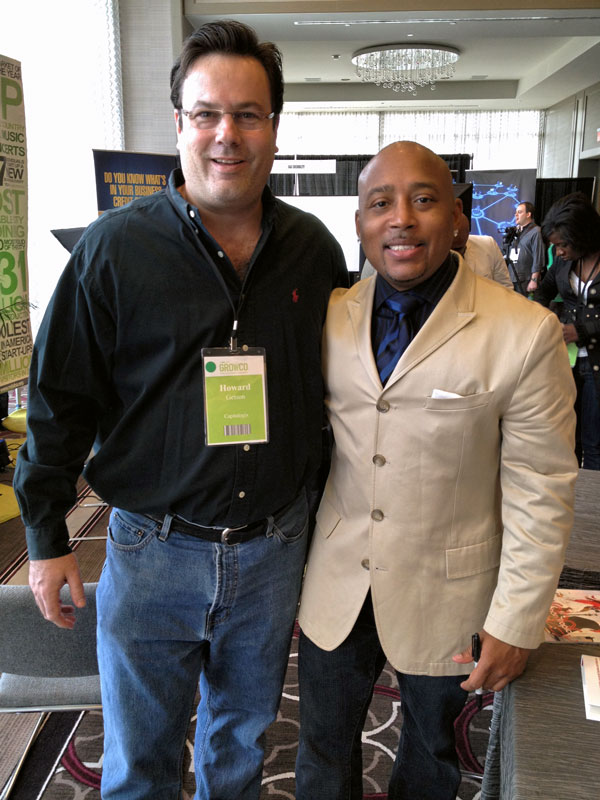
    I spent part of last week at the Inc. Magazine GROWCO Conference.

    If you're not still learning … your dying.  So, consider continuing education part of your perpetual youth plan.

    Plus, there are plenty worse places to be then New Orleans

    With that said, I know I'm getting older because after walking through the French Quarter – the part of me I most wanted rubbed were my feet. (I wish I was joking).

    The first speaker was the Mayor of New Orleans.  He explained that one of the key decisions they made after Katrina wasn't to re-build the city … instead, it was to build the city they always wanted New Orleans to be.

    Bill Clinton was there, too.  He was articulate, charismatic and clever. But the star of the show (based on audience response and the rush of people to get his autograph) was Daymond John (of FUBU and Shark Tank fame).


    120310-HMG-and-Daymond-John


    Daymond talked about his five Shark Rules:  1. Set Goals; 2. Do your Homework; 3. Always do what you love; 4. Remember you are the brand; and 5. Keep moving.

    He stressed that the secret to power is to be decisive.

    He also shared that the money they invest on the Shark Tank show really comes from each of them; however, only about 20% of the deals actually get to a closing. 

    Daymond said that he invests in people, not companies.  Moreover, he claims that each of Sharks know who they will invest in within the first minute of the presentation (and he suspects that is how most business-people make decisions).  Interesting.


    Enhanced by Zemanta
  • A Little Monday Morning Motivation

    I spent part of last week at the Inc. Magazine GROWCO Conference.

    If you're not still learning … your dying.  So, consider continuing education part of your perpetual youth plan.

    Plus, there are plenty worse places to be then New Orleans

    With that said, I know I'm getting older because after walking through the French Quarter – the part of me I most wanted rubbed were my feet. (I wish I was joking).

    The first speaker was the Mayor of New Orleans.  He explained that one of the key decisions they made after Katrina wasn't to re-build the city … instead, it was to build the city they always wanted New Orleans to be.

    Bill Clinton was there, too.  He was articulate, charismatic and clever. But the star of the show (based on audience response and the rush of people to get his autograph) was Daymond John (of FUBU and Shark Tank fame).


    120310-HMG-and-Daymond-John


    Daymond talked about his five Shark Rules:  1. Set Goals; 2. Do your Homework; 3. Always do what you love; 4. Remember you are the brand; and 5. Keep moving.

    He stressed that the secret to power is to be decisive.

    He also shared that the money they invest on the Shark Tank show really comes from each of them; however, only about 20% of the deals actually get to a closing. 

    Daymond said that he invests in people, not companies.  Moreover, he claims that each of Sharks know who they will invest in within the first minute of the presentation (and he suspects that is how most business-people make decisions).  Interesting.


    Enhanced by Zemanta
  • Expect Extraordinary – Here’s a Video of Something Not to Try at Home

    Sometimes normal isn't enough.

    Playing safe is often a good strategy … But, sometimes you have to expect the extraordinary.

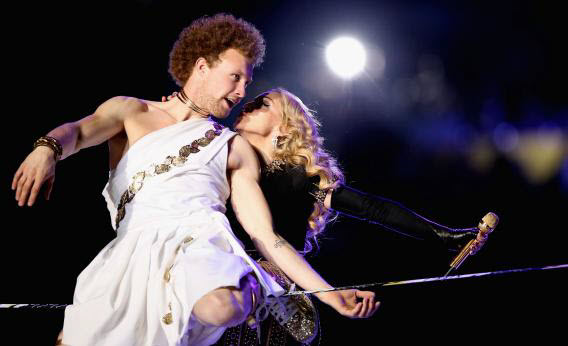
    Did you see the strange guy doing a modified tight-rope circus routine during Madonna's Super Bowl half-time performance.


    120211 Madonna and Sketchy Andy at the Super Bowl


    Well, it was more than that … did you see the guy bounce up and down as though that little rope was a trampoline?

    What in the world was going on?

    Well, the short answer is: slacklining. Or, if you want to get technical and specific, tricklining. According to California's Adventure Sports Journal , slacklining was invented in the early 1980s by two rock climbers.

    As you may have guessed, the Super Bowl halftime cameo was a big moment for the young sport of slacklining—and for the talented, curly-haired slackliner who got the spotlight: Andy Lewis, aka Sketchy Andy . You've got to watch what he can really do!


    Imagine what went into developing this skill.  Was it thought … or something you forgot you could exercise?

    What are you committed to expecting extraordinary about … starting now?

    Enhanced by Zemanta