Personal Development

  • Does Money Buy Happiness?

    Thanksgiving was this week. Hope you had fun.

    I was lucky enough to spend time with family and friends watching the Cowboys make the Los Angeles Chargers look good. 

     

    11252017 Cowboys


    My mother always used to lead the table in answering "What are you thankful for?"  After the groaning subsided, we would answer.  Typically, the focus was predictable – family, togetherness, and health. 

    Those answers neglect a pivotal part of our happiness. People often view happiness or gratitude as a consequence of their surroundings … of good things happening in the world around them.

    A different, but potentially related question is … does money buy happiness?

    I asked my son, Zach, to answer … Here is what he compiled.

    Happiness is a complex issue. It differs from culture to culture, and more granularly from person to person. 

    One of the more basic questions is, where are the happiest people?
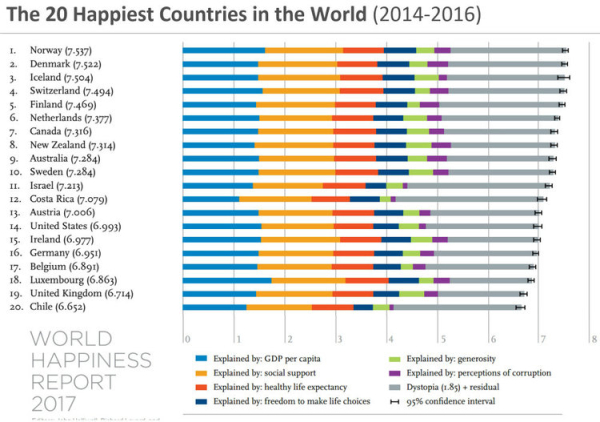
    11262017 Happiness Reportvia World Happiness Report

    Unfortunately, finding out where the happiest people are doesn't tell us how to be happy. In fact, there's a whole section of economics called Happiness Economics that strives to figure it out.

    Most studies show that money doesn't buy happiness … above a certain point. 

    The studies show that there's an income level (relative to your cost of living) where increased money does not increase happiness. For example, in Hawaii, it would be $122,175, but in Mississippi, the threshold is only $65,850. Essentially, past subsistence, other factors matter more. Quality of life and work/life balance being two key ones.

    The Easterlin Paradox states that while individuals in higher GDP countries were more likely to report happiness, it doesn't hold at a national level, creating the paradox. 

    The existence of a hedonic treadmill - or set point of happiness – may be up to debate, but this hits on an important distinction. Most people start yearning for money as a means of protection and care for themselves and their families, but don't change their goals once they've accomplished that.

    If obtaining more money comes at the cost of your happiness is it worth it?

    Finding the right balance can be hard. With most high-achievers, there's always a best next step, a new mountain to climb, a tougher challenge to surmount … and nothing is ever enough. 

    While achievement drives me as well, I think the story below is worth considering below. 

    The Story of The Mexican Fisherman: 

    An American investment banker was at the pier of a small coastal Mexican village when a small boat with just one fisherman docked.  Inside the small boat were several large yellowfin tuna.  The American complimented the Mexican on the quality of his fish and asked how long it took to catch them.

    The Mexican replied, “only a little while. The American then asked why didn’t he stay out longer and catch more fish? The Mexican said he had enough to support his family’s immediate needs. The American then asked, “but what do you do with the rest of your time?”

    The Mexican fisherman said, “I sleep late, fish a little, play with my children, take siestas with my wife, Maria, stroll into the village each evening where I sip wine, and play guitar with my amigos.  I have a full and busy life.” The American scoffed, “I am a Harvard MBA and could help you. You should spend more time fishing and with the proceeds, buy a bigger boat. With the proceeds from the bigger boat, you could buy several boats, eventually you would have a fleet of fishing boats. Instead of selling your catch to a middleman you would sell directly to the processor, eventually opening your own cannery. You would control the product, processing, and distribution. You would need to leave this small coastal fishing village and move to Mexico City, then LA and eventually New York City, where you will run your expanding enterprise.”

    The Mexican fisherman asked, “But, how long will this all take?”

    To which the American replied, “15 – 20 years.”

    “But what then?” Asked the Mexican.

    The American laughed and said, “That’s the best part.  When the time is right you would announce an IPO and sell your company stock to the public and become very rich, you would make millions!”

    “Millions – then what?”

    The American said, “Then you would retire.  Move to a small coastal fishing village where you would sleep late, fish a little, play with your kids, take siestas with your wife, stroll to the village in the evenings where you could sip wine and play your guitar with your amigos.”

    Finding your own personal brand of happiness is vital … to your success, your companies success, and the success of your relationships, and I was reminded of a video my dad shot on zero-based thinking.


    To be happy, or successful, are there things you need to stop doing? Something you want to start doing? Or things you need to do more of? Food for thought to pair with your leftovers from Thanksgiving.

    Happy Thanksgiving!
  • Before and After The Snap: What Can Business Learn From Football?

     
    Nonetheless, I am impressed by the product NFL teams put on the field week-after-week and year-after-year.
     
    Recently, I took some friends to The Star, which is the Cowboys' new world headquarters and training facility  (and, as a side note, cost more to build than the Cowboys' stadium).
     
     
    Fullsizeoutput_47b4
     

    This post seems like it is about football … but it is really a playbook of things we can do in business.

    What Can Business Learn From Football Teams?

    If you get a chance to watch an NFL practice … I highly recommend it.   It is an awesome experience and opportunity for a businessperson. 

     
    Each time I've watched a practice session I've come away impressed by the amount of preparation, effort, and skill displayed.
     
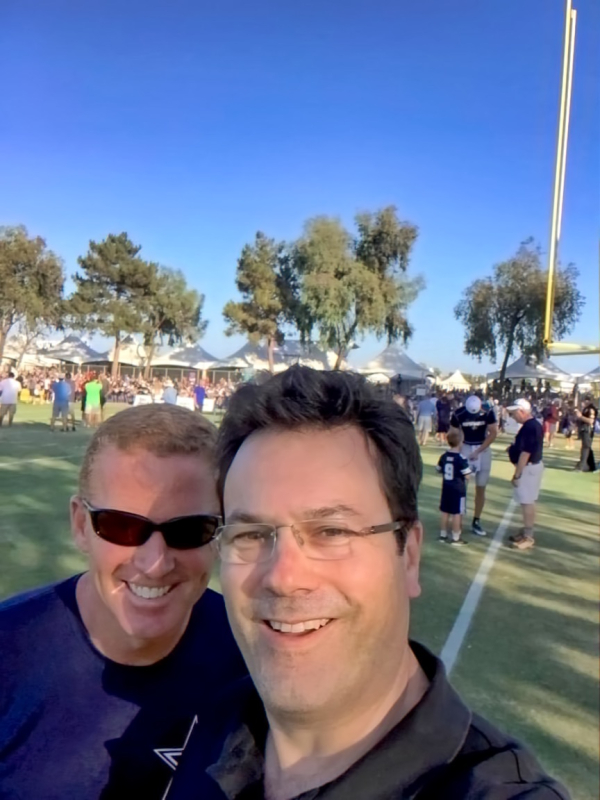
    The Cowboys' coach is Jason Garrett.  He is detail-oriented and intellectual.  His pedigree … he is a Princeton graduate who played quarterback in the NFL.


    171111 HMG and Jason Garrett 2


    During practice, there's a scheduled agenda. Practice is broken into chunks, and each chunk has a designed purpose and a desired intensity.  There's a rhythm, even to the breaks.

    Every minute was scripted.  You could tell there was a long-term plan … but, there was also a focus on the short-term details (many details).

    They alternate between individual and group drills.  Moreover, the drills run fast … but for shorter time periods than you'd guess.  It is bang-bang-bang – never longer than a millennial's attention span.  And they move from drill to drill – working not just on plays, but the skillsets as well (where are you looking, which foot do you plant, how do you best use your hands, etc.).

    They use advanced technology (including advanced player monitoring, bio-metric tracking, and medical recovery devices … but also things like robotic tackling dummies and virtual reality headsets). 

    They don't just film games, they film the practices … and each individual drill.  Coaches and players get a cut of the film on their tablet as soon as they leave.  It is a process of constant feedback, constant improvement, or constant renewal.

    How you do one thing is how you do everything.  So, they try to do everything right. 

    Pro football is one thing. College football is another. But, even in high school, the coaches have a game plan. There are team practices and individual drills. They have a depth chart, which lists the first, second, and third choice to fill certain roles.

    The focus is not just internal, on the team.  They focus on the competition as well.  Before a game, the coaches prepare a game plan and have the team watch tape of their opponent in order to understand the tendencies and mentally prepare for what's going to happen.

    During the game, changes in personnel groups and schemes keep competitors on their toes and allow the team to identify coverages and predict plays. Coaches from different hierarchies work in tandem to respond faster to new problems. 

    After the game, the film is reviewed in detail. Each person gets a grade on each play, and the coaches make notes for each person about what they did well and what they could do better.

    Think about it … everyone knows what game they are playing … and for the most part, everybody understands the rules, and how to keep score (and even where they are in the standings).

    Imagine how easy that would be to do in business.  Imagine how much better things could be if you did those things.

    Challenge accepted.

     
  • Defining A Meaningful Life – Howard Getson on The American Dreams Show

    Recently, I was interviewed on The American Dreams Show. with Alan Olsen.

    Alan is a wealth manager to the ultra-wealthy.  His American Dreams show is very popular in Silicon Valley.

    It's a show about finding your path in life, and making businesses thrive through adversity and challenging economic times. 

    We talked about my career path and how I went from a young lawyer to spending over 25 years running tech companies … and we talked about the lessons I learned along the way.

    It is different than other interviews I've done.  Take a look.


    via The American Dream (transcript is here

    I also encourage you to check out some of the other American Dream interviews.

    Good stuff!

  • How Many People Lie To You On Social Media?

    Social Media often becomes a "best-of" reel of our lives … carefully curated to show off our best selves. 

    Imagine what that leads to for us and our children … ??

    It is tough to live up to your social media standards (let alone to keep up with others').

    This  Instagram model (apparently, that's a thing now) with over half a million followers took to changing her captions to display the falsehoods


    anti-social-media-lets-be-game-changers-essena-oneill-2

    via The Guardian


    How tempting is it to photoshop (or embellish) a little?  In a recent survey of 2000 British people, more than 75% admitted to lying about themselves on social profiles.

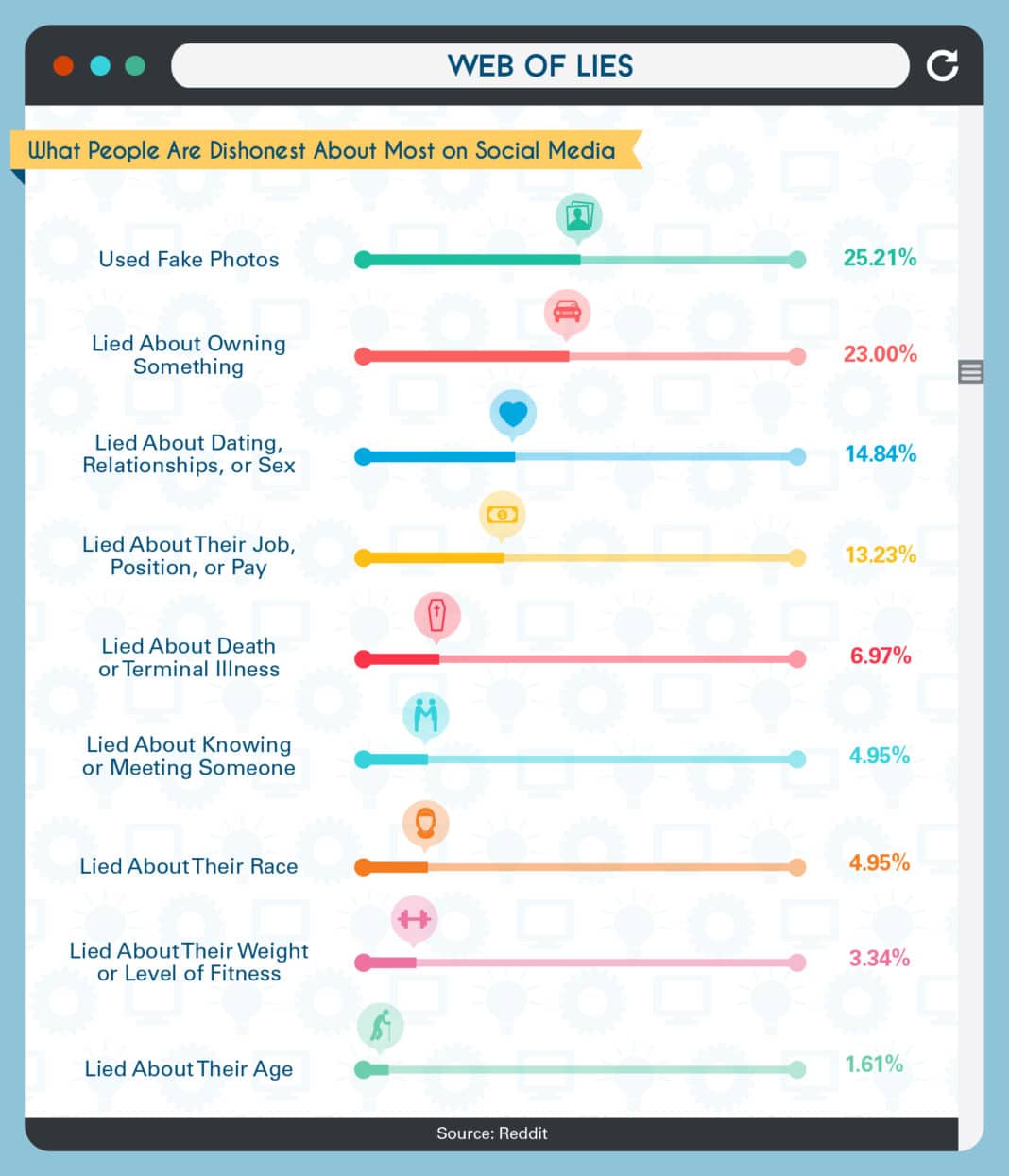
    Here is a chart ranking the most common topics people are most dishonest about.


    1-Infographic-Web-Of-Lies-Most-Common-Falsehoods-Told-On-Social-Media2

    via 10Awesome


    Fake photos, fake ownership, and relationship lies top the list.  

    There was something magical about taking a trip back before everything was a camera.

  • Yom Kippur: A Day of Atonement

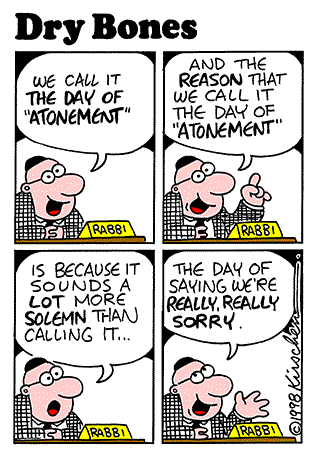
    Yesterday was Yom Kippur, one of the High Holy Days for Jews, otherwise known as the Day of Atonement.

    As part of the holiday, we read down a list of sins (text available here), apologizing for the ones that we committed, and asking forgiveness.  In addition, we promise to do better next year.  

    It's really interesting how little human nature has changed in the past several thousand years. The list of sins is just as relevant today as I imagine it was back then.  

    9292017 Yom Kippur 2via Dry Bones

    Equally important to recognizing and repenting for your sins, is what comes after.

    Remembering all the good you did as well … for yourself, your friends and family, or your community. 

    It's an important framework that highlights how you have grown; and, it also shows where you have room to grow. 

    Hoping you all experience growth in your mental states, your relationships, and in your businesses. 

  • Here Are Some Links For Your Weekly Reading – September 25th, 2017

    Interesting week in the Twit-o-Sphere as Steph Curry and Donald Trump feud, and Ted Cruz is "caught" liking porn on Twitter

    9242017 Ted cruz

    Who would have guessed Twitter would play such a strong a role in today's political climate?

    I believe that everyone deserves the right to my opinion (as much as anyone) … Still, sometimes silence is the best policy.

    Here are some of the posts that caught my eye recently. Hope you find something interesting.

    Lighter Links:

    Trading Links:

  • Arousal States: Biofeedback and the Story You Tell Yourself [Part 3]

    In the first part of this exercise series, I talked about mindset and action.

    In Part 2, I talked about normalizing your habits and picking consistent, normalized metrics. This doesn't just work at the gym; it applies to life and business as well. 

    Today, I want to explain how and why this helps. To do so, we will talk about controlling your arousal states. 

    Watch the video, it is only 90 seconds.


    Chemically, most arousal states are the same.  Meaning, the same hormones and neurotransmitters that make you feel fear also can make you feel excited.  They affect your heart rate, respiration, etc.  … Though, the outside stimuli you experience likely determines how you interpret what is happening.  

    In most situations, a heart rate of 170 beats per minute is an indicator of extreme danger (or an impending toe-tag).  If I felt my heart racing like that in a meeting, it might trigger a fight or flight instinct.  I prefer conscious and controlled responses.  So, I train myself to recognize what I can control and to respond accordingly.

    One way I do that is by being mindful of heart rate zones during exercise.  

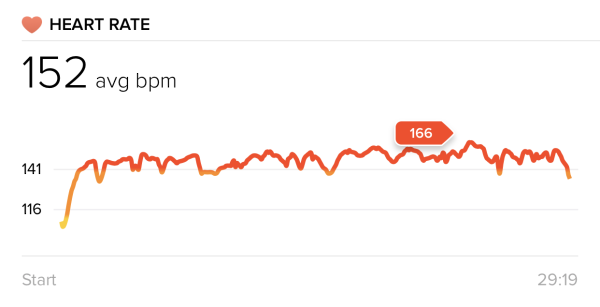
    My goal is to get as close to 170 bpm as I can, then stay in that peak zone for as long as possible.

    Here is a chart showing a Fitbit readout of a recent exercise session.

    8102017 dads heartrate


    As you can see, every time I reach my limit … I get my heart rate back down.  It becomes a conscious and controlled learned behavior.

    It's a form of biofeedback; it's not only gotten me better at controlling what happens after my heartrate reaches 170 but at identifying when I'm close even without a monitor. 

    Now, when my heart rate is at 170 bpm(regardless of the situation), I don't feel anxious … I think about what I want to do. 

    This is a very useful tool.

    It's the same with trading … Does a loss or error harsh your mellow – or is it a trigger to do what you are supposed to do.  

    Getting used to normalized risk creates opportunity.  

    When you are comfortable operating at a pace, or in an environment, that others find difficult – you have a profound advantage and edge.

  • Rubik’s Cubes … More than just a game.

    One of my unique abilities is pattern matching.

    Even if I'm not an expert in a field, based on context and patterns, I quickly see the big picture – and recognize the bottlenecks and leverage points that impact transformative results.

    Perhaps that's why Rubik's Cubes fascinate me. 

    A scrambled cube presents an insurmountable challenge to newbies.  It almost seems that there are infinite possibilities … and most lead towards chaos and failure. In reality, a Rubik's cube is pretty easy to solve if you understand a few simple algorithms (and match the positions of a couple key blocks in relation to the decisions you need to make next). 

    As more people learn to solve standard cubes, the game evolves.  There is new generation of "Cubers" that attempt to find new creative situations to add difficulty, solve it faster than the next person, or try crazy variations of the cube that barely resembles the original. 


    If you're trying to learn how to solve a basic cube, here's a great resource

    After you've learned the basic patterns, and solved a few puzzles,  you can up the ante.

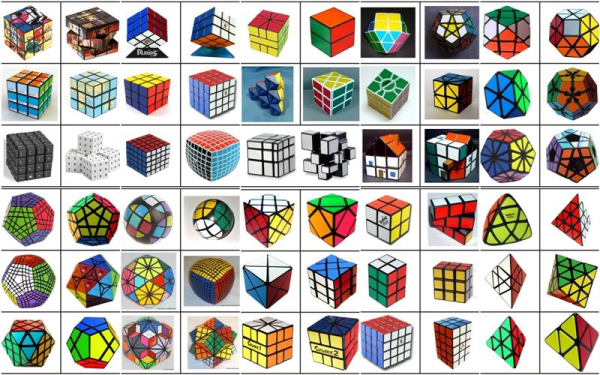
    Here are some examples of bigger cubes with more variables and different shapes.


    8162017 rubik2

    via hananujiya

    Ultimately, it is that base pattern recognition and simple solving skills (applied in the right order) that sets the stage.

    It doesn't matter where you start.  As long as you continue to make progress, the result is inevitable.