Personal Development

  • The Right People To Raise Your Thinking

    There's a popular quote by Jim Rohn that states that you are the average of the 5 people you spend the most time with.

    I think there's a lot of truth to that statement, but I also think it's true of larger groups. 

    The people and groups you spend time with influence who you are in the moment and over time. We all act differently within different groups of people, and that's part of why surrounding yourself with the right people is so important.

    You can see this when you visit your childhood home after many years, or spend time with your parents, or visit your old college. It is easy to revert to who you were when you were most influenced by that person or environment. 

    A few weeks ago, I spent a couple of hours speaking to Dan Sullivan and Steven Krein to record two podcasts.  The first was about building your own future and the second discusses surrounding yourself with the right people.  Here is a link to listen to the second podcast, "The Right People to Raise Your Thinking."


    For decades I have believed that you can predict a lot about your future based on who you choose to spend your present with.

    That is why I think participation in quality peer groups is critical. Peer groups help us set higher standards for our behavior, aim higher in our aspirations, and they help us stay better focused and committed to big-picture goals.

    I belong to several executive and business leader peer groups — groups that double as advisory boards, counselor’s offices, and idea factories. They allow me to see, hear, and discuss things I don't normally think about, talk about, or even notice.  Peer groups bring blind spots to my attention and keep me fully connected to trends that are transforming the world on a global scale.

    I love going to Strategic Coach because it has a unique approach to challenging people about how they think.  After years in the program, the frameworks have unconsciously become a part of how I work and live day-to-day. 

    If I could challenge you to do one thing based on the lessons in this podcast, I'd encourage you to lay out the framework for where you will be in 25 years. Who do you want to be? How do you want to live? What are you committed to building?  Who are you going to be spending more or less time with?

    The next part is easy. With those things in mind, start taking steps in the right direction today. 

    Onwards!
  • Getting To Next: How Thoughts Become Things

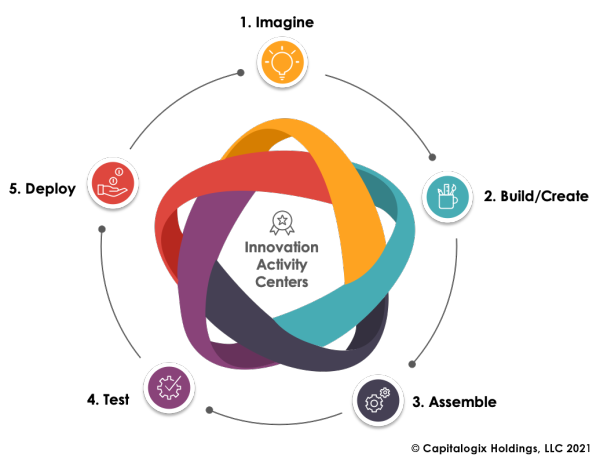
    Two weeks ago, I introduced Innovation Activity Centers which are the building blocks for my technology adoption model.InnovationActivityCenters2

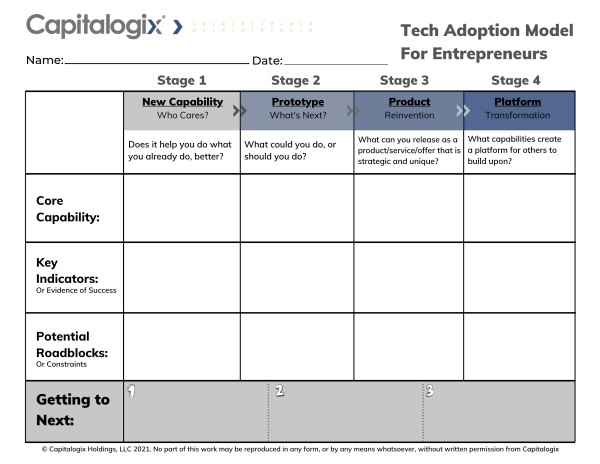
    Today, I have a video and a worksheet for you that goes into the overarching Technology Adoption Model Framework. It explains how thoughts become things and how ideas scale with respect to capability, audience, and monetization.

    The four base stages of this framework are: Capability –> Prototype –> Product –> Platform. 

    It's a great use of 20 minutes. Check it out.


    While the Technology Adoption Model Framework stages are important, the ultimate takeaway is that you don't have to predict what's coming, only how human nature works in response to the capabilities in front of them.

    It's a bit cliche, but to paraphrase Wayne Gretzky, you just have to skate to where you think the puck is going to be. 

    Desire fuels commerce.  As money fuels progress, desire grows … and so does the money funding that path. As such, the path forward is relatively easy to imagine.

    This isn't about predicting specific technologies, but rather about the capabilities people will want.  I think of it as anticipating the natural path.  It is easier to ride the wave than it is to fight nature.

    Each stage is really about the opportunity to scale desire and adoption.

    It isn't really about building the technology, rather it is about supporting the desire.

    If you understand what is coming, you don't have to build it, but you can figure out where you want to build something that will benefit from it.

    This model is fractal.  It works on many levels of magnification or iteration.

    What first looks like a product is later seen as a prototype for something bigger.

    For example, as a Product transforms into a Platform, it becomes almost like an industry of its own.  Consequently, it becomes the seed for a new set of Capabilities, Prototypes, and Products.

    SpaceX's goal to get to Mars feels like their North Star right now … but once it's achieved, it becomes the foundation for new goals.

    This Framework helps you validate capabilities before sinking resources into them. 

    In the video, I walk you through several examples of companies, their innovations, and how they fit into each stage. I even used Capitalogix as an example. 

    I'm also attaching a fillable PDF of the form we used so that you can run through this with your business as well. 

    Tech Adoption Model for Entrepreneurs (1)

    As I continue to refine and work with this framework, I look forward to improving it and sharing it with you all. 

    As the world continues to change faster and more dramatically, this framework will help you anticipate changes, and it will also help you take advantage of them. 

    If you have any questions or comments about the idea, or how to implement it, feel free to reach out. 

    Onwards! 

  • Make News Beautiful Again

    My mother watches the news religiously. To her credit, she watches a variety of sources and creates her own takeaways based on them. Regardless, there's a common theme in all the sources she watched – they focus on fear or shock-inducing stories with a negative bias. As you might guess, I hear it when I talk with her.

    While I value being informed, I also value things that nourish or make you stronger (as opposed to things that make you weak or less hopeful).

    Negativity Sells. 

    Sure, news sources throw in the occasional feel-good story as a pattern interrupt … but their focus skews negative.  History shows that stories about improvement or the things that work simply don't grab eyeballs, attention, or ratings consistently.

    The reality is that negativity sells. If everything were great all the time, people wouldn't need to buy as many products, they wouldn't need to watch the news, and this cycle wouldn't continue.

    It's worth acknowledging and understanding the perils our society is facing, but it's also worth focusing on the ways humanity is expanding and improving.

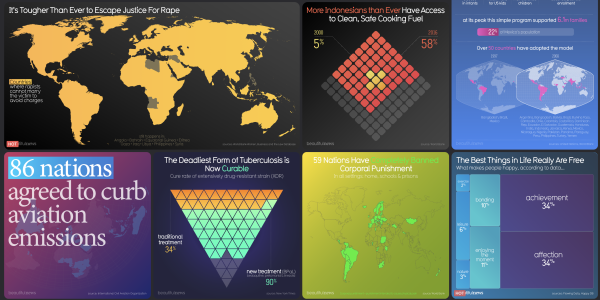
    As a brief respite from the unending doom and gloom of mainstream media, Information Is Beautiful has a section of their site focused on "Beautiful News".

    It's a collection of simple data visualizations for positive trends, it's updated daily, and can be sorted by topic.


    Screen Shot 2021-06-06 at 2.20.21 PM

    Beautiful News via Information Is Beautiful

    If you're looking for more "good news", here's a list of 10 sources focusing on good news

  • The Law and Flaw of Averages

    The law of averages is a principle that supposes most future events are likely to balance any past deviation from a presumed average.

    Take, for example, flipping a coin. Should you get 5 "Heads" in a row, you'll assume the next one must be "Tails" despite the fact that each flip has a 50/50 chance of landing on either. 

    Even from this example, you can tell it's a flawed law. While there are reasonable mathematical uses of this law, in everyday life, this "law" mostly represents wishful thinking. 

    Crisis-of-2008

    It's also one of the most common fallacies seen in gamblers and traders. 

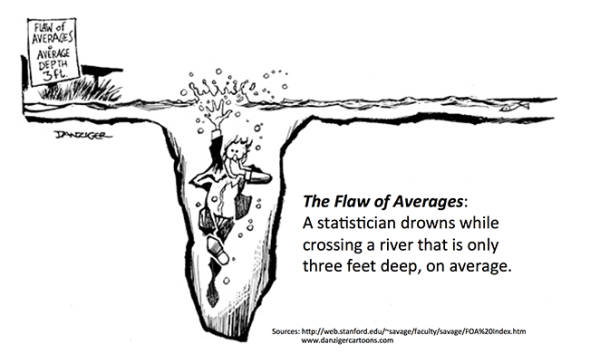
    Perhaps you heard the story about how the U.S. Air Force discovered the 'flaw' of averages by creating cockpits based on very complex mathematics surrounding the average height, width, arm length, etc. of over 4,000 pilots. Despite engineering the cockpit to precise specifications, pilots crashed their planes on a too regular basis. 

    The reason?  With the benefit of hindsight, they learned that very few of those 4,000 pilots were actually "average". Ultimately, the Air Force re-engineered the cockpit and fixed the problem. 

    It's a good reminder that 'facts' can lie, and assumptions and interpretations are dangerous. It's why I prefer taking decisive action on something known, rather than taking tentative actions about something guessed. 


    via ReasonTV


  • My Recent Podcasts with Dan Sullivan & Brett Kaufman

    I recently did two interviews I want to share with you. The first was done with Dan Sullivan and Steven Krein for Strategic Coach's Free Zone Frontier podcast… and the second was with Brett Kaufman on his Gravity podcast. 

    Please listen to them.  They were quite different, but both were well done and interesting. 

    Free Zone Frontier with Dan Sullivan and Steve Krein

    Free Zone Frontier is a Strategic Coach group (and podcast) about creating "Free Zones." It refers to the green space where entrepreneurs can collaborate and create without competition.

    It's a transformative idea for entrepreneurial growth. 

    In my episode, we focused on topics like building your own future, how decision-making frameworks and technology can extend your edge, and what it takes to get to the next level.   I realize there is a lot of Strategic Coach jargon in this episode, but it is still easy to understand, and there was great energy and an elevated conversation about worthy topics.

    As an aside, Steve Krein happens to be my cousin, and we joined Strategic Coach entirely separately before realizing we had joined the same group. 

    The podcast is 47 Minutes. I hope you enjoy it.


    Or click here to listen on: Spotify, Google Podcasts, Apple Podcasts 

    Gravity Podcast with Brett Kaufman

    Normally, I talk about business, mental models, and the future of AI and technology, but Brett Kaufman brought something different out of me. 

    Brett's Gravity Project is about living with intention, community, consciousness, and connection. He focuses on getting people to share their life experiences … with the intent that others can see themselves in your story. 

    In my talk with Brett, we do talk about the entrepreneurial journey … but we also probe some deep insights by discussing the death of my younger brother, how my life changed almost immediately upon meeting my wife, and why love is the most powerful and base energy in the universe. 

    This was not a typical conversation for me (a different ratio of head-to-heart), but it was a good one (and I've had a lot of people reach out because of this podcast). 

    The episode is 65 minutes. I hope you enjoy it. 


    Click here to listen on: Spotify, Apple Podcasts, Listen Notes

    Let me know what you think.

  • Assessments and You

    Over the years, I've used a number of different assessment tests on myself and our team. It's a great way to help people better understand each other and the different forms of communication and problem-solving styles we use.

    Here are several of the tests that have proven themselves time and again:

    1. Kolbe: measures a person's instinctive method of problem-solving, and identifies the ways they will be most productive.
    2. Predictive Index (PI) – helps you understand the way their traits manifest in relation to their true nature and their perceived role.
    3. StrengthsFinder: helps people uncover their talents, so they can do more of those things each day.

    On top of my normal tests, as a team of data scientists, it's always fun to see what's available. 

    For example, Ray Dalio recently created a personality assessment called PrinciplesYou that you can take for free. I've seen a number of articles claiming that the assessment is not only accurate, but that it also has impressive insights.

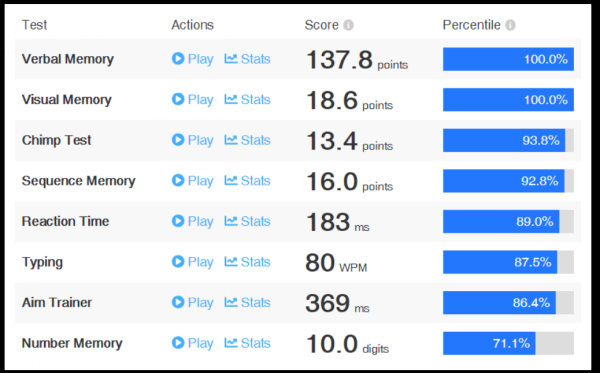
    Less meaningful, but still fun, I also found a website that lets you test your performance on various reaction and memory tests. Unsure how scientific it is, but it was an interesting use of 10 minutes nonetheless. 

    Image-2via Human Benchmark


    Progress starts by telling the truth … most often to yourself.  

  • Timeless Wisdom From Socrates

    Small distinctions separate wise men from fools. Perhaps one of them has to do with what the wise man deems important.

    Socrates' Triple Filter

    In ancient Greece, Socrates was reputed to hold knowledge in high esteem.  One day an acquaintance met the great philosopher and said, "Do you know what I just heard about your friend?"

    "Hold on a minute," Socrates replied. "Before telling me anything, I'd like you to pass a little test. It's called the Triple Filter Test."

    "Triple filter?"

    "That's right," Socrates continued.  "Before you talk to me about my friend, it might be a good idea to take a moment and filter what you're going to say. That's why I call it the triple filter test.

    The first filter is Truth.  Have you made absolutely sure that what you are about to tell me is true?"

    "No," the man said, "Actually I just heard about it and…"

    "All right," said Socrates. "So you don't really know if it's true or not. Now let's try the second filter, the filter of Goodness.  Is what you are about to tell me about my friend something good?"

    "No, on the contrary…"

    "So," Socrates continued, "You want to tell me something bad about him, but you're not certain it's true.  You may still pass the test though, because there's one filter left.  The third filter is Usefulness.  Is what you want to tell me about my friend going to be useful to me?"

    "No, not really."

    "Well," concluded Socrates, "If what you want to tell me is neither true, nor good, nor even useful … then why tell it to me at all?"

    With all the divisiveness in both media and in our everyday conversations with friends, family, and strangers … this is a good filter for what you say, what you post, and even how you view markets. 

    How Does That Apply to Me or Trading?

    The concept of Socrates' Triple Filter applies to markets as well.

    When I was a technical trader, rather than looking at fundamental data and scouring the news daily, I focused on developing dynamic and adaptive systems and processes to look at the universe of trading algorithms to identify which were in-phase and likely to perform well in the current market environment.

    As we've transitioned to using advanced mathematics and AI to understand markets it becomes even more true. 

    Filter Out What Isn't Good For You.

    In contrast, there are too many ways that the media (meaning the techniques, graphics, music, etc.), the people reporting it, and even the news itself, appeals to the fear and greed of human nature.

    Likewise, I don't watch TV news anymore either. It seems like story after story is about terrible things. For example, during a recent visit with my mother, I listened to her watch the news.  There was a constant stream of "oh no," or "oh my," and "that's terrible". You don't even have to watch the news to know what it says.

    It's also true with what you feed your algorithms. Garbage in, garbage out. Just because you can plug in more data, doesn't mean that data is adding value. Deciding what not to do, and what not to listen to is equally as important as deciding what to do. 

    Artificial intelligence is exciting, but artificial stupidity is terrifying. 

    What's The Purpose of News for You?

    My purpose changes what I'm looking for and the amount of attention I pay to different types of information. Am I reading or watching the news for entertainment, to learn something new, or to find something relevant and actionable?

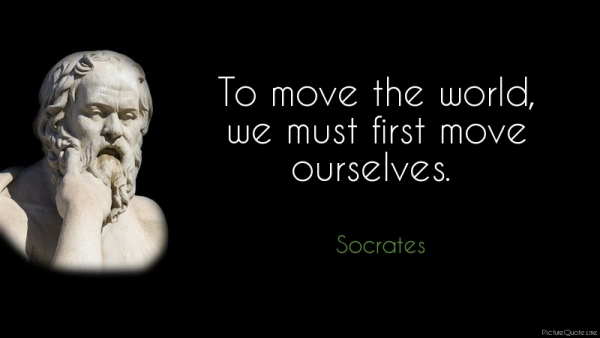
    Socrates_quote_to_move_the_world_we_must_first_move_ourselves_5420

    One of my favorite activities every week is looking for new insights and interesting articles to share with you and my team.  If you aren't getting my weekly reading list on Fridays – you're missing out. You can sign up here

    Getting back to Socrates' three filters and the business of trading, I often ask myself: is it important, does it affect our edge, or can I use it as a catalyst for innovation?

    There's a lot of noise out there competing for your attention. Stay focused. 

    Onwards!

     
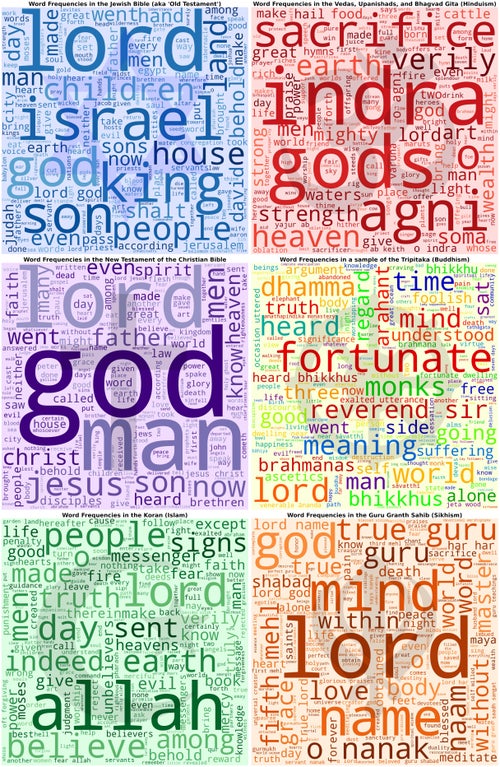
  • A Wordcloud For Each of the Major Religions

    The six largest religions in the world are Christianity, Islam, Judaism, Hinduism, Buddhism and Sikhism. 

    We often think about the differences between religions.  However, the many similarities are obvious if you look (and may be indications of a more integral "truth". 

    Below is a wordcloud for each of those religions based on their major religious text. 

    Q04t0id427v61teddyterminal via Reddit

    If you find the name "Keith" it's because it was the translator's name, and the word "car" in the Hinduism wordcloud is an old-fashioned word for "chariot".

    It's also worth acknowledging that this wordcloud is from the English translations so some words that may mean slightly different things in other languages can be all translated to one word in English. For example, it's very common in Biblical Hebrew to see different words translated into the same English word. A good example is Khata, Avon, and Pesha–three different ways of committing a wrong, that may all be translated the same.

  • Ikigai in the Post-Quarantine World

    Getting old is tough … and it gets tougher the older you get.   As a result, finding your 'reasons for being' and joy in life become increasingly important as well. 

    2020 was a year of massive upheaval for many. Stress, change, pandemics, quarantine, new jobs, new goals … or at the other end of the spectrum, lack of change, lack of a job, or lack of purpose.

    Regardless of the reason, many people struggle to get up in the morning. This is a shame because life is so much better than the alternative (and life becomes even better when you learn to enjoy living and let go of what isn't serving you). 

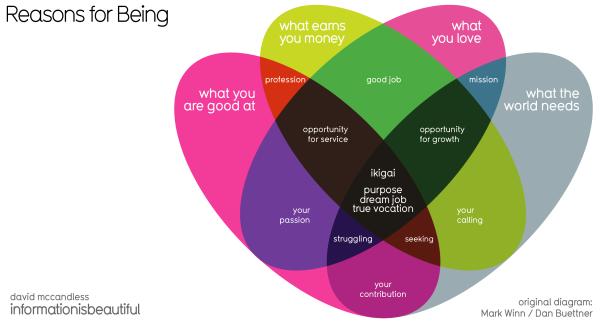
    There's a Japanese concept called Ikigai that may help.

    Ikigai centers around finding purpose as you grow older.  Paradoxically, it makes sense to start the process as early as possible. 

    Here is an infographic that lays out some "Reasons for Being."


    IIB-Ikigai-1

    via InformationIsBeautiful

    Finding your "reason to be" and living with purpose are keys to making the most of your time.

    The beauty of 2021 being a fresh start is that you can also change your approach and your vision.

    The graphic highlights something interesting (yet almost counter-intuitive) … When two areas intersect, it creates something positive (e.g., a passion or a mission).   However, where three areas intersect, it creates a pain point (for example it could be what you're good at, you love doing it, the world needs it … but it doesn't make you any money – so now you're struggling).

    Worth examining and thinking about for a bit.

    On a related note, here is a TEDx talk about the 9 common diet and lifestyle habits that help people live past 100.


    TED-ED via YouTube

    And here is a link to Dan Sullivan's free e-book on his plan to live to 156

    Live long and prosper!

  • Mindfulness & Exponential Technologies

    Have you noticed that it's easier for most people to identify and solve someone else's problem than it is to do the same for themselves?

    Humans are emotional creatures.  As a result, our decision-making often suffers from fear, greed, and discretionary mistakes. 

    As an entrepreneur, I strive to be objective about the decisions I make. Towards that goal, using key performance indicators, getting different perspectives from trusted advisors, and relying on tried-and-true decision frameworks all help. 

    Combining all three creates a form of "mindfulness" that comes from dispassionately observing from a perspective of all perspectives.

    That almost indifferent and objective approach is also where exponential technologies like AI excel.  They amplify intelligence by helping make better decisions, take smarter actions, and continually improve performance. 

    I shot a video about mindfulness and the future of A.I.


    Artificial intelligence is cool. The truth, however, is that AI is still relatively limited. Individual techniques (or algorithms) are good at "something".  The challenge is that they only focus on what they need to come up with their answer, without considering a different perspective. While it is good at what it is good at, it isn't necessarily good at empathetically understanding that a different technique, which comes up with a different answer, might be "right" as well.

    The future of AI likely will be based on swarm intelligence, where many specialist components communicate, coordinate, and collaborate to view a situation more objectively, better evaluate the possibilities, and determine the best outcome in a dynamic and adaptable way that adds a layer of objectivity and nuance to decision making.

    One of the lessons I teach to our younger employees is that an answer is not THE answer. It's intellectually lazy to think you're done simply because you come up with a solution. There are often many different ways to solve a problem, and the goal is to figure out the one that comes up with the best results.

    Even if you find THE answer, it is likely only THE answer temporarily.  So, it is really just a step in the right direction that buys you time to learn, improve and re-evaluate.

    Hope that helps.