Personal Development

  • Social Media Is Changing Everything … 10+ Years Later

    In 2009, I wrote an article highlighting the audacious amount of texts and data my then-16-year-old son was using compared to the rest of the family … It's funny to look back on.

    Here is an excerpt from that post. 

    _______

    My son won't use e-mail the way I did. So how will people communicate and collaborate in the next wave of communications?

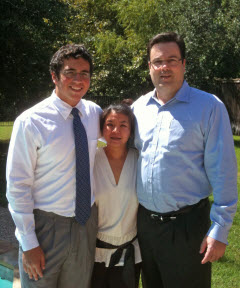
    091019 Getson Family 240p

     Here is a peek into the difference that is taking hold.  I was looking at recent phone use.  The numbers you are about to see are from the first 20 days of our current billing cycle.

    • My wife, Jennifer, has used 21 text messages and 38 MB of data.
    • I have used 120 text messages and 29 MB of data.
    • My son, at college, used 420 text messages, and is on a WiFi campus so doesn't use 3G data.
    • My son, in high school, used 5,798 text messages and 472 MB of data.

    How can that be?  That level of emotional sluttiness makes porn seem downright wholesome. 

    But, of course, that isn't how he sees it.  He is holding many conversations at once.  Some are social; some are about the logistics of who, what, when, where and why … some are even about homework.  Yet, most don't use full sentences, let alone paragraphs.  There is near instant gratification.  And, the next generation of business people will consider this normal.

    Is social media a fad? Or is it the biggest shift since the Industrial Revolution?
    _______

    Fourteen years later, I send more text messages than my son, and we both use multiples of that amount of data a month. 

    I also remember scoffing at my son having his phone on hand at meetings – that it was a distraction. And yet, here I am, phone on my desk at meetings. But, e-mail is just as important as it was in 2009. 

    One of the things we miss in discussions about generations is that the trends of the younger generation are often adopted by the previous – even if they're not as tech literate. 

    Technology changes cultures for better or worse … but it's hard to look at the impact of social media and believe it hasn't been deleterious. 

    The promise and peril of technology! 
  • Are You Ready For Some Football?

    Are you ready for some Football?

    Yesterday was the Cowboys' first preseason game. 

    It wasn't exactly the prettiest (partly because it was the first game of the season, but also because many of the starters sat the game out to avoid injury).  With that said, it was still a fantastic experience.  The NFL (and Jerry Jones) knows how to put on a show. 


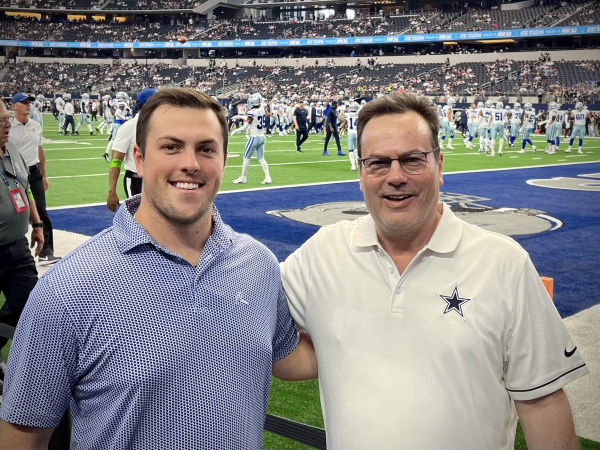
    HMG Cowboys Sideline on First Home Game of 2023

    It's Easy to Feel Good at the Start of a Season.

    Lots of people ask me how the Cowboys look this year.  The truth is, at this point in the season, it's impossible to know because injuries have a dramatic impact on the game.  

    Regardless, each year I choose to be optimistic about the chance of a post-season run. 

    That kind of logic (or lack there of) is why I think automated trading is better than humans attempting to do it themselves.  It's a way to make objective decisions and eliminate fear, greed, and discretionary mistakes.

    On the other hand, it feels so good to hope!

    A Lesson From the Game.

    I had an interesting discussion at the game yesterday.  My guest commented that Jerry Jones is a fantastic business person – which is hard to argue – but probably shouldn't be running the team.  He believes the team needs a change of pace to switch things up. 

    While I don't know if that's why we tend to struggle so much more late in the season, it reminded me of a great business lesson. 

    Entrepreneurs often mistake their domain expertise for general expertise.  "I'm fantastic because I'm fantastic at all these different things." And the result is they overestimate their ability to be great at things outside their unique ability.  A similar issue is that many people believe they are deep thinkers, because they think deeply about what they think about.  However, they often don't realize how narrow their range of thinking is, and how many things fall outside their expertise, interest, or even consideration.

    Less Is Often More.

    Learning to offload tasks that you may not be as fantastic at as others is a great way to free up time to focus on not only the things that you're great at – but also bring you joy and energy. 

    Hope that helps!

    How 'bout them Cowboys!

  • E.M.I.G.L.I.O: The Electronic Mechanical Industrial Generated For Logical Infiltration and Observation Robot

    I have an old toy robot in my office that my kids played with when they were little.  Its name is E.M.I.G.L.I.O.

    Even though it is a toy, this Italian-made robot was interesting technology when it came out.  It was remote-controlled, the remote had a microphone that transformed my voice to sound like a robot, and it had a tray sturdy enough to deliver a video game (or some other surprise) for my kids when they visited the office.


    Looking back, it's barely even technology, let alone a robot.  But that's because I'm evaluating it based on what's possible now.

    I feel the same when I think about my previous company, IntellAgent Control, and what we considered A.I. in the 1990s.  We made a sales automation solution for teams before tools like Salesforce existed.  At the time, the decision logic we used was innovative.  The premise is still valid today, but the technology and implementation scream "relic of a time gone by."

    As another aside … when I searched for Emiglio (in order to write this article), I was astonished by the archive of old robots someone had put together. The site is like a specialized Wikipedia site for toy robots.  Each of the entries has high-quality photos of the robots and their packaging.  It also includes facts, marketing copy, ads, and patents. 

    It is kind of cool … Kind of like Emiglio.

    It got me thinking about how much of history – and esoteric knowledge – only exists because a tiny community of people decided it needed to be cataloged or preserved.

    Garbage In – Garbage Out.  Nothing In – Nothing Out.  What are we missing from the past because history is often written by the winner (or because no one volunteered to chronicle what happened)?

    Even a site like Wikipedia has some serious content curation issues.  For example, the top 50 Wikipedia editors have each contributed more than 500,000 edits.  Think how much is missing.

    Soon A.I. will decide what to write about what it decided happened, what to save and for how long, and what to say when asked about it.

    Not only will the future be different … even the past will be remembered differently.

    Just a thought! 

  • Time Flies – Another Year, Another Lesson

    Thursday was my 60th birthday.  I can't believe how time flies.  Birthdays seem to come more quickly as you get older.

    It makes sense, though, I suppose.  When you were four, a birthday represented a quarter of your life.  Now, a year represents a much smaller percentage.

    While it's not always pleasant getting older, it sure beats the alternative!

    This year, I made a concerted effort to be more healthy, fit, and vital in mind, body, and spirit. I said I wanted to sprint into 60, rather than roll into it.

    If you are going to live longer, your future has to be compelling to you.  Otherwise, who would want to extend their stay?  That is why I strive to keep my future bigger than my past.  

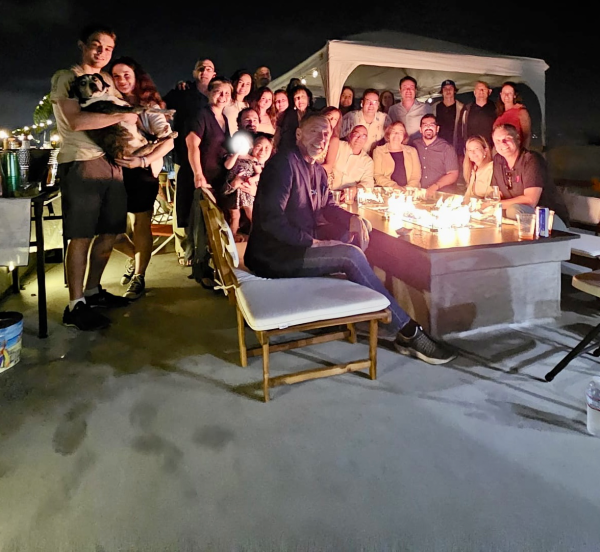
    As time marches on, I become increasingly grateful for the friends and family who share the journey with me.  This year, I spent my birthday in San Diego, surrounded by family and some close friends.  On Saturday, they surprised me with a "Birthday Palooza," celebrating my 60th along with my wife Jennifer's 50th. 


    IMG_4968


    When I was a kid, I couldn't imagine being where I am today … nor could I imagine the path that got me here. 

    Looking back, it all seems to make sense (even though it felt pretty random while making my way through it).

    I feel lucky to have been in the right place at the right time, so consistently, and to find the gift in most situations (even when it seemed so well hidden).

    I'm grateful for a lot today, and as much as I love innovation, sometimes things are perfect just the way they are. 

    Hopefully, you took time this weekend to let someone know they're important to you.  If not, now is a good time for that too.

    Onwards!

  • Do You Think the U.S. Has Aliens?

    I'll admit to being fascinated by the idea of aliens.  Growing up in the 60s and 70s, there was no shortage of science fiction fantasies imagining what a space-faring civilization would look like and, more importantly, what would we, the Earthlings, do when they made contact. 

    Last year, there was a U.S. congressional hearing on Unidentified Flying Objects.  While there wasn't any proof of aliens, they did admit to phenomena they couldn't explain with their current information.

    Now, we have multiple former military officials testifying in a House of Representatives meeting that the U.S. has recovered not only spacecraft but alien biological matter for decades.  While I do believe in the possibility of aliens, I remain skeptical.

    There are many stories (or theories) about how we had encountered aliens before and just kept them secret.  For example, in 2020, a former senior Israeli military official proclaimed that Aliens from a Galactic Federation had contacted us – and that not only is our government aware of this, but they are working together

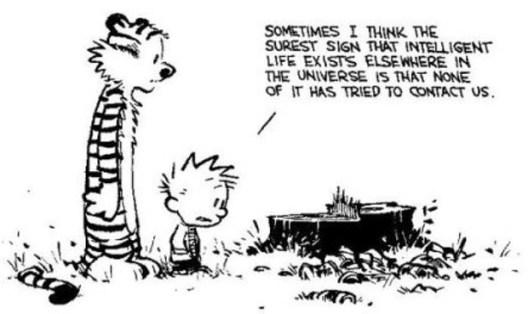
    In contrast, I have found it more realistic and thought-provoking to consider theories about why we haven't seen aliens until now.

    For example, the Fermi Paradox considers the apparent contradiction between the lack of evidence for extraterrestrial civilizations and the various high probability estimates for their existence. 

    Let's simplify the issues and arguments in the Fermi Paradox.  There are billions of stars in the Milky Way galaxy (which is only one of many galaxies).  Each of these stars is similar to our Sun.  Consequently, there must be some probability of some of them having Earth-like planets.  Further, it isn't hard to conceive that some of those planets should be older than ours, and thus some fraction should be more technologically advanced than ours.  Even if you assume they're only looking at evolutions of our current technologies – interstellar travel isn't absurd.  Thus, based on the law of really large numbers (both in terms of the number of planets and the length of time we are talking about) … it makes the silence all the more deafening and curious. 

    If you are interested in the topic "Where are all the aliens?"  Stephen Webb (who is a particle physicist) tackles that in his book and in this TED Talk.   


    via TED

    In the TED talk, Stephen Webb covers a couple of key factors necessary for communicative space-faring life. 

    1. Habitability and stability of their planet
    2. Building blocks of life 
    3. Technological advancement
    4. Socialness/Communication technologies

    But he also acknowledges the numerous confounding variables, including things like imperialism, war, bioterrorism, fear, moons' effect on climate, etc. 

    Essentially, his thesis is that there are numerous roadblocks to intelligent life – and it's entirely possible we are the only planet that has gotten past those roadblocks – or that there might have been others in the past, or others may develop in the distant future. 

    6a00e5502e47b28833026bdeacdf44200c-550wi

    What do you think?

    Here's another article I wrote on the subject, titled "Are We Alone In The Universe?"

    Finally, here are some other links I liked on this topic.  There is some interesting stuff you don't have to be a rocket scientist to understand or enjoy. 

    To Infinity and Beyond!

  • Life After Death … Will A.I. Help you Live Forever?

    My Aunt recently passed away. She was my Dad's sister … and she was a fantastic person. She was loving and kind. She was a natural-born caregiver, And she was as sharp as a tack. What wouldn't we give for another moment with her? My response to her death reminded me of my feelings when my Dad passed away

    This time, the conversation was a little different. People asked me if I thought that A.I. would enable us to live on after our bodies started to give out on us. I recorded some of my thoughts. 


    I don't think A.I. will give us life after death.

    I do believe technology will get good enough to create a replica of you – that talks like you, responds like you, and even comforts people who miss you. 

    I don't believe technology can capture whatever part of us doesn't live in our bodies. Whether you call it our soul (or something else), I don't think that will ever get uploaded to the matrix, so you live on. 

    And, I think that's okay. Part of the beauty of existence is the transience, the joy, the suffering, and the range of human experience. That is a big part of what we call life.

    When my Dad was dying, every moment took on new meaning. Not only did time seem to slow down, but there was a weight and intimacy that's often taken for granted. 

    What do you think?

  • Rewriting The Past, Present, and Future

    "Fate has ordained that the men who went to the moon to explore in peace will stay on the moon to rest in peace." – Nixon's Apollo 11 Disaster Speech

    In an ideal world, history would be objective; facts about what happened, unencumbered by the bias of society, or the victor, the narrator, etc.

    I think it's apparent that history as we know it is subjective.  The narrative shifts to support the needs of the society that's reporting it.  History books are written by the victors. 

    The Cold War is a great example where, during the war, immediately after the war, and today, the interpretation of the causes and events has all changed.  

    But while that's one example, to a certain degree, we can see it everywhere.  We can even see it in the way events are reported today.  News stations color the story based on whether they're red or blue, and the internet is quick to jump on a bandwagon even if the information is hearsay. 

    Now, what happens when you can literally rewrite history?

    “Every record has been destroyed or falsified, every book rewritten, every picture has been repainted, every statue and street building has been renamed, every date has been altered. And the process is continuing day by day and minute by minute. History has stopped.“ – Orwell, 1984

    That's one of the potential risks of generative AI and deepfake technology.  As it gets better, creating "supporting evidence" becomes easier for whatever narrative a government or other entity is trying to make real.

    On July 20th, 1969, Neil Armstrong and Buzz Aldrin landed safely on the moon.  They then returned to Earth safely as well. 

    MIT recently created a deepfake of a speech Nixon's speechwriter William Safire wrote during the Apollo 11 mission in case of disaster.  The whole video is worth watching, but the speech starts around 4:20. 


    MIT via In Event Of Moon Disaster

    Media disinformation is more dangerous than ever.  Alternative narratives and histories can only be called that when they are discernible from the truth.  In addition, people often aren't looking for the "truth" – instead, they are prone to look for information that already fits their biases. 

    As deepfakes get better, we'll also get better at detecting them.  But it's a cat-and-mouse game with no end in sight.  In Signaling Theory, it's the idea that signalers evolve to become better at manipulating receivers, while receivers evolve to become more resistant to manipulation.  We're seeing the same thing in trading with algorithms. 

    In 1983, Stanislav Petrov saved the world. Petrov was the duty officer at the command center for a Russian nuclear early-warning system when the system reported that a missile had been launched from the U.S., followed by up to five more.  Petrov judged the reports to be a false alarm and didn't authorize retaliation (and a potential nuclear WWIII where countless would have died). 

    But messaging is now getting more convincing.  It's harder to tell real from fake.  What happens when a world leader has a convincing enough deepfake with a convincing enough threat to another country?  Will people have the wherewithal to double-check?

    Lots to think about. 

    I'm excited about the possibilities of technology, and I believe they're predominantly good.  But, as always, in search of the good, we must acknowledge and be prepared for the bad. 

  • Economic Allies and Economic Enemies

    Last week, I brought up the concept of Economic Freedom. It reminded me of an idea I last shared in 2008, during the housing crisis. 

    I noticed how correlated and coordinated worldwide actions were during the housing crisis. During the pandemic, while there was a lot of dissent, there was also a remarkable amount of coordination. 

    Why Do We Shake Hands? | Mind Fuel Daily | Life & Journey

    The concept of economic allies presupposes that we also have economic enemies. It’s easy to construct a theory that countries like Russia and China use financial markets to exert leverage in a nascent form of economic warfare.

    It's easy to come up with a theory that suggests we are our own worst enemies. Our innate fear and greed instincts (and how we react to them) tend to lead us down a path of horrifying consequences. This has been evident in recent years, not just in society, but also in the world of business. I am confident that this pattern will persist in the context of Artificial Intelligence, with both its potential benefits and risks.

    The butterfly effect theorizes that a butterfly flapping its wings in Beijing on one day can create or impact a rainstorm over Chicago a few days later. Similarly, in a world with extensive global communication and where automated trading programs (and even toasters) can interact with each other from anywhere across the globe, it is not surprising that market movements are becoming larger, faster, and more volatile.

    Perhaps governments cooperate and collaborate because they collectively recognize the need for a new form of protection to mitigate the increasing speed, size, and leverage behind market movements.

    And we can also extend this idea to other entities beyond governments. It doesn’t have to be limited to traditional markets either; it can include cryptocurrencies or other emerging technologies as well.

    It’s worth understanding the currents, but we must also consider the undercurrents and countercurrents. 

    Conspiracy theories are rarely healthy or helpful, but maintaining a healthy skepticism is a great survival mechanism.

    Hope that helps.

  • Understanding Economic Freedom

    We often think about the U.S. as the "land of the free." That is good marketing … but is it true?  In large part, it depends on the contexts and frameworks you choose to evaluate what constitutes freedom. 

    For example, Strategic Coach breaks "entrepreneurial freedom" into four categories: time, money, relationships, and purpose.

    Meanwhile, if you look at the First Amendment of the U.S. Constitution, you've got freedom of speech, press, assembly, and the right to petition the government … and we've since instituted a litany of other freedoms and liberties. 

    In this post, we will examine the concept of economic freedom.  Economic freedom represents more than just freedom to make money, it pertains to the decisions and liberties one has in that pursuit. 

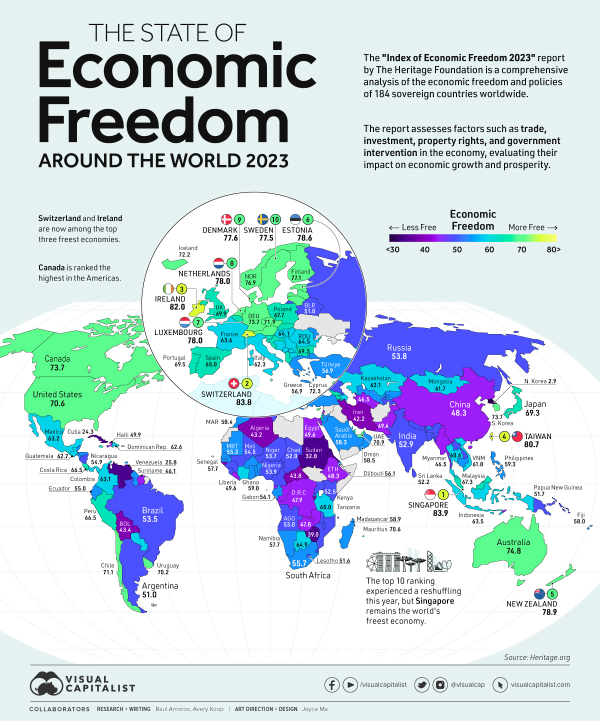
    The Heritage Foundation releases a yearly Economic Freedom Index. 


    Economic-freedom-2023-MAIN-1


    According to VisualCapitalist, the ranking uses four broad categories, each with three key indicators to measure economic freedom.

    1. Rule of law: property rights, judicial effectiveness, government integrity
    2. Size of government: tax burdens, fiscal health, government spending
    3. Regulatory efficiency: labor freedom, monetary freedom, business freedom
    4. Open markets: financial freedom, trade freedom, investment freedom

    The 12 indicators are weighted equally and scored from 0-100.  The overall score is the average score among those indicators. 

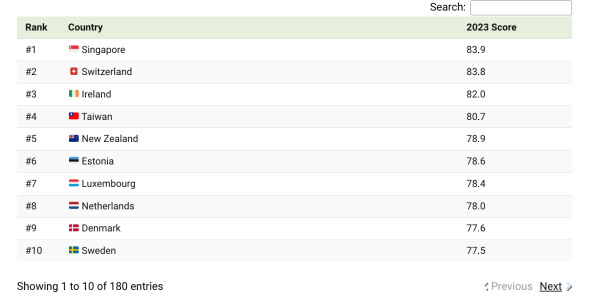
    Based on these metrics, the U.S. doesn't even enter the top 10. 

    Screen Shot 2023-07-01 at 2.14.51 PM

    Surprisingly, the U.S. ranks 25th overall – and only 3rd in the Americas. 

    Now, freedom means a lot of different things, and economic freedom is only one of many modalities … but it's an important factor. 

    If you were in control, what change would you make to increase the United States' economic freedom?  If you're not from the U.S., where does your country rank, and why?