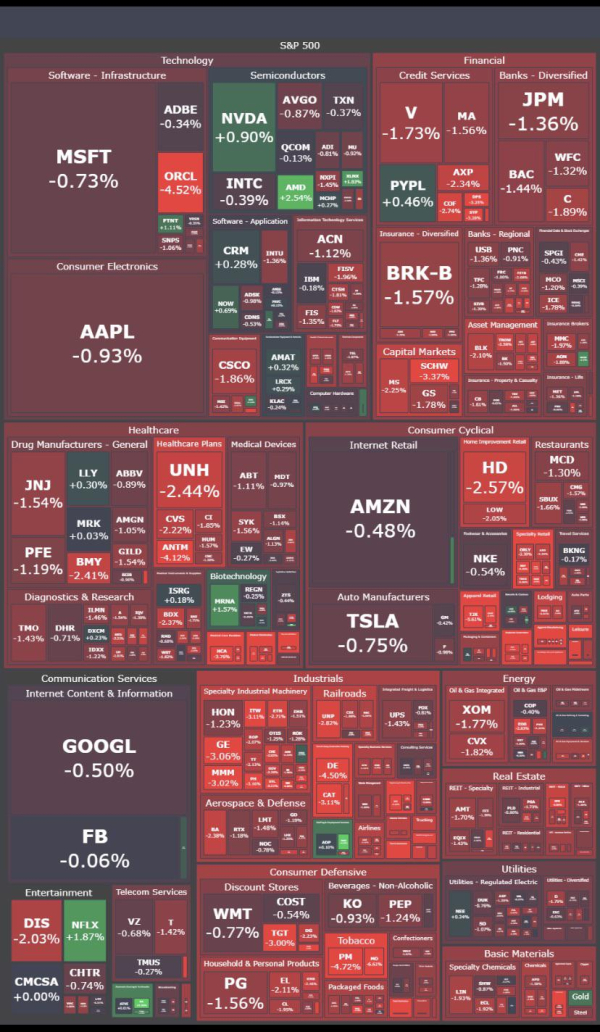
The S&P 500 Index had another bad week and ended the month down 4.8%. It was the sharpest monthly decline since March 2020 – and finished a seven-month streak of gains. Here is a heat map chart showing how widely spread the pullback was last week.
It will be interesting to see how the S&P 500 Index fairs in October as the Delta variant continues to linger, the Federal Reserve plans to slow its purchase of government-backed bonds, and fear continues around the U.S.'s cash reserves and debt limit. Adding further pressure are the continuing shortages of many retail goods and computer chips.
But, for all the times we've expected a contraction, the market has shown remarkable resiliency in the past year and a half.
On a more lighthearted note, here are two charts I thought were interesting and worth sharing.
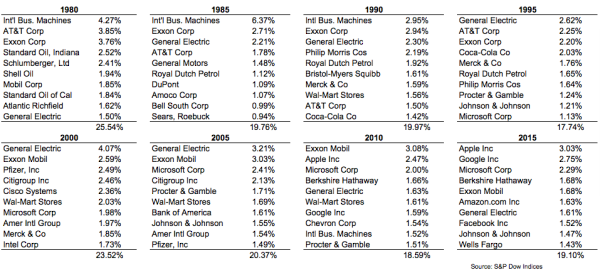
First, here's a chart from A Wealth Of Common Sense that shows the top 10 stocks in the S&P 500 in 5-year increments.
There are a lot of interesting takeaways you can glean from this chart. But I was surprised to see how much turnover there is. Also, in the 1980s, the top 10 companies were almost all energy companies, while today they're almost all tech companies.
Here's a bonus chart that shows the top 10 companies at the end of 2020.
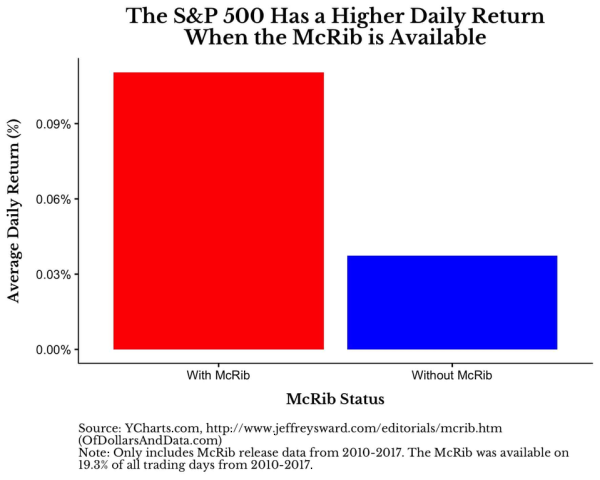
With the McRib coming back on November 1st, you might want to invest now. Seems like a solid bet.
Perhaps the correlation exists because McDonald's only offers the McRib when pork prices are low enough? If so, McD's is reacting to the market (and not the other way around).
There are many ways to make money in fast food (including food sales, real estate, and commodities trading).
Last week, ESPN televised a blow-out of Ohio's Bishop Sycamore high school football program by Florida's IMG Academy. The score was 58-0. But that has little to do with this story.
The supposed school in Colombus, Ohio, is not recognized by the state's athletic association … and the department of education doesn't list a school with that name. Despite that, they somehow scammed ESPN into scheduling the game.
Here are some of the troubling data-points.
The head coach of the team, Roy Johnson, has an active warrant out for his arrest
They falsely claimed they had multiple Division 1 college prospects
ESPN couldn't verify any of the players in their scouting databases.
The director of Bishop Sycamore claims the school is not a scam, and his son is in the program. On the other hand, the “school” currently doesn't even have a working website.
It's impressive that in this era of information access, a school could defraud the nation, not once, but twice.
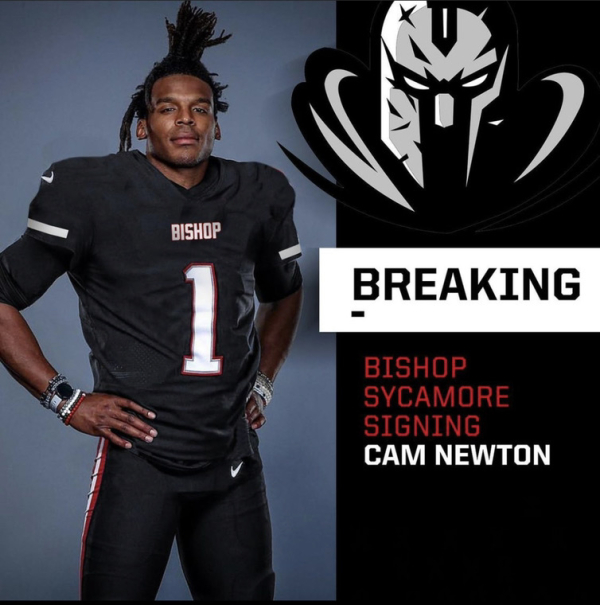
I even heard that Cam Newton got picked up by Bishop Sycamore after getting dropped from the Patriots.
Not really … but this is an interesting story – and reflects how easy it is for “fake” things and get real coverage.
Recently, however, it seems that we are increasingly presented with issues divided into polar opposite points of view, with little to no tolerance for disagreement.
Nonetheless, not all topics need to be debated or negotiated.
Sometimes, a fact is a fact.
Hopefully, this video won't step on any toes – but if you're a "flat earther," I wouldn't watch.
Here's a clip from Behind The Curve (a documentary on the flat earth society) that I think perfectly shows confirmation bias.
Start with the evidence and then form a conclusion. Doing that in reverse doesn't tend to work out as well.
As a polite reminder, if a conspiracy relies on millions of people (as well as different countries and organizations) to all commit to the disinformation campaign … it's not likely true.
As Occam's razor states, the simplest explanation is often the correct one.
While the calculation is based on five factors, the primary conditions indicate a big disagreement about market conditions.
For example, two of the conditions are that a substantial number of stocks have to be at yearly highs, while a substantial number of stocks have to be at new annual lows. Ultimately, it is hard for those two conditions to be met in a short period of time unless there's uncertainty in the market. Moreover, after a rally, uncertainty is often a precursor to a decline.
In addition, technically (for the pattern to be complete), a second sighting of the five elements must occur within 36 days. Logically, lingering uncertainty is a momentum killer.
Should I Be Worried?
This week, Cumberland Advisors' shared the following from Art Cashin, Director of Floor Operations for UBS Financial Services at the New York Stock Exchange.
Art had this to say:
“I had told Carl Quintanilla on CNBC’s Squawk on the Street in an interview about 10:20 that I thought the chatroom bears were turning a bit more aggressive. Several were trying to point out that we had had two Hindenburg Omens in a row. In case you had forgotten, a Hindenburg Omen is rather arcane indicator that takes as a measurement the ratio or relationship between the new 52-week highs and the new 52-week lows. It is quite unusual to have two days back-to-back with new Hindenburg Omens.
Now, you have to be a little bit careful about the Hindenburg Omen because, over the last 35 or 40 years, we haven’t had a market ‘crash’ without the presence of the Hindenburg Omen, and that is what chatroom bears were pushing. You have to remember the other part of that, which is while there has always been a Hindenburg Omen before a crash, there has not been a crash after every Hindenburg Omen. To use a rather poor analogy, it is almost like saying, we have never had a flood without rain. But, then again, every time it rains, it doesn’t mean it is going to flood.
So, it was, nevertheless, an effective tool among the chatroom types just to make people nervous. I am not sure how many have bought into the Hindenburg aspect, but it was one of those ‘Wait a minute – should I be aggressive on the buy-side or should I wait and hold back here?’ I think it had some of that effect.” – Art Cashin
From my perspective, while this pattern may have correctly predicted every big stock market swoon of the past two decades (including the October 2008 decline), not every Hindenburg Omen has been followed by a crash. Resorting to a geometry analogy: All rectangles are squares, but not all squares are rectangles.
Times are strange – and there's reason to be wary of the markets, but indicators like this are a reason to be cautious, not a basis for trading decisions.
In an interview with Tom Bilyeu (co-founder of Quest Nutrition), he addresses the issue of managing Millennials – and why they seem lazy, entitled, and unfocused.
via Inside Quest
Sinek points to four characteristics that help "create" this issue:
Parenting,
Technology,
Impatience, and
Environment.
Sinek suggests that this generation is a product of failed parenting strategies … being told they're special without effort, being told they can have anything they want, and being handed trophies for showing up.
Next, add technology to the mix.
Before millennials, interaction happened in person much more frequently … meaningful trust-based relationships were built with time and effort, and when you were at dinner with friends or watching a movie, you were living in the moment, not distracted by your phone.
For added irritation, next add impatience (which is a byproduct of instant gratification).
Why wait for amusement when it's a text away? You've got Netflix making video rental a thing of the past, Tinder making dating as easy as "swiping right" and Amazon making it so you don’t have to check out when you go to a store.
Is it any wonder that these kids have short attention spans? Now imagine the Gen Z kids forced into quarantine where their only companionship was online?
Now put those kids in an environment where they're forced to realize you can't rush success, and you can't force meaningful relationships. Where they have to put in the effort and stay focused for extended periods of time
It's a story that often doesn't have a happy ending.
I thought it would be fun to ask one of them what they thought about it … So I asked my son, Zachary. Here are his thoughts.
I was born in 1993. When I was in elementary school, I was already using a computer almost daily, and a lot of my education and entertainment was computer-centric.
As such, I am a textbook “Millennial.”
I use Snapchat too much, I often relax by playing games on my phone, and I am easily distracted. Because of that, I found this interview with Simon Sinek particularly interesting.
I’m lucky. My dad forced me to work hard and valued my efforts more than my results. So, while I'm constantly reminded that I'm lucky I'm not working 80-hour days (and being forced to get a haircut every week), I do feel as if I'm a step ahead of many of my peers.
I still find myself falling into a lot of the "traps" Sinek describes – I'm reliant on social media; I'm frustrated when my effort doesn't transfer into immediate impact; and I struggle to not take my phone out whenever there's not another stimulus keeping me occupied.
That being said, I do think the issue is bigger than millennials. It's not just our generation that takes their phones out at meetings and ignores who they're with for someone on their phone. If you pay attention, I'll bet you'll notice that you do it as well. To me, it seems more like a trapping of the era than of a generation.
The difference, I think, is that millennials spent their formative years in this environment. This does affect the way we see and interact with the world. But you can watch each generation chastise the youth for the same things as they get older.
"This new generation has no respect! They're too reliant on technology, and don't know how to do anything themselves! Lazy and entitled!
I'm positive I can find similar rhetoric levied against Generation X, Boomers, and more. There's always been resistance to new technologies and the belief that the new generation takes what they're blessed with for granted. I even catch myself judging Gen Z for the same things I remember being judged for as a teenager.
Will we ever measure up to your expectations? Perhaps not … because our generations approach the world the world so differently.
Nonetheless, we are still capable of greatness. We are still driven to pursue growth, to create new things, and to provide value to our communities. It's just that we are playing a different game and keeping score a little differently. 2020 brought a lot of that to the forefront of the conversation.
Understanding that, in and of itself, can help to close the gap. As we mature and become the main working force, as we become managers and leaders, I think you'll find that a lot of our failings were the symptoms of youth – and have dissipated with age.
There's plenty more I want to say, but I don't want to go on for too long. I'm happy to have a more in-depth conversation offline. You can e-mail me at [email protected] with any thoughts on the subject, any questions, or just to say hello.
You might imagine something based on pop culture references of virtual lifeforms with sentience and free will … but, at least for now, that's far from the truth.
Modern AI does many things and has many applications, but it's still relatively primitive. It works in the background, silently collecting vast amounts of data, and performs increasing amounts of work.
AI may not currently compare with the Star Trek character Data, yet it already is transforming our economy at warp speed. For a recent example, McDonald's is now doing a 10-store pilot replacing their human drive-thru attendants with AI.
Some current uses of AI and robotics are genuinely impressive. Here's a video taking you into "The Hive" a supermarket warehouse run by a "Hivemind" AI. With thousands of "bots" and various other forms of AI and technology, this will give you a glimpse of the future of AI and automation.

 via
via 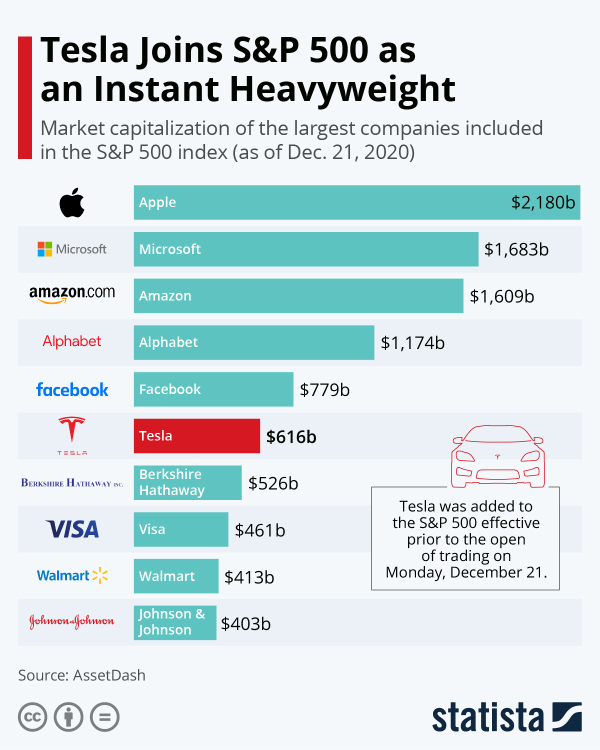 via Statista
  via PuzzledHippo3