Business

  • Why You Can’t Predict March Madness

    Last year, I shared some facts about March Madness. For example, the chances of a perfect bracket are  at 1 in 9,223,372,036,854,775,808. For those who don't wanna do the math that's 9.2 quintillions. 

    This year, 16-seed UMBC (The Chesapeake Bay Retrievers) beat 1-seed Virginia, and left no perfect brackets after only 28 Games

    As we came into the Elite Eight, nobody picked all eight. Almost nobody predicted No. 3 Texas Tech making it this far … and there were 17,304,320 digital brackets this year. 

    Is there any way to accurately predict something with this many potentialities and this much discord?

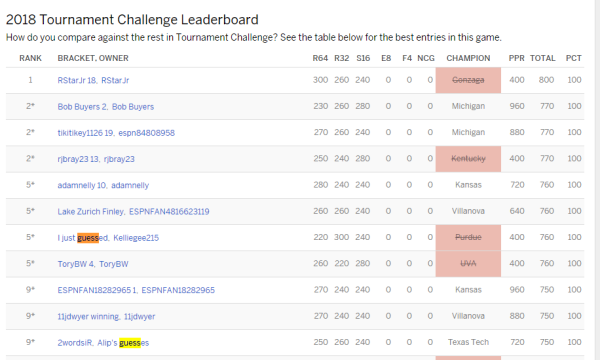
    Different factors can feel like they provide an edge … knowing the history of teams, their ranks, how often they've been to the Final Four, or how great their coach is … but even that knowledge can lead you astray. You'd think an NCAA analyst might have a better shot at a perfect bracket than your grandma or co-worker, but several of the highest-ranked brackets this year were guesses. 
    325 NCAAvia ESPN

    It's fun guessing when you're making bets on college basketball, but what if this is your livelihood …

    Prediction is hard … especially about the future.

    The way people fill out their brackets often mimics the way investors pick trades or allocate assets. Some use gut feel, some base their decisions on rank and past performance, and some use predictive models … and some of us get disappointed when Duke loses.

     Apparently, humans aren't as great at prediction as we think we are. 
  • There’s Always A Best Next Step – The Relentless Pursuit of Something Better

    Someone asked me what one thing best described or accounted for my success.  Here is what I told them.

    Success is not about an event or an outcome. It comes from the relentless pursuit of something better … even in the face of failure, competition, or surprises.

    2_2

    It doesn't matter where you are (or how you got there). There is always a best next step. And, if you don't see it, the best next step might be remembering that there is one and shifting your perspective or role until you do.

    What do you think? What's your answer to that question?


  • How Blockchain Will Eventually Disrupt Every Industry

    Recently, I shared an infographic with 25 notable cryptocurrencies and restated that the support technologies for coins (specifically, blockchain and smart contracts) are more exciting than any individual currency. 

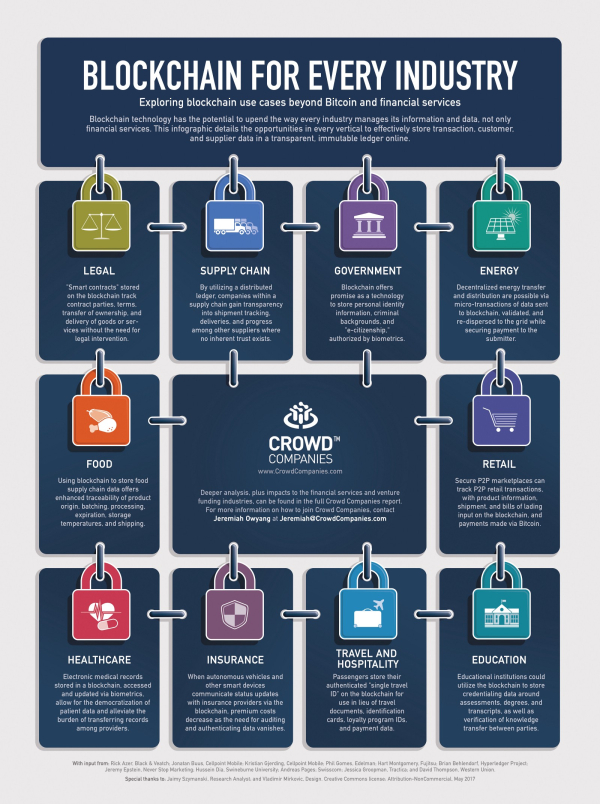
    Blockchain is radically changing the future of transaction-based industries. Industry leaders are fervently evaluating and exploring blockchain to determine its potential for disruption, and for developing a long-term strategic advantage over their competitors.  

    Blockchain is disruptive because of its ability to digitize, decentralize, and secure the validation of "transactions".  Everywhere there's a hand-off of information or goods, blockchain has the opportunity to improve that process. 

    Imagine being able to see the entire history of a property, and know it's accurate. Imagine being able to track individual shipments globally through your supply-chain with ease. Imagine being able to enter/exit countries without the elongated passport check-ins. 

    The list goes on … Aviation, Big Pharma, Manufacturing, Finance, SaaS … In the same way that artificial intelligence is transforming what's done by humans and what's done by machines, the blockchain is transforming security and how we transfer data. If data is the new currency, blockchain is the banking system. 

    Blockchain enables transparency and accountability on a radically bigger scale. 

    Here are 36 companies already using blockchain to innovate, and here's a simple infographic for some of the basic applications of blockchain in non-financial industries.

     3152018 blockchain

    NewCoShift via Crowd Companies


    I've said this before, but it's worth echoing …  Some of what was once Impossible becomes Possible.   Some of what became Possible becomes Probable.  And, and some of what became Probable becomes Inevitable.

    Blockchain is happening.  Technological shifts,  like this, require you to think about your industry and your potential opportunity differently.

    Change is happening faster (and creating bigger edges) than ever before. 

    What a great time to be an entrepreneur.

    Seize the Edge!

    Onwards.

  • What Are The Most Notable Cryptocurrencies?

    A few months ago, it seemed like everyone was asking about Bitcoin (and many were investing heavily). While it's still a common topic of discussion, the sentiment has definitely flattened out.

    Making sense of cryptocurrencies is tough. There are over 1000 currencies out there – and the list is growing.  But it isn't just about first-mover advantages or features.  You have to consider government policies and regulations, and a host of other issues.

    Consequently, it's hard to recommend putting money in any coin, as an investment.

    Trading is a different conversation.

    There is a lot of momentum and interest in this space.  If it seems worth learning more, here's an infographic on some of the more notable currencies. 


    3112018 cryptocurrencies

    nickwb via Reddit 

    Each currency has it's own strengths and weaknesses, but I stay much more bullish on the underlying technologies (like Blockchain) than any individual coin.

    What about you? 

  • Pro Tip: You’re Not An Author

    I love books … bookshelf after bookshelf confirms that (I’ve even read most of them!)

    So far, however, none of the books on those shelves were written by me.

    Not surprisingly, it’s a lot easier to read one than write one.

    The Internet makes being a bestseller seem easy, and writing the book even easier. It feels like everyone and their mother has a book.

    But it’s not that easy.

    After reading several posts on writing books, listening to experts, talking with friends that have written them, I’ve tried a lot of different approaches. I’ve transcribed speeches and presentations, I’ve chronicled dozens of stories on key points, etc. I've used book writing software, voice transcription services, grammar checkers, and even text expansion software, trying to make it easier. 

    I've spent more time not writing a book than many successful authors spent from start to finish.

    Technology makes most things easier and faster … but, whether we’re talking about writing a book or a trading algorithm, at some point, you realize that it’s not enough to use tools, you also have to know how to use them.

    If you don’t have the right skills and knowledge, tools only help you create garbage faster.

    That is where Tucker Max and Book in a Box come in … When it's time to write your book, they can help.

    Tucker Max has written 4 Best Sellers (for himself) with 3 on the Best Sellers’ List at the same time.

    Here is an interview I did with Tucker about the book-writing process, and why it can be hard, even for very smart people, to write a book. 


    via YouTube

    Are you planning on writing a book?

    I am!


  • 12 Ways to Get Smarter – In One Infographic

    I just got back from Asia and have been jet-lagged.  Consequently, my mental clock-speed is not yet back to normal.
     
    It got me thinking about productive output … and how to increase it.
     
    According to VisualCapitalist, the level of a person’s raw intelligence, as measured by aptitude tests such as IQ scores, is generally pretty stable for most adults.
     
    While it’s true that there are things you can do to fine tune your natural capabilities (such as doing brain exercises, puzzle solving, and getting optimal sleep) – the amount of raw brainpower you have is difficult to increase in any meaningful or permanent way.
     
    For those of us who constantly strive to be high-performers in our fields, this seems like bad news. If we can’t increase our processing power, then how can we solve life’s bigger problems as we move up the ladder?
     

    The Key is Mental Models

     
    The good news is that while raw cognitive abilities matter, it’s how you use and harness those abilities that really makes the difference.
     
    18 0225 mental-models-infographic
     
    via VisualCapitalist – Click the image to see a larger version.
     
    The world’s most successful people, from Ray Dalio to Warren Buffett, are not necessarily leagues above the rest of us in raw intelligence – they have simply developed and applied better mental models of how the world works, and they use these principles to filter their thoughts, decisions, strategies, and execution.
     
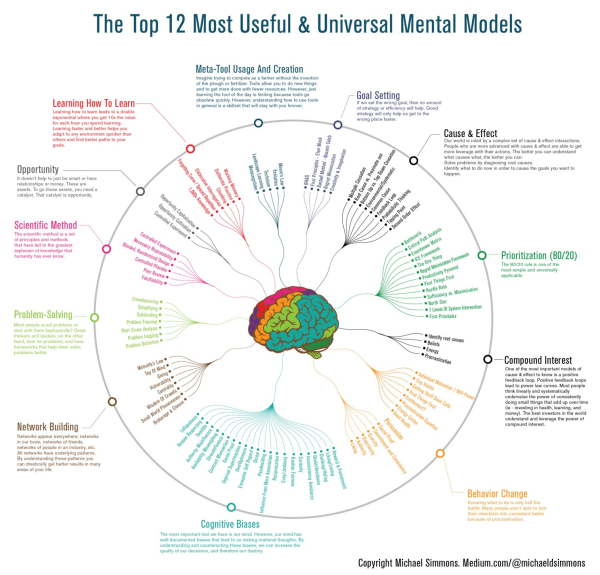
    Today’s infographic comes from best-selling author and entrepreneur Michael Simmons, who has collected over 650 mental models through his work. The infographic (in a similar style to one VisualCapitalist previously published on cognitive biases) synthesizes these models down to the most useful and universal mental models that people should learn to master first.
     
    Concepts such as the 80/20 rule (Pareto’s Principle), compound interest, and network effects are summarized in the visualization, and their major components are broken down further within the circle.
     
    If you want to be a top performer, it’s worth looking into mental models. They can help you better frame reality, so that you can harness your intelligence and effort in the most effective way possible – and it’ll allow you to deliver results along the way.
     
    Otherwise, caffeine and modafinil help.
  • The Time Horizons of Start-Up Growth

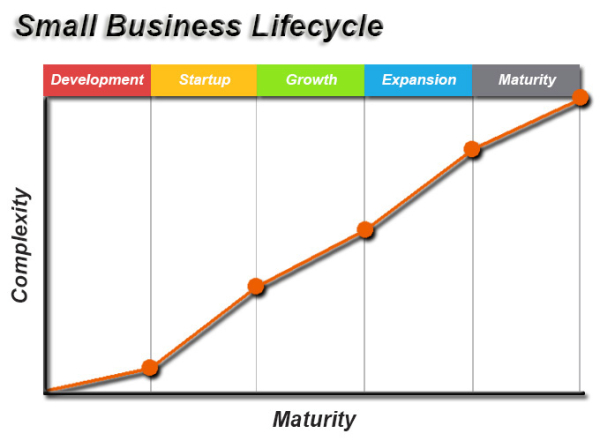
    Growing a company is in many ways similar to raising a child. 

    In parenting, you watch your child crawl, walk, and then run.  You also watch them go through phases, tackle new problems, and come out the other side of their trials a changed (and hopefully) stronger person. 

    In growing a company, you watch the idea take form (and evolve), and you watch a plan and path unfold.  You also watch your team grow and mature as they encounter problems and strategy pivots that (hopefully) result in a stronger company. 


    292018 Small business Growth

    via business2community

    In my opinion, persistence despite discomfort is a master key to success.  In other words, learn to be comfortable being uncomfortable.

    Breakthroughs happen in response to challenge.

    The only companies that don't have problems are the ones that no longer exist.  The goal is to hope for better quality problems.  

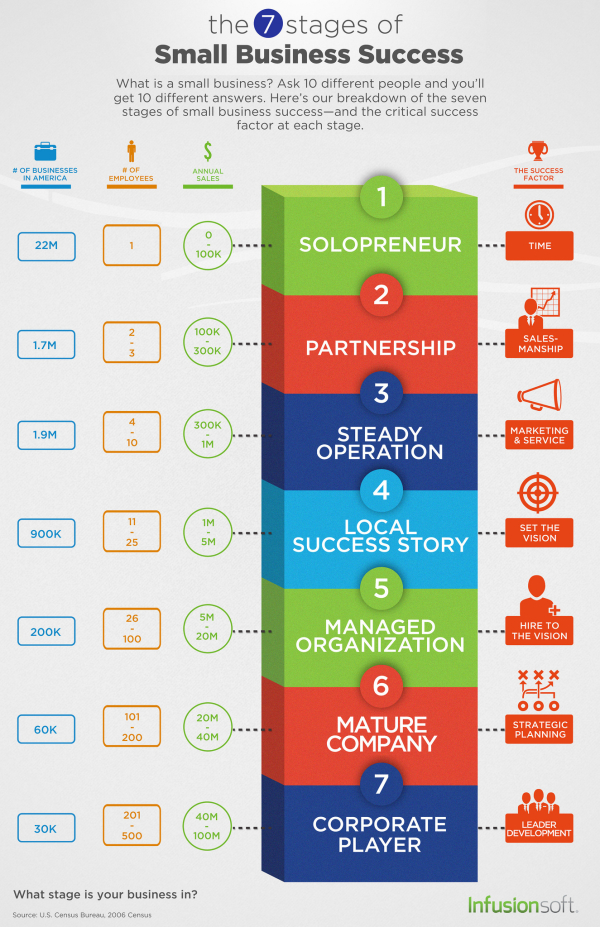
    Below is a framework that explains the 7 Stages of Small Business Success.  For each of the seven stages, it identifies the critical success factor (problem to solve) that it takes to move the business forward to the next stage of success. 
     
    180218-the-7-stages-of-small-business-success_5029195987b6f
    I've found this model to be helpful.  Let me know what you think.
     
    Onwards!
  • Why Elon Musk’s SpaceX Launch Is So Important

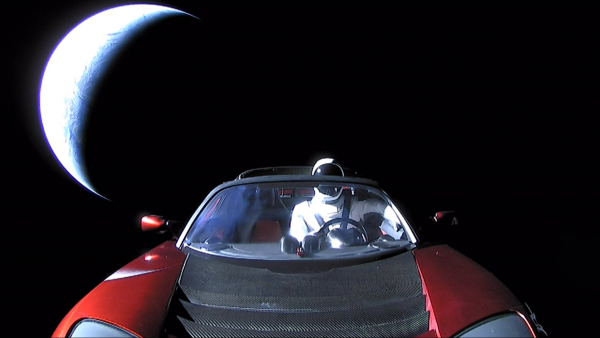
    Last Tuesday, Musk launched his Tesla Roadster and it's passenger "Starman" into space on his Falcon Heavy rocket. 

    Cool?  Clever Marketing?  Or Both?


    282018 Roadster and Starman

    Space via Twitter

    This feat is exciting for a number of reasons.

    1. Falcon Heavy is cheaper than other heavy lift rockets – yet, it is twice as powerful. 
    2. This means we can ship payloads to Mars (or potentially farther). 
    3. The boosters landed back on their platform to be reused.
    4. And, ultimately, it's inspiring and momentum building to a new age of future space explorers.

    When I was growing up, the space race caught the public's hearts and minds.  I was a kid, but I still remember watching the lunar landing.  It was a big deal! 

    Likewise, I remember when astronauts were positioned as national heroes.  Now, we're more jaded.

    In the past decade, rockets, space-stations, satellites, etc. were often just an afterthought or a small filler news item.  Meanwhile, A.I., Cloning, Voice Recognition, 3D Printing, Drones, and other technological advances were the sexy attention-getting topics. 

    Recently, that has changed.  The space race is getting hot again.  Resources are pouring into this area, and SpaceX's launch is proof that we are making progress (and probably altering life's history). 

    Take a look. 


    This was supposed to be captivating.  Teachers can show their students a rocket launch where a man shot a car into space … then they can watch the car float through space.  It's taking what we're used to only seeing in movies … and making it real. 

    Passion in the sciences is important, and successes like this can ignite passion in our future, in more than just space exploration. 

    We live in exciting times. 

    Onwards!