There's a popular quote by Jim Rohn that states that you are the average of the 5 people you spend the most time with.
I think there's a lot of truth to that statement, but I also think it's true of larger groups.
The people and groups you spend time with influence who you are in the moment and over time. We all act differently within different groups of people, and that's part of why surrounding yourself with the right people is so important.
You can see this when you visit your childhood home after many years, or spend time with your parents, or visit your old college. It is easy to revert to who you were when you were most influenced by that person or environment.
For decades I have believed that you can predict a lot about your future based on who you choose to spend your present with.
That is why I think participation in quality peer groups is critical. Peer groups help us set higher standards for our behavior, aim higher in our aspirations, and they help us stay better focused and committed to big-picture goals.
I belong to several executive and business leader peer groups — groups that double as advisory boards, counselor’s offices, and idea factories. They allow me to see, hear, and discuss things I don't normally think about, talk about, or even notice. Peer groups bring blind spots to my attention and keep me fully connected to trends that are transforming the world on a global scale.
I love going to Strategic Coach because it has a unique approach to challenging people about how they think. After years in the program, the frameworks have unconsciously become a part of how I work and live day-to-day.
If I could challenge you to do one thing based on the lessons in this podcast, I'd encourage you to lay out the framework for where you will be in 25 years. Who do you want to be? How do you want to live? What are you committed to building? Who are you going to be spending more or less time with?
The next part is easy. With those things in mind, start taking steps in the right direction today.
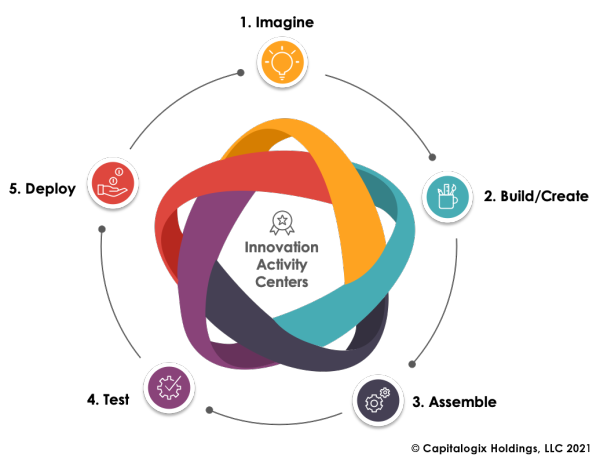
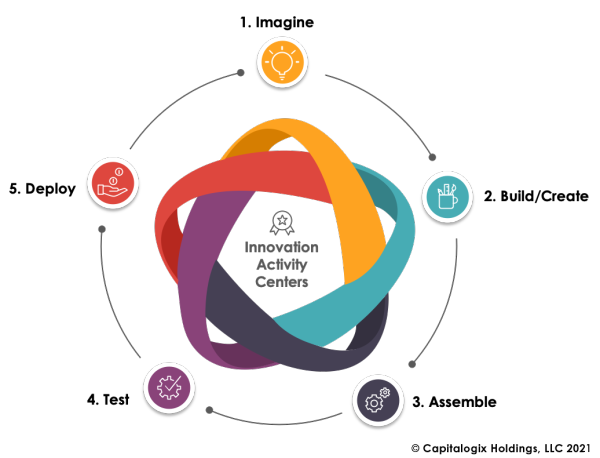
Two weeks ago, I introduced Innovation Activity Centers which are the building blocks for my technology adoption model.
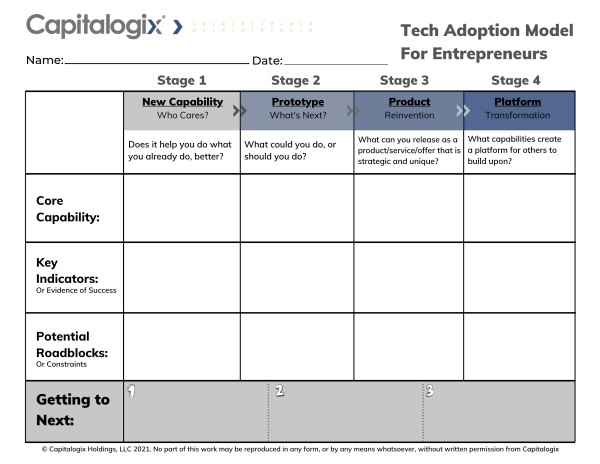
Today, I have a video and a worksheet for you that goes into the overarching Technology Adoption Model Framework. It explains how thoughts become things and how ideas scale with respect to capability, audience, and monetization.
The four base stages of this framework are: Capability –> Prototype –> Product –> Platform.
It's a great use of 20 minutes. Check it out.
While the Technology Adoption Model Framework stages are important, the ultimate takeaway is that you don't have to predict what's coming, only how human nature works in response to the capabilities in front of them.
It's a bit cliche, but to paraphrase Wayne Gretzky, you just have to skate to where you think the puck is going to be.
Desire fuels commerce. As money fuels progress, desire grows … and so does the money funding that path. As such, the path forward is relatively easy to imagine.
This isn't about predicting specific technologies, but rather about the capabilities people will want. I think of it as anticipating the natural path. It is easier to ride the wave than it is to fight nature.
Each stage is really about the opportunity to scale desire and adoption.
It isn't really about building the technology, rather it is about supporting the desire.
If you understand what is coming, you don't have to build it, but you can figure out where you want to build something that will benefit from it.
This model is fractal. It works on many levels of magnification or iteration.
What first looks like a product is later seen as a prototype for something bigger.
For example, as a Product transforms into a Platform, it becomes almost like an industry of its own. Consequently, it becomes the seed for a new set of Capabilities, Prototypes, and Products.
SpaceX's goal to get to Mars feels like their North Star right now … but once it's achieved, it becomes the foundation for new goals.
This Framework helps you validate capabilities before sinking resources into them.
In the video, I walk you through several examples of companies, their innovations, and how they fit into each stage. I even used Capitalogix as an example.
I'm also attaching a fillable PDF of the form we used so that you can run through this with your business as well.
As I continue to refine and work with this framework, I look forward to improving it and sharing it with you all.
As the world continues to change faster and more dramatically, this framework will help you anticipate changes, and it will also help you take advantage of them.
If you have any questions or comments about the idea, or how to implement it, feel free to reach out.
My mother watches the news religiously. To her credit, she watches a variety of sources and creates her own takeaways based on them. Regardless, there's a common theme in all the sources she watched – they focus on fear or shock-inducing stories with a negative bias. As you might guess, I hear it when I talk with her.
While I value being informed, I also value things that nourish or make you stronger (as opposed to things that make you weak or less hopeful).
Negativity Sells.
Sure, news sources throw in the occasional feel-good story as a pattern interrupt … but their focus skews negative. History shows that stories about improvement or the things that work simply don't grab eyeballs, attention, or ratings consistently.
The reality is that negativity sells. If everything were great all the time, people wouldn't need to buy as many products, they wouldn't need to watch the news, and this cycle wouldn't continue.
It's worth acknowledging and understanding the perils our society is facing, but it's also worth focusing on the ways humanity is expanding and improving.
As a brief respite from the unending doom and gloom of mainstream media, Information Is Beautiful has a section of their site focused on "Beautiful News".
It's a collection of simple data visualizations for positive trends, it's updated daily, and can be sorted by topic.
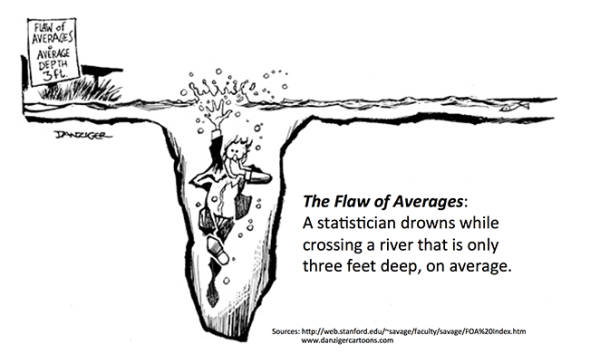
The law of averages is a principle that supposes most future events are likely to balance any past deviation from a presumed average.
Take, for example, flipping a coin. Should you get 5 "Heads" in a row, you'll assume the next one must be "Tails" despite the fact that each flip has a 50/50 chance of landing on either.
Even from this example, you can tell it's a flawed law. While there are reasonable mathematical uses of this law, in everyday life, this "law" mostly represents wishful thinking.
It's also one of the most common fallacies seen in gamblers and traders.
Perhaps you heard the story about how the U.S. Air Force discovered the 'flaw' of averages by creating cockpits based on very complex mathematics surrounding the average height, width, arm length, etc. of over 4,000 pilots. Despite engineering the cockpit to precise specifications, pilots crashed their planes on a too regular basis.
The reason? With the benefit of hindsight, they learned that very few of those 4,000 pilots were actually "average". Ultimately, the Air Force re-engineered the cockpit and fixed the problem.
It's a good reminder that 'facts' can lie, and assumptions and interpretations are dangerous. It's why I prefer taking decisive action on something known, rather than taking tentative actions about something guessed.
In many of my recent talks, I've been focusing on a technology adoption model for entrepreneurs. It is a framework that explains how thoughts become things and how ideas scale with respect to capability, audience, and monetization.
The four base stages are: Capability –> Prototype –> Product –> Platform.
You can listen to me talk about it in more detail on my recent podcasts, I'm also working on a separate video about this.
From a different perspective, each stage of the Framework requires the following Innovation Activity Centers.
I shot a video going into more detail. Check it out.
Understanding the Technology Adoption Framework and the Innovation Activity Centers makes it easier to understand and anticipate the capabilities, constraints, and milestones that define the path forward.
We are making lots of progress refining these models, and they are the basis for our plans to expand our Amplified Intelligence Platform.
Ultimately, frameworks aren't important if you aren't using them.
If you have questions about this, or how you might use these models, feel free to reach out to me.
In any case, there are growing reasons to be wary of Bitcoin as a viable long-term value store.
On top of the many reasons I've talked about in previous articles, I'm hearing many more people talk about it as if they are crypto experts. Consequently, it reminds me of the Dot.com bubble. Sure, the Internet continues to boom (but many of the early high-fliers don't exist today). Meanwhile, it's possible crypto will evolve like the Internet, but at this point, it's hard to discern how much of the success in crypto is luck versus skill.
There is a ton of demand and interest. But fear of missing out and enjoying the roller-coaster ride is not the basis of a long-standing Platform. Blockchain is a different story.
Back to Crypto … Even a blind squirrel finds a nut in a forest during a bull market.
Governments have a disincentive to allow alternate currencies (not backed by their government). In addition, another obstacle for cryptocurrency mining is the high cost of energy consumption.
Mining crypto takes a lot of electricity because when people are creating new coins they're really solving complex math puzzles with a 64-digit hexadecimal solution known as a hash. To solve those equations faster than your competitors you need massive data centers which can even overload local infrastructure.
It's increasingly expensive and energy-taxing to mine new coins. For context, it's estimated that the current annual power consumption for Bitcoin alone (not including other cryptocurrencies) rivaled the state of New York, and beat Norway.
To compare it to the tech giants, Bitcoin took 129 terawatt-hours of power consumption … Google took 12, and Facebook only took 5.
Many are looking for ways to decrease the energy consumption of mining cryptocurrency using methods like renewable resources.
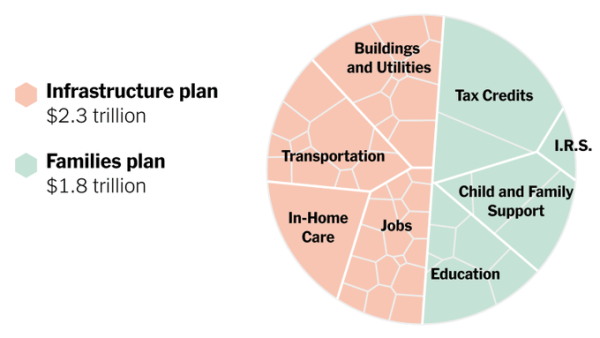
Biden campaigned heavily on an economic plan centered around bolstering the middle class, taxing the wealthy, and investing in healthcare and green energy infrastructure. There are other aspects of his plan – but those were the focuses.




 via
via 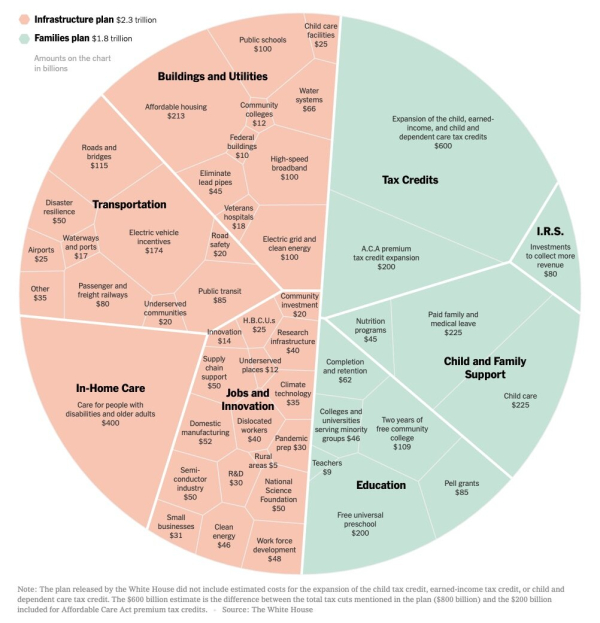 via
via