Business

  • Reinventing The Wheel

    When I think about the invention of the wheel, I think about cavemen (even though I know that cavemen did not invent the wheel).

    Lots of significant inventions predated the wheel by thousands of years.  For example, woven cloth, rope, baskets, boats, and even the flute were all invented before the wheel.

    While simple, the wheel worked well (and still does).  Consequently, the phrase "reinventing the wheel" often is used derogatorily to depict needless or inefficient efforts.

    But how does that compare to sliced bread (which was also a pretty significant invention)?

    Despite being a hallmark of innovation, it still took more than 300 years for the wheel to be used for travel.  With a bit more analysis, it makes sense. In order to use a wheel for travel, it needs an axle, and it needs to be durable, and loadbearing, requiring relatively advanced woodworking and engineering. 
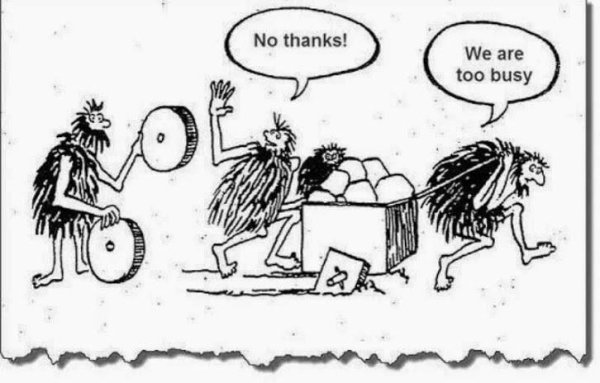
    2014-innovatie-stenentijdperk

    All the aforementioned products created before the wheel (except for the flute) were necessary for survival.  That's why they came first.

    As new problems arose, so did new solutions.

    Necessity is the mother of invention

    Unpacking that phrase is a good reminder that inventions (and innovation) are often solution-centric. 

    Too many entrepreneurs are attracted to an idea because it sounds cool. They get attracted to their ideas and neglect their ideal customer's actual needs. You see it often with people slapping "AI" on to their product and pretending it's more helpful. 

    If you want to be disruptive, cool isn't enough. Your invention has to be functional, and it has to fix a problem people have (even if they don't know they have it.) The more central the complaint is to their daily lives the better.  
    6a00e5502e47b2883301b7c93a974c970b-600wi

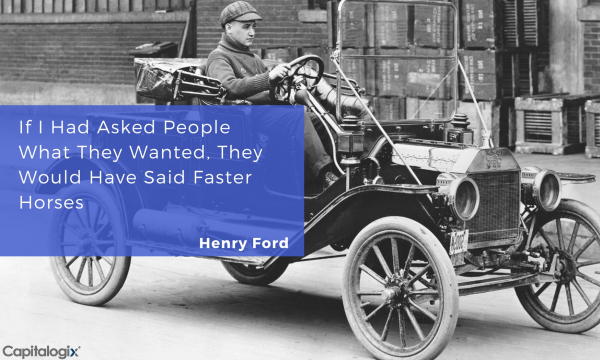
    Henry Ford famously said: “If I had asked people what they wanted, they would have said faster horses.

    Innovation means thinking about and anticipating wants and future needs.

    Your customers may not even need something radically new. Your innovation may be a better application of existing technology or a reframe of best practices. 

    Uber didn't create a new car, they created a new way to get from where you want with existing infrastructure and less friction. Netflix didn't reinvent the movie, they made it easier for you to watch one. 

    As an entrepreneur, the trick is build for human nature (meaning, give people what they crave or eliminate the constraint they are trying to avoid) rather than the cool new tech that you are excited about.  

    Human nature doesn’t seem to change much … Meanwhile, the pace of innovation continues to accelerate. 

    The challenge is to focus on what people want rather than the distraction of possibility.

    It gets harder as more things become possible.

    We certainly live in interesting times!
  • Americans’ Top Financial Concern

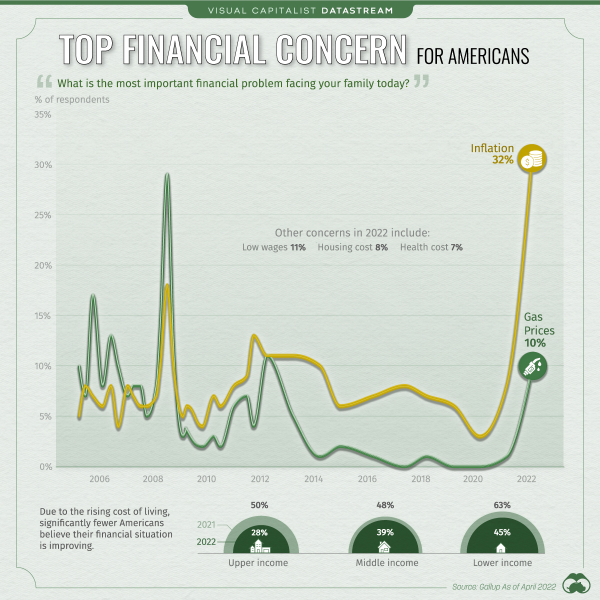
    It's no secret that the economy is slowing – with high inflation rates and rising interest rates

    According to Mohamed El-Erian, from Queens College at Cambridge University, we're experiencing stagflation – which is when inflation is high but growth is slowing significantly. Theoretically, that leads to recession. 

    Inflation-Top-Financial-Concern_Infographicvia visualcapitalist

    The Consumer Price Index has also grown by over 8% in the past year, so the American household is facing financial threats from many angles. 

    Many feel that the Fed has responded disappointingly recently, and their response (or lack thereof) will be a major dictator of whether we enter a recession. 

    I believe that emotions play a role too. When people are afraid, they spend less and hoard what they can to save themselves from an unknown future. They feel anticipatory grief.  And their fear, uncertainty, and doubt ripple through society and our lives. 

    Personally, I've weathered my heaviest storms by sailing toward the future regardless of the threats. An abundance mindset is a powerful tool, and as more people feel confident it becomes a macroeconomic trend with real influence. 

    I'd encourage you to think about what opportunities there are and will be. There are always seasons of change … Winter eventually comes – and goes. Nevertheless, winter can be a great opportunity to plan your next moves and build the infrastructure to sow more seeds in the coming spring. 

    As well, unlike nature, you can personally have springtime while the majority are in winter. We're currently in an A.I. springtime – and I believe that will continue regardless of economic trends. 

    Happy to talk about this … Let me know what you are thinking and feeling!

  • How Bad Were The Markets In The First Half Of 2022?

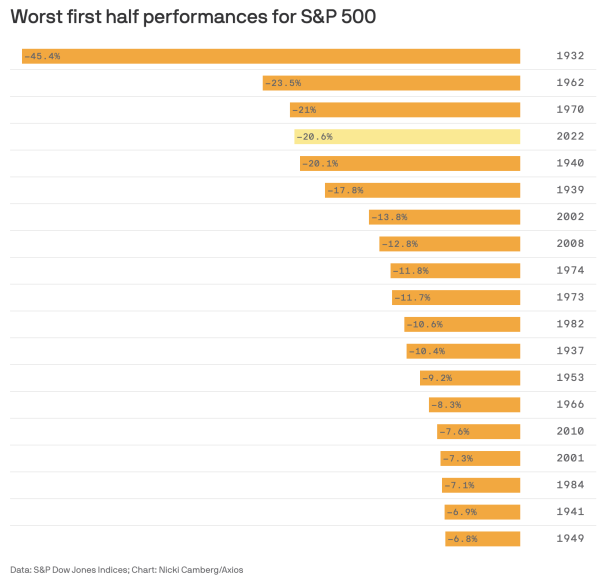
    The S&P 500 has had its worst first half performance since 1970

    Screen Shot 2022-07-01 at 3.30.06 PMvia AXIOS

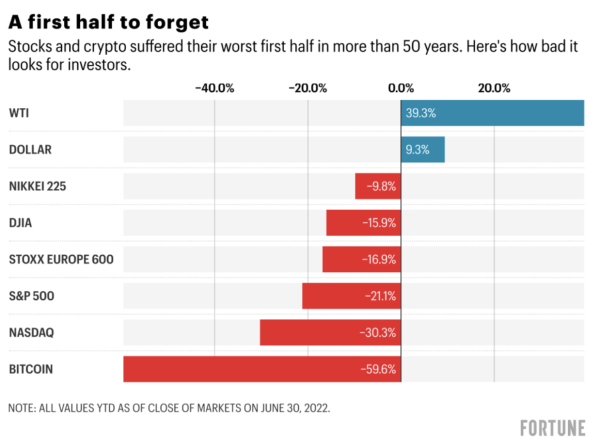
    But, the S&P's performance isn't the only danger indicator. 

    Screen Shot 2022-07-01 at 3.32.52 PMvia Fortune

    Stocks, bonds, crypto, and more, all saw rapid declines in the first half of 2022. 

    It's hard to pin the blame on any one factor. Was it the result of the actions we took to stabilize the economy during the throes of Covid? Is it the runaway inflation, Russia, or the continuing supply-chain issues? 

    It feels like everything that could go wrong – is going wrong. I mean, how often do stocks and bonds fall at the same time?

    On a positive note, bear markets are often much shorter than bull markets.  Also keep in mind that while global growth is slowing, innovation isn't!

    Don't forget, “Winter” for the economy or a particular industry doesn't have to be winter for you. 

    Onwards! 

  • Companies With The Most Patents in 2021

    Intellectual Property is an important asset class in exponential industries.

    Why?  Because I.P. is both a property right (that increases the owner's tangible and intangible value) and a form of protection.

    They say good fences make good neighbors.  But you are also more willing to work to build an asset if you know that your right to use and profit from it is protected.

    As a result of that thinking, Capitalogix has numerous patents – and we're developing a patent strategy that goes far into the future.  So, it's a topic that's front of mind for me.

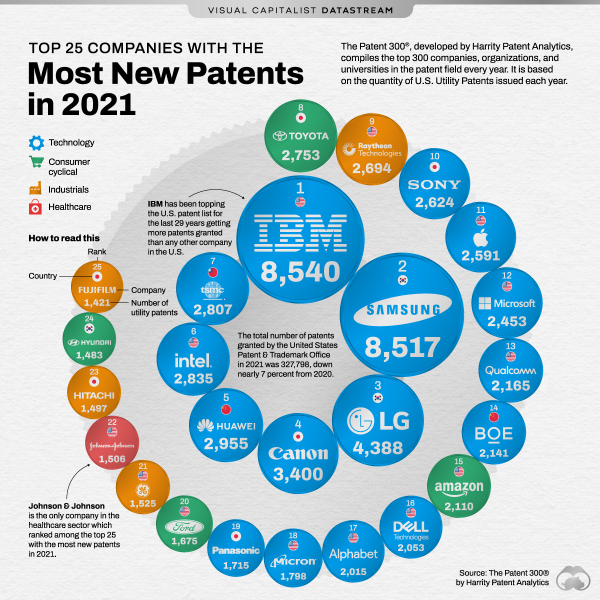
    Consequently, this visualization of which companies got the most patents last year caught my eye.  In 2021, the U.S. granted over 327,000 patents.  Here is who got them.


    DS-Top-25-Companies-with-the-Most-New-Patents-in-2021-main-Apr20Raul Amoros via VisualCapitalist

    While IBM isn't the public-facing industry leader they once were, they've been topping the list for most patents for the past three decades.  Their patents this past year cover everything from climate change to energies, high-performance computing, and A.I.. 

    What ideas and processes do you have that are worth patenting?  And, what processes are worth not patenting – to keep from prying eyes?

    Food for thought … Onwards!

  • Thoughtful Entrepreneur Podcast

    Recently I had a chance to talk with Josh Elledge on his Thoughtful Entrepreneur podcast. We talked about AI's inevitable influence on trading as well as my experience as an entrepreneur. 

    Getson Wide

    Despite mis-spelling Capital Logix … it's Capitalogix … the conversation we had is worth a listen. 

    Check it out.  

  • Happy Father’s Day 2022

    For Father's Day, my youngest son took me to see Top Gun 2 in DFX.  It's been a while since I've been in a movie theatre, and this was a movie worth doing the right way.  It lived up to the hype. 

    He also took me to brunch and invited his girlfriend – a rare occasion that I hope becomes more common.

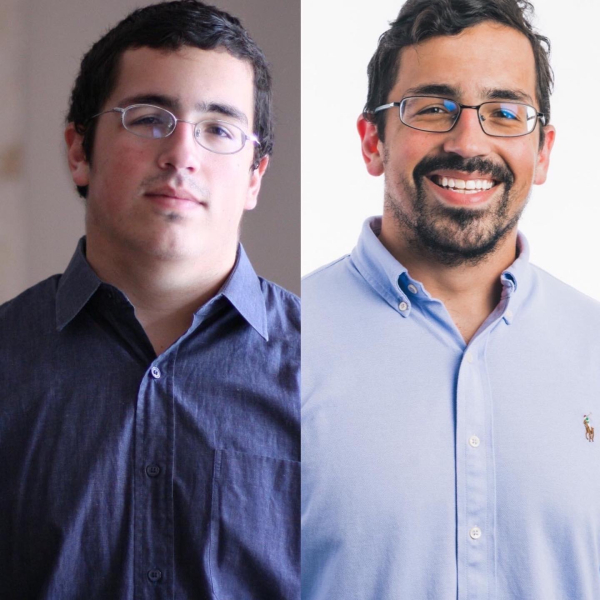
    It's been ten years since he started working with me at Capitalogix. Here's his first professional pic and his most recent.  Time flies while you are getting older!

    B5AF31D4-F28F-4149-8F13-9E20CA46BCDB

    As a father, having great kids is a double blessing.  On one hand, it's nice to be proud of who your kids are and the things they do.  On the other hand, it's also nice to feel proud of the small part you played in helping them become who they are.  It's also my first Father's Day as a grandfather.   After decades of messing with my kids, now I get to mess with a new generation! 

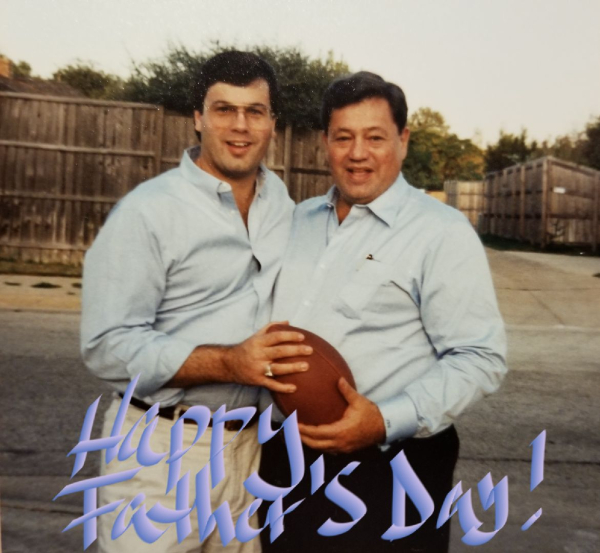
    Of course, I also look back … and spent some time thinking about my father and his terrific influence on so many lives.  

    IMG_2766

    My Dad was incredibly loving.  Yet, he was also incredibly demanding.

    For example, after winning the State Championship in the shot put, I watched him run down from the stands.  I figured he was coming down to celebrate.  Instead, he looked deeply into my eyes and asked whether I was disappointed that I did not throw a personal best that day?  I replied: "But Dad, I won." He smiled and recognized that winning was important too … then he reminded me that the other throwers were not the real competition.  In life, to be and do your best, the competition is really with yourself; and we both knew I could do better.

    My Dad believed in setting high standards.  He explained that most people's lives are defined by their minimum standards.  Why?  Because once those standards get met, it is easy to get distracted by other things and meeting the minimum standards for them as well.

    Here is something else worth sharing; it was one of his favorite sayings.  "The difference between good and great is infinitesimal."  This applies to many things.  For example, people who are good take advantage of opportunities; people who are great create them.  The point is to set a higher standard and to have a better life.

    Well, that should explain a little of the dysfunction …  but, if you can't mess up your own kids, whose kids can you mess up?

    Hopefully, you had a happy Father's Day weekend. 

  • Visualizing Oil Prices in Response to Economic Events

    In the past, I've talked about where America gets its oil, and how data is more than just "the new oil"

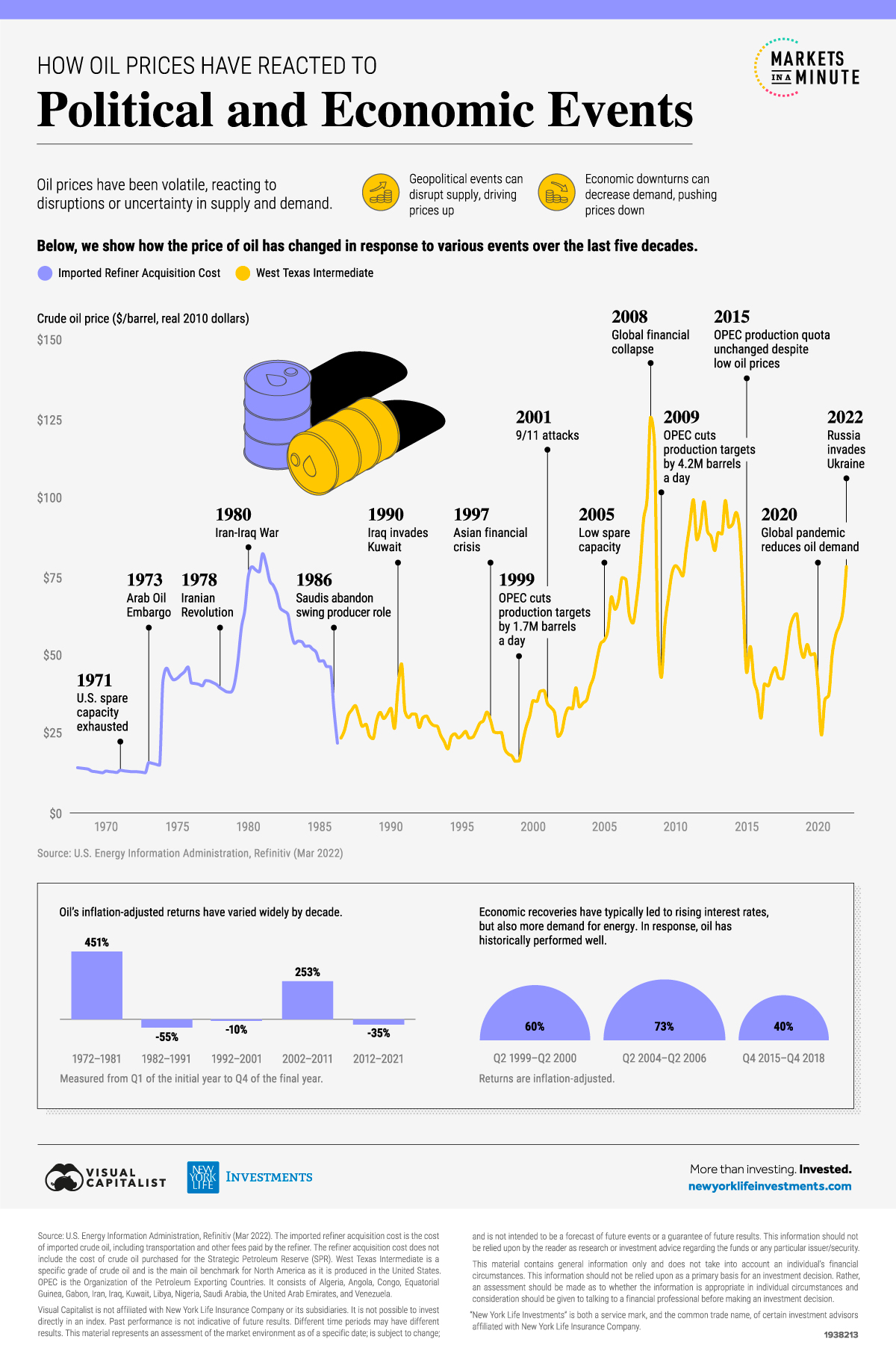
    During the worst of the pandemic, oil prices dropped almost 40%. They've now risen 216% from that pandemic low. With gas prices skyrocketing, it's probably time to look at historical oil prices.

    Visual Capitalist put together a simple infographic. 

    Historical_Oil_Pricesvia visualcapitalist

    So why are prices so high? Unfortunately, large portions of the world's oil reserves are in regions prone to political conflict.

    Currently, the Russia-Ukraine conflict is leading to supply uncertainty and rising prices.

    Meanwhile, oil companies are bringing in record profits

    Oil prices are a complicated topic because supply and demand aren't particularly responsive to price changes in the short term. Regardless of price, people need to drive. And, regardless of demand, it takes time and money to drill new oil wells. 

    As a result, you can see mismatches, like today, where uncertainty has raised prices, but oil companies are doing tremendously well. 

    The question now becomes … where does it end? Does it take a resolution to the current conflict? Or, will prices reach a ceiling and fall back down based on other factors?

  • Dall-E …. Not Wall-E: AI-Generated Art

    Neural networks creating images from text isn't new.  I wrote about it in 2019 when AI self-portraits were going viral. 


    Mauro Martino via YouTube

    Just like VR is getting a new lease on life, despite its age, AI-generated art is getting another 15-minutes of fame. 

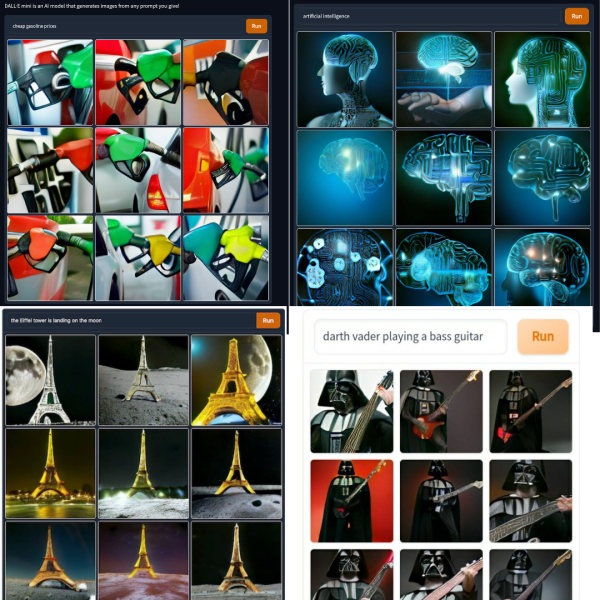
    This past week, a new model called Dall-E Mini went viral.  It creates images based on the text prompts you give it – and it's surprisingly good.  You even can give Dall-E absurd prompts, and it will do its best to hybridize them (for example, a kangaroo made of cheese). 

    Unfortunately, like our current reality, Dall-E may not be able to produce cheap gas prices.  Nonetheless, it is fun to try.  Click the image to enter the concepts you want Dall-E to attempt to represent.

    My projectvia Dall-E mini

    While the images themselves aren't fantastic, the tool's goal is to understand and translate text into a coherent graphic response.  The capabilities of tools like this are growing exponentially (and reflect a massive improvement since I last talked about AI-generated images).

    Part of the improvement is organic (better hardware, software, algorithmic evolution, etc.), while another part comes from stacking.  For example, Dall-E's use of GPT-3 has vastly increased its ability to process language. 

    However, the algorithms still don't "understand" the meaning of the images the way we do … they are guessing based on what they've "seen" before.  That means it's biased by the data it was fed and can easily get stumped.  The Dall-E website's "Bias and Limitations" section acknowledges that it was trained on unfiltered internet data, which means it has a known, but unintended, bias to be offensive or stereotypical against minority groups. 

    It's not the first time, and it won't be the last, that an internet-trained AI will be offensive. 

    Currently, most AI is essentially a brute force application of math masquerading as intelligence and computer science.  Fortunately, it provides a lot of value even in that regard. 

    The uses continue to get more elegant and complex as time passes … but we're still coding the elegance. 

    An Elegant Use Of Brute Force_GapingVoid


    Onwards!