Business

  • Making Room for New Ideas

    How many things that you think you "know" are out-dated or simply not true?  Ignorance isn't always the problem; this video shows that pre-conceived notions pose quite a challenge.

    In this Ted Talk, called "Let My Dataset Change Your Mindset", watch as Hans Rosling uses fascinating data-bubble software to burst myths about the developing world, and how the world has developed.

    Very interesting for the content … and the analysis techniques.

    For Additional Information.

  • Making Room for New Ideas

    How many things that you think you "know" are out-dated or simply not true?  Ignorance isn't always the problem; this video shows that pre-conceived notions pose quite a challenge.

    In this Ted Talk, called "Let My Dataset Change Your Mindset", watch as Hans Rosling uses fascinating data-bubble software to burst myths about the developing world, and how the world has developed.

    Very interesting for the content … and the analysis techniques.

    For Additional Information.

  • Augmenting Reality

    090830 Minority-Report UI Sometimes new technology seems like science fiction. Other times, science fiction introduces us to new technology.

    I remember watching Minority Report and having a sense that I was watching a future closer than it seemed. There's a scene where Tom Cruise is walking through a shopping area and each time he passes a store there is a personalized ad; and in other scenes there is a "Terminator-Like" text that overlays the physically real world. That is called "Augmented Reality". 

    Well, your phone may not be as cool as that, yet; however it's getting there pretty quickly.

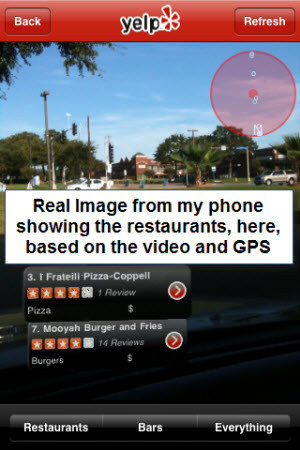
    The next picture doesn't look like much; but it's using the iPhone's built-in camera and GPS unit to recognize highly rated restaurants in real time. The application doing this is Yelp. This feature is
    currently hidden by default; but you can turn it on by shaking your
    phone vigorously, until the "Monocle" feature activates.

    090830 Augmented Reality

    Soon, I imagine this will be enhanced further with a discount coupons and the
    ability to place orders before you walk in the door. Nonetheless, it's
    an example of what's coming.

    Where Else Will This Be Useful?

    Imagine what this could do to the real-estate industry (as price per square foot, tax rates, etc. overlay the properties as you drive by). Or, imagine traders looking at a chart displaying the most relevant indicators, patterns, setups, and triggers for the company or market they are analyzing.  It gives a whole new meaning to real-time business intelligence.

  • Augmenting Reality

    090830 Minority-Report UI Sometimes new technology seems like science fiction. Other times, science fiction introduces us to new technology.

    I remember watching Minority Report and having a sense that I was watching a future closer than it seemed. There's a scene where Tom Cruise is walking through a shopping area and each time he passes a store there is a personalized ad; and in other scenes there is a "Terminator-Like" text that overlays the physically real world. That is called "Augmented Reality". 

    Well, your phone may not be as cool as that, yet; however it's getting there pretty quickly.

    The next picture doesn't look like much; but it's using the iPhone's built-in camera and GPS unit to recognize highly rated restaurants in real time. The application doing this is Yelp. This feature is
    currently hidden by default; but you can turn it on by shaking your
    phone vigorously, until the "Monocle" feature activates.

    090830 Augmented Reality

    Soon, I imagine this will be enhanced further with a discount coupons and the
    ability to place orders before you walk in the door. Nonetheless, it's
    an example of what's coming.

    Where Else Will This Be Useful?

    Imagine what this could do to the real-estate industry (as price per square foot, tax rates, etc. overlay the properties as you drive by). Or, imagine traders looking at a chart displaying the most relevant indicators, patterns, setups, and triggers for the company or market they are analyzing.  It gives a whole new meaning to real-time business intelligence.

  • Is Knowing Why and How Enough?

    Over the years, I've used a number of different assessment tests on
    myself and our team. It's a great way to help people better understand
    a each other and the different forms of communication and problem solving styles we use.

    Here are several of the tests that have proven themselves time and again:

    1. Kolbe: measures a person's instinctive method of operation, and identifies the ways they will be most productive.
    2. Myers-Briggs: identifies personality styles and temperaments.
    3. StrengthsFinder: helps people uncover their talents, so they can do more of those things each day.

    090822 whytelligence logo Recently Janine de Nysschen from whytelligence introduced me to a new tool.  She helps people perform better by getting them to understand the "Why" and "How" patterns driving them. Janine believes every person has a core sense of purpose that drives their beliefs and behavior, and a logic pattern that is hard-wired into how they think and decide.

    The whytelligence process helps people discover their distinct purpose, and shows them how embracing and leveraging that can help them thrive and succeed with less effort or resistance.

    What Can You Learn from whytelligence?

    Janine's starting point was clarifying "Why" I do things. She
    identified that I like to help people see what's real (though often hidden), and then show
    them how that truth about themselves or what they are doing can help
    them. During her next step in the process, here is how she described my "How" pattern:
    090822 Making a Point

    • First, you confront positions. You listen, you observe, but then you question and you challenge.
    • Second, you re-frame the thinking. Most of the time, you do this using stories or metaphors; but sometimes you use practical experiences too.
    • Third, you reveal the new paradigm. You get people to re-state their positions in light of what you have helped them understand.
    • Fourth, you help people put it into practice. You find opportunities or tell them about options for them to use their new paradigms, knowledge, and experience.
    • Finally, you measure response.  You will try the applied intelligence, the new technique, or better way – but they have to produce a certain level of value and give you the sense of peace, fulfillment, success, etc. … or it's back to the drawing board.

    If you know me, then you probably recognize that pattern.  After she pointed it out to me, I recognize that I use it often in my business and personal dealings.  It is how I argue, and how I help people. As a coaching point, Janine points out that my first step often is to confront; and that by becoming aware of it, I can soften its delivery for greater impact.

    This How pattern also defines my work.  In many respects, my job is to decode the logic moving the markets, and to translate that into easy to follow trading systems. This makes sense and is a great fit given my Why and How patterns.

    However, Janine then asked if I ever get so focused on finding the right tool or technique to get to a better solution, that I sometimes I forget to look for an endpoint? If you know me, then you probably recognize that pattern too. 

    Awareness Is the First Step of the Next Step.

    In other words, the How pattern can become such a powerful habit, that sometimes it runs by itself.  That's interesting information to know. Consequently, recognizing that it is running is important … as are the questions: 'Does it need improvement?' and 'Would breaking-out of it serve you better'?

    And in keeping with my pattern,
    it made me think a little bit deeper. In a sense, knowing about your pattern shows you how and why you get what you tend to get.
    However, if you want to get different results, then you need to change, or perhaps transcend, your habitual patterns in a way that lets you get better results.

    Knowing your Why and How patterns can be a great first step towards making those changes happen.

    For More Info:

  • Is Knowing Why and How Enough?

    Over the years, I've used a number of different assessment tests on
    myself and our team. It's a great way to help people better understand
    a each other and the different forms of communication and problem solving styles we use.

    Here are several of the tests that have proven themselves time and again:

    1. Kolbe: measures a person's instinctive method of operation, and identifies the ways they will be most productive.
    2. Myers-Briggs: identifies personality styles and temperaments.
    3. StrengthsFinder: helps people uncover their talents, so they can do more of those things each day.

    090822 whytelligence logo Recently Janine de Nysschen from whytelligence introduced me to a new tool.  She helps people perform better by getting them to understand the "Why" and "How" patterns driving them. Janine believes every person has a core sense of purpose that drives their beliefs and behavior, and a logic pattern that is hard-wired into how they think and decide.

    The whytelligence process helps people discover their distinct purpose, and shows them how embracing and leveraging that can help them thrive and succeed with less effort or resistance.

    What Can You Learn from whytelligence?

    Janine's starting point was clarifying "Why" I do things. She
    identified that I like to help people see what's real (though often hidden), and then show
    them how that truth about themselves or what they are doing can help
    them. During her next step in the process, here is how she described my "How" pattern:

    090822 Making a Point

    • First, you confront positions. You listen, you observe, but then you question and you challenge.
    • Second, you re-frame the thinking. Most of the time, you do this using stories or metaphors; but sometimes you use practical experiences too.
    • Third, you reveal the new paradigm. You get people to re-state their positions in light of what you have helped them understand.
    • Fourth, you help people put it into practice. You find opportunities or tell them about options for them to use their new paradigms, knowledge, and experience.
    • Finally, you measure response.  You will try the applied intelligence, the new technique, or better way – but they have to produce a certain level of value and give you the sense of peace, fulfillment, success, etc. … or it's back to the drawing board.

    If you know me, then you probably recognize that pattern.  After she pointed it out to me, I recognize that I use it often in my business and personal dealings.  It is how I argue, and how I help people. As a coaching point, Janine points out that my first step often is to confront; and that by becoming aware of it, I can soften its delivery for greater impact.

    This How pattern also defines my work.  In many respects, my job is to decode the logic moving the markets, and to translate that into easy to follow trading systems. This makes sense and is a great fit given my Why and How patterns.

    However, Janine then asked if I ever get so focused on finding the right tool or technique to get to a better solution, that I sometimes I forget to look for an endpoint? If you know me, then you probably recognize that pattern too. 

    Awareness Is the First Step of the Next Step.

    In other words, the How pattern can become such a powerful habit, that sometimes it runs by itself.  That's interesting information to know. Consequently, recognizing that it is running is important … as are the questions: 'Does it need improvement?' and 'Would breaking-out of it serve you better'?

    And in keeping with my pattern,
    it made me think a little bit deeper. In a sense, knowing about your pattern shows you how and why you get what you tend to get.
    However, if you want to get different results, then you need to change, or perhaps transcend, your habitual patterns in a way that lets you get better results.

    Knowing your Why and How patterns can be a great first step towards making those changes happen.

    For More Info:

  • An Experience Worth Paying For …

    What does $1.2 billion buy nowadays? Apparently, an amazing stadium that will change the way you experience events.

    As I was leaving the first preseason football game played in the new Dallas Cowboys stadium, one of the guys I went with said "that was the best football game I've ever seen." He was wrong; it was, however, probably the best experience he's had at a football game.

    I've been to hundreds of professional sporting events. Yet, Jerry and Stephen Jones, HKS Architects, and the rest of the team that built that stadium found a way to surprise and excite me, while exceeding my expectations on almost every level.

    Years ago, I read a book called "The Experience Economy: Work Is Theater & Every Business a Stage", which explains that as the world cascades towards sameness, a business can achieve a sustainable competitive advantage by differentiating the experience it provides to its customers. The Cowboys have done that with this stadium.
    There's a certain amount of theater, pageantry, and spectacle that you expect from a professional sporting event. Even the word "event" implies that, doesn't it?

    Well the Cowboys got it right; and it was larger than life.  Watching people as they walked in the stadium, it was amazing to see how many of them said "Wow!" And during the game, I can't tell you how many times I heard somebody say "this is incredible" … and they weren't talking about the game.

    Do You Watch the HD Screen … Or the Field?

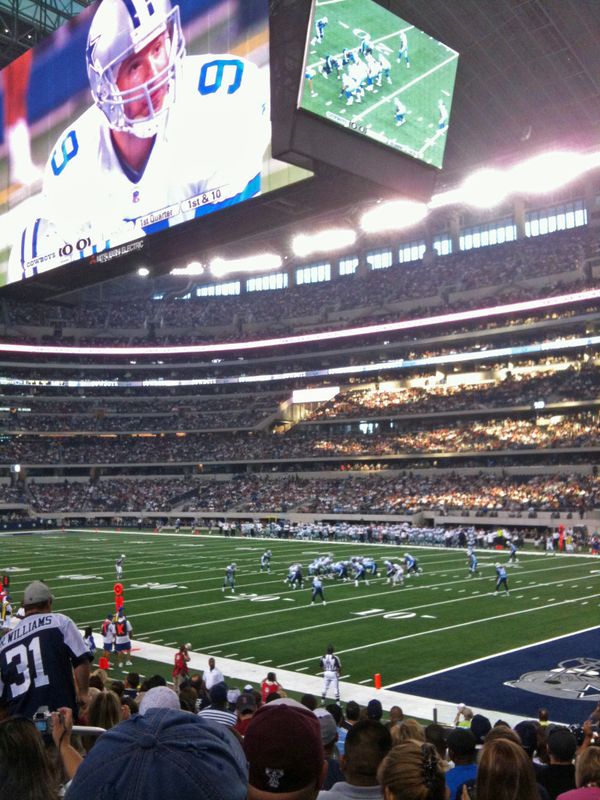
    A few weeks ago I wrote about the stadium.  This time I'm writing about what it is like to attend an event there.  One thing worth noting, the GINORMOUS HD video screen is so clear and so large that it changes how you see the game (I certainly never paid attention to cheerleaders before this, and the video is so clear you can literally read the tattoos on a player's arms during a play).  Frankly it was slightly unnerving because I couldn't figure out how
    best to watch the game. I found myself drawn to the massive video
    screen rather than the field. I literally had to train myself to watch
    the play on the field, and then to allow myself to look up to see the
    replay (often from multiple angles).

    090822 Cowboys Stadium Opener

    You know how some movies whisper "wait for the DVD" while other movies were clearly built for the Big-Screen. This stadium changes how you consume a live event product (like an NFL game), and makes it worthwhile to be there.

    It is hard to control what happens on any given Sunday, but with this, the Jones have created a sustainable brand promise and set a new standard.

    You've got to experience it for yourself. 

    My guess is that it will change stadiums around the world. Bravo.

    For More On This:

  • An Experience Worth Paying For …

    What does $1.2 billion buy nowadays? Apparently, an amazing stadium that will change the way you experience events.

    As I was leaving the first preseason football game played in the new Dallas Cowboys stadium, one of the guys I went with said "that was the best football game I've ever seen." He was wrong; it was, however, probably the best experience he's had at a football game.

    I've been to hundreds of professional sporting events. Yet, Jerry and Stephen Jones, HKS Architects, and the rest of the team that built that stadium found a way to surprise and excite me, while exceeding my expectations on almost every level.

    Years ago, I read a book called "The Experience Economy: Work Is Theater & Every Business a Stage", which explains that as the world cascades towards sameness, a business can achieve a sustainable competitive advantage by differentiating the experience it provides to its customers. The Cowboys have done that with this stadium.

    There's a certain amount of theater, pageantry, and spectacle that you expect from a professional sporting event. Even the word "event" implies that, doesn't it?

    Well the Cowboys got it right; and it was larger than life.  Watching people as they walked in the stadium, it was amazing to see how many of them said "Wow!" And during the game, I can't tell you how many times I heard somebody say "this is incredible" … and they weren't talking about the game.

    Do You Watch the HD Screen … Or the Field?

    A few weeks ago I wrote about the stadium.  This time I'm writing about what it is like to attend an event there.  One thing worth noting, the GINORMOUS HD video screen is so clear and so large that it changes how you see the game (I certainly never paid attention to cheerleaders before this, and the video is so clear you can literally read the tattoos on a player's arms during a play).  Frankly it was slightly unnerving because I couldn't figure out how
    best to watch the game. I found myself drawn to the massive video
    screen rather than the field. I literally had to train myself to watch
    the play on the field, and then to allow myself to look up to see the
    replay (often from multiple angles).

    090822 Cowboys Stadium Opener

    You know how some movies whisper "wait for the DVD" while other movies were clearly built for the Big-Screen. This stadium changes how you consume a live event product (like an NFL game), and makes it worthwhile to be there.

    It is hard to control what happens on any given Sunday, but with this, the Jones have created a sustainable brand promise and set a new standard.

    You've got to experience it for yourself. 

    My guess is that it will change stadiums around the world. Bravo.

    For More On This:

  • What If You Outsourced Your Job Overseas?

    News satire from The Onion. It is funny, well done, and like most good humor … it has an insightful kernel of truth.  This one provides a different perspective on employment and outsourcing.


    More American Workers Outsourcing Own Jobs Overseas

  • What If You Outsourced Your Job Overseas?

    News satire from The Onion. It is funny, well done, and like most good humor … it has an insightful kernel of truth.  This one provides a different perspective on employment and outsourcing.


    More American Workers Outsourcing Own Jobs Overseas