Business

  • Why I’m Still Excited About The Future of GPTs as a 20+ Year AI CEO

    Last week, I explained how to create content by simply talking to your computer using ChatGPT's new voice interface. In that post, I multi-tasked in a whole new way by writing the article by merely talking with ChatGPT while walking around my neighborhood to get some fresh air and "exercise."

    In that article, I shared my conversation along with the end result – a quick and dirty article about the applications of AI voice agents. I didn't edit the article the way I usually would, but that was intentional to demonstrate what it could create on its own. My evaluation was that it produced content that met the minimum standard and provided a great starting point for me to enhance.

    Next week, I'll redo that process, emphasizing the prompts used to interact with the AI. I also used some additional prompts to refine the writing.

    As I find new tools, prompts, and applications, I can't help but share them with the people around me. Technology has always excited me and given me energy.

    Meanwhile, as I share these tools and prompts with my son, Zach, it's clear he's not as excited as I am about them. For context, Zach and I work on these articles together. So, when I find a new writing tool that I think will make our lives easier, I'm quick to share it.

    This past week, I shared some prompts with him that I thought were profound (because they were simple – but produced useful productive output). Through simple prompts and appropriate context settings, we can now get ChatGPT (or other tools like Gemini, Claude, or Perplexity) to perform functions a small business may not have internally. For example, a company could use AI as a comptroller or product manager. It can also help create reports and summarize meetings better than my assistant or I would.

     

    1556701699345

    Zach acknowledged the utility of capabilities like these … but described them as 'pedestrian.' He was unimpressed because, in his eyes, these were capabilities that were already possible early into the public release of ChatGPT.

    He does appreciate more specific use cases for generative AI – but focuses more heavily on apps with a singular utility. For example, he likes a writing app called Lex, which works more like a standard Word Processor (but with several nicely done AI assists) … or the Hemmingway Editor app, which helps make your writing concise and correct (by suggesting fixes for lengthy, complex sentences, and common errors).

    Instead of focusing on the new generality & ubiquity – and automating tasks outside his wheelhouse – he gets excited about supplementing his ability or improving his efficiency.

    His lack of excitement helped me understand more why I'm excited.

    Since the '90s, I've been fascinated by AI. For much of that time, two types of people shared my excitement. The first was Hollywood executives, who created cliché dystopian depictions to perpetuate a false human vs AI dichotomy (think The Terminator, I, Robot, or 2001: A Space Odyssey). The other were other people like me. Entrepreneurs or academics looking to leverage exponential technologies.

    The average person had very little practical exposure to AI outside of the hidden-in-plain-sight applications that were often glorified decision logic. Eventually, you got tools like Siri or Alexa that put it into everyone's home.

    My son takes for granted that even when ChatGPT grew popular, using it well took expertise. You had to be clever, deliberate, and patient to get results that weren't verbose garbage.

    AI is genuinely becoming not just available but accessible.

    Three great examples are Letterly, Talktastic, and Rosebud Journal.

    Letterly is an application that allows me to dictate whatever I'm thinking. It runs a process behind the scenes to organize and clean up disorganized text. Then it gives me dozens of rewrite options that allow me to choose the tone (Business, Casual, Friendly, Clear and Concise, etc.), the purpose (Email, Social Post, Journal Entry, etc.), and the type of output (Structured, 2X Shorter, Meeting Takeaways, Detailed Summary, Outline, etc.). It sounds much more complicated than it really is. The primary reason that I like it is that it's so simple that I take it for granted. 

    Another tool like that is Talktastic. For short burst dictation, TalkTastic is better than speech recognition tools (like ChatGPT, OpenAI Whisper, Google Speech-to-Text, or Apple Dictation). It is a game changer because it interprets what you're saying based on what it sees on your computer screen, regardless of the app or website. That means when you trigger it to run, TalkTastic analyzes a snapshot of your chosen app and automatically understands your conversation's tone, style, and substance while accurately spelling people's names and easily confused words. So you can turn your rough ideas into thoughtful and articulate language everywhere. I use it dozens of times every day to create short messages, emails, and even some of the sentences in an article like this. Currently, Taltastic only works on macOS devices (and is totally free while in beta).

    Rosebud is a journalling app reimagined to incorporate AI in many subtle and clever ways. I've been tempted to journal many times throughout my career, but always found reasons to abandon the practice. That's not true anymore. Rosebud's AI journal has fundamentally changed how I look at and use tools like this. Chatting with AI tools is one thing (I wrote about that in a post called Conversing With AI), but Rosebud is a level beyond even that. It has all the benefits of a traditional journal, but it adds intelligent responses, subtle prompts, and reminders to think about certain things. It's interactive and collaborative. It challenges you to re-examine certain beliefs, set goals, or measure success in different ways. Try it!

    Each of these tools is a great example of something you quickly take for granted because it's easy to get used to nice things.

    Expect a lot more things like that.

    Isn't that exciting?
  • The NFL’s Halftime Hack

    When you think of food meant to help athletes, you might think back to when parents would give orange slices or Gatorade to kids during soccer games. Now, fast forward your thinking to the best options available to fuel today's performance athletes. What do you imagine they would use before or during a game? 

    I quickly went to protein bars or energy gels (like GU) … But, I was wrong.

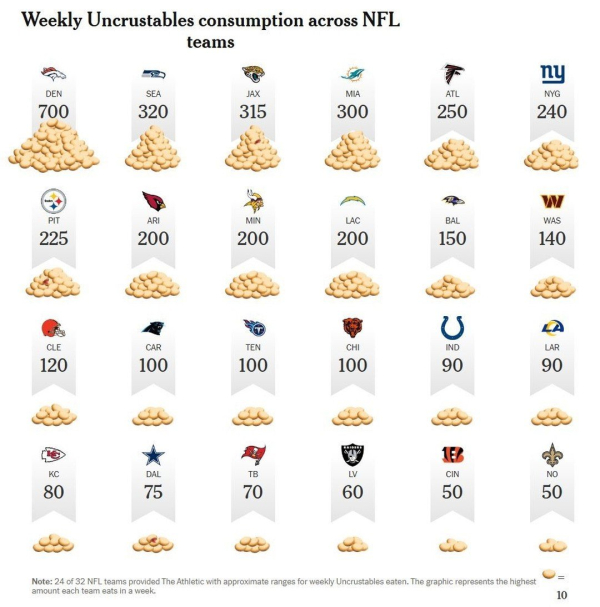
    According to research from The Athletic, The NFL's favorite halftime energy booster is now the uncrustable.

    What is that? An "uncrustable" is a crustless sandwich consisting of a filling between two layers of crimp-sealed bread. They are convenient, portable, and they tend to come in homey flavors like PB&J. While you can theoretically make one at home, Uncrustables, in this context, are made by Smuckers. 

    GaxdbP-WoAA2_mCThe Athletic via X 

    Based on this math, it's reasonable to assume that NFL teams go through ~4000 Uncrustables a week (on top of however many PB&Js or other sandwiches they consume). Regardless, it is a lot. 

    Why the sudden surge in popularity? It's a combination of factors:

    • Nostalgia and Comfort: The uncrustable taps into a sense of childhood nostalgia, offering a comforting and familiar taste.
    • Nutritional Balance: It provides a balanced blend of carbohydrates for quick energy, fats for sustained power, and protein for recovery.
    • Convenience: Pre-packaged and mess-free, uncrustables are perfect for a half-time snack when you have very little time to eat. 

    If you think about it, it makes sense. PB&Js are universal. Regardless of geographic region, socioeconomic status, etc. – it's a staple. 

    They're easy to digest, convenient, and comforting. Hitting all the marks a professional athlete might be looking for. 

    Even in a high-tech world, people still crave simplicity and effectiveness.

    I've never had one … but now I kind of want to try. On the other hand, I'm pretty sure they used to call this a Pop-Tart. But I guess that just makes me seem old.

  • Getting Educated Before You Vote!

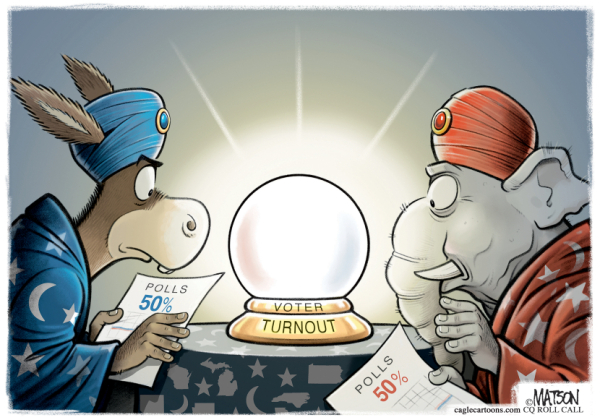
    Early voting has started, and if all goes to plan, we’ll know who will be the President on Tuesday, November 5th. Realistically, it’s more likely that you’ll know who you think the President is … but the country may still be officially undecided.

    It has gotten more challenging to exercise truly educated decision-making through the fog of fake news and the growing echo chambers of noise surrounding the candidates (and their policies).

    The reality is that most of our news sources are tinted by the lens of their ideology – which is okay. That means they’re appealing to their targeted audience. 

    That being said, it may also be worth looking at the same news story from a comparative news source from the other spectrum – or even better, a primary source when it comes to science/economics. I found two tools that help me do this kind of comparison easily – Ground News and Particle.

    Ground News is a news aggregation platform that makes it easy to compare news sources, read between the lines of media bias, and break free from algorithms. Key features and benefits include:

    • Source comparison: Allows users to see how different news outlets cover the same story, grouped by political leaning (left, center, right)
    • Bias distribution: Shows the breakdown of political orientation for news sources covering each story
    • AI-generated summaries: Provides summaries of coverage from different political perspectives
    • Blindspot feature: Helps users identify stories not widely covered by their preferred sources
    • Ownership information: Shows the ownership/financial interests behind news outlets.

    Particle is a news reader app that delivers AI-powered news summaries to help you understand more, faster. It was created by an ex-Twitter alumni. The Particle app lets you browse a personalized list of stories to get you up-to-speed at a glance … or go infinitely deeper to understand various perspectives, broader context, and how a story has unfolded over time. They’re still in private beta. You can sign up for the waitlist here.

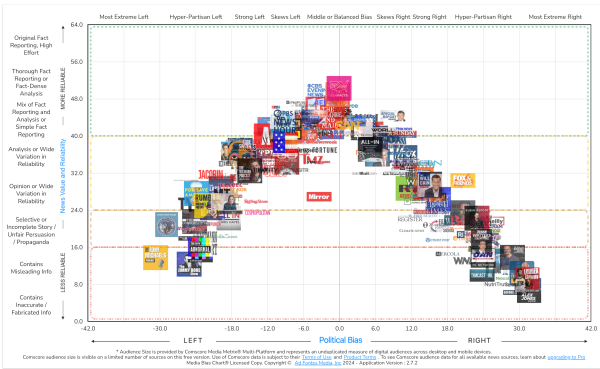
    Here’s a chart that shows where news sources rank. You can click the image for an interactive version with more details. And, if you’re curious about their methods, click here

    Screenshot 2024-10-25 at 8.29.57 PM

    via Ad Fontes Media

    On top of reading various news sources, there are a couple of other tools I like: 

    • FiveThirtyEight – Uses graphics to tell visual stories on valid statistics. Named after the number of electoral votes. Also has a visual presidential forecast
    • RealClearPolitics – Aggregates news from various sources, as well as writing their own opinion pieces. Also has a good visual on the current state of the presidentialsenate, and house races. 
    • Brittanica ProCon – Tracks the stated positions of politicians on various issues. It can be sorted by candidate and by issue. It also has a quiz you can take to assess which candidate you actually resonate with. 
    • Politifact & FactCheck – Both sites fact-check presidential statements, party statements, and more. We know politicians often lie by omission or focus only on the specific stats that are relevant to their point. Fact-checking helps you gain a more holistic picture. 

    You are probably sick and tired of all the noise surrounding the election. However, our democratic system thrives on the intricate system of checks and balances powered by information sharing and continuous debate. This process compels the government to remain responsive and accountable to the people. 

    Remember, choosing not to vote is still a choice … and getting out to vote is the only way to make sure that your voice is heard – whether or not you believe in the health of America's democracy

     
  • Multi-Tasking with ChatGPT’s Advanced Voice Interface ‘or’ Unlocking the Power of Voice Agents: A New Frontier in Content Creation

    This article was created using a unique process compared to our usual approach. To test ChatGPT’s Advanced Voice capabilities, I decided to talk with it while walking around my neighborhood. I wanted to explore if it could help me be productive while getting fresh air and exercise.


    Gettyimages-918789438-1585262043

    What follows is the transcript, with only some light editing and formatting to better provide insight into the process and its outputs.

    The embedded mini-article that ChatGPT produced isn’t the main takeaway here. What interests me is the quality of the article, considering how little effort went into creating it. It was so painless and quick that I found myself contemplating how easily I could use this process for other types of productive output. In fact, that concept is a key focus of the mini-article below.

    That said, this is just a snapshot of AI’s current capabilities. If I were to repeat this experiment in six months or a year, I’m confident the results would be even more impressive. I'm also confident that if I'd asked it to flesh out the article, I would have been more impressed as well.

    I’d probably consider this article “good enough” if I weren’t someone who takes pride in my writing and thinking. Nonetheless, I believe it’s a solid starting point. For the record, my son (who helps write these weekly commentaries) disagrees. He liked our article and its premise – but "hated" what ChatGPT produced.

    Sure, some additional work and deeper reflection could make it meaningfully better … but it’s impressive how quickly and easily we came up with something valuable (that could become even more valuable with a little extra effort).

    In conclusion, these content creation capabilities represent a key shift: the content bar will rise, and the minimum standard for what’s acceptable will get higher. But as the bar for “acceptable” rises, I think fewer people will strive for greatness. That’s where you can extend your edge … if you’re willing to do the extra work.


    Here is the Chat.

    “Hello.”

    00:00

    Hey there! How’s it going?

    “Going pretty well. Today, I want to work on a blog post.”

    00:06

    That sounds great! What topic are you thinking about for your blog post?

    “How voice agents like you can help to create articles in a new way.”

    00:07

    That’s a fascinating topic! Exploring how voice agents can revolutionize content creation could really capture readers’ imaginations. You could delve into how it streamlines the writing process, adds a conversational tone, and even opens up new possibilities for interactive or personalized content. What angle are you thinking of taking?

    “Everything you just said, but I also want to add a piece on instant feedback.”

    00:01

    Fantastic! So, you could structure the blog post around how voice agents enhance the writing process by making brainstorming more dynamic, offering immediate feedback, and allowing for a more fluid, conversational tone. Is there anything else you want to explore in the post?

    “An example where I’m walking around the neighborhood, but instead of simply walking, I talk to the AI agent and have it even ask me questions.”

    00:16

    So, while strolling through the neighborhood, you engage in a productive dialogue with the AI agent instead of just walking. It can prompt you with questions …

    “And help me consider and refine the post; yes.”

    00:020

    So, while strolling through the neighborhood, instead of just walking, you engage in a productive dialogue with the AI agent. It can prompt you with questions, helping you refine your ideas and shape your article, all while you’re getting some fresh air and exercise. It’s a great way to maximize productivity in otherwise idle moments. Want to include anything else?

    “Yes, a couple of other examples and challenges for the reader to think about other uses of this technology that open up AI and exponential progress in ways that they haven’t thought of before.”

    00:21

    Great idea! You could include examples like using voice agents for language learning, where they act as conversation partners, or for project management, where they help organize tasks and deadlines through natural conversation. For challenges, invite readers to think about how voice agents might transform areas like mental health support, creative collaborations, or even scientific research. This approach could really spark some innovative thinking!

    “Great. Please come up with a detailed outline for what you’re thinking.”

    00:08

    1. Introduction
      • Brief overview of how voice agents are changing content creation.
      • Mention of the growing role of AI in everyday life.
    2. Voice Agents: A New Way to Write
      • How voice agents can turn walking time into productive writing sessions.
      • The ease of having a conversation with an AI to generate content.
    3. Benefits of Voice Agents in Content Creation
      • Brainstorming: How voice agents can help generate ideas.
      • Instant Feedback: Getting immediate responses to refine ideas.
      • Conversational Tone: How speaking thoughts out loud can create a more natural writing flow.
    4. Examples of Voice Agent Applications
      • Language Learning: Acting as a conversation partner.
      • Project Management: Organizing tasks through dialogue.
      • Mindfulness and Mental Health Support: Providing an outlet for expression and guidance.
      • Creative Collaborations: Assisting in the co-creation of stories or projects.
    5. Challenges for the Reader
      • Encourage readers to think of other areas where voice agents could be transformative.
      • Provoke thought on the broader implications of AI in accelerating exponential progress.
    6. Conclusion
      • Summarize the key points discussed.


    “Okay, please write that blog post for an executive or entrepreneur audience, making it simple, engaging, and relevant to their interests.”

    00:15

    …Got it. Here’s the blog post:


    Unlocking the Power of Voice Agents: A New Frontier in Content Creation

    In today’s fast-paced world, efficiency and innovation are essential, especially for executives and entrepreneurs. One of the most exciting developments in this arena is the rise of voice agents — AI-powered assistants that are transforming how we create content. Imagine turning a simple walk around the neighborhood into a dynamic brainstorming session or a full-fledged article creation process. Let’s explore how voice agents can open up new horizons for you.


    A7f1fa55-67b2-48ae-af46-297621450debThis image was created using X’s Grok AI to pair with this article.

    Voice Agents: A New Way to Write

    Picture this: you’re out for your morning walk, and instead of just enjoying the scenery, you’re also creating content. With a voice agent, you can do just that. Engage in a conversation with your AI assistant, and the spoken ideas seamlessly transform into written words.

    Benefits of Voice Agents in Content Creation

    • Brainstorming

    Voice agents excel at helping you brainstorm. Throw ideas at them, and they’ll help you explore different angles, often sparking new thoughts in the process.

    • Instant Feedback

    Gone are the days of waiting for feedback. With a voice agent, you get instant responses. As you articulate your thoughts, the AI provides real-time feedback, helping you refine your ideas on the fly. It’s like having an editor by your side, 24/7.

    • Conversational Tone

    Speaking your thoughts can lead to a more natural, conversational tone in your writing. This style is increasingly popular, as it engages readers and makes complex topics more accessible.

    Examples of Voice Agent Applications

    • Language Learning

    Voice agents can act as conversation partners, helping you practice new languages in a low-pressure environment. They can introduce vocabulary, correct pronunciation, and even engage in dialogue, making language learning more interactive and fun.

    • Project Management

    Organizing tasks and deadlines through natural conversation is another strength of voice agents. Discuss your project needs, and let the AI help you prioritize tasks, set reminders, and keep you on track.

    • Mindfulness and Mental Health Support

    Voice agents can offer a safe space for expression and reflection. They can guide you through mindfulness exercises, provide mood trackers, or simply lend an empathetic ear, offering support whenever you need it.

    • Creative Collaborations

    Imagine co-writing a story or developing a project with your AI assistant. Voice agents can contribute ideas, help you overcome creative blocks, and add a new dimension to collaborative efforts.

    Some Challenges to Consider

    As you consider these applications, think about other areas where voice agents could revolutionize your work or personal life. Could they streamline your decision-making processes? Might they open up new avenues for customer engagement? The potential is vast, limited only by our imagination.

    Conclusion

    Voice agents are changing how we create content, offering benefits beyond simple convenience. From brainstorming to project management, and from language learning to mental health support, the possibilities are endless. As we continue to integrate AI into our daily lives, voice agents will evolve into increasingly powerful tools for innovation and growth. So, the next time you head out for a walk, consider inviting your AI assistant along — you might just discover your next big idea.


    “Okay, thanks.”

    00:01

    You’re welcome! If you need any more help, just let me know.


    I’d love your feedback on this … and I’m curious to learn how you’re using AI or want to use AI.

    As I’ve said before – we live in interesting times.

    Onwards!

  • Old School Wisdom Isn’t Always So Wise …

    When I first got interested in trading, I relied on traditional sources and old-school market wisdom. For example, I studied the Stock Trader’s Almanac.

    While there is some real wisdom in some of those sources, most might as well be horoscopes or Nostradamus-level predictions. Throw enough darts, and one might hit the bullseye.

    Traders love patterns … from head-and-shoulders, to Fibonacci sequences, and even Elliot Wave Theory.

    Here’s an example from Samuel Benner, an Ohio farmer. In 1875, he released a book titled “Benner’s Prophecies: Future Ups and Downs in Prices,” where he shared the often-referenced chart called the Benner Cycle. Some claim it’s been accurately predicting market fluctuations for over 100 years. Let’s check it out.


    Here’s what it gets right … markets go up and down … and that cycle continues. Consequently, if you want to make money, you should buy low and sell high … It’s hard to call that a competitive advantage.

    Mostly, you’re looking at vague predictions with +/- 2-year error bars on a 10-year cycle.

    However, it was close to the dotcom bust and the 2008 crash … so even if you sold a little early, you’d have been reasonably happy with your decision to follow the cycle.

    We use a form of cycle analysis in our models but it’s more rigorous, nuanced, and scientific than the Benner Cycle. The trick is figuring out what to focus on – and what to ignore.

    Just as humans are good at seeing patterns, even where there are none … they tend to see cycles that aren’t anything but coincidences.

    In trading, “alpha” measures the excess return created by manager skill rather than luck or movement of the underlying market. As you might guess, both “art” and “science” are involved in that calculation. Profitable traders want to believe it’s a sign of their skill, while losing traders prefer to blame luck.

    Nicholas Nassim Taleb pointed out in “Fooled by Randomness” that many successful traders, even those with decades-long careers, were likely more lucky than skillful. They just happened to be at the right firm, on the right trading desk, at the right time.

    That said, I believe technology, algorithms, and AI are evolving into Amplified Intelligence – the ability to make better decisions, take smarter actions, and continually improve performance. We’re about to experience a huge asymmetric advantage … those who understand technology and science (math, statistics, game theory, etc.) will have a real edge over those relying on more primitive techniques or gut instinct.

    In a sense, this is another type of cycle.

    The best traders I know believe that “smart money” takes “dumb money”. While it may sound harsh, this cycle has played out repeatedly over time. Cutting-edge science can seem like magic to those who don’t understand it. However, these capabilities give a significant advantage to those who possess and use them.

    I believe the gap between smart and dumb money is widening. That represents a massive opportunity for those who recognize what’s coming.

    This is a reminder that just because an AI chat service recommended something that made money, doesn’t make it a good recommendation. Those models may do some things well … but they also might just have made a lucky prediction at an opportune time. Making scientific or mathematically rigorous market predictions probably isn’t an area to trust ChatGPT or one of its rivals (at least if you don’t understand how to ask AI to do something that you understand and believe gives you a real edge).

    If you don’t know what your edge is, then you don’t really have one. This becomes even more important in the age of AI. It doesn’t matter if AI does what it’s supposed to unless you believe it is doing what you want. 

    Be careful out there.

  • The Law Of Diminishing Returns

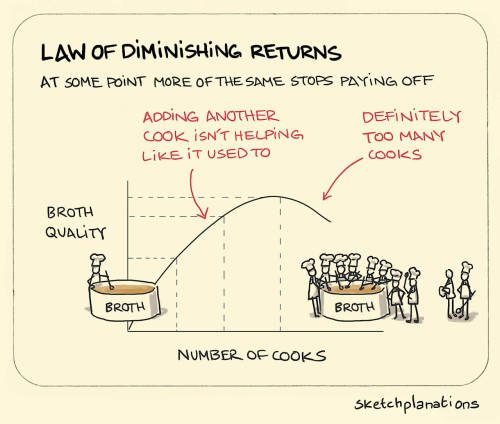
    At some point, more of the same stops paying off … it is called the law of diminishing returns.


    Law of Diminishing Returnsvia Sketchplanations

    Nature (and common sense) reminds us that equilibrium is important. For example, when you exercise too much, you get injured; when you drink too much water, you get poisoned; etc. 

    This concept applies almost everywhere.

    • It's why diversification is so important in portfolio construction theory. 
    • Or, why you don't want to put all your eggs in one basket (concentrating your risk).
    • And, my favorite, it's also why you shouldn't only eat vegetables.

    A related nugget of wisdom from the extreme … Too much of a good thing is a bad thing! 

    And of course … Be moderate in everything, including moderation.

  • Looking Back on Ryan Deiss’s Thoughts on AI & Humanity

    In 2017, I asked Ryan Deiss – a famous digital marketer – about his perspective on AI


    via YouTube

    How do you think his thoughts held up?

    To be fair, we shot this video BCGPT (before ChatGPT). Since then, AI has become much more accessible and useful.

    It was the start of the golden age of AI, machine learning, and process automation … but in the last seven years, AI's effects and impact have become radically more widespread.

    While marketing relies on data, analytics, and automation, Ryan believes it also needs a personal touch. He suggested that the best AI should make conversations feel more human (particularly in marketing and selling) and allow humans to be more human. In other words, as technology frees people up, they can focus on more valuable things.

    Today, more marketers – including Ryan – use generative AI tools to streamline their process and improve their output.

    His points about using tools like ChatGPT remain valid.

    The saying is trite, but AI won't replace your job … a human with AI will.

    This has happened many times in society. Fewer people work in farming or manufacturing, yet more people are doing more jobs. However, many of these new jobs didn't exist – or couldn't have been imagined – before people were freed up to contemplate what they could or should do. This shift in perspective is what truly matters and adds the most value to society, the economy, and people's lives.

    Just as mechanization freed up workforces for better jobs, AI can do the same.

    What do you think?

  • Are You As Smart As You Think You Are?

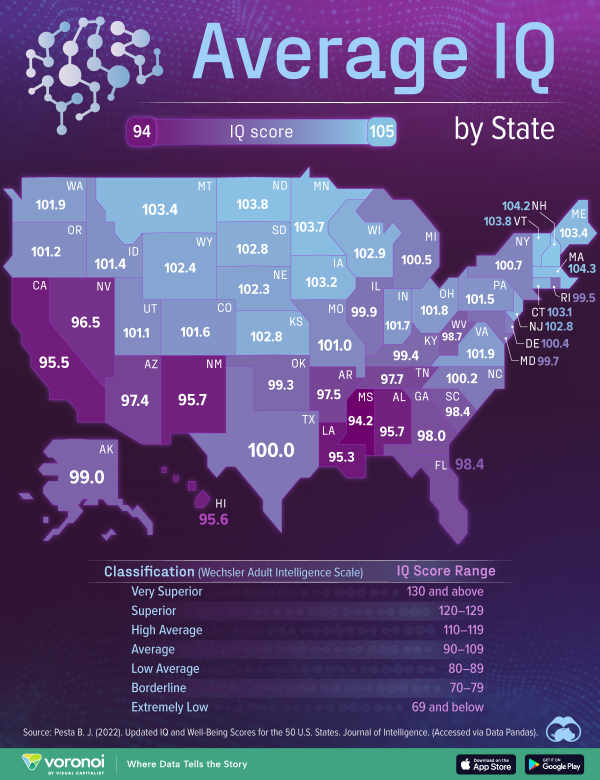
    VisualCapitalist just shared an infographic showing the Average IQ by state. It caught my eye and my interest.  Here it is.


    AverageIQbyState_web

    via VisualCapitalist.

    When I first examined the chart, I focused on the state-by-state differences. Honestly, I was taken aback that some states scored higher than others. And by that, I mean it wasn't necessarily the states I would've predicted. But then I took a closer look at the scale and realized these differences are probably insignificant. The results essentially show that, on average, states' intelligence levels are… well, average.

    I know a lot of smart people.

    I also know many people who think they're smarter than they are (even the smart ones … or, perhaps, especially the smart ones). 

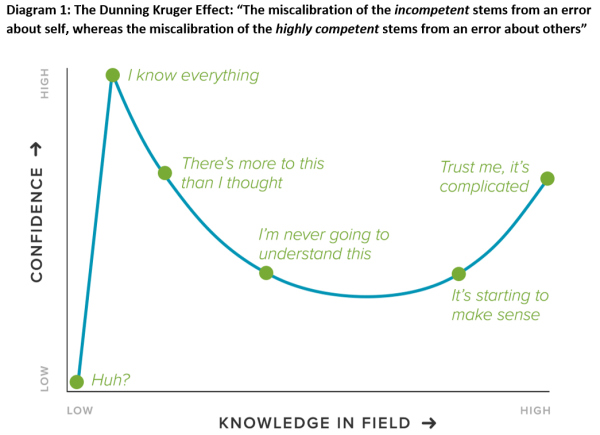
    It's common. It's so common that there's a name for it—the Dunning-Kruger Effect.

    Have you ever met someone who's so confident about what they think that they believe they know more than an expert in a field? That's the Dunning-Kruger effect. It's defined as a cognitive bias where a lack of self-awareness prevents someone from accurately assessing their skills. 

    Here's a graph that shows the general path a person takes on their journey towards mastery of a subject. 

    Dunning-w-caption

    via NC Soy

    The funny thing about the above image… it's not actually a part of the paper on the Dunning-Kruger Effect. But it's now so commonplace that people report that chart as fact—a fitting example of the effect. 

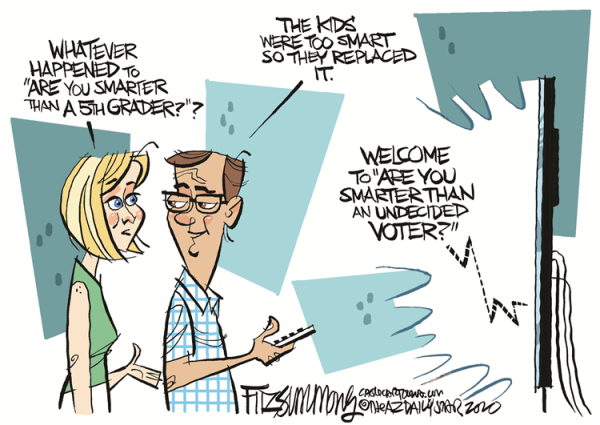
    244667

    David Fitzsimmons via Cagle Cartoons

    Recognizing the "victims" of this effect in our daily lives can often be funny or frustrating. But we're all prone to this; it's a sign of ignorance, not stupidity

    This is a problem with all groups and all people. You're not immune to it, even if you already know about the cognitive bias resulting from the Dunning-Kruger Effect. 

    It should be a reminder to reflect inward – not cast aspersions outward. 

    Two different ways that people get it wrong, first is to think about other people and it’s not about me. The second is thinking that incompetent people are the most confident people in the room, that’s not necessarily true.

    Usually, that shows up in our data, but they are usually less confident than the really competent people but not that much… - David Dunning

    To close out, even this article on the Dunning-Kruger presents a simplification of its findings. The U-shape in the graph isn't seen in the paper, the connection that lack of ability precludes meta-cognitive ability on a task is intuitive, but not the only potential takeaway from the paper. 

    Regardless, I think it's clear we are all victims of an amalgam of different cognitive biases. 

    We judge ourselves situationally and assume "the best". Meanwhile, we often assume "the worst" of others. 

    We can do better … it starts with awareness.

    Progress starts by telling the truth.