
October 18, 2026

  • What To Do When Optimization Takes The Fun Out of Everything …

    I recently saw a Reddit thread comparing McDonald’s and Hot Wheels in the 1990s with their modern counterparts. The images were meant to show how much color, character, and personality seemed to have disappeared.
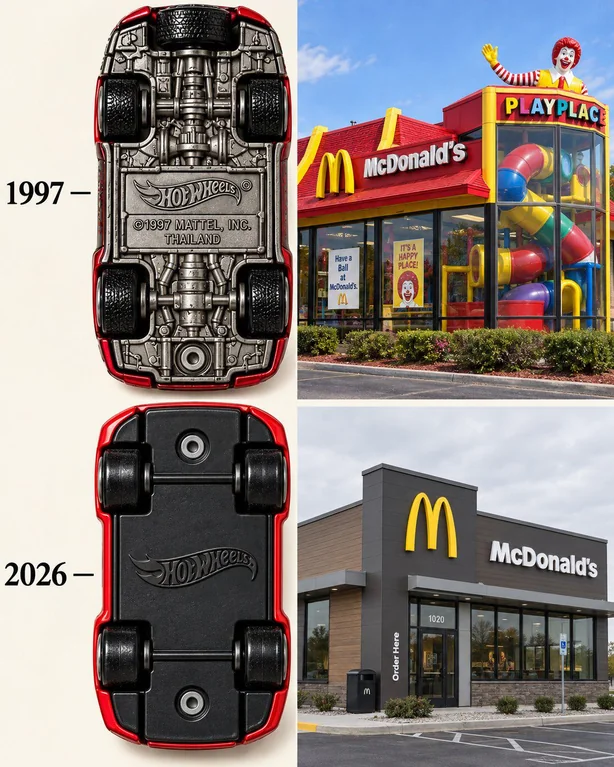
    via r/SipsTea

    Millennials tend to think everything was better in the ’90s, and while that’s demonstrably not true, corporate design was less brutalist.

    The comparison felt a little nostalgic, but it got me thinking about a real business problem: What happens when companies focus so much on optimization that they lose sight of what made people love them in the first place?

    Capitalism Rules

    Capitalism is remarkably good at creating things people want. Competition gives entrepreneurs a reason to build better products, take risks, challenge established players, and find entirely new markets. McDonald’s made fast food an experience, not just a meal. Hot Wheels made a little toy car feel like an adventure.

    But success changes the incentives.

    Once a company has established its position, the challenge can shift from making a better product to making the existing product more efficiently. Can we reduce manufacturing costs? Simplify the experience? Remove a feature without hurting sales? Improve margins by another fraction of a percent?

    Individually, these decisions can make perfect sense. Collectively, they can produce something that works just fine but feels like a shell of what it used to be. The magic fades, and trouble sits just off in the horizon, waiting for a disruptor to bring it to light.

    You can see a similar pattern around town. Compared with much of the architecture and construction many of us remember from the 1990s, so much new development can feel repetitive and interchangeable. There are understandable reasons for that, from construction costs and zoning requirements to financing constraints and the economics of building at scale. Still, it’s worth asking what gets lost when efficiency and predictability dominate every decision.

    You can even see it in trading. Over-optimize a strategy against its own backtest, and you can curve-fit your way to a beautiful equity curve that has nothing to do with how markets actually behave going forward.

    Don’t Optimize On The Wrong Metrics …

    The irony is that optimizing away these qualities may be the very things that once differentiated the business. Color. Character. Craftsmanship. Surprise. The little details that make someone choose your product even when a cheaper or more convenient alternative exists.

    When every competitor follows the same playbook, optimization can become a race to the bottom. Everyone gets a little more efficient, but nobody gives customers a compelling reason to care.

    That creates an opportunity, too. When established companies leave customers wanting more, a competitor can win by bringing back what was lost or by creating something entirely new that incumbents have stopped looking for.

    For entrepreneurs, the question isn’t whether to optimize. Of course we should. The question is what we’re optimizing for, and whether our metrics capture the things customers actually value.

    Are we measuring what matters, or just what’s easy to measure? Are we improving the experience, or simply reducing the cost of delivering it? And when we look at our own products five or ten years from now, will we see something more useful, more distinctive, and more valuable, or just more cheaper & more efficient?

    The goal shouldn’t be to preserve everything the way it was. It should be to make progress without losing the spark.

    As you continue to use exponential technologies, it becomes more important to decide how much you prioritize your ‘Why’ over your ‘What’ and ‘How’.
  • Can We Predict The Future?

    New technologies fascinate me … As we approach the Singularity, I guess that is becoming human nature. 

    Ray Kurzweil (a well-respected futurist, inventor, and entrepreneur) optimistically predicts accelerating returns and exponential progress, arguing that 21st-century technological advances will be far more significant and disruptive than those of previous centuries. Kurzweil believes: “The next century won’t feel like 100 years of progress—it will feel like 20,000.”

    However, a tension exists between our ability to imagine grand futures and our struggle to execute the how—the messy, uncertain work of getting there.

    Nassim Nicholas Taleb (a noted expert on randomness, probability, complexity, and uncertainty) reminds us that, “We often overestimate what we know and underestimate uncertainty.” Likewise, “continuous forward motion” can sometimes lead to dead ends, and speed without thoughtful direction can be dangerous.

    This is true in part because technology adoption often depends more on human nature than on technology’s absolute value. 

    This post is about embracing the paradox: valuing vision while practicing the discipline of small, progressive steps.

    Dreaming vs. Doing

    Recognize that the future is co-authored by dreamers and doers.

    In a 1966 interview, Marshall McLuhan discussed the future of information with ideas that now resonate with AI technologies. He envisioned personalized information, where people request specific knowledge and receive tailored content … like ChatGPT.

    Although McLuhan was against innovation, he recognized the need to understand emerging trends to maintain control and know when to “turn off the button.” 

    Prophecy vs. Navigation

    While we revere “prophetic” moments, most successful outcomes arise from continuous adjustment—not perfect foresight.

    Peter Drucker famously said, “The best way to predict the future is to create it.”

    I’ll say it a different way … It’s more useful to view innovation as navigation, rather than prophecy.

    Like evolution, Success isn’t about strength or certainty — it’s about the ability to adapt quickly and course-correct as conditions change. This mindset urges leaders to embrace agile, resilient strategies that can respond rapidly to emerging opportunities and threats.

    The forecast is almost always wrong … but an adaptive process survives being wrong.

    With that said, activity is not progress if it doesn’t lead you in the right direction. Sometimes, continuous course correction can lead a team in circles. Pausing for periodic reflection and creating feedback loops helps prevent innovation drift. 

    Not all predictions are created equal; we seem to have a better idea of what we want than how to accomplish it. 

    The farther the horizon, the more guesswork is involved. Compared with the prior video on predictions from the mid-1900s, this 1995 internet video seems downright prophetic. 

    via YouTube

    The Distinction Between Envisioning Outcomes and Creating Practical Paths to Them.

    There’s a lesson there. It’s hard to predict the future, but that doesn’t mean you can’t skate to where the puck is moving. Future success goes to those who can quickly sense shifts, reorient, make appropriate decisions, and take action.

    Even when the path ahead is unclear, it’s relatively easy to pick your next step … and then the next. As long as you are moving in the right direction and keep taking steps without stopping, the result is inevitable. 

    In Uncharted Territory, It’s Better to Use a Compass Than a Map

    The distant future may be fuzzy, but our willingness to keep moving—and keep learning—tips the odds in our favor.

    Reflect on the value of looking ahead, not for certainty but for direction.

    Don’t worry if you can’t see your intended destination. Just focus on your next step and trust the journey.

    Remember, there is always a best next step.

    Onwards!