
The world’s stock markets are more intertwined and unpredictable than ever. As we move toward the end of 2026, record highs, emerging uncertainties, and shifting regional dynamics dominate the landscape. What forces are redrawing the map—and how should forward-looking investors respond?
Here is a look at global stock markets. Worldwide, they were worth $158 trillion in 2025, with U.S. markets accounting for nearly half.
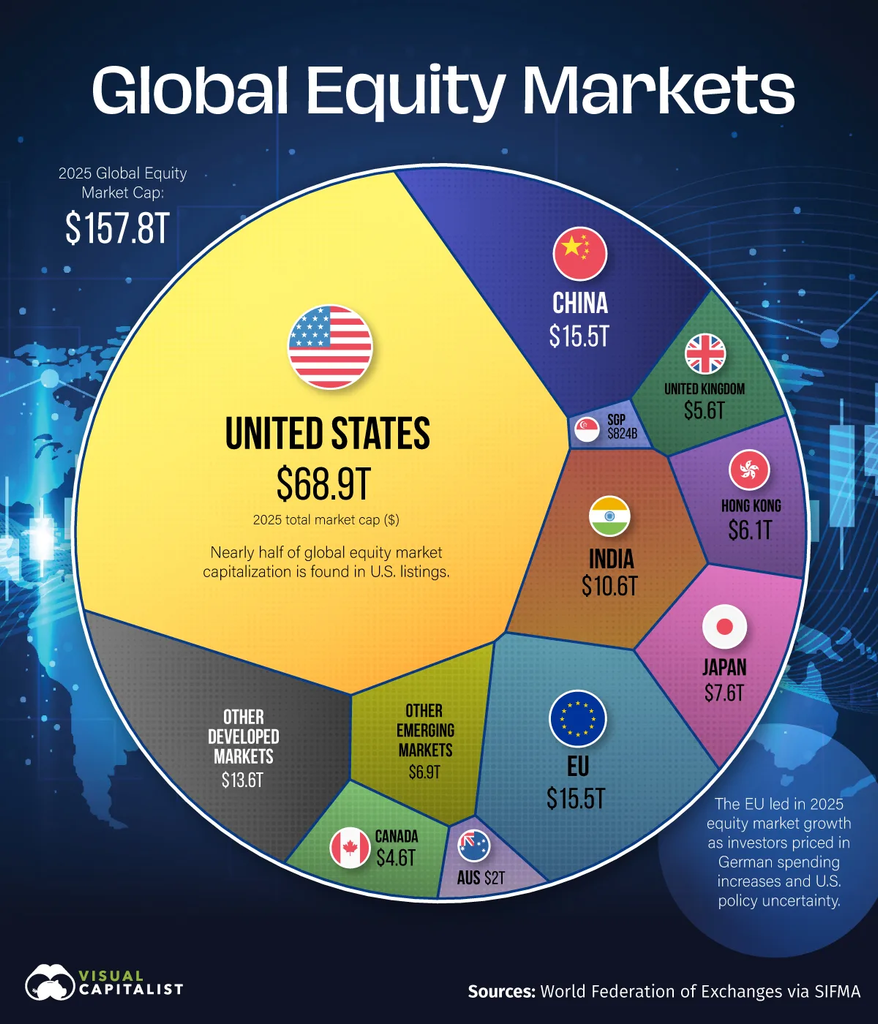
Global Market Snapshot
The global stock market has grown significantly.
At the end of 2025, global equity markets reached a record $157.8 trillion in market capitalization—more than $25 trillion higher than the previous year.
But the more interesting story isn’t simply how much the market has grown. It’s where that growth is happening—and how concentrated global wealth has become.
The U.S. remains in a league of its own.
U.S. Dominance vs. Global Opportunity
U.S.-listed companies now represent roughly 44% of the entire global stock market, with a combined market capitalization of $68.9 trillion. That’s more than four times the size of either China or the European Union individually.
And America’s dominance has actually increased.
Back in 2012, U.S. companies represented roughly one-third of global equity market capitalization. Today, that figure is closer to half.
Much of that growth has come from the extraordinary performance of America’s technology giants. Companies such as NVIDIA, Apple, Alphabet, and Microsoft have transformed not only the U.S. market, but the global distribution of market value.
That raises an interesting question:
If the U.S. already dominates global markets this much, where is the opportunity elsewhere?
Not Like U.S. …
The rest of the map isn’t empty, just smaller and more complicated. China and the EU are essentially tied at roughly $15.5 trillion each — enormous by any historical standard, and still less than a quarter of the U.S. market. China’s scale comes bundled with geopolitical risk and a property market still working through its problems; Europe’s re-rating — equities up nearly 40% year over year — rides on unusually specific catalysts, German spending chief among them, layered on an economy still weighted toward banks and industrials rather than platforms. India, at $10.6 trillion, is the one growth story that doesn’t need much interpreting: a huge population, an expanding middle class, and a growing role in global supply chains. And across Japan, Korea, Taiwan, and Singapore, the real story isn’t consumer AI at all — it’s the chips, the manufacturing, and the infrastructure sitting underneath it.
The Bigger Picture
The most striking takeaway from the chart isn’t simply that the global stock market has reached $158 trillion.
It is that market leadership continues to concentrate around innovation.
The U.S. has increased its share of global equity value by more than 10 percentage points since 2012, largely because investors believe innovative companies are formed there.
And that creates an interesting tension for investors.
On one hand, diversification matters. No country stays dominant forever, and concentrating too heavily in any single market creates its own risks.
On the other hand, diversification for its own sake isn’t necessarily a strategy. Capital tends to flow toward places where innovation, productivity, capital formation, and economic opportunity are strongest.
The challenge is figuring out whether today’s winners are experiencing a temporary boom … or participating in a much larger structural shift.
Takeaways for Investors
The global market isn’t a static pie. It is a constantly changing map of capital, innovation, and expectations.
The U.S. currently owns the largest piece by a wide margin. But beneath that headline are several competing stories: China’s enormous but uncertain market, Europe’s potential re-rating, India’s long-term rise, and Asia’s increasingly important role in the technology supply chain.
And then there is AI.
The AI boom is already influencing where capital flows, which companies command the highest valuations, and which countries are gaining market share. If AI continues to reshape productivity and corporate profitability, today’s market leaders could become even more dominant.
But technological revolutions rarely follow a straight line.
That is why investors shouldn’t simply ask, “Where is the market today?” Instead, “What would have to change for this picture to look completely different five or ten years from now?”
The good news is that the global opportunity set is enormous … and growing.
Perhaps you can’t reliably predict the future … but that doesn’t mean you can’t prepare for it reliably.
Leave a Reply