
The real AI question isn’t what it’s becoming. It’s what you’ve already handed it — and whether it earned the keys.
Years ago, a programmer brought me his work, and I told him it was wrong. He pushed back and reminded me that he was the one with the computer science and math degrees (and I’d only been running an AI company for thirty years). He confidently declared that he’d done the math right.
He had … but the answer was still wrong. Yes, he’d done the calculation perfectly; that was the easy part. The hidden wisdom lay in a distinction he didn’t consider … whether he used the right equation and data.
I think about that moment often now, because today’s AI has the exact quality that made his mistake so hard to catch: it’s fluent, polished, and supremely confident. And confidence is precisely what makes us stop checking.
The Quiet Handoff
Most leaders are busy debating what AI is — conscious, AGI, a partner, a threat, or even a deity. It’s an interesting debate. It’s also largely beside the point. The question that will actually shape your business is quieter: what authority have you already handed it?
Authority doesn’t transfer in one dramatic decision. It migrates. A system starts by drafting, then recommending, then deciding — and somewhere in there it stops being a tool you use and becomes the place the decision actually gets made. In our world, that isn’t one algorithm you can watch; it’s thousands, far more than any human can track in real time. You don’t notice the handoff. You notice the result.
Would You Promote It This Fast?
So I use what I call an AI Maturity Model, and it’s the same standard I’d apply to a person before trusting them with real responsibility. I want to see the process, not the answers. Does it look at and consider the right things? Can it tell good data from stale, dirty, or incomplete data (because bad data compounds into worse results)? Can it turn information into knowledge — first by bringing order to chaos, and then by making the finer distinctions that separate wisdom from raw horsepower? Can it rank and evaluate options, and does the ranking still hold when I change the goal? Can it make a real recommendation under pressure, and not just hand me what’s at the top of a list?
Here’s a simple graphic of the maturity model’s ascent.
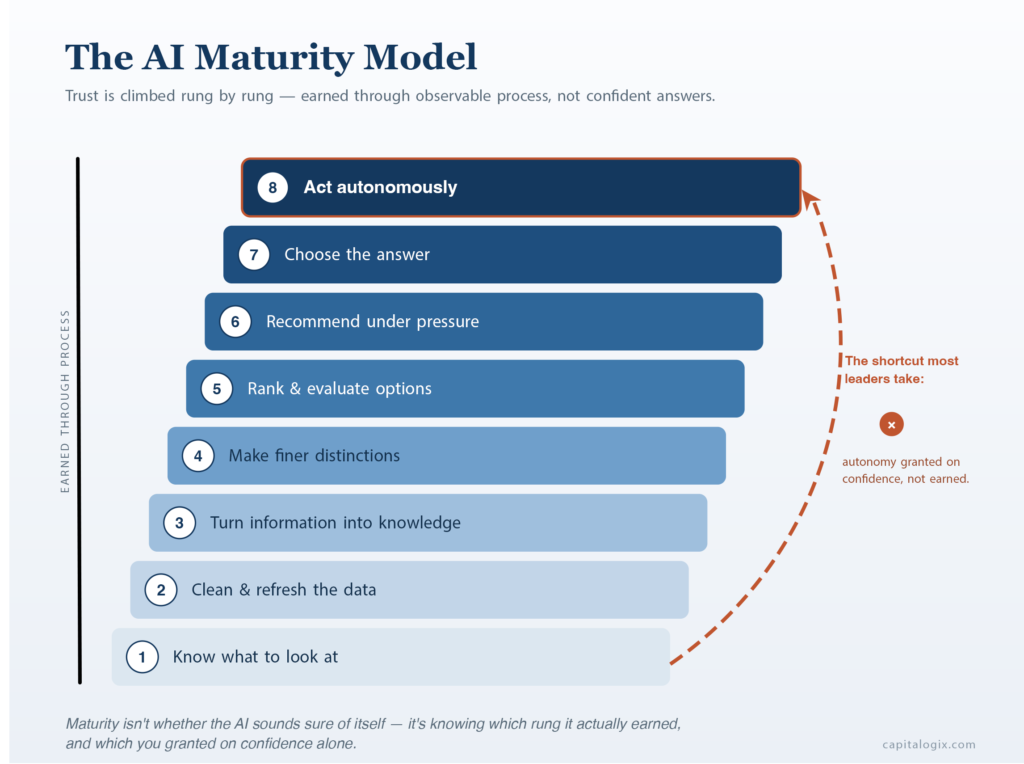
Only after a system shows me all of that — and shows me it’s still getting better — does it earn the right to act on its own.
Maturity isn’t whether the AI sounds sure of itself. It’s whether you granted autonomy at a rung it actually climbed, or one you handed over on confidence alone. Most over-delegation is exactly that: trusting the answer because it was stated well.
At scale, you can’t supervise your way to safety — there’s simply too much happening. So you do two things. You build sensors and feedback loops that flag when something drifts off track. And — this is the part most people skip — you plant failures on purpose. You feed the system things you know are wrong and confirm it catches them. Because if it misses the faults you buried, you can’t assume the rest is fine. Assume the opposite … a lot more is slipping through.
And when something is wrong, I audit the same three places I always have.
Long before AI, I knew that bad results traced back to people, processes, or data (or worse, a combination of those things). That hasn’t changed — except now “people” might be an agent, a swarm of them, or an orchestrated pipeline.
Even though the doer might have gone digital, owning the answer didn’t.
AI 101: When Not To Grab the Wheel
Here’s the part that took me longest to learn — and I’ll admit I learned it the hard way, in a business where a bad impulse costs real money. Once you’ve handed a system authority, the instinct is to reserve the right to grab the wheel the moment you get nervous. That instinct is usually wrong. The moment you most want to intervene is often the exact moment your intervention likely does the most damage (because what you’re bringing to it is fear, greed, and discretionary risk — the very things you built the system to remove).
The mature move isn’t to override on impulse. It’s to give yourself and your people enough visibility to stay oriented — to understand what’s happening and trust the direction (so you don’t panic and yank control at the worst possible time).
Human-in-the-loop is valuable, but it has to be organized, accounted for, and built into the framework (not simply the result of an emotional reaction).
Years ago, I built something I call “filtered relevance” around a simple fact: people can really only remember about seven things at once (think about a phone number, if you know the area code). The point was to show someone exactly where they were in a process and the few choices that actually mattered, so they stayed in genuine command instead of drowning. It’s the difference between falling off a cliff while trapped in a cardboard box and piloting a helicopter. Nobody governs well from inside a box with no visibility, agency, or control.
So the real maturity test of this era isn’t whether your machines are ready for more authority. It’s whether you are.
Do that well, and AI doesn’t drain you — it frees you up and gives you energy and momentum.
If using AI or automation leaves you exhausted, you’re probably guarding the wrong things.
Done right, delegation isn’t about replacing your judgment. It’s about clearing away everything that isn’t your judgment … giving you the space and resources to focus on what you want to happen.
So before you ask what AI is going to become, ask the questions that actually decide it: What have you already handed over? Did it earn that authority (or did you grant it on confidence)? And when it’s wrong, will you know where to look to set things right?
Onwards!
Leave a Reply