
Thoughts about the markets, automated trading algorithms, artificial intelligence, and lots of other stuff

  • Events & The Stock Exchange (1990 – 2018)

    We all understand that events affect the stock market. Predicting what events will affect the stock market is an entirely different beast. 

    Christian Spreafico put together an infographic website that tracks one key event per month, and that events effect on the monthly closure of the major stock exchanges. 

    Events are split into categories: Politics, War, Terrorism, Calamity, Economy, Sports. 

    At the top of the infographic, you can see the indexes' performance. Below, you can see the effect of the categories over time. 

    The infographic starts with the US invasion of Panama, and ends with the beginning of the Yellow Vests Movement (a political movement for economic justice in France. 

    Screen Shot 2020-02-07 at 2.13.27 PMvia Christian Spreafico

    It's fun to look through month-by-month and track the movement. 

    An interesting inflection point I found started in July of 2010. At this point, the effect of politics on the global indices was negative. Issues with the European Union and Obama's election both caused drops. Since 2010, the effect of politics on the economy has been staggeringly positive (excluding the December 2015 UN Climate Change Conference). 

    That includes a massive spike in the NYSE, NASDAQ, and TOKYO when Occupy Wall Street started in September of 2011.

    Interest aside, I struggle with sharing this infographic because it's a gross oversimplification of the various driving factors of both our economy and markets. The biggest event isn't the only event and we don't know on which metric Christian decided which event was the biggest. In other words, correlation doesn't prove causation.

    Nonetheless, if you don't take this too seriously, it's an interesting look back through time. 

    What caught your eye?

  • Mummy, I’ve Lost My Voice

    Some applications of technology are just … strange. That being said, I think there's something beautiful about science being done "just to see if we can". 

    Not every experiment needs to be in pursuit of some grand truth or miracle cure… Sometimes it's nice just to be curious. 

    In that regard, the researchers who recreated a 3,000-Year-Old Egyptian mummy's voice might "take the cake" (or "drop the mic"). 


    41598_2019_56316_Fig1_HTMLNature via Leeds Teaching Hospitals (Click To Learn More)

    The mummy's name is Nesyamun. They used a 3D printer and an electronic larynx to create the sound. They didn't recreate his tongue – so his voice doesn't take that into account. From what I can tell, all they've gotten "him" to say is "ehh". Very mummy-like. 

    Here's a link to the sound. 

    For what it's worth, they did test this methodology on a living human to validate it before going to some 3000-year-old dead guy.

    Here's an interview with one of the scientists on BBC's Inside Science. 

  • On Ambient Computing and Privacy

    I like to think of myself as on top of technology trends – but I heard a new term recently. 

    Ambient Computing represents the ubiquitous computing reality we're transitioning toward: Sensors, displays, etc. embedded throughout the world. If you think about Smart Homes, or the Internet Of Things, these are building blocks for ambient computing. 

    We've already seen some early examples of this technology gaining adoption – and it's developing fast. 

    I flip-flop between excitement about the cornucopia of useful applications and fear of the safety and privacy concerns these technologies will inevitably create … or have already created.


    Screen Shot 2020-01-24 at 3.00.56 PMJames O'Malley via Twitter

    A couple of weeks ago, I talked about the surveillance state – and how many cameras different places now have (Spoiler Alert: China has a ridiculous number). That, paired with facial recognition technologies, means that ubiquitous technology has "interesting" consequences. 

    It's hard to imagine a country like China not abusing that technology, but it's also hard to imagine the US not abusing that technology. The temptation is too high. An example being the repeated requests by the US government for backdoor access into iPhones.  

    It's a slippery slope, and unfortunately, the few often ruin a technology for the many. I err on the side of protecting the many from the few, but it's up to you to decide where your comfort level with lack of privacy is. 

    To a certain extent, privacy is now a fallacy (or at least it doesn't mean what it used to mean)… but that doesn't mean you shouldn't try to protect what privacy you have left.

  • Gong Xi Fa Cai!

    Chinese New Year happened this weekend.

    So, Gong Xi Fa Cai … which translates to "Best wishes for a prosperous New Year!"

    I went to Indonesia to celebrate with Jennifer's side of the family in Jakarta.

    It was nice to see her parents.


    82447150_10157016459478321_4113650690344091648_o


    Here's a picture of the immediate family at this year's gathering. Quite a group. 


    83516451_10157016459393321_5439261474029568000_o


    It's interesting to think about how many New Year celebrations there are.  In addition to Chinese New Year, the Muslims have Hari Raya Idul Fitri; Jews have Rosh Hashanah; of course, there is January 1st (and there are many others).

    Which is correct?  I think the answer is all of them. Regardless of your chosen New Year, it provides an opportunity to celebrate, share, reflect, plan, and commit to the right actions.

    As I think about it, the same principle applies to trading. It's all a matter of perspective.

    At some level, there really isn't a correct answer as to which trading style is best. The best style is the one that works. Trading styles go in and out of phase, and if you get too attached to the style of trading, you get detached from profit.  As any experienced trader can tell you, edges decay, people catch on, trends change.

    It is a lot easier to go to a party when there is a party to go to… The trick is finding the celebration in the first place.

  • Super Bowl 2020

    A friend has two tickets for the 2020 SUPER BOWL — both box seats. He paid $2,500 for each ticket, but didn't realize last year when he bought them that it was going to be on the same day as his wedding. If you are interested, he is looking for someone to take his place — it’s at St. Dominic's Church in San Francisco at 3pm. Her name is Melissa . She's 5'7 about 140 lbs. She's a good cook, too. She'll be the one in the white dress.
     
    As for the Super Bowl, it seems like this will be a good matchup. The KC Chiefs are in it for the first time in 50 years (and have an amazing offense), while the 49ers are coming off a series of tough seasons (but have an amazing defense). It will also be a Super Bowl without Bill Belichick's scowl gracing our screens. 
    It's not just the fans that are excited about the matchup, it's also the bookies. Two years ago, gamblers set a record by placing $158.6 million in Super Bowl bets. Expect more of the same with gambling now legalized in an additional 13 states beyond Nevada. 
     
    If you're still looking for a bet – there's another wishful thinking approach you could take to find one … it is called the "Super Bowl Indicator."
     

    Patrick-mahomes-chiefs


    The theory is that a Super Bowl win for a team from the AFC foretells a decline in the stock market and a win for the NFC means the stock market will rise in the coming year. So, if you're hoping for a strong S&P you'd be rooting for 49ers. 

    There's one big caveat … it counts the Pittsburgh Steelers as NFC because that's where they got their start (or as a data scientist would caution … they did that to fit the data better). 

    With that "adjustment," at one point the SBI was "right" 33 years out of 41 – an 80% success rate. Sounds good, right?

    Come on … you know better. It's been wrong four of the last four years … another sign of spurious correlation if you weren't sure. 

    Here are some other "fun" stock market fallacies:


    Back to Reality

    Rationally, we understand that football and the stock market have little in common, and we probably intuitively understand that correlation ≠ causation. Yet, we crave order and look for signs that make markets seem a little bit more predictable.

    The problem with randomness is that it can appear meaningful. 

    Wall Street is, unfortunately, inundated with theories that attempt to predict the performance of the stock market and the economy. The only difference between this and other theories is that we openly recognize the ridiculousness of this indicator. More people than you would hope, or guess,  attempt to forecast the market based on gut, ancient wisdom, and prayers.

    While hope and prayer are good things … they aren’t good trading strategies.

    As goofy as it sounds, some of these "far-fetched" theories perform better than professional money managers with immense capital, research teams, and decades of experience…

    I have a thought experiment I sometimes ask people. 

    What percentage of active managers beat the S&P 500 any given year?

    … Now, what percentage beat the S&P 500 over 15 years?

    Recently, the answer is about 5% (and that's in a predominantly bull market).  For the record, that's significantly worse than chance. Perhaps that means something they're doing is hurting, not helping. 


    6a00e5502e47b28833022ad3bb6fb9200d
     via Gaping Void

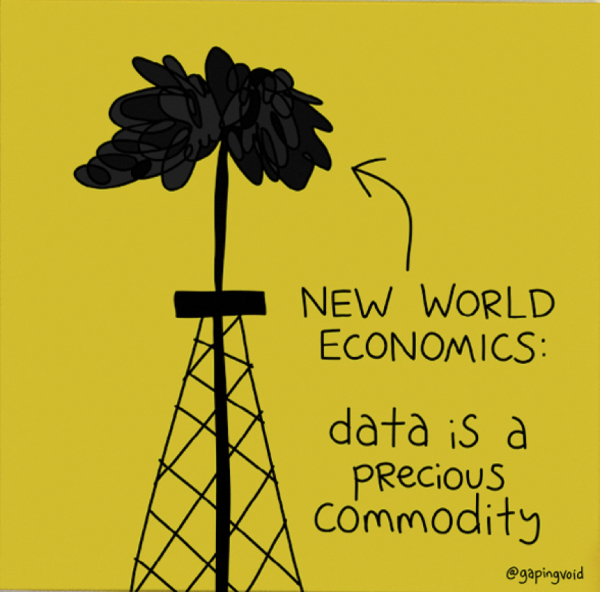
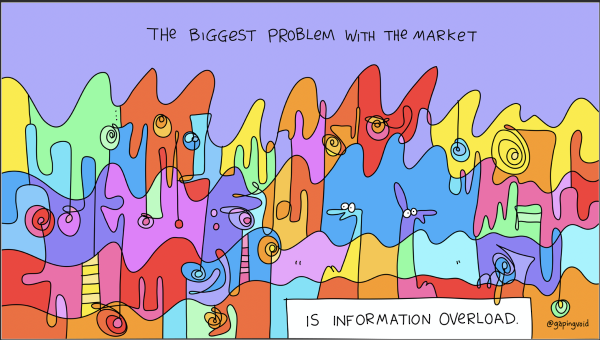
    There's simply too much information out there for us to digest, process, rank, and use appropriately.

    Every second you spend looking at a market is a second wasted.

    There are people beating the markets — not by using the Super Bowl Indicator … they're doing it with more algorithms and better technology. 

    There will never be less data or slower markets. A good reminder that if you don't know what your edge is … you don't have one!

    Onwards.

  • The Most Hyped Technologies of The 2000s

    The Hype Cycle provides the raw material for some of my favorite posts every year.

    In general, as technology advances, it is human nature to get excited about the possibilities and to get disappointed when those expectations aren't met. 

    At its core, the Hype Cycle tells us where in the product's timeline we are, and how long it will take the technology to hit maturity. It attempts to tell us which technologies will survive the hype and have the potential to become a part of our daily life. 

    Gartner's Hype Cycle Report is one of my favorites.  It is a considered analysis of market excitement, maturity, and the benefit of various technologies.  It aggregates data and distills more than 2,000 technologies into a succinct and contextually understandable snapshot of where various emerging technologies sit in their hype cycle.

    Here are the five regions of Gartner's Hype Cycle framework:

    1. Innovation Trigger (potential technology breakthrough kicks off),
    2. Peak of Inflated Expectations (Success stories through early publicity),
    3. Trough of Disillusionment (waning interest),
    4. Slope of Enlightenment (2nd & 3rd generation products appear), and
    5. Plateau of Productivity (Mainstream adoption starts). 

    Understanding this hype cycle framework enables you to ask important questions like "How will these technologies impact my business?" and  "Which technologies can I trust to stay relevant in 5 years?"

    Another methodology uses frequency analysis to identify the "most hyped" concepts and technologies.  

    VisualCapitalist recently put together an infographic highlighting the most hyped technologies of each year. They call it the "Peak of Inflated Expectations".

     Screen Shot 2020-01-17 at 4.03.00 PM 2(Click To See Full Infographic) via VisualCapitalist

    Here's a Summary of the most hyped technologies, by year, since 2000.

    • 2000 – Wireless Web, ASPs, Bluetooth
    • 2001 – Web Services, Enterprise IM, m-Commerce
    • 2002 – Biometrics, Grid Computing
    • 2003 – Process Portals
    • 2004 – Micro Portals, Virtual Content Repositories
    • 2005 – P2P VOIP, Biometric ID Documents, BPM Suites
    • 2006 – Mashup, Web 2.0 
    • 2007 – Legal P2P, Digital Video Broadcasting
    • 2008 – Green IT
    • 2009 – Cloud Computing, e-Book Readers, Social Software Suites
    • 2010 – 4G Standard, Activity Streams
    • 2011 – Internet TV, NFC Payment, Augmented Reality
    • 2012 – BYOD, 3D Printing, Complex Event Processing
    • 2013 – Big Data, Gamification, Wearable User Interfaces
    • 2014 – IoT, Natural-Language Question Answering, Cryptocurrencies
    • 2015 – Speech-To-Speech Translation, Advanced Analytics, Autonomous Vehicles
    • 2016 – Blockchain, Cognitive Expert Advisors, Machine Learning
    • 2017 – Virtual Assistants, Connected Home, Deep Learning
    • 2018 – Biochips, Digital Twin, Deep Neural Networks
    • 2019* – 5G, AI PaaS, Graph Analytics
      *Missing from the infographic, but updated by Gartner

    As we take our smartphones for granted, it's hard to imagine bluetooth, wireless web, or e-book readers as emerging technologies at this point – but at a time, the lightbulb was an emerging technology. 

    It's also interesting to look at which technologies peaked in a hype cycle, or which now popular technologies don't show up on this list. Despite Virtual Reality being around since the 80's, I expected to see it on this list. 

    Cryptocurrencies, "smart homes", and several older examples are fizzling or burnt out – but that doesn't mean they won't have resurgences. 

    As a reminder, the hype cycle and the innovation/adoption cycle are often on very different time scales. It's very possible that technologies from the early 2000s may still have their heyday. 

    What are you surprised wasn't on the list? And, what do you think is about to get added?

  • Autonomous Lyft – Waymo

    I went to a conference in Phoenix with my son Zach last week.  While there, he noticed something interesting … Lyft is testing Alphabet's Waymo autonomous driving service live on the streets.

    Regardless of concerns about the future of the gig economy – this is a glimpse into our not-to-distant future.  

    Here's what they say about it.

    IMG_1454

    I had to leave early to catch a flight, so my son decided to use Lyft to get around.  He accepted the Waymo terms, but didn't get a Waymo vehicle. Still, I thought this was cool.


    IMG_1459

    There will likely soon be a tipping point where autonomous vehicles proliferate.  Even though we are not "there" yet … the progress is obvious and the "quickening" is happening. 

    Meanwhile, examples of innovation and exponential technology successes and adoption are all around us. 

    The future is getting closer. 

    Onwards.