Thoughts about the markets, automated trading algorithms, artificial intelligence, and lots of other stuff

  • Happy Mother’s Day

     To those of you with young children, here's a peek into your future.A37b6a9dd32e9ed1bc3a2d0797fa492b

    After years of hard work and your best efforts (OK, mostly your best efforts) … I predict that your adorable bundles of joy will someday wish they could send you this card.

    So, take a moment to think about your Mom … and remember that she was very young when she did those things to you …

    … and what you make them mean is up to you.

    Here's a funny clip from SNL in honor of Mother's Day.


    via SNL

    Hope you celebrated all the important mothers in your life. And, to the mothers, I hope the people around you recognize how much you sacrificed for them. 

    Happy Mother's Day. 

  • Exposure To The Blockchain

    A few months ago, I mentioned that the level of discussion around cryptocurrency and blockchain was developing. People are beginning to think about secondary and tertiary value propositions. The elevated conversations even made me think about repurposing some of our underutilized hardware in our server room for some crypto-related purposes.

    While I'm still skeptical about any given currency, I believe strongly in the blockchain. Trust has been eroded. We've lost trust in our media, in big tech, and in the banks.  As a result, the blockchain economy will become more ubiquitous.

    Blockchain is radically changing the future of transaction-based industries. Industry leaders are fervently evaluating and exploring blockchain to determine its potential for disruption and to create a long-term strategic advantage over their competitors.  

    Blockchain is disruptive because of its ability to digitize, decentralize, and secure the validation of "transactions."  Everywhere there's a hand-off of information or goods, blockchain has the opportunity to improve that process. To not only make it safer but more efficient. 

    Imagine being able to see the entire history of a property … and know it's accurate. Not just for the property, but the land, the air rights, land rights, and more. Imagine being able to track individual shipments globally through your supply chain with ease. Imagine being able to enter/exit countries without the elongated passport check-ins or the need for a new currency.

    The list goes on … Aviation, Big Pharma, Manufacturing, Finance, SaaS … In the same way that artificial intelligence is transforming what's done by humans and what's done by machines, the blockchain is transforming security and how we transfer data. If data is the new currency, blockchain is the banking system. 

    Blockchain enables transparency and accountability on a radically bigger scale. 

    Here are two charts that talk about the evolution of crypto and blockchain … and various ways you can get involved. 

    The first is a new graphic put together by MSCI on the rising Blockchain economy.

    Blockchain economyMSCI via visualcapitalist

    It talks about the rise in crypto volume, the new trends coming to Bitcoin, and more. 

    The second is a very simple chart that I first shared in 2018. It shows the non-financial uses of Blockchain. 

    1_bTiqPvb975TdbD6bJr6ovw

    NewCoShift via Crowd Companies


    I've said this before, but it's worth echoing …  Some of what was once Impossible becomes Possible.  Some of what became Possible becomes Probable. And, and some of what became Probable becomes Inevitable.

    Blockchain is happening.  Technological shifts,  like this, require you to think about your industry and your potential opportunity differently.

    Change is happening faster (and creating bigger edges) than ever before. 

    What a great time to be an entrepreneur!

    Seize the Edge!

    Onwards.


  • How Tech Giants Make Their Money

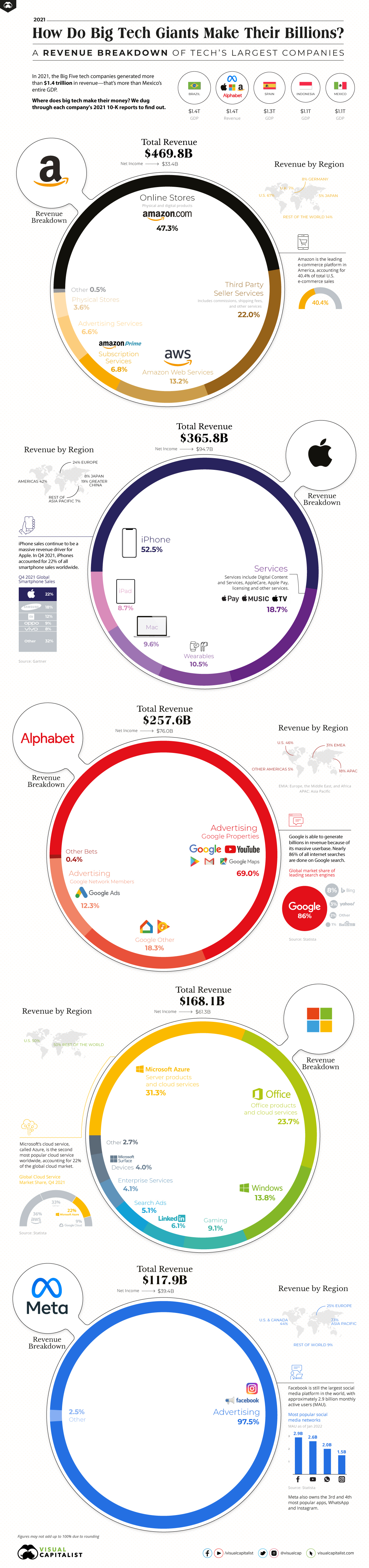
    In 2021, the Big Five – Alphabet (Google), Amazon, Apple, Meta (Facebook), and Microsoft – generated over $1.4 trillion in revenue.

    How did they generate that revenue? We know they sell products … but we also know that we're often the product they sell. 

    Google and Facebook each make a lot of money selling you (or data about you) to advertisers. 

    The image below shows how Alphabet generated its revenue.   The full infographic shows that breakdown for each of the Big Five.

    Screen Shot 2022-05-01 at 3.49.00 PMClick to view the other companies via visualcapitalist

    Apple, Amazon, and Microsoft, primarily sell products (like more traditional businesses). On the other hand, almost 98% of Meta's revenue (and 81% of Google's revenue) comes from advertising. 

    Unsurprisingly, all five companies saw significant growth during the pandemic. 

    Though the economy shrank in the past two years, societal changes continued to push demand for big tech's products and services. 

    Will growth continue or slow down? 

    I'm curious what you think.

  • How I Got Started In Artificial Intelligence

    Recently, I've had several people ask about how I got into AI. 

    There are a couple of different answers, but I shot a video to go through the main points. 


    Click here for a transcript

    You could argue that I got my start in AI with my most recent company – Capitalogix – which started almost 20 years ago. You could also say that my previous company – IntellAgent Control – was an early AI company, and that's where I got my start.  By today's standards, the technology we used back then was too simple to call AI … but at the time, we were on the cutting edge.

    You could go further back and say it started when I became the first lawyer in my firm to use a computer, and I fell in love with technology. 

    As I look back, I've spent my whole life on this path.  My fascination with making better decisions, taking smarter actions, and a commitment to getting better results probably started when I was two years old (because of the incident discussed in the video).

    Ultimately, the starting point is irrelevant. Looking back, it seems inevitable. The decisions I made, the people I met, and my experiences … they all led me here.

    However, at any point in the journey, if you asked, "Is this where you thought you'd end up?" I doubt that I'd have said yes. 

    I've always been fascinated by what makes people successful and how to become more efficient and effective. In a sense, that's what AI does. It's a capability amplifier. 

    When I switched from being a corporate securities lawyer to an entrepreneur, I intended to go down that path. 

    Artificial Intelligence happened to be the best vehicle I found to do that. It made sense then, and it makes sense now.

    I wouldn't have it any other way. 

    Onwards!

  • A Few Graphs On The State Of AI

    Every year, Stanford puts out an AI Index with a massive amount of data attempting to sum up the current state of AI. 

    It's 190 pages that detail where research is going and covers current specs, ethics, policy, and more. 

    It is super nerdy … yet, it's probably worth a skim. 

    Here are a few things that caught my eye and might help set some high-level context for you. 

    Investments In AI 
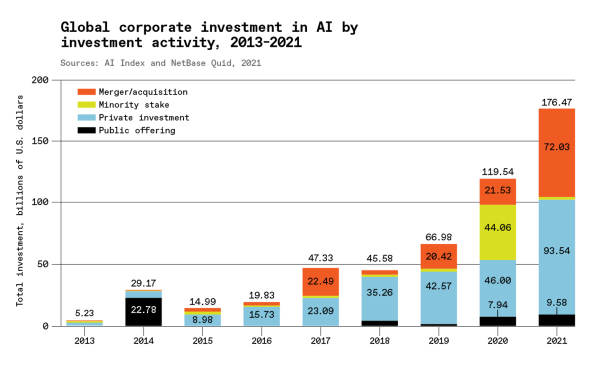
    A-bar-chart-of-global-corporate-investment-in-ai-by-investment-activity-2013-2021


    via AI Index 2022

    In 2021, private investments in AI totaled over $93 billion – which was double the investments made in 2020. However, fewer companies received investments. The number of companies receiving funding dropped from 1051 in 2019 to 746 in 2021.

    At extremes, putting greater resources in fewer hands increases the danger of monopolies.  But we are early in the game, and it is safe to interpret this consolidation as separating the wheat from the chaff. As these companies become more mature, you're seeing a drop-off similar to when the web began its exponential growth. 

    With investment increasing, and the number of companies consolidating, you can expect to see massive improvements in the state of AI over the next few years.

    We knew that already – but following the money is a great way to identify a trend. 

    Increased regulation is another trend you should expect as AI matures and proliferates.

    Ethical AI 

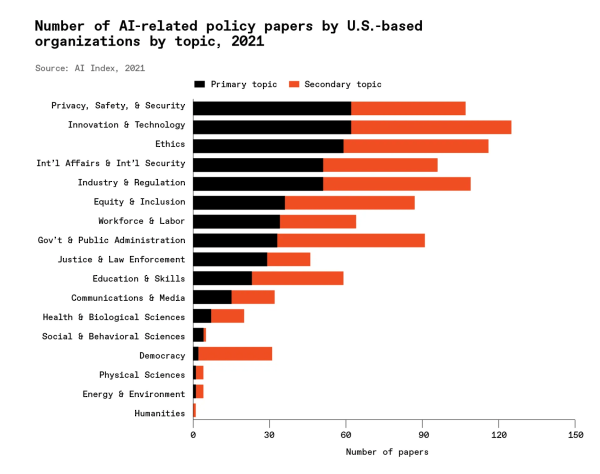
    A-chart-showing-number-of-ai-related-bills-passed-into-law-in-25-select-countries-2016-2021 A-chart-showing-number-of-ai-related-policy-papers-by-u-s-based-organizations-by-topic-2021

    via AI Index 2022

    Research on the ethics of AI is becoming much more widespread – while the research influences papers, it is also a catalyst for new laws.

    AI's academic and philosophical implications are being taken much more seriously across the board. Many people recognize that AI has the potential to impact the world in unprecedented ways.  As a result, its promise and peril are under constant scrutiny.

    The adoption of AI might seem slow … but like electricity (or the internet), it only seems slow until it's suddenly ubiquitous.

    As you find AI in more domains, the ethics of its use becomes a more pressing concern. There is a lot of potential for abuse of technologies like facial recognition and deepfakes.  Likewise, people worry about mistakes, judgment, and who's liable for errors in technologies like self-driving cars.

    Luckily, you have many of the world's greatest minds working on the subject – including the Hastings Center.  

    Many factors contribute to the speed of AI's maturation and adoption.  Here are three of the obvious reasons. First, hardware and software are getting better.  Second, we have access to more and better data than ever before.  And third, more people are actively seeking to leverage these capabilities for their benefit.

    Technical ImprovementsScreen Shot 2022-03-31 at 2.01.17 PM
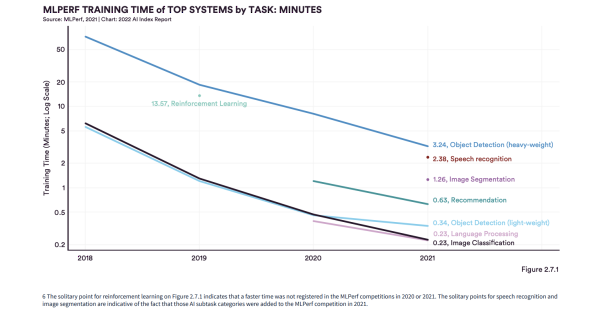
    via AI Index 2022

    Top-performing hardware systems can reach baseline levels of performance in task categories like recommendation, light-weight objection detection, image classification, and language processing in under a minute.

    Not only that, but the cost to train systems is also decreasing. By one measure, training costs for image classification systems have dropped by a factor of 223 since 2017. 

    When people think of advancements in AI, they often think of the humanization of technology. While that may eventually happen, most of the progress in AI comes from more practical improvements and applications. Think of these as discrete capabilities (like individual Lego blocks) that help you do something better than before.  These capabilities are easily stacked to create prototypes that do more.  Prototypes mature into products when the capabilities are robust and reliable enough to allow new users to achieve desired results.  The next stage happens when the capabilities mature to the point that people use them as the foundation or platform to do a whole new class of things.

    We're past the trough of disillusionment and are on the slope to enlightenment.

    Practical use cases abound.  Meaning, these technologies aren't only for giant companies anymore.

    AI is ready for you to use.

    If I think of a seasonal metaphor, it is "springtime" for AI (a time of rapid growth).  But not for you unless you plant the seeds, water them, and start to build your capabilities to understand and use what sprouts.

    As a reminder, it isn't really about the AI … it is about understanding the results you want, the competitive advantages you need, and the data you're feeding it (or getting from it) so that you know whether something is working.

    You've probably heard the phrase "garbage-in-garbage-out."  This is especially true with AI. Top results across technical benchmarks have increasingly relied on extra training data for combinatorial and dimensional reasons. Another reason this is important is to compound insights to continue learning and growing.  As of 2021, 9 state-of-the-art AI systems out of the 10 benchmarks in this report are trained with extra data. 

    To read more of my thoughts about these topics, you can check out this article on data and this article on alternative datasets

    Conclusion

    Artificial Intelligence capabilities are becoming much more robust and more able to transfer their learnings to new domains. They're taking in broader data sets and producing better results (while taking less investment to do so). 

    It isn't a question of "If" … it is a question of "when." 

    AI is exciting and inevitable!

    Let me know if you have questions or comments.

  • Spring and Rebirth

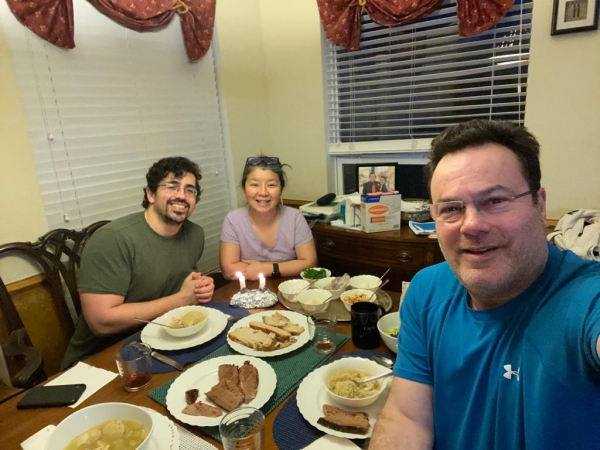
    For Jews, Friday was the first night of Passover, a family-centric holiday that recounts the biblical story of the Exodus of the ancient Israelites from Egypt into the Promised Land. For me, it's a reminder to appreciate what we have – and how we stand on the shoulders of those who came before us. 

    6a00e5502e47b288330263e999fff2200b-600wi

    For Christians, today is Easter – the holiday honoring Jesus's resurrection. 

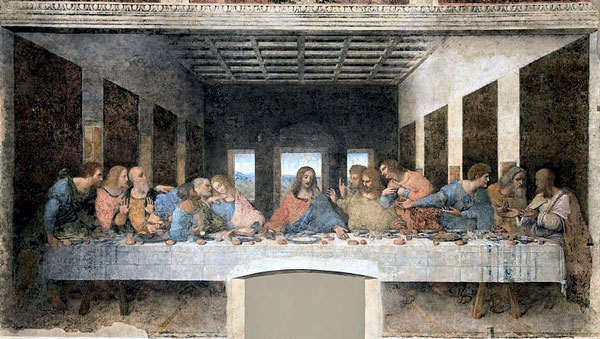
    The overlap can be seen in DaVinci's Last Supper, a Passover Seder, and Jesus's last meal before his Crucifixion.  

    6a00e5502e47b288330240a454f862200c-600wi

    For Jews, a notable part of the ritual dinner is recounting each of the ten plagues inflicted upon Biblical Egypt and saying, "Never again."

    Last year, I joked that maybe COVID-19 should be added to the list. 

    And, just like the Jews making it through slavery, the plagues, and 40 years wandering through the wilderness and desert before entering the Promised Land … We are finally approaching the promise of life post-COVID.

    Of course, other global events remind us that while the world and our capabilities continue to improve and expand … human nature stays maddeningly the same.

    With the coming of spring, the return to normalcy, and the reminders from the stories of Exodus and Easter - it's a great time to do a mental and physical "spring cleaning". Mine your experiences for the things you want to keep doing (or continue not doing) as things go back to "normal".  

    Hope you celebrated with family, food, and a reverence for all the blessings around you. 

  • Global Happiness Levels in 2022

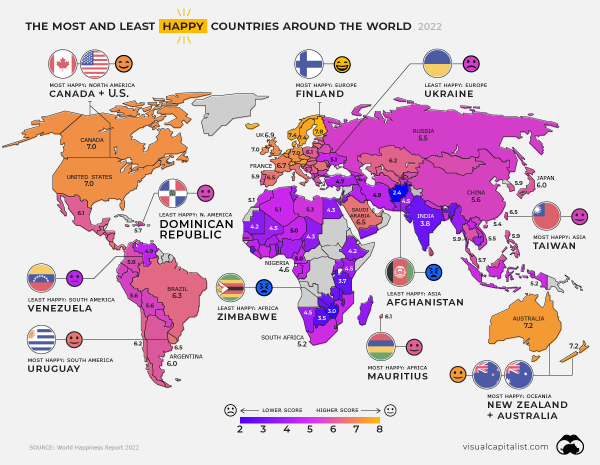
    Happiness is a complex concept comprised of conditions that highlight positive emotions over negative ones – bolstered by the support of comfort, freedom, wealth, and other things people aspire to experience. 

    Regardless of how hard it is to describe (let alone quantify) … humans strive for happiness.

    Likewise, it is hard to imagine a well-balanced and objective "Happiness Report" because so much of the data required to compile it seems subjective and requires self-reporting. 

    Nonetheless, the World Happiness Report takes an annual look at quantifiable factors (like health, wealth, GDP, and life expectancy) and more intangible factors (like social support, generosity, emotions, and perceptions of local government and businesses).  Click the image below to view the Report.

    OC_GlobalHappiness_Main-1via visualcapitalist

    In their 2021 report, there was a significant focus on the effect of COVID-19 on happiness levels and mental health. Much of that continued into the 2022 report. 

    As you might expect, the pandemic caused a significant increase in negative emotions reported. Specifically, there were substantial increases in reports of worry and sadness across the ninety-five countries surveyed.  The decline in mental health was higher in groups prone to disenfranchisement or other particular challenges – e.g., women, young people, and poorer people. 

    It is remarkable how resilient and stable the scores have been globally considering the amount of uncertainty, stress, and disruption households experienced this past year.

    Ultimately, humans persevered in the face of economic insecurity, anxiety, and challenges to mental and physical health. 

    This year, the average score improved slightly compared to 2021 – though worry and stress have continued to rise. 

    There has been a decrease in overall happiness compared to pre-pandemic scores.  Yet, the relative balance demonstrated in the face of such adversity may point towards the existence of a hedonic treadmill – or a set-point of happiness.

    Regardless of the circumstances, people can focus on what they choose, define what it means to them, and choose their actions.

    I'm still surprised by what people can get used to … and how some people find pockets of joy in even the hardest of times.  Conversely, other people use the same ability to feel profound unhappiness, even when they have seemingly everything. 

    It's an oddly beautiful reminder that happiness comes from within.

    Another bright spot, worth mentioning, has been the massive global upsurge in benevolence. People are supporting others, communities have stepped up, more money is being donated to charity, and more people are volunteering. 

    Onwards!