What do you do when your wife and kids are out of town, and you find yourself alone?
Besides catching-up on projects that I somehow avoided until now, I like to watch movies.
TiVo now links to Netflix,
and provides an instant viewing option. Upon opening that folder on the DVR, I saw a
bunch of things I normally wouldn't choose to watch on my own. One of them
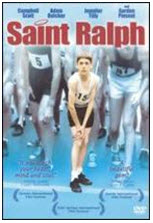
was a movie called Saint Ralph. And I chose to watch it anyway.
My Dad had an "interesting" belief. He didn't watch scary or negative movies, because he felt that life was enough of a challenge on its own … and it was better to find things that raised our spirits. Well, I inherited that from him.
Don't get me wrong, I still I love drama and thrillers. But in the absence of compelling circumstances, I tend to prefer positive stories.
So a plot about a down-on-his luck Catholic High School student whose father is dead and whose mother is in a coma, doesn't sound like my type of movie.
But Saint Ralph was my type of movie. It made me think and I enjoyed it. The movie was lighter, funnier, and better than I expected.
On one level, it's a coming-of-age story about perseverance and faith through uncertain times. On another level, it's a well-written comedy about a quirky 14-year-old boy who gets it in his head that the only way to
save his mother is through a miracle (and the miracle he thinks will
save her … is for him to win the Boston Marathon).
It is a movie that asks, if you're going to dream for something, why not dream for miracles?
I was in Columbus Ohio last week for a series of meetings and strategic planning sessions.
I love getting away from the business in order to work on the
business. That means stepping back from day-to-day issues, to look at
the bigger picture. It also means getting back in-touch with goals and
intent.
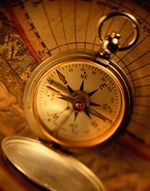
In a sense, the process acts like a compass, which sets the general direction for the journey.
In addition, preparing for a series of meetings, like this, is a lot like working on a business plan.
Personally, I've found that that one of the primary benefits of
creating a business plan has almost nothing to do with the plan itself.
Working on the plan, immersing yourself in the ideas and possibilities,
and ultimately choosing what stays-in, versus what's filtered out …
there is magic in that.
Yes, the plan is important. But it is the planning that takes you from thinking … to feeling … to knowing. That's where the real benefit of business planning comes from.
A Good Sign.
Sometimes you hear a question and it takes the air out of an idea.
Other times a question helps you make a new distinction or consider an
alternate and better course of action.
At our planning sessions, last week, there was a lot of those
pushing, pulling, probing, and deep thought … yet it built momentum.
So, I felt like we were on the right track.
How to Tell You Are On the Right Track.
I
tend to be analytical. Yet, over time, I've come to believe that one
of the best tools to measure whether you are on the right track is how
you feel.
Have you ever gotten a phone call from someone, and when you saw or heard that it was from them, you wilted? In
contrast, have you ever become more animated and energized while
interacting with someone else? It is easy to recognize the difference.
Each person has different thoughts, people, or situations that trigger these positive and negative states.
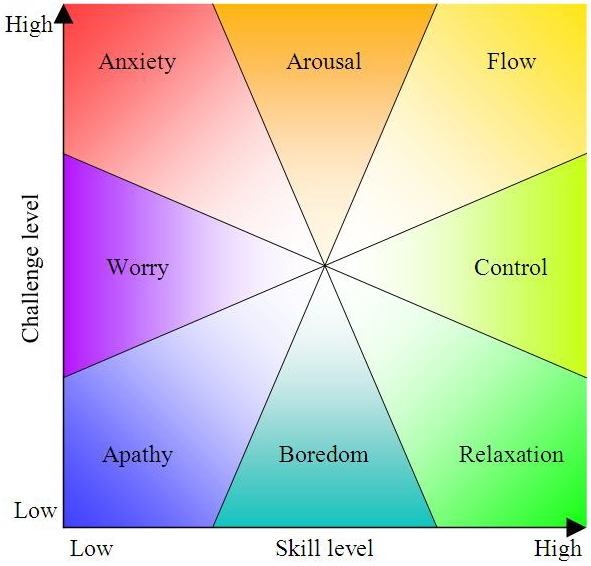
In sports, this positive state is often referred to as being "in-the-Zone". It is also called "Flow".
It happens when someone is fully immersed in what they are doing, and
has a feeling of energized focus or awareness, full involvement, and
success in the process of their activity.
Being in Flow feels good. On some level, when you are in Flow, you know you're on the right track.
I was in Columbus Ohio last week for a series of meetings and strategic planning sessions.
I love getting away from the business in order to work on the
business. That means stepping back from day-to-day issues, to look at
the bigger picture. It also means getting back in-touch with goals and
intent.
In a sense, the process acts like a compass, which sets the general direction for the journey.
In addition, preparing for a series of meetings, like this, is a lot like working on a business plan.
Personally, I've found that that one of the primary benefits of
creating a business plan has almost nothing to do with the plan itself.
Working on the plan, immersing yourself in the ideas and possibilities,
and ultimately choosing what stays-in, versus what's filtered out …
there is magic in that.
Yes, the plan is important. But it is the planning that takes you from thinking … to feeling … to knowing. That's where the real benefit of business planning comes from.
A Good Sign.
Sometimes you hear a question and it takes the air out of an idea.
Other times a question helps you make a new distinction or consider an
alternate and better course of action.
At our planning sessions, last week, there was a lot of those
pushing, pulling, probing, and deep thought … yet it built momentum.
So, I felt like we were on the right track.
How to Tell You Are On the Right Track.
I
tend to be analytical. Yet, over time, I've come to believe that one
of the best tools to measure whether you are on the right track is how
you feel.
Have you ever gotten a phone call from someone, and when you saw or heard that it was from them, you wilted? In
contrast, have you ever become more animated and energized while
interacting with someone else? It is easy to recognize the difference.
Each person has different thoughts, people, or situations that trigger these positive and negative states.
In sports, this positive state is often referred to as being "in-the-Zone". It is also called "Flow".
It happens when someone is fully immersed in what they are doing, and
has a feeling of energized focus or awareness, full involvement, and
success in the process of their activity.
Being in Flow feels good. On some level, when you are in Flow, you know you're on the right track.
Another grim report on unemployment casts doubt on the likelihood of a quick economic recovery.
The unemployment rate edged up to 9.5 percent in June, to its highest level in 26 years. The bigger problem is that many analysts expect joblessness to get worse in the coming months.
A Different Perspective on the Job Market:
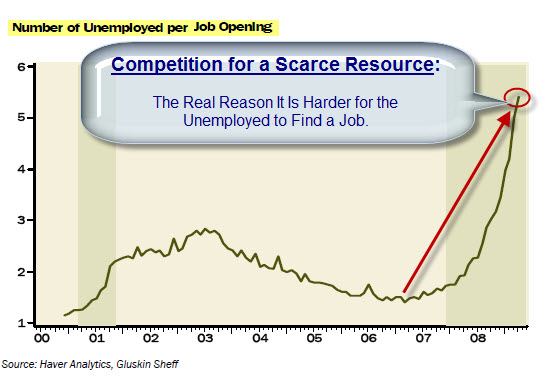
Here is a chart that caught my eye on Barry Ritholtz's blog. It shows the increased competition for jobs. There are now close to six unemployed people for each available position.
The point is that as fewer jobs become available, it will get harder for normal citizens to obtain them. The cycle continues because loss of jobs means reduced spending … which means tighter margins.
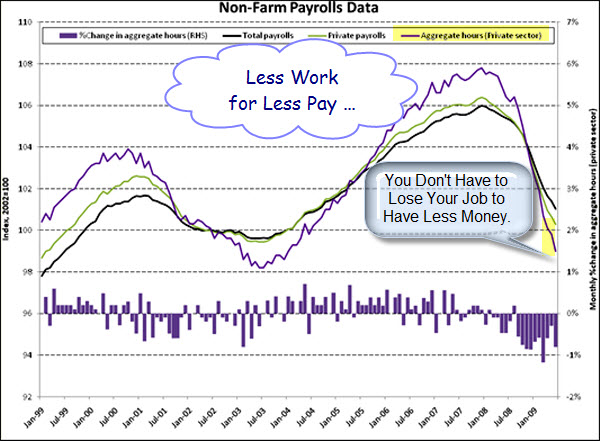
So, this next chart doesn't surprise me. It shows that in addition to an increase in unemployment, there was also a decrease in hours worked. Simply counting the number of people who lost their jobs misses something important. Lots of people have lost part of their jobs through a variety of techniques like furloughs and thirty-hour work weeks.
Notice how consistent the decline in aggregate hours worked (purple line) has been over recent months. It is something to watch.
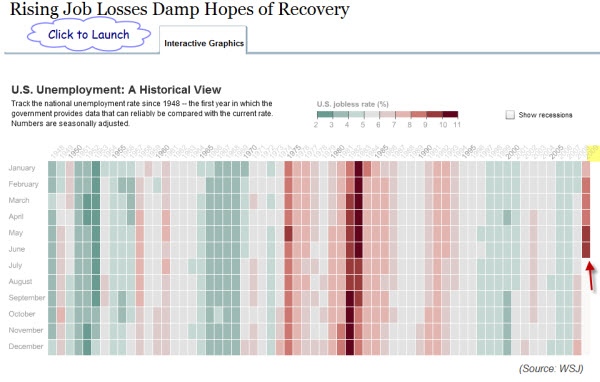
For a longer perspective, here is a chart comparing the monthly national unemployment rates since 1948. Click the chart to see the interactive version on WSJ.com.
Market Chart:
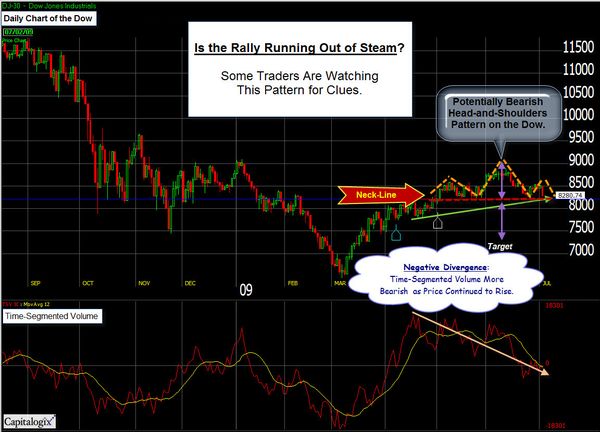
How will all that play-out in the Markets? So far, the markets have held-up nicely. I've been seeing more negative divergences and selling on down days … and less positive momentum and market breadth. But price is the primary indicator, and it has stayed above support.
Here is a daily chart of the Dow Jones Industrial Average Index. I marked a head and shoulders pattern that many traders are watching. Click the chart to see a full-size image.
Short-term, a bounce still wouldn't surprise me. Nonetheless, a bigger correction seems likely.
I'm so glad I found Snagit. It is one of the un-sung heroes that I use all the time but don't think about because it is so reliable and stable that I forget how good it is.
What Can You Do With Snagit?
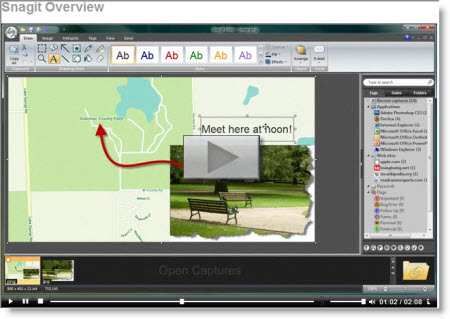
Capture anything you see on the screen. Edit and combine those captures. Add text, arrows, or highlights to make the image better. Then share them through your favorite applications. Organize and find them again later.
I end-up using it several times a day. It is my default image editor. I use it to create or edit the graphics for the blog, presentations and e-mails. I use it to capture and annotate certain financial transactions … and to get or give tech support. Bottom-Line: the more you use Snagit, the more ways you'll find to use it.
Here is a two-minute video that will give you a quick overview of some of the things Snagit can do for you.
Techsmith makes several other cool tools too. I'm not affiliated with them, other than as a satisfied client. Just thought it was worth sharing. Hope it helps you too.
I'm so glad I found Snagit. It is one of the un-sung heroes that I use all the time but don't think about because it is so reliable and stable that I forget how good it is.
What Can You Do With Snagit?
Capture anything you see on the screen. Edit and combine those captures. Add text, arrows, or highlights to make the image better. Then share them through your favorite applications. Organize and find them again later.
I end-up using it several times a day. It is my default image editor. I use it to create or edit the graphics for the blog, presentations and e-mails. I use it to capture and annotate certain financial transactions … and to get or give tech support. Bottom-Line: the more you use Snagit, the more ways you'll find to use it.
Here is a two-minute video that will give you a quick overview of some of the things Snagit can do for you.
Techsmith makes several other cool tools too. I'm not affiliated with them, other than as a satisfied client. Just thought it was worth sharing. Hope it helps you too.
Rolling Stone is not where I typically read insightful Market commentary. Nonetheless, Matt Taibbi wrote a piece for them you should read. The article is called "The Great American Bubble Machine", and it details Goldman Sachs' role in engineering every major market manipulation since the Great Depression. Take a look.
This chart caught my eye. It shows the top-ten residential real-estate markets, and let's just say none of them are around here. Click the picture to go to Reiden's site for more data.
I guess Goldman Sachs isn't the only one who can create Bubbles.
Also, I'm hearing a lot more rumblings from experienced traders about buying a little gold. Richard Russell, of Dow Theory fame, says: “The way the world is going, ‘gold will be the last man standing’. Gold will be wanted because unlike everything else, gold can not go bankrupt. Gold has no debt against it, gold is not the product of some nation’s central bank. Gold is pure intrinsic wealth. It needs no nation to guarantee it. Gold is outside the paper system.”
Confidence In the U.S. Equity Markets.
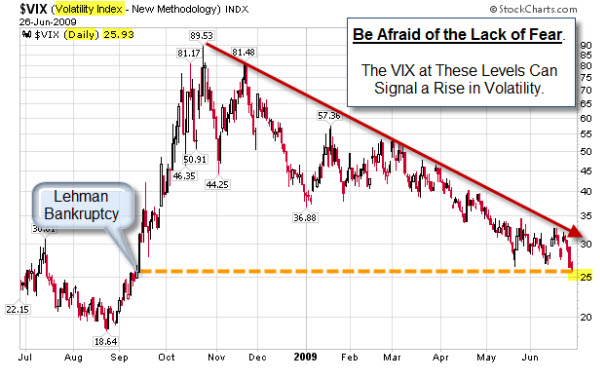
The VIX closed at 25.93 today, down more than 16% from Monday’s close of 31.17 to the lowest closing level since September 12, 2008 – the last trading day before the Lehman Brothers bankruptcy was announced. A rise in volatility from these levels would likely be bearish.
Bespoke notes that the Michigan Confidence joins the growing number of indicators that are now at or better than Pre-Lehman levels. It is currently at its highest level since January 2008. This month's reading is also the fourth consecutive month-over-month increase in confidence.
Market Metaphor?
This NYC hotel claims that one of its rooms is not only a tourist attraction, but is “art”. Art that starts to smell bad in warm weather.
Rolling Stone is not where I typically read insightful Market commentary. Nonetheless, Matt Taibbi wrote a piece for them you should read. The article is called "The Great American Bubble Machine", and it details Goldman Sachs' role in engineering every major market manipulation since the Great Depression. Take a look.
This chart caught my eye. It shows the top-ten residential real-estate markets, and let's just say none of them are around here. Click the picture to go to Reiden's site for more data.
I guess Goldman Sachs isn't the only one who can create Bubbles.
Also, I'm hearing a lot more rumblings from experienced traders about buying a little gold. Richard Russell, of Dow Theory fame, says: “The way the world is going, ‘gold will be the last man standing’. Gold will be wanted because unlike everything else, gold can not go bankrupt. Gold has no debt against it, gold is not the product of some nation’s central bank. Gold is pure intrinsic wealth. It needs no nation to guarantee it. Gold is outside the paper system.”
Confidence In the U.S. Equity Markets.
The VIX closed at 25.93 today, down more than 16% from Monday’s close of 31.17 to the lowest closing level since September 12, 2008 – the last trading day before the Lehman Brothers bankruptcy was announced. A rise in volatility from these levels would likely be bearish.
Bespoke notes that the Michigan Confidence joins the growing number of indicators that are now at or better than Pre-Lehman levels. It is currently at its highest level since January 2008. This month's reading is also the fourth consecutive month-over-month increase in confidence.
Market Metaphor?
This NYC hotel claims that one of its rooms is not only a tourist attraction, but is “art”. Art that starts to smell bad in warm weather.
I recently went to a Tony Robbins seminar in Toronto. One of the highlights of the event was the Firewalk, which is a barefoot walk across red-hot embers.
Learning the technique is not really that hard (it is basically walking at
a normal pace, while not hesitating or tripping). The hard part is doing that knowing that there are burning embers under your feet.
It is breath-taking on several levels. The firewalk is cool in-and-of-itself;
isn't it? So, it doesn't have to mean anything beyond doing
it. Yet, there are some great opportunities to make it more impactful by leveraging what you make the experience mean.
For example you can use the
experience as a powerful memory, triggering feelings of being able to do
anything you commit to … or breaking through what used to be your limits. Or the firewalk can be taken as a metaphor for life … and being able to put yourself into a resourceful state, and choosing to take the right action regardless of what's happening externally or in your mind.
What Goes Through Your Mind?
I was scared the first time I walked on fire. Even though I knew it would do it, when I got to the front of the line, looked down, saw the burning embers, and smelled the smoke … my mind wanted to scream "NO"!! I had a whole lifetime of conditioning that touching hot things was dangerous, and certainly walking barefoot across hot coals made little sense to my logical mind, and even less sense to that primal instinct part of the mind that's there to protect me.
That's why many of the techniques used in the seminars revolve around getting into a peak state, and filling your head with phrases that you repeat again, and again, and again. If you're saying "yes", "yes", "yes" … There's no room for your brain to say "no".
Is It State of Mind … Or Science?
I'm not going to pretend I understand the science of why it's possible to walk barefoot for 30 or 40 feet across burning coals, without injuring yourself. But you don't have to be a scientist to guess that hesitating in the middle might have painful consequences. This video is well done and explains a lot.
.
It is Better the Second Time Around.
I've done the firewalk many times now, and still enjoy it. It's really interesting to watch the faces of people doing it for the first time. Some express abject terror, others pump themselves up into a manic state, while still others follow the crowd with a glazed look on their face.
This time, I tried something different than what I've done before. Instead of working myself into a peak state and charging across the coals triumphantly, I wanted to do it from a place of calm resolve. To me this is a different type of peak state.
In some ways it's about being more present to the situation and my own capabilities. Since I had done this before, being afraid would be somewhat irrational (however emotions do not have to be logical). I didn't want to numb myself to the experience by focusing internally, or by jacking-myself-up into a warrior state; instead I wanted to enjoy the sights, sounds, and smells of what was happening — and how cool it was to do this from a purposeful intent.
A Little Bit of Mastery Goes a Long Way.
As a trader, the winning, losing, and the uncertainty and certainly trigger fear, greed, and doubt. Learning to master these states, and keeping a clear head, leads to a much longer career.
It's funny, because I wasn't sure that going through this exercise again would have the same impact. It did, just for different reasons than I have before. I highly recommend it. Feel free to contact me if you have questions or comments. I'd love to hear about your experiences.
I recently went to a Tony Robbins seminar in Toronto. One of the highlights of the event was the Firewalk, which is a barefoot walk across red-hot embers.
Learning the technique is not really that hard (it is basically walking at
a normal pace, while not hesitating or tripping). The hard part is doing that knowing that there are burning embers under your feet.
It is breath-taking on several levels. The firewalk is cool in-and-of-itself;
isn't it? So, it doesn't have to mean anything beyond doing
it. Yet, there are some great opportunities to make it more impactful by leveraging what you make the experience mean.
For example you can use the
experience as a powerful memory, triggering feelings of being able to do
anything you commit to … or breaking through what used to be your limits. Or the firewalk can be taken as a metaphor for life … and being able to put yourself into a resourceful state, and choosing to take the right action regardless of what's happening externally or in your mind.
What Goes Through Your Mind?
I was scared the first time I walked on fire. Even though I knew it would do it, when I got to the front of the line, looked down, saw the burning embers, and smelled the smoke … my mind wanted to scream "NO"!! I had a whole lifetime of conditioning that touching hot things was dangerous, and certainly walking barefoot across hot coals made little sense to my logical mind, and even less sense to that primal instinct part of the mind that's there to protect me.
That's why many of the techniques used in the seminars revolve around getting into a peak state, and filling your head with phrases that you repeat again, and again, and again. If you're saying "yes", "yes", "yes" … There's no room for your brain to say "no".
Is It State of Mind … Or Science?
I'm not going to pretend I understand the science of why it's possible to walk barefoot for 30 or 40 feet across burning coals, without injuring yourself. But you don't have to be a scientist to guess that hesitating in the middle might have painful consequences. This video is well done and explains a lot.
.
It is Better the Second Time Around.
I've done the firewalk many times now, and still enjoy it. It's really interesting to watch the faces of people doing it for the first time. Some express abject terror, others pump themselves up into a manic state, while still others follow the crowd with a glazed look on their face.
This time, I tried something different than what I've done before. Instead of working myself into a peak state and charging across the coals triumphantly, I wanted to do it from a place of calm resolve. To me this is a different type of peak state.
In some ways it's about being more present to the situation and my own capabilities. Since I had done this before, being afraid would be somewhat irrational (however emotions do not have to be logical). I didn't want to numb myself to the experience by focusing internally, or by jacking-myself-up into a warrior state; instead I wanted to enjoy the sights, sounds, and smells of what was happening — and how cool it was to do this from a purposeful intent.
A Little Bit of Mastery Goes a Long Way.
As a trader, the winning, losing, and the uncertainty and certainly trigger fear, greed, and doubt. Learning to master these states, and keeping a clear head, leads to a much longer career.
It's funny, because I wasn't sure that going through this exercise again would have the same impact. It did, just for different reasons than I have before. I highly recommend it. Feel free to contact me if you have questions or comments. I'd love to hear about your experiences.


 So a plot about a down-on-his luck Catholic High School student whose father is dead and whose mother is in a coma, doesn't sound like my type of movie.
  I was in Columbus Ohio last week for a series of meetings and strategic planning sessions.