
Thoughts about the markets, automated trading algorithms, artificial intelligence, and lots of other stuff

  • Capitalogix Commentary for the Week of 03/01/10

    The markets held-up well again this week despite lots of bad news on many fronts.  While there were several bouts of selling, each time buyers were there to prop things back up.

    Here were some of the news items the market handled last week. 

    And then there is the economy and the deficit …

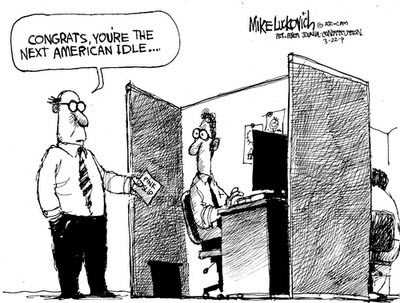
    100228 Political Cartoon US Deficit Ice Dancing

    So, let's use some technical analysis to see where the markets stand.

    Three Views of the Market – and All Say the Same Thing.

    Sometimes simple is better.  What follows is a top-down look at the Dow Jones Industrial Average.  It starts with a monthly chart for the bigger picture.  That is followed by a weekly chart, and then by a daily chart.  In all three the key level is just above where we are.

    080228 Dow Monthly at Resistance

    Here is the weekly chart.  It shows price re-testing the upwards sloping trend-line from below.

    080228 Dow Weekly Re-Testing Trend-Line

    Here is the daily chart.  A sustained move above the orange line would be bullish.

    080228 Dow Daily Decision Zone

    Here is something else to watch.

    Does the Euro Help Predict US Equity Market Moves?

    This video suggests that the Euro is worth watching as an early indicator of likely movement in the U.S. Equity Indices (like the S&P 500 Index).

    080228 Video Using the Euro to Predict the SP500

    That is something I will keep an eye on to see how it works.  In the mean-time, here is a recent chart of the S&P 500 and the Euro.  It is showing a negative divergence because the Euro is continuing to show weakness while the S&P 500 rallied in February.

    080228 Using the Euro to Predict the SP500

    Time will tell.  Hope you have a good week.

    Business Posts Moving the Markets that I Found Interesting This Week:

    • Bernanke Reaffirms "Extended Period" of Low Rates. (NYTimes)
    • Recovery Focus: Which Banks Are Worth Betting-On? (WSJ)
    • U.S. New-Home Sales Drop 11.2% – to 1963 Levels. (WSJ)
    • Intel, VCs Investing $3.5 Billion In U.S. Technologies. (InfoWeek)
    • Economic Annual Report of the President – An Interesting Read. (White House)
    • More Posts Moving the Markets.

    Lighter Ideas and Fun Links that I Found Interesting This Week

    Reblog this post [with Zemanta]
  • Capitalogix Commentary for the Week of 03/01/10

    The markets held-up well again this week despite lots of bad news on many fronts.  While there were several bouts of selling, each time buyers were there to prop things back up.

    Here were some of the news items the market handled last week. 

    And then there is the economy and the deficit …

    100228 Political Cartoon US Deficit Ice Dancing

    So, let's use some technical analysis to see where the markets stand.

    Three Views of the Market – and All Say the Same Thing.

    Sometimes simple is better.  What follows is a top-down look at the Dow Jones Industrial Average.  It starts with a monthly chart for the bigger picture.  That is followed by a weekly chart, and then by a daily chart.  In all three the key level is just above where we are.

    080228 Dow Monthly at Resistance

    Here is the weekly chart.  It shows price re-testing the upwards sloping trend-line from below.

    080228 Dow Weekly Re-Testing Trend-Line

    Here is the daily chart.  A sustained move above the orange line would be bullish.

    080228 Dow Daily Decision Zone

    Here is something else to watch.

    Does the Euro Help Predict US Equity Market Moves?

    This video suggests that the Euro is worth watching as an early indicator of likely movement in the U.S. Equity Indices (like the S&P 500 Index).

    080228 Video Using the Euro to Predict the SP500

    That is something I will keep an eye on to see how it works.  In the mean-time, here is a recent chart of the S&P 500 and the Euro.  It is showing a negative divergence because the Euro is continuing to show weakness while the S&P 500 rallied in February.

    080228 Using the Euro to Predict the SP500

    Time will tell.  Hope you have a good week.

    Business Posts Moving the Markets that I Found Interesting This Week:

    • Bernanke Reaffirms "Extended Period" of Low Rates. (NYTimes)
    • Recovery Focus: Which Banks Are Worth Betting-On? (WSJ)
    • U.S. New-Home Sales Drop 11.2% – to 1963 Levels. (WSJ)
    • Intel, VCs Investing $3.5 Billion In U.S. Technologies. (InfoWeek)
    • Economic Annual Report of the President – An Interesting Read. (White House)
    • More Posts Moving the Markets.

    Lighter Ideas and Fun Links that I Found Interesting This Week

    Reblog this post [with Zemanta]
  • The Egg Trick: TV From a Different Age

    Here is a skit from Johnny Carson and Dom DeLuise.  It's funny to see how talk shows have changed.

    It is a different kind of clean … and a different kind of dirty.

    Reblog this post [with Zemanta]
  • The Egg Trick: TV From a Different Age

    Here is a skit from Johnny Carson and Dom DeLuise.  It's funny to see how talk shows have changed.

    It is a different kind of clean … and a different kind of dirty.

    Reblog this post [with Zemanta]
  • The Illusion of Focus and Meaning

    Recently, the concept of "Focus" keeps coming to mind when I try to
    make sense of what's happening in the markets.

    As I review
    stories, news, and data, I'm trying to be more aware of where the bias
    is (even if it is unintentional).

    Focus,
    Bias and Perspective.

    The photo series, below, is an
    example of how our perception can be easily shaped.  The far left
    version looks violent.  The far right version looks compassionate.  It
    could be both (or neither).

    Example of How Focus Changes Meaning

    Each
    of us perceives the world through our own filters.  It is as if we're
    producing a film (which could be edited into a comedy, drama, or
    thriller … based on what we focus on, highlight, or ignore). Except
    that we often don't know it's just a film, edited by an amateur …
    Instead, we
    perceive it as truth because it is what we perceive.

    The point is
    that perspective matters.

  • The Illusion of Focus and Meaning

    Recently, the concept of "Focus" keeps coming to mind when I try to
    make sense of what's happening in the markets.

    As I review
    stories, news, and data, I'm trying to be more aware of where the bias
    is (even if it is unintentional).

    Focus,
    Bias and Perspective.

    The photo series, below, is an
    example of how our perception can be easily shaped.  The far left
    version looks violent.  The far right version looks compassionate.  It
    could be both (or neither).

    Example of How Focus Changes Meaning

    Each
    of us perceives the world through our own filters.  It is as if we're
    producing a film (which could be edited into a comedy, drama, or
    thriller … based on what we focus on, highlight, or ignore). Except
    that we often don't know it's just a film, edited by an amateur …
    Instead, we
    perceive it as truth because it is what we perceive.

    The point is
    that perspective matters.

  • Capitalogix Commentary 02/21/10

    It seems like everywhere I look, there is bad news about the economy. Recently, however, venture capital and M&A activities have been picking-up.  Both of those are early indicators of economic optimism. In addition, here are two other signs that economic winter may soon give way to spring.

    100221 vinceFirst, a Bankruptcy Partner in a major Dallas law firm just told me that he sees fewer filings in the pipeline. In addition, he says that credit has started opening-up to corporations, which is giving them the lifeline they need to start making progress again.

     Second, speaker bookings for corporate meetings seem to be picking-up again. I suspect that this is an indicator that corporations are willing to spend money on motivation, teamwork, and culture. In Maslow's hierarchy of needs, that's certainly a tier above food and shelter. In other words, when money frees-up for these types of activities, it suggests that corporations are starting to feel more comfortable about the short-term … and more optimistic about the longer-term.

    From a technical analysis perspective, optimism shows itself in the charts.

    Where Are We?

    In last week's commentary, I indicated that a
    holiday-shortened options expiration week was a likely time to expect a
    bounce. Well, even though the Fed announced a surprise discount rate hike to banks,
    the markets did rally.  While impressive on some levels, it happened on
    low trading volume and takes us to a resistance level.

    It is
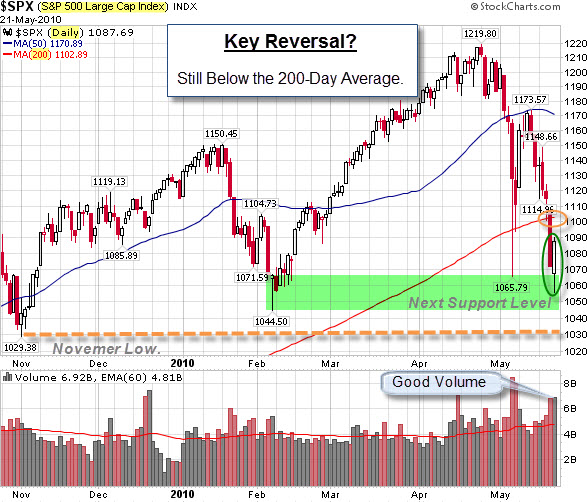
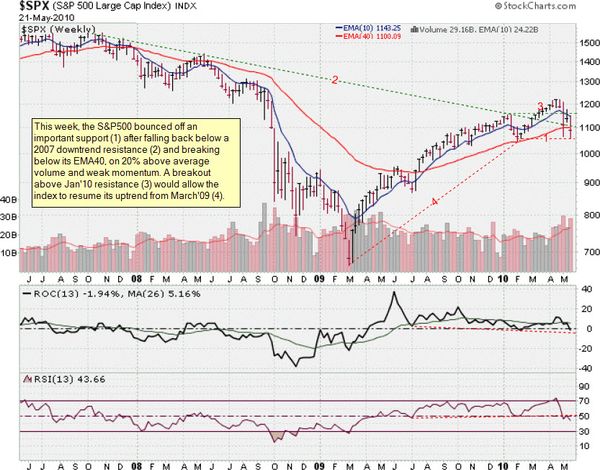
    decision-time for the S&P 500 Index. The weekly chart, below, shows
    the downward sloping trend-line from the 2007 highs, as well as the
    rally off the 2009 lows. More recently, we've seen a nice rally off the
    high volume reversal bar from several weeks ago (marked by the yellow
    highlight in the green circle).  Nonetheless, the bigger issue is whether price will be
    able to rally and hold above the down-trend line
    (marked by the
    red arrow)?

    100221 SP500 Decision Time

    If the markets do sell-off soon, then many eyes will shift to the 200-day moving average (similar to the 40-week average marked in blue) as a likely support level.

    It Is a Matter of Perspective … But the Real Story is the Lack of Selling.

    I read an article that claims to outline the three basic causes of the market rally since March of 2009.

    1. The first is that the Fed has recently chosen to pump liquidity into the financial systems during options expiration week.
    2. The second is that markets closed higher on approximately 75% of Monday's since the recent market low (with 80% of the gains, since those lows, happening on Mondays).
    3. The third is that virtually all of the Q4 2009 market gains occurred in the overnight futures session, when US markets are closed. 

    The chart, below shows the gains and losses that occurred during the normal trading session versus during after-hours sessions.

    100221 Gains Came During After-Hours Session

    My first reaction was that this probably was the result of government
    action or manipulation by some unseen hand. Pushing the market higher
    during light futures trading periods (like weekends or after-hours)
    resulted in bigger gap-up openings.

    After a little thought, however,
    these actions make sense. Even if these after-hour pushes were the
    result of the government, it was easier, took less capital (and thus
    cost less to do it) after-hours than it would have during periods of
    thicker trading. So, it was smart to do it that way.

    More importantly,
    this is a free market; so if the market "disagrees" with the push
    higher, then sellers can freely take their profits or positions. The
    bigger issue is that even though the markets have been pushed higher, we
    still haven't gotten to the point that triggers selling volume.

    Business Posts Moving the Markets that I Found Interesting This Week:

    Lighter Ideas and Fun Links that I Found Interesting This Week

  • Capitalogix Commentary 02/21/10

    It seems like everywhere I look, there is bad news about the economy. Recently, however, venture capital and M&A activities have been picking-up.  Both of those are early indicators of economic optimism. In addition, here are two other signs that economic winter may soon give way to spring.

    100221 vinceFirst, a Bankruptcy Partner in a major Dallas law firm just told me that he sees fewer filings in the pipeline. In addition, he says that credit has started opening-up to corporations, which is giving them the lifeline they need to start making progress again.

     Second, speaker bookings for corporate meetings seem to be picking-up again. I suspect that this is an indicator that corporations are willing to spend money on motivation, teamwork, and culture. In Maslow's hierarchy of needs, that's certainly a tier above food and shelter. In other words, when money frees-up for these types of activities, it suggests that corporations are starting to feel more comfortable about the short-term … and more optimistic about the longer-term.

    From a technical analysis perspective, optimism shows itself in the charts.

    Where Are We?

    In last week's commentary, I indicated that a
    holiday-shortened options expiration week was a likely time to expect a
    bounce. Well, even though the Fed announced a surprise discount rate hike to banks,
    the markets did rally.  While impressive on some levels, it happened on
    low trading volume and takes us to a resistance level.

    It is
    decision-time for the S&P 500 Index. The weekly chart, below, shows
    the downward sloping trend-line from the 2007 highs, as well as the
    rally off the 2009 lows. More recently, we've seen a nice rally off the
    high volume reversal bar from several weeks ago (marked by the yellow
    highlight in the green circle).  Nonetheless, the bigger issue is whether price will be
    able to rally and hold above the down-trend line
    (marked by the
    red arrow)?

    100221 SP500 Decision Time

    If the markets do sell-off soon, then many eyes will shift to the 200-day moving average (similar to the 40-week average marked in blue) as a likely support level.

    It Is a Matter of Perspective … But the Real Story is the Lack of Selling.

    I read an article that claims to outline the three basic causes of the market rally since March of 2009.

    1. The first is that the Fed has recently chosen to pump liquidity into the financial systems during options expiration week.
    2. The second is that markets closed higher on approximately 75% of Monday's since the recent market low (with 80% of the gains, since those lows, happening on Mondays).
    3. The third is that virtually all of the Q4 2009 market gains occurred in the overnight futures session, when US markets are closed. 

    The chart, below shows the gains and losses that occurred during the normal trading session versus during after-hours sessions.

    100221 Gains Came During After-Hours Session

    My first reaction was that this probably was the result of government
    action or manipulation by some unseen hand. Pushing the market higher
    during light futures trading periods (like weekends or after-hours)
    resulted in bigger gap-up openings.

    After a little thought, however,
    these actions make sense. Even if these after-hour pushes were the
    result of the government, it was easier, took less capital (and thus
    cost less to do it) after-hours than it would have during periods of
    thicker trading. So, it was smart to do it that way.

    More importantly,
    this is a free market; so if the market "disagrees" with the push
    higher, then sellers can freely take their profits or positions. The
    bigger issue is that even though the markets have been pushed higher, we
    still haven't gotten to the point that triggers selling volume.

    Business Posts Moving the Markets that I Found Interesting This Week:

    Lighter Ideas and Fun Links that I Found Interesting This Week

  • Why Cloud Computing Irks Larry Ellison, But Benefits You.

    The network is becoming the computer.

    Here is a short video that puts "Cloud Computing" in perspective.  In it, Ellison jokes that someone decided to change the word "Internet" to
    "Cloud" because it was a lot easier than innovation.


    Microsoft is spending a lot of time and money to make sure it does better gaining an early lead and monetizing this type of "Internet" service.  Their cloud computing platform is called Azure.

    Amazon also has a cloud offering worth a look. 

    Why Should You Care?

    Basically, you can “rent” a current version Windows Server for as little as 12 cents per hour, and only pay for the hours you need it each month. That’s $12 bucks to use 100 servers for an hour. You also pay for data transfer and storage, but that is negligible. The nice thing is that you can fire up an army of servers to run a batch process … then stop paying when they complete their work.

    You can get access even cheaper under a program where you bid on unused capacity within the cloud at any given time (Spot pricing). 

    I still have reservations about using cloud computing for many daily business applications. However, for “crunch on demand” processes … this model makes much more sense that investing in piles of hardware that all too soon becomes obsolete.

    Most of the data from this post comes from Tim McDonald, the president of Infassure, a technology consulting and out-sourcing company in the Dallas area.  They've been a big help to us on this, and many other matters.

  • Why Cloud Computing Irks Larry Ellison, But Benefits You.

    The network is becoming the computer.

    Here is a short video that puts "Cloud Computing" in perspective.  In it, Ellison jokes that someone decided to change the word "Internet" to
    "Cloud" because it was a lot easier than innovation.


    Microsoft is spending a lot of time and money to make sure it does better gaining an early lead and monetizing this type of "Internet" service.  Their cloud computing platform is called Azure.

    Amazon also has a cloud offering worth a look. 

    Why Should You Care?

    Basically, you can “rent” a current version Windows Server for as little as 12 cents per hour, and only pay for the hours you need it each month. That’s $12 bucks to use 100 servers for an hour. You also pay for data transfer and storage, but that is negligible. The nice thing is that you can fire up an army of servers to run a batch process … then stop paying when they complete their work.

    You can get access even cheaper under a program where you bid on unused capacity within the cloud at any given time (Spot pricing). 

    I still have reservations about using cloud computing for many daily business applications. However, for “crunch on demand” processes … this model makes much more sense that investing in piles of hardware that all too soon becomes obsolete.

    Most of the data from this post comes from Tim McDonald, the president of Infassure, a technology consulting and out-sourcing company in the Dallas area.  They've been a big help to us on this, and many other matters.