On the first day of June, the total U.S. public debt crossed the $13 trillion mark. In the 20 some days since then, it has already grown more than another $52 billion. The debt number is currently equal to just under 90 percent of the entire size of the U.S. economy.
The national debt is growing at $45,000 per second. That’s more than $5,000 more than the annual U.S. income per capita — every second.
Putting It In Perspective.
I was looking through some clippings I'd saved and a few of them caught
my eye.
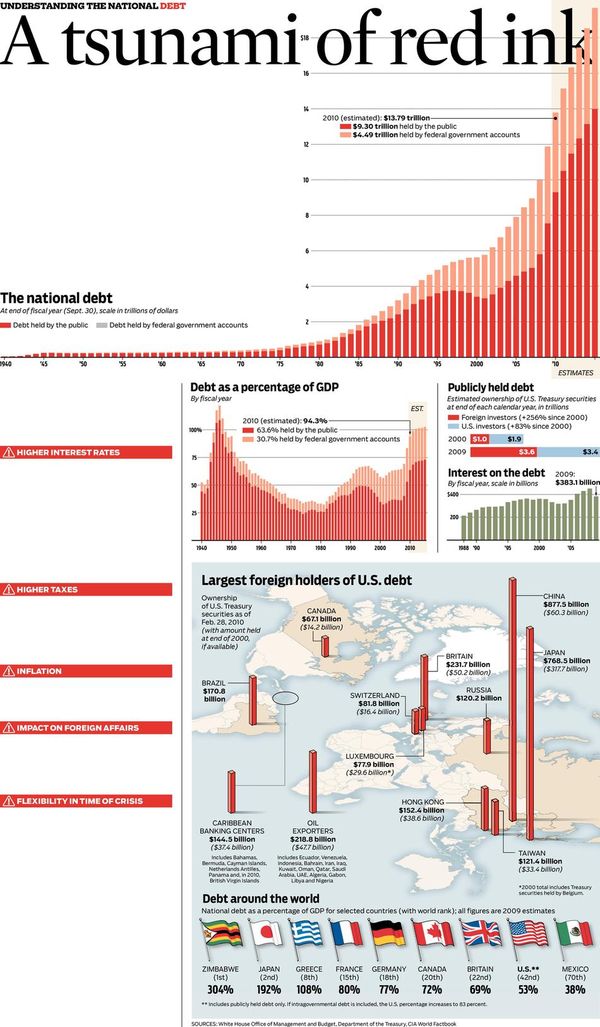
The first is a graphic from the Chicago Tribune about understanding the National Debt. It speaks for itself.
How Big is a Trillion?
A Trillion is a hard concept to grasp. That is a million millions. Here are two videos that put the number in perspective.
The first is from Mint. It's official, Trillion is the new Billion. No longer is government spending talked about in terms of a mere ten digits. With the recent flurry of government spending, we are going to need another three zeros to make sense of it all. One trillion dollars is a number that few people can comprehend, let alone your standard nine digit calculator. So what does one trillion dollars look like?
The second video is from CNN. They ask a Temple University mathematics professor John Allen Paulos to explain how much $1 trillion actually is. The story notes Senate Republican Leader Mitch McConnell is correct when he says that if you spent $1 million per day starting in the year 0, you still would not have spent $1 trillion by 2009.
On the first day of June, the total U.S. public debt crossed the $13 trillion mark. In the 20 some days since then, it has already grown more than another $52 billion. The debt number is currently equal to just under 90 percent of the entire size of the U.S. economy.
The national debt is growing at $45,000 per second. That’s more than $5,000 more than the annual U.S. income per capita — every second.
Putting It In Perspective.
I was looking through some clippings I'd saved and a few of them caught
my eye.
The first is a graphic from the Chicago Tribune about understanding the National Debt. It speaks for itself.
How Big is a Trillion?
A Trillion is a hard concept to grasp. That is a million millions. Here are two videos that put the number in perspective.
The first is from Mint. It's official, Trillion is the new Billion. No longer is government spending talked about in terms of a mere ten digits. With the recent flurry of government spending, we are going to need another three zeros to make sense of it all. One trillion dollars is a number that few people can comprehend, let alone your standard nine digit calculator. So what does one trillion dollars look like?
The second video is from CNN. They ask a Temple University mathematics professor John Allen Paulos to explain how much $1 trillion actually is. The story notes Senate Republican Leader Mitch McConnell is correct when he says that if you spent $1 million per day starting in the year 0, you still would not have spent $1 trillion by 2009.
Even people who are not big fans of technical analysis tend to look at the market's 200-day moving average. This is the simply the average of the closes for the previous 200 days. The 200 DMA has a decent track record — when the market is above the 200 DMA, it tends to rally, below it, not so much.
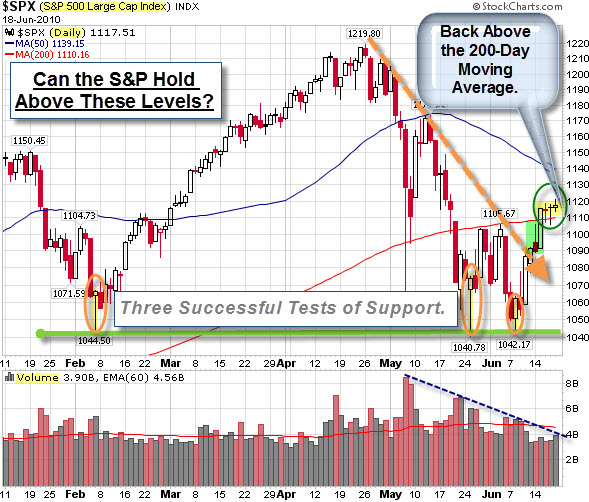
In the daily chart of the S&P 500 Index, below, the 200 DMA is drawn as a red line. The recent trades, back above the 200 DMA line, are circled in green with a yellow highlight.
In the past few weks, the S&P 500 has tried to break out above its 200 DMA several times, but each attempt has sputtered out. Let's see if it holds this time?
There are a few other bullish reasons for it to hold. The market has stayed above the light green 1040 support level, despite three tests (marked by the orange circles). The last two tests count as a double-bottom, which indicates a bullish reversal (especially with price back above the orange-dashed down-trend line and 200 DMA).
Sentiment towards the U.S. Markets is also getting better.
The Pendulum Swings: Investors Starting to Pick U.S. Over BRICs.
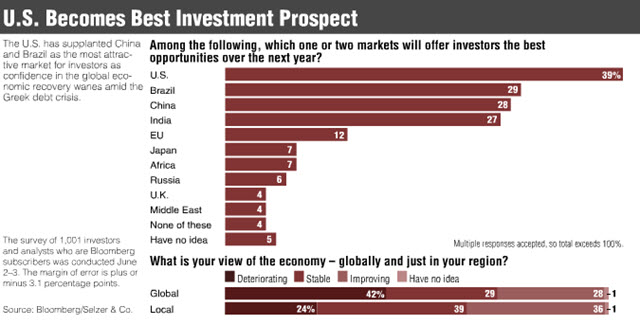
Bloomberg reports that the U.S. has supplanted China and Brazil as the most attractive market for investors as confidence in the global economic recovery wanes in the wake of the Greek debt crisis.
Almost four of 10 respondents picked the U.S. as the market presenting the best opportunities in the year ahead. That’s more than double the portion who said so last October.
Even people who are not big fans of technical analysis tend to look at the market's 200-day moving average. This is the simply the average of the closes for the previous 200 days. The 200 DMA has a decent track record — when the market is above the 200 DMA, it tends to rally, below it, not so much.
In the daily chart of the S&P 500 Index, below, the 200 DMA is drawn as a red line. The recent trades, back above the 200 DMA line, are circled in green with a yellow highlight.
In the past few weks, the S&P 500 has tried to break out above its 200 DMA several times, but each attempt has sputtered out. Let's see if it holds this time?
There are a few other bullish reasons for it to hold. The market has stayed above the light green 1040 support level, despite three tests (marked by the orange circles). The last two tests count as a double-bottom, which indicates a bullish reversal (especially with price back above the orange-dashed down-trend line and 200 DMA).
Sentiment towards the U.S. Markets is also getting better.
The Pendulum Swings: Investors Starting to Pick U.S. Over BRICs.
Bloomberg reports that the U.S. has supplanted China and Brazil as the most attractive market for investors as confidence in the global economic recovery wanes in the wake of the Greek debt crisis.
Almost four of 10 respondents picked the U.S. as the market presenting the best opportunities in the year ahead. That’s more than double the portion who said so last October.
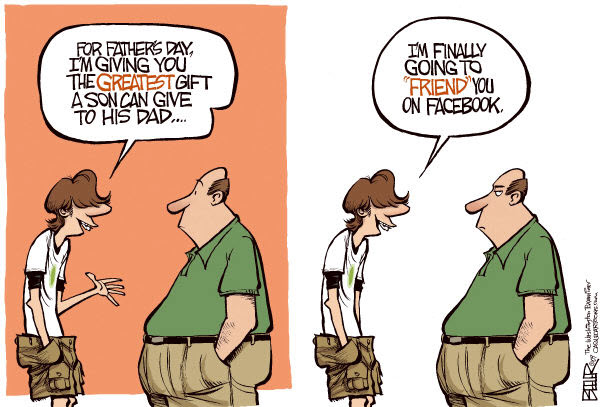
My kids are getting older. So Father's Day looks a little different than it used to.
But as I look back, there is an investment I made that paid-off in a big way, and I want to share it with you.
Like many parents, I wanted to teach my children that, to a large extent, they control what happens to them. One of the first ways I did that was to set up a "compensation system" for them to earn video games.
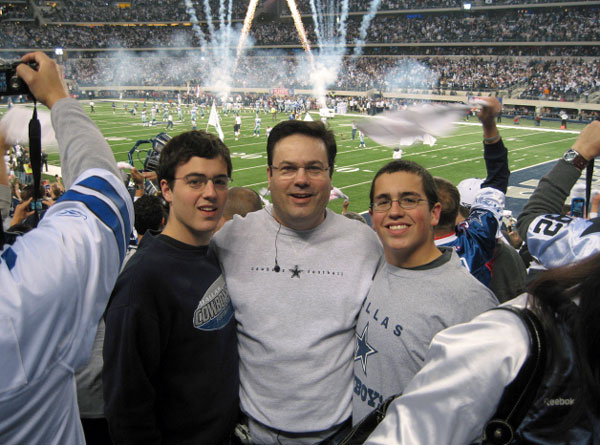
Some parents try to limit the amount of time their kids spend watching TV or playing video games. I tried something different. Instead, my kids earned their games by reading books. Here is a photo from way back then.
Paid With Play.
Here's how it worked. When they were younger, 10 books was enough to earn a small game. When they finished a book, it was their right, and my obligation, to take them to the bookstore for us to pick up the next book together. Likewise, when they finished the requisite number of books, it was their right, and my obligation, to take them to the computer store or game store for them to choose any game they wanted.
When they finished hundred books, they got a bonus of earning the next game system. That meant if they had a Nintendo, they could now also get a PlayStation 3 or Xbox 360.
How Can You Encourage a Jump to the Next Level?
There came a point when I wanted one of my sons to start reading grown-up books. He was comfortable reading a certain type of book, and didn't want to read the kind of books that I read. So, I created a bonus system that counted a particular book as three books. I didn't force him; I just let the easier path to a reward "whisper" in his ear what to read. Once he finished that, he never went back to teen fiction.
It Is a Great Way to Learn About Your Kids.
I also used the bookstore visits to get a sense of how the boys were doing. For example, I might say "I notice that you read five books in that series, maybe you'd like this book". Or, "That sure is a lot of science fiction; what was the last biography you read?" For the most part, though, I didn't care what they read. The key was to get them to want to choose certain books for their own reasons. Ultimately, their preference meant they were learning to love reading.
It Puts Them In Control of Their Destiny and Rewards.
My younger son likes competition. He also broke or misplaced many things. So, in order to earn back the Game Boy unit that he lost, I challenged him to read five books in five days. These weren't easy books either. It was designed to stretch him, and also to teach him that he could read a book a night. The bet was that he either finished all the books in the allocated time, or none of them counted towards games or Game Boys. On the other hand, if he read a book a night for two weeks, not only would he get to have his Game Boy back, the books would count towards a game too. It worked like a charm, and we were both happy.
So, Who Got the Better Bargain?
As they started to get into their teenage years, I needed to up the ante a little. So, 500 books meant they got a laptop of their choice. Both boys cashed in, and probably felt like they were taking advantage of their dad.
I got what I wanted, though; both my boys love reading, and know that they can accomplish anything they put their minds to … one step at a time.
That's an investment that will pay dividends for a long time.
My kids are getting older. So Father's Day looks a little different than it used to.
But as I look back, there is an investment I made that paid-off in a big way, and I want to share it with you.
Like many parents, I wanted to teach my children that, to a large extent, they control what happens to them. One of the first ways I did that was to set up a "compensation system" for them to earn video games.
Some parents try to limit the amount of time their kids spend watching TV or playing video games. I tried something different. Instead, my kids earned their games by reading books. Here is a photo from way back then.
Paid With Play.
Here's how it worked. When they were younger, 10 books was enough to earn a small game. When they finished a book, it was their right, and my obligation, to take them to the bookstore for us to pick up the next book together. Likewise, when they finished the requisite number of books, it was their right, and my obligation, to take them to the computer store or game store for them to choose any game they wanted.
When they finished hundred books, they got a bonus of earning the next game system. That meant if they had a Nintendo, they could now also get a PlayStation 3 or Xbox 360.
How Can You Encourage a Jump to the Next Level?
There came a point when I wanted one of my sons to start reading grown-up books. He was comfortable reading a certain type of book, and didn't want to read the kind of books that I read. So, I created a bonus system that counted a particular book as three books. I didn't force him; I just let the easier path to a reward "whisper" in his ear what to read. Once he finished that, he never went back to teen fiction.
It Is a Great Way to Learn About Your Kids.
I also used the bookstore visits to get a sense of how the boys were doing. For example, I might say "I notice that you read five books in that series, maybe you'd like this book". Or, "That sure is a lot of science fiction; what was the last biography you read?" For the most part, though, I didn't care what they read. The key was to get them to want to choose certain books for their own reasons. Ultimately, their preference meant they were learning to love reading.
It Puts Them In Control of Their Destiny and Rewards.
My younger son likes competition. He also broke or misplaced many things. So, in order to earn back the Game Boy unit that he lost, I challenged him to read five books in five days. These weren't easy books either. It was designed to stretch him, and also to teach him that he could read a book a night. The bet was that he either finished all the books in the allocated time, or none of them counted towards games or Game Boys. On the other hand, if he read a book a night for two weeks, not only would he get to have his Game Boy back, the books would count towards a game too. It worked like a charm, and we were both happy.
So, Who Got the Better Bargain?
As they started to get into their teenage years, I needed to up the ante a little. So, 500 books meant they got a laptop of their choice. Both boys cashed in, and probably felt like they were taking advantage of their dad.
I got what I wanted, though; both my boys love reading, and know that they can accomplish anything they put their minds to … one step at a time.
That's an investment that will pay dividends for a long time.
Mike Novogratz is the President of Fortress Investment Group, the first U.S.-based private equity/hedge fund manager to sell shares to the public. He joined Fortress in March 2002, and is responsible for the liquid hedge fund business, which includes running the Global Macro Funds.
When we met earlier this year, I was impressed by his openness and perspective on the industry. It also comes through in the interview below.
In this revealing three-part interview, Novogratz shares his insights and reflections about:
1. How he earned his position.
2. The DNA, Risk Management, and Rules of Success in Macro Trading.
3. The significance of Instinct, Luck, Intuition, and a "Real Intelligence".
Mike Novogratz, President of Fortress Investment Group — Opalesque TV — Part 1.
Mike Novogratz, President of Fortress Investment Group — Opalesque TV — Part 2.
Mike Novogratz, President of Fortress Investment Group — Opalesque TV — Part 3.
Prior to joining Fortress, Novogratz spent 11 years at Goldman Sachs,
where he became a partner in 1998. He held the positions of president of
Goldman Sachs Latin America and Head of Fixed Income, Currencies and
Commodities Risk in Asia, where he lived from 1992 to 1999. Mr.
Novogratz received a B.A. from Princeton University, and served as a
helicopter pilot in the U.S. Army.
Fortress Investment Group
(NYSE: FIG) is a leading global
investment management firm. Total assets are around $41.6bn, with
$4.3bln in a global macro and a commodities based hedge fund.
Mike Novogratz is the President of Fortress Investment Group, the first U.S.-based private equity/hedge fund manager to sell shares to the public. He joined Fortress in March 2002, and is responsible for the liquid hedge fund business, which includes running the Global Macro Funds.
When we met earlier this year, I was impressed by his openness and perspective on the industry. It also comes through in the interview below.
In this revealing three-part interview, Novogratz shares his insights and reflections about:
1. How he earned his position.
2. The DNA, Risk Management, and Rules of Success in Macro Trading.
3. The significance of Instinct, Luck, Intuition, and a "Real Intelligence".
Mike Novogratz, President of Fortress Investment Group — Opalesque TV — Part 1.
Mike Novogratz, President of Fortress Investment Group — Opalesque TV — Part 2.
Mike Novogratz, President of Fortress Investment Group — Opalesque TV — Part 3.
Prior to joining Fortress, Novogratz spent 11 years at Goldman Sachs,
where he became a partner in 1998. He held the positions of president of
Goldman Sachs Latin America and Head of Fixed Income, Currencies and
Commodities Risk in Asia, where he lived from 1992 to 1999. Mr.
Novogratz received a B.A. from Princeton University, and served as a
helicopter pilot in the U.S. Army.
Fortress Investment Group
(NYSE: FIG) is a leading global
investment management firm. Total assets are around $41.6bn, with
$4.3bln in a global macro and a commodities based hedge fund.