This video made me laugh out loud.
It shows a "motivational" speaker attempting to break a piece of wood over his head.
There might be a deeper point worth capturing; but it is worth watching purely for the entertainment value.
via Tony Robbins.



Thoughts about the markets, automated trading algorithms, artificial intelligence, and lots of other stuff
This video made me laugh out loud.
It shows a "motivational" speaker attempting to break a piece of wood over his head.
There might be a deeper point worth capturing; but it is worth watching purely for the entertainment value.
via Tony Robbins.
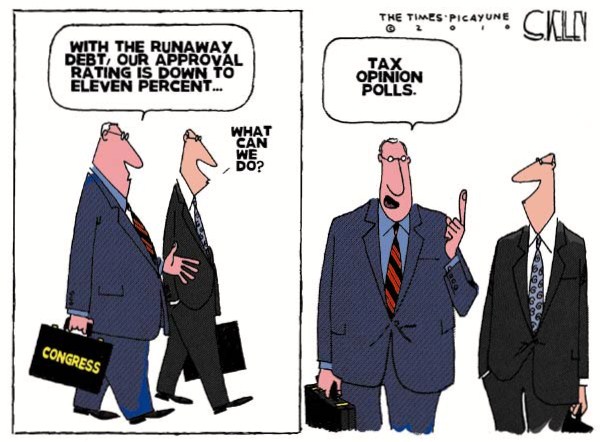
The government's latest snapshot of the job market was bleak, with 14.6 million Americans still searching for work. The disappointment is not limited to July; the report also included unfavorable revisions to data released in previous months. It is becoming clear that the existing policy mix is not appropriate for the task at hand.
Even though we've heard bad news, the market has continued to hold up well. And that is a decidedly bullish sign. There are also a number of positive signs of market strength (like strong breadth, increased corporate spending, and lots of capital on the sidelines ready to be deployed).
Market Commentary: Let's Look Under the Covers.
The charts show a few challenges ahead, however. First, the S&P 500 Index is sitting at a resistance zone in a rising wedge pattern. From a technical analysis perspective, that pattern is often bearish (or the place traders look for a reversal).
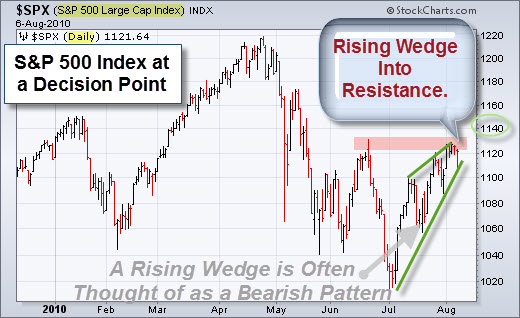
Bulls are looking for a sustained move above the 1140 level to make them comfortable.
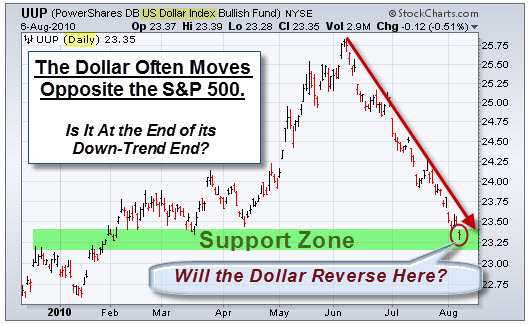
Second, the Dollar looks like it might be at a support level. Will it reverse here? These two markets often move counter to each other. So, having the Dollar at "support" while the S&P 500 Index is at "resistance" might increase the odds of a market turn here.
Just something to keep your eye on.
Finally, this is from late May; but it is making the rounds again … and I thought it was worth sharing.
Steve Wynn Is Not a Shy Man With Few Opinions.
In this video, Steve Wynn (a casino resort/real-estate developer who has been credited with spearheading the dramatic resurgence and expansion of the Las Vegas Strip) calls out the White House and talks about the Fall of America. Interesting perspective from a billionaire.
Business Posts Moving the Markets that I Found Interesting This Week:
Lighter Ideas and Fun Links that I Found Interesting This Week

The government's latest snapshot of the job market was bleak, with 14.6 million Americans still searching for work. The disappointment is not limited to July; the report also included unfavorable revisions to data released in previous months. It is becoming clear that the existing policy mix is not appropriate for the task at hand.
Even though we've heard bad news, the market has continued to hold up well. And that is a decidedly bullish sign. There are also a number of positive signs of market strength (like strong breadth, increased corporate spending, and lots of capital on the sidelines ready to be deployed).
Market Commentary: Let's Look Under the Covers.
The charts show a few challenges ahead, however. First, the S&P 500 Index is sitting at a resistance zone in a rising wedge pattern. From a technical analysis perspective, that pattern is often bearish (or the place traders look for a reversal).
Bulls are looking for a sustained move above the 1140 level to make them comfortable.
Second, the Dollar looks like it might be at a support level. Will it reverse here? These two markets often move counter to each other. So, having the Dollar at "support" while the S&P 500 Index is at "resistance" might increase the odds of a market turn here.
Just something to keep your eye on.
Finally, this is from late May; but it is making the rounds again … and I thought it was worth sharing.
Steve Wynn Is Not a Shy Man With Few Opinions.
In this video, Steve Wynn (a casino resort/real-estate developer who has been credited with spearheading the dramatic resurgence and expansion of the Las Vegas Strip) calls out the White House and talks about the Fall of America. Interesting perspective from a billionaire.
Business Posts Moving the Markets that I Found Interesting This Week:
Lighter Ideas and Fun Links that I Found Interesting This Week
Another barrier between person and machine is fading … and your voice is the key.
Here is a demo I made showing how Dragon NaturallySpeaking 11 turns your talk into typing (or helps you send an e-mail without touching the keyboard). It really is as accurate and easy to use as it looks in this video.
How do you think that affects your writing?
 Humans can only focus on a few things at a time, and if you're focused on where your fingers are going or whether you've made a mistake, you are using cognitive resources that could have gone into thinking better or communicating more clearly.
It shouldn't come as a big surprise to you that talking is so much more natural than typing. Think how much more practice you get doing it. So, it follows that it's easier to create natural sounding content by transcribing what you say, rather than typing what you think.
The Whole Process Is Faster … Not Just the Typing.
 How Fast Do You Type? You can check your speed here or here.
I was surprised to learn that my average typing speed is between 40 and 50 words per minute. Dragon NaturallySpeaking clocks in about three times faster than that.
Speech Recognition Is Getting Better All the Time.
Nuance has become a leader in this field. In addition to DNS, they've got great applications that work on smart phones, and they also bought the popular service called Jott. I mention it because their massive user-base across these products and services allow Nuance to collect millions of voice samples and customer feedback from around the world. The samples show not only different ways that people pronounce words, but which words are more likely to be spoken, and in what context. Add that to the improvements in microphones, sound cards, processing power, etc. — and the result is a faster and more accurate recognition engine.
Earlier versions of the technology were very dependent on how well you trained it. Now, it works decently out-of-the-box, with virtually no setup or specialized training. As good as it is, I appreciate that Nuance makes it easy for the program to learn my writing style and particular vocabulary. To do this, for example, you can let it look at your sent mail folder or a folder of word processing documents.
 Try It Yourself.
Bottom-Line: It's time to give this technology a fresh look. It's ready for prime time, and I think Nuance has a hit.
Give it a try.

Another barrier between person and machine is fading … and your voice is the key.
Here is a demo I made showing how Dragon NaturallySpeaking 11 turns your talk into typing (or helps you send an e-mail without touching the keyboard). It really is as accurate and easy to use as it looks in this video.
How do you think that affects your writing?
Humans can only focus on a few things at a time, and if you're focused on where your fingers are going or whether you've made a mistake, you are using cognitive resources that could have gone into thinking better or communicating more clearly.
It shouldn't come as a big surprise to you that talking is so much more natural than typing. Think how much more practice you get doing it. So, it follows that it's easier to create natural sounding content by transcribing what you say, rather than typing what you think.
The Whole Process Is Faster … Not Just the Typing.
How Fast Do You Type? You can check your speed here or here.
I was surprised to learn that my average typing speed is between 40 and 50 words per minute. Dragon NaturallySpeaking clocks in about three times faster than that.
Speech Recognition Is Getting Better All the Time.
Nuance has become a leader in this field. In addition to DNS, they've got great applications that work on smart phones, and they also bought the popular service called Jott. I mention it because their massive user-base across these products and services allow Nuance to collect millions of voice samples and customer feedback from around the world. The samples show not only different ways that people pronounce words, but which words are more likely to be spoken, and in what context. Add that to the improvements in microphones, sound cards, processing power, etc. — and the result is a faster and more accurate recognition engine.
Earlier versions of the technology were very dependent on how well you trained it. Now, it works decently out-of-the-box, with virtually no setup or specialized training. As good as it is, I appreciate that Nuance makes it easy for the program to learn my writing style and particular vocabulary. To do this, for example, you can let it look at your sent mail folder or a folder of word processing documents.
Try It Yourself.Bottom-Line: It's time to give this technology a fresh look. It's ready for prime time, and I think Nuance has a hit.
Give it a try.
It is 106° here in Texas. That is sit-in-the-shade (or better yet, air-condtitioning) and read a book weather.
One of the recent news stories reminded me of a good book, worth recommending.
Spies Among Us.
The allegations were shocking: four couples living in the U.S. under assumed false identities while secretly working as covert Russian spies on long-term, "deep-cover" assignments to obtain information on nuclear weapons.
Behind the scenes, they were known as "illegals" — short for illegal Russian agents — and were believed to have fake back stories known as "legends."
U.S. authorities say they sometimes worked in pairs and pretended to be married so they could blend into American society as the couple next door. Aside from fake identities, authorities say, they used Cold War spycraft — invisible ink, coded radio transmissions, encrypted data — to avoid detection.
 It sounds like a story right out of a Nelson DeMille novel.
Wait, it is the plot-line of one of his best books, The Charm School, written in 1988.
The plot is simple and compelling. Two U.S. diplomats in the Soviet Union discover that many of the U.S. pilots shot down over Vietnam (and classified as Missing-In-Action) ended-up at the KGB-run "Mrs. Ivanova's Charm School". There, the Soviets forced the pilots to teach aspiring Russian spies how to act, speak, and pass as Americans. Once discovered, the embassy and US government have to decide how to react. With Glasnost on the table and the two countries trying to work together, this revelation can destroy everything.
If you are looking for a fun book to read, this is a great story. I recommend it.
Other Links About this Topic:
It is 106° here in Texas. That is sit-in-the-shade (or better yet, air-condtitioning) and read a book weather.
One of the recent news stories reminded me of a good book, worth recommending.
Spies Among Us.
The allegations were shocking: four couples living in the U.S. under assumed false identities while secretly working as covert Russian spies on long-term, "deep-cover" assignments to obtain information on nuclear weapons.
Behind the scenes, they were known as "illegals" — short for illegal Russian agents — and were believed to have fake back stories known as "legends."
U.S. authorities say they sometimes worked in pairs and pretended to be married so they could blend into American society as the couple next door. Aside from fake identities, authorities say, they used Cold War spycraft — invisible ink, coded radio transmissions, encrypted data — to avoid detection.
It sounds like a story right out of a Nelson DeMille novel.
Wait, it is the plot-line of one of his best books, The Charm School, written in 1988.
The plot is simple and compelling. Two U.S. diplomats in the Soviet Union discover that many of the U.S. pilots shot down over Vietnam (and classified as Missing-In-Action) ended-up at the KGB-run "Mrs. Ivanova's Charm School". There, the Soviets forced the pilots to teach aspiring Russian spies how to act, speak, and pass as Americans. Once discovered, the embassy and US government have to decide how to react. With Glasnost on the table and the two countries trying to work together, this revelation can destroy everything.
If you are looking for a fun book to read, this is a great story. I recommend it.
Other Links About this Topic:
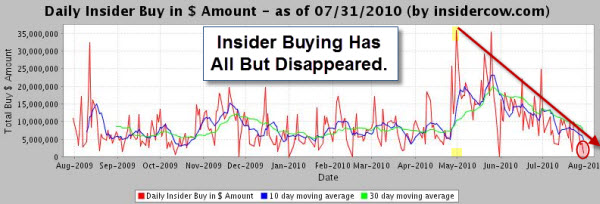
Insider Buying Has Dried Up Since May.
Insider buying and selling behavior offers a unique insight on the prospects of a company, industry, economic sector, or even the stock market in general. By definition, Insiders have a deep knowledge and understanding of the company, exclusive information on the company's performance and prospects … and if they are risking their own money on the stock, you might expect that they have good reasons, especially when several insiders buy or sell at the same time.
Well, since May, Insiders have certainly changed their buying habits. Here is a chart from Insidercow showing how bearish insiders are right now.
Another sign I've been watching has been the performance of China.
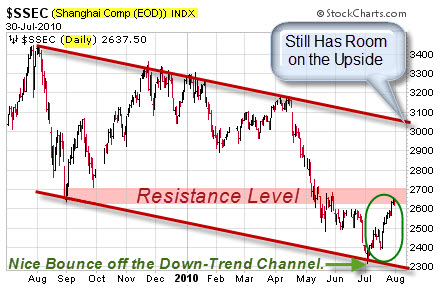
China's Shanghai Index Has Some Room to Move.
China's Shanghai Index has been in a downtrend for a while. It has under-performed most of the major world markets recently. However, in early July it bounced nicely off the downtrend channel. At this point, it is sitting right at the resistance zone. A sustained move above the 2700 level will likely give the index plenty of room to rally. On the other hand, a failure at this level could send a signal to other world markets.
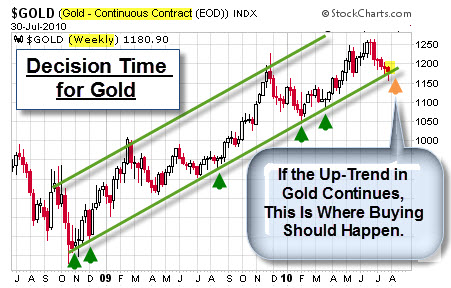
This next chart shows a weekly view of gold. This is a market that I don't pay close attention to, normally. Nonetheless, its chart caught my eye this weekend.
Decision Time for Gold.
The price of Gold is sitting at the bottom of the up-channel. So, this where you'd expect to see buying come in from those expecting the up-trend to continue in Gold. The chart speaks for itself.
We'll see what happens. Hope you have a good week.
Business Posts Moving the Markets that I Found Interesting This Week:
Lighter Ideas and Fun Links that I Found Interesting This Week:
Insider Buying Has Dried Up Since May.
Insider buying and selling behavior offers a unique insight on the prospects of a company, industry, economic sector, or even the stock market in general. By definition, Insiders have a deep knowledge and understanding of the company, exclusive information on the company's performance and prospects … and if they are risking their own money on the stock, you might expect that they have good reasons, especially when several insiders buy or sell at the same time.
Well, since May, Insiders have certainly changed their buying habits. Here is a chart from Insidercow showing how bearish insiders are right now.
Another sign I've been watching has been the performance of China.
China's Shanghai Index Has Some Room to Move.
China's Shanghai Index has been in a downtrend for a while. It has under-performed most of the major world markets recently. However, in early July it bounced nicely off the downtrend channel. At this point, it is sitting right at the resistance zone. A sustained move above the 2700 level will likely give the index plenty of room to rally. On the other hand, a failure at this level could send a signal to other world markets.
This next chart shows a weekly view of gold. This is a market that I don't pay close attention to, normally. Nonetheless, its chart caught my eye this weekend.
Decision Time for Gold.
The price of Gold is sitting at the bottom of the up-channel. So, this where you'd expect to see buying come in from those expecting the up-trend to continue in Gold. The chart speaks for itself.
We'll see what happens. Hope you have a good week.
Business Posts Moving the Markets that I Found Interesting This Week:
Lighter Ideas and Fun Links that I Found Interesting This Week:
Your contact database is becoming an increasingly important hub linking your personal, professional, and social life. So it's not fun when that data gets messed-up.
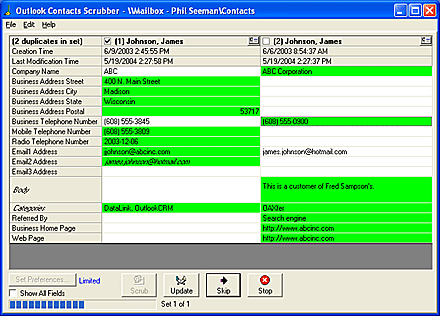
If you are like me, over time, I combined contact records from different sources (e.g., cell phone, Microsoft Outlook, and web-mail accounts). At some point, I ended up with more duplicate records than I wanted to handle manually.

The real issue was that not all the duplicate records were really "duplicates". Some of the information was the same, but other information was different. I wanted something that let me pick and choose what to keep, what to get rid of, and what to merge.
It's not just duplicate records; lots of other things can go wrong too. For example, somehow many of the birthdays in my contacts database got shifted by one day. That meant someone whose birthday was July 27th, didn't show up on my calendar until July 28th. That defeats the purpose of setting birthday reminders, doesn't it? I had an older backup saved on the hard disk; but what about all the additions and changes I made since then?
 It turns out there is an application that neatly fixes things in situations like those. It's called Contact Scrubber for Outlook by TeamScope.
I have used several versions of this software over time. Contacts Scrubber was already a fine solution to a messy problem; yet it keeps getting better. It handles most things automatically, while still giving you control (when you want it).
I'm happy to say that it worked beautifully. If you ever run into this problem, I suggest you give Contacts Scrubber a try. It might save you a lot of time. Bottom-Line: it is the easiest way I've found to merge & purge and end-up with accurate Outlook 2010 contact records.