
Today is July 4th. However, few flags were waving as I drove around our
neighborhood.
A few years
ago, at least two-thirds of the houses had flags. Today I would estimate that number being 15% to 20% .
Around here, there is a relatively cheap service that provides flags for
patriotic holidays (like Independence Day, Memorial Day, etc.). They provide the flags, set-them-up, take them down, etc. It requires no effort – other than to write a check.
So,
did the economy make the outlay feel too extravagant? Or did the
collective level of patriotism drop significantly, recently?
My guess … a
little of both; but it probably has more to do with the economy. What
do you think?
Today is July 4th. However, few flags were waving as I drove around our
neighborhood.
A few years
ago, at least two-thirds of the houses had flags. Today I would estimate that number being 15% to 20% .
Around here, there is a relatively cheap service that provides flags for
patriotic holidays (like Independence Day, Memorial Day, etc.). They provide the flags, set-them-up, take them down, etc. It requires no effort – other than to write a check.
So,
did the economy make the outlay feel too extravagant? Or did the
collective level of patriotism drop significantly, recently?
My guess … a
little of both; but it probably has more to do with the economy. What
do you think?
I've been reading a pretty good new book that is an interesting mix of stories, life-lessons, and business content. It combines a behind the scenes peek into the situations, emails, checklists, sample interview questions, and "Happiness Framework" that led to some surprising results.
For example, here are Zappos' Core Values from which they develop their culture, brand, and business strategies:
In 1999, Tony Hsieh (pronounced Shay) sold LinkExchange, the company he co-founded, to Microsoft for $265 million. He then joined Zappos as an adviser and investor, and eventually became CEO.
In 2009, Zappos was listed as one of Fortune magazine's top 25 companies to work for, and was acquired by Amazon later that year in a deal valued at over $1.2 billion on the day of closing.
So, you might guess that he learned a few things about what worked, and what didn't.
In his first book, Tony shares the different business lessons he learned in life, from a lemonade stand and pizza business through LinkExchange, Zappos, and more. Ultimately, he shows how using happiness as a framework can produce profits, passion, and purpose both in business and in life.
I've been reading a pretty good new book that is an interesting mix of stories, life-lessons, and business content. It combines a behind the scenes peek into the situations, emails, checklists, sample interview questions, and "Happiness Framework" that led to some surprising results.
For example, here are Zappos' Core Values from which they develop their culture, brand, and business strategies:
In 1999, Tony Hsieh (pronounced Shay) sold LinkExchange, the company he co-founded, to Microsoft for $265 million. He then joined Zappos as an adviser and investor, and eventually became CEO.
In 2009, Zappos was listed as one of Fortune magazine's top 25 companies to work for, and was acquired by Amazon later that year in a deal valued at over $1.2 billion on the day of closing.
So, you might guess that he learned a few things about what worked, and what didn't.
In his first book, Tony shares the different business lessons he learned in life, from a lemonade stand and pizza business through LinkExchange, Zappos, and more. Ultimately, he shows how using happiness as a framework can produce profits, passion, and purpose both in business and in life.
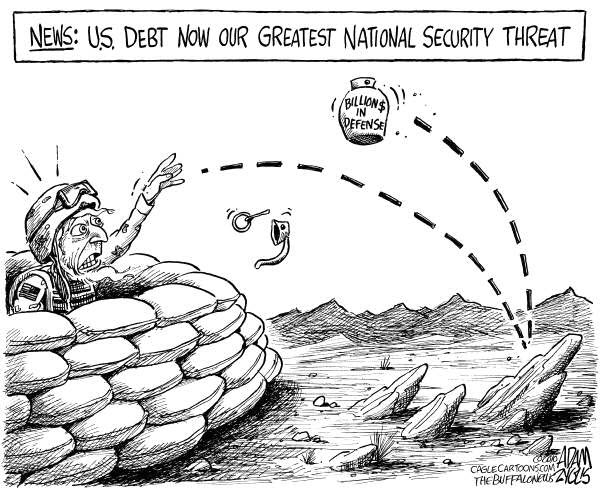
The deficit, the war, and the oil spill are still in the news. While this cartoon jokes about how America achieves greatness, I suspect it is a topic that will get more attention.
Meanwhile, US Treasury Secretary Timothy Geithner told the BBC that the US can 'no longer drive global growth'; and the world
"cannot depend as much on the US as it did in the past". Instead, he said that other major economies would have to grow more for the global economy to prosper.
With that in mind, there are three big bearish macroeconomic stories hanging over the market:
The sovereign debt issue in Europe.
The slowing Chinese economy.
The second leg down in housing.
The big question is – to what extent is the bad news already priced-in to the market?
Let's Look at the Charts.
The markets moved lower, as the economic news from housing
to retail sales to revised Q1 GDP continues to confirm the weakness.
The weekly chart of the S&P 500 Index shows that we are still beneath the down-trend that started in late 2007. While price has held above the 1040 support zone (marked by the green highlight), last week's pattern (marked by the orange circle) is considered bearish. The week started higher, yet closed lower, than the prior week's range (this is called a Bearish Engulfing Pattern); and often signals a trend change.
However, short term oscillators are getting more oversold. As a result, there are probably lots of people looking for an oversold rally next week.
A Leading Indicator of Economic Activity is Dying-Up.
If you are looking for insight into global
supply and demand trends, the Baltic Dry
Index is one of the purest leading indicators of economic activity. It
offers a real-time glimpse at global raw material and
infrastructure demand,
as well as the supply of ships available to move this type of cargo.
Since making a short-term peak in late May (about a month after equity
markets peaked), the index has declined 38%, and
has just dropped below its February lows.
The deficit, the war, and the oil spill are still in the news. While this cartoon jokes about how America achieves greatness, I suspect it is a topic that will get more attention.
Meanwhile, US Treasury Secretary Timothy Geithner told the BBC that the US can 'no longer drive global growth'; and the world
"cannot depend as much on the US as it did in the past". Instead, he said that other major economies would have to grow more for the global economy to prosper.
With that in mind, there are three big bearish macroeconomic stories hanging over the market:
The sovereign debt issue in Europe.
The slowing Chinese economy.
The second leg down in housing.
The big question is – to what extent is the bad news already priced-in to the market?
Let's Look at the Charts.
The markets moved lower, as the economic news from housing
to retail sales to revised Q1 GDP continues to confirm the weakness.
The weekly chart of the S&P 500 Index shows that we are still beneath the down-trend that started in late 2007. While price has held above the 1040 support zone (marked by the green highlight), last week's pattern (marked by the orange circle) is considered bearish. The week started higher, yet closed lower, than the prior week's range (this is called a Bearish Engulfing Pattern); and often signals a trend change.
However, short term oscillators are getting more oversold. As a result, there are probably lots of people looking for an oversold rally next week.
A Leading Indicator of Economic Activity is Dying-Up.
If you are looking for insight into global
supply and demand trends, the Baltic Dry
Index is one of the purest leading indicators of economic activity. It
offers a real-time glimpse at global raw material and
infrastructure demand,
as well as the supply of ships available to move this type of cargo.
Since making a short-term peak in late May (about a month after equity
markets peaked), the index has declined 38%, and
has just dropped below its February lows.
On the first day of June, the total U.S. public debt crossed the $13 trillion mark. In the 20 some days since then, it has already grown more than another $52 billion. The debt number is currently equal to just under 90 percent of the entire size of the U.S. economy.
The national debt is growing at $45,000 per second. That’s more than $5,000 more than the annual U.S. income per capita — every second.
Putting It In Perspective.
I was looking through some clippings I'd saved and a few of them caught
my eye.
The first is a graphic from the Chicago Tribune about understanding the National Debt. It speaks for itself.
How Big is a Trillion?
A Trillion is a hard concept to grasp. That is a million millions. Here are two videos that put the number in perspective.
The first is from Mint. It's official, Trillion is the new Billion. No longer is government spending talked about in terms of a mere ten digits. With the recent flurry of government spending, we are going to need another three zeros to make sense of it all. One trillion dollars is a number that few people can comprehend, let alone your standard nine digit calculator. So what does one trillion dollars look like?
The second video is from CNN. They ask a Temple University mathematics professor John Allen Paulos to explain how much $1 trillion actually is. The story notes Senate Republican Leader Mitch McConnell is correct when he says that if you spent $1 million per day starting in the year 0, you still would not have spent $1 trillion by 2009.
On the first day of June, the total U.S. public debt crossed the $13 trillion mark. In the 20 some days since then, it has already grown more than another $52 billion. The debt number is currently equal to just under 90 percent of the entire size of the U.S. economy.
The national debt is growing at $45,000 per second. That’s more than $5,000 more than the annual U.S. income per capita — every second.
Putting It In Perspective.
I was looking through some clippings I'd saved and a few of them caught
my eye.
The first is a graphic from the Chicago Tribune about understanding the National Debt. It speaks for itself.
How Big is a Trillion?
A Trillion is a hard concept to grasp. That is a million millions. Here are two videos that put the number in perspective.
The first is from Mint. It's official, Trillion is the new Billion. No longer is government spending talked about in terms of a mere ten digits. With the recent flurry of government spending, we are going to need another three zeros to make sense of it all. One trillion dollars is a number that few people can comprehend, let alone your standard nine digit calculator. So what does one trillion dollars look like?
The second video is from CNN. They ask a Temple University mathematics professor John Allen Paulos to explain how much $1 trillion actually is. The story notes Senate Republican Leader Mitch McConnell is correct when he says that if you spent $1 million per day starting in the year 0, you still would not have spent $1 trillion by 2009.