This video shows how narrow your focus can be. You'll have some fun, and what is revealed at the end is surprising. So pay attention as you watch the video. See what you notice.
It was done by pychologist, magician, and author Prof Richard Wiseman. Click here for background information about this video and the psychology behind it.
In part 1 of this post, we examined Change Blindness and how we can miss incredibly obvious things (right in front of us) if our attention is focused elsewhere.
In an information-rich environment, attention is a scarce and essential resource.
Think how often your focus blinds you to the obvious.
Here are two books written by Professor Wiseman. The first is called Quirkology, and it is about discoving big truths in small things. The second is called 59 Seconds, and it is about little things that make big differences.
This video shows how narrow your focus can be. You'll have some fun, and what is revealed at the end is surprising. So pay attention as you watch the video. See what you notice.
It was done by pychologist, magician, and author Prof Richard Wiseman. Click here for background information about this video and the psychology behind it.
In part 1 of this post, we examined Change Blindness and how we can miss incredibly obvious things (right in front of us) if our attention is focused elsewhere.
In an information-rich environment, attention is a scarce and essential resource.
Think how often your focus blinds you to the obvious.
Here are two books written by Professor Wiseman. The first is called Quirkology, and it is about discoving big truths in small things. The second is called 59 Seconds, and it is about little things that make big differences.
Next week will tell us a lot about where this market is headed. Three big events will give us a sense of how the market reacts to news from its perch near recent highs.
It starts Tuesday, when we get election results. Many believe the market has been waiting for republicans to gain seats. If that takes place, and appears that it will, the market, you would think, will like it. However, some wonder if the news is already priced in to the markets. Here is a chart from Intrade showing how likely people believe it is that republicans gain seats.
On Wednesday, the fed will disclose more about QE2. The market wants to know where Fed Chair Bernanke stands on the critical issue of flooding liquidity. Again, even if the market gets what it wants, will it matter … or has the rally already priced-in the effects of QE2?
Finally, Friday is when we see what's going on in the world of job creation (or lack thereof). This report is potentially more important than the first two, and I'm interested in how the markets respond more than I care about the details of the report.
The Rally Continues.
The Dow Jones Industrial Average is sitting in a decision zone with overhead resistance from the April recovery highs. This is notable because we are overbought, with negative divergences … yet almost no selling pressure.
A sustained move above the resistance zone, shown in pink, would be a bullish sign.
Down Volume Is Rising … And That Means So Is Risk.
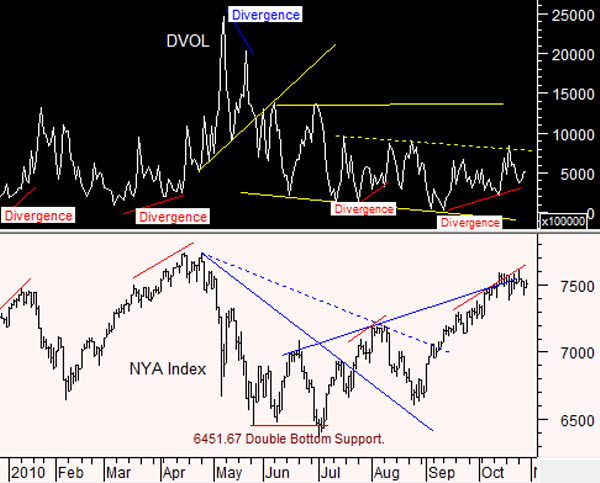
Have you looked at what the New York Stock Exchange's "Down Volume" (DVOL) is showing lately? Marty Chenard, from StockTiming.com did and here is what he found.
Normal behavior in a rally is for the Down Volume to be trending lower.
That means, that as the market goes higher, less selling is occurring. However, rallies always reach a point where profits start to be captured. Since investors cannot take profits without selling, the Down Volume increases as profit taking activity increases.
Such a Down Volume-to-Market relationship pattern can be seen on today's chart.
Notice the rising red lines on the DVOL part of the chart. Those lines show that the Down Volume was increasing as the NYA Index continued to rise. That represented a negative divergence, and sign that investors were taking profits and selling into the rally.
If you look at the first three instances this year, the market soon pulled back after each round of profit taking.
What about the fourth instance?
That is one of those "you are here now" events. Since early September, our DVOL model shows that it has made a higher/low and a higher/high. That is important because that is the definition of an "up trend".
A historical word of caution … if the Down Volume on the New York Stock Exchange index is rising, then risk levels are also rising.
Sentiment Is Approaching Extreme Levels.
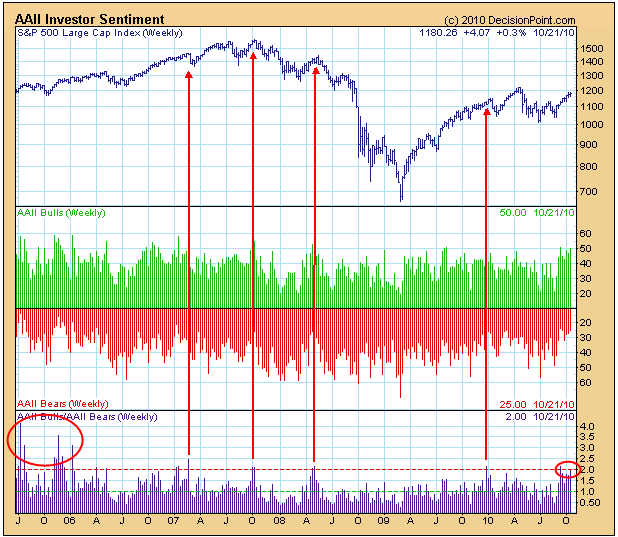
The AAII Sentiment Survey shows a jump to a 2-to-1 ratio of Bulls-to-Bears. Readings above 2 tend to be bearish. We saw a reading like this about a month and a half ago and the market rally continued. Nonetheless, if you go back to the 2007-2008 bear market, it was a good early indicator of when to be a seller. Of course, some believe this is a bull market, so the indicator may behave differently. The circled area shows this ratio went much higher during more bullish times in 2005 and early 2006. Still, this bears watching.
Next week will tell us a lot about where this market is headed. Three big events will give us a sense of how the market reacts to news from its perch near recent highs.
It starts Tuesday, when we get election results. Many believe the market has been waiting for republicans to gain seats. If that takes place, and appears that it will, the market, you would think, will like it. However, some wonder if the news is already priced in to the markets. Here is a chart from Intrade showing how likely people believe it is that republicans gain seats.
On Wednesday, the fed will disclose more about QE2. The market wants to know where Fed Chair Bernanke stands on the critical issue of flooding liquidity. Again, even if the market gets what it wants, will it matter … or has the rally already priced-in the effects of QE2?
Finally, Friday is when we see what's going on in the world of job creation (or lack thereof). This report is potentially more important than the first two, and I'm interested in how the markets respond more than I care about the details of the report.
The Rally Continues.
The Dow Jones Industrial Average is sitting in a decision zone with overhead resistance from the April recovery highs. This is notable because we are overbought, with negative divergences … yet almost no selling pressure.
A sustained move above the resistance zone, shown in pink, would be a bullish sign.
Down Volume Is Rising … And That Means So Is Risk.
Have you looked at what the New York Stock Exchange's "Down Volume" (DVOL) is showing lately? Marty Chenard, from StockTiming.com did and here is what he found.
Normal behavior in a rally is for the Down Volume to be trending lower.
That means, that as the market goes higher, less selling is occurring. However, rallies always reach a point where profits start to be captured. Since investors cannot take profits without selling, the Down Volume increases as profit taking activity increases.
Such a Down Volume-to-Market relationship pattern can be seen on today's chart.
Notice the rising red lines on the DVOL part of the chart. Those lines show that the Down Volume was increasing as the NYA Index continued to rise. That represented a negative divergence, and sign that investors were taking profits and selling into the rally.
If you look at the first three instances this year, the market soon pulled back after each round of profit taking.
What about the fourth instance?
That is one of those "you are here now" events. Since early September, our DVOL model shows that it has made a higher/low and a higher/high. That is important because that is the definition of an "up trend".
A historical word of caution … if the Down Volume on the New York Stock Exchange index is rising, then risk levels are also rising.
Sentiment Is Approaching Extreme Levels.
The AAII Sentiment Survey shows a jump to a 2-to-1 ratio of Bulls-to-Bears. Readings above 2 tend to be bearish. We saw a reading like this about a month and a half ago and the market rally continued. Nonetheless, if you go back to the 2007-2008 bear market, it was a good early indicator of when to be a seller. Of course, some believe this is a bull market, so the indicator may behave differently. The circled area shows this ratio went much higher during more bullish times in 2005 and early 2006. Still, this bears watching.
Even if you are not a baseball fan, here's a statistic that jumps out and demands attention.
When the Texas Rangers competed against the New York Yankees, it marked the greatest disparity in raw dollars between payrolls in the history of playoff baseball, at $152 million.
In addition, there are some fun facts for you to impress your friends. For example, the Rangers could triple every current player's salary, sign Mark Teixeira away from the Yankees, and still have a lower payroll.
Even if you are not a baseball fan, here's a statistic that jumps out and demands attention.
When the Texas Rangers competed against the New York Yankees, it marked the greatest disparity in raw dollars between payrolls in the history of playoff baseball, at $152 million.
In addition, there are some fun facts for you to impress your friends. For example, the Rangers could triple every current player's salary, sign Mark Teixeira away from the Yankees, and still have a lower payroll.
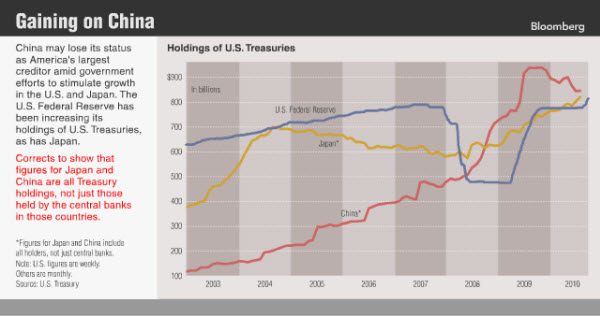
According to Bloomberg,the Federal Reserve and Japanese investors are poised to pass China and become America’s largest creditors following efforts from U.S. policy makers and the Bank of Japan to stimulate growth.
This chart shows the U.S. central bank’s Treasury holdings have risen to a record $821.2 billion, approaching China’s $846.7 billion. The figure for Japan is $821 billion, the most ever. China overtook both the Fed and Japan in 2008 as the communist nation bought dollars to hold down the yuan as a way to aid exporters, funneling the greenbacks into U.S. debt.
Does it seem strange to you that we are about to be our own biggest creditor?
Perhaps, as a sovereign nation, it makes sense if you plan on printing money to pay it back.
According to Bloomberg,the Federal Reserve and Japanese investors are poised to pass China and become America’s largest creditors following efforts from U.S. policy makers and the Bank of Japan to stimulate growth.
This chart shows the U.S. central bank’s Treasury holdings have risen to a record $821.2 billion, approaching China’s $846.7 billion. The figure for Japan is $821 billion, the most ever. China overtook both the Fed and Japan in 2008 as the communist nation bought dollars to hold down the yuan as a way to aid exporters, funneling the greenbacks into U.S. debt.
Does it seem strange to you that we are about to be our own biggest creditor?
Perhaps, as a sovereign nation, it makes sense if you plan on printing money to pay it back.
"If your job is to identify opportunities and risks in the market, you have to recognize that when the Fed is pouring fuel on the fire, when they send their minions out to discuss the Greenspan put, some people rush for the fire hoses … but my job is to go grab some marshmallows and sticks and head over to the Boy Scout jamboree campfire. If your job is a policy analyst, well that’s a different situation. But if you’re an asset manager, you can’t fight the tape constantly. You have to recognize when massive Federal Reserve liquidity is going to goose the market. But I’m not going to argue with people who say this ends badly. Hey, every bull market eventually ends badly. You know, I can’t tell you if it’s a 25% correction or down 1,000 [points]. But you know what? You’ll have plenty of time to make that decision. Right now, as long as they are giving us an opportunity to make some hay, you have to participate while the sun is shining."
Dow Stalls With High Volume Near April High.
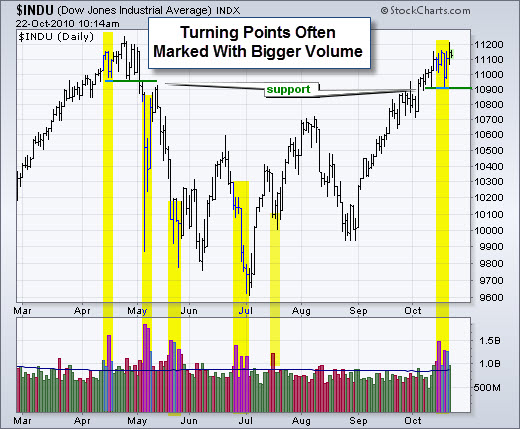
With a surge from 10,000 to 11,200, the Dow Jones Industrial Average is trading near its April highs and close to a 52-week high. However, it has started to stall with high volume. The chart shows the Dow battling the 11100 area with above average volume the last seven days. Arthur Hill notes that the trend since late August is still up. Nonetheless, a high volume stall could give way to a short-term reversal that starts a correction. High volume is often present at or near inflection points.
The yellow areas on the chart show volume surges that occurred at turning points.
For now, the Dow has yet to show any signs of weakness on the price chart. The Average established support at 10,900 with two lows over the last few weeks. This support level looks similar to the April support level. Notice how the April support break provided a clear signal. The bulls are in good shape as long as current support holds. A move below 10900 would argue for a correction that would be expected to retrace a portion of the prior advance.
Are there any other clues we can watch?
How Does the Dollar Affect the Dow?
Looking at the charts below, it is easy to see that there is a strong inverse correlation between the U.S. Dollar and the Dow. According to TSP Talk, this is not always the case … but when it is, it does assist us to predict direction changes.
The upcoming quantitative easing (QE2) by the Fed could be seen as a catalyst for the dollar's decline, as more money being pumped into the system means a weaker dollar. If QE2 is priced-in to the market already, then we could have a “buy the news” reaction in the dollar, which in turn would likely hurt the stock market. In the mean time, the trend is clear.

 Usually, bookmarks are static links. Diphur alerts you when content changes occur on the sites you choose. For example, with Diphur you can?