Thoughts about the markets, automated trading algorithms, artificial intelligence, and lots of other stuff

  • Overhyped Technologies (Or Not)

    Just because something is overhyped doesn’t mean it’s bad.

    Gartner’s Hype Cycle is a great example of this concept.  It highlights the likely cycle of inflated expectations, disillusionment, and, ultimately, utility.

    The key takeaway from the Hype Cycle model is that much of what happens is predictable … and that a significant portion of the extreme swings are based on human nature rather than technical merit.

    Haters are going to hate, and sometimes a fad is more than a fad.  For example, here is a front-page article from the New York Times in 1879.  It questions the utility of electric lights as a replacement for gas-powered lighting.  In case you were wondering, that one might have been a bright idea.


    Screen Shot 2022-05-15 at 8.45.33 PM


    The point is that humans have proven themselves to be pretty bad at exponential thinking.  We’re not bad at recognizing periods of inflection, but we often have trouble recognizing the consequences of the change (and the consequences of those consequences) and predicting who the winners and losers will be as a result of those regime changes. 


    Screen Shot 2022-05-15 at 2.26.23 PM


    There are countless examples.  Here’s a funny one from Maximum PC Magazine in 2008.  It shows that hype isn’t always a sign of mistaken excess.  This list purported to show things that were getting too much attention in 2008.  Instead of being a list of has-beens and failures, many of these things rightfully deserved the attention and hype they were getting.


    Maximumpc


    It’s been over 15 years since this came out.  How did the predictions hold up?

    Apple has become one of the world’s biggest and most successful companies (with a market cap approaching 3 Trillion dollars).  The iPhone has sold over 2.2 billion phones and accounts for over half of Apple’s total revenue.  Meanwhile, Facebook has become Meta and is also one of the biggest and most successful companies in the world (with a market cap of well over a Trillion dollars).  And the list keeps going: HD video, 64-bit computing, downloading movies from the internet, and multiple GPU video cards. 

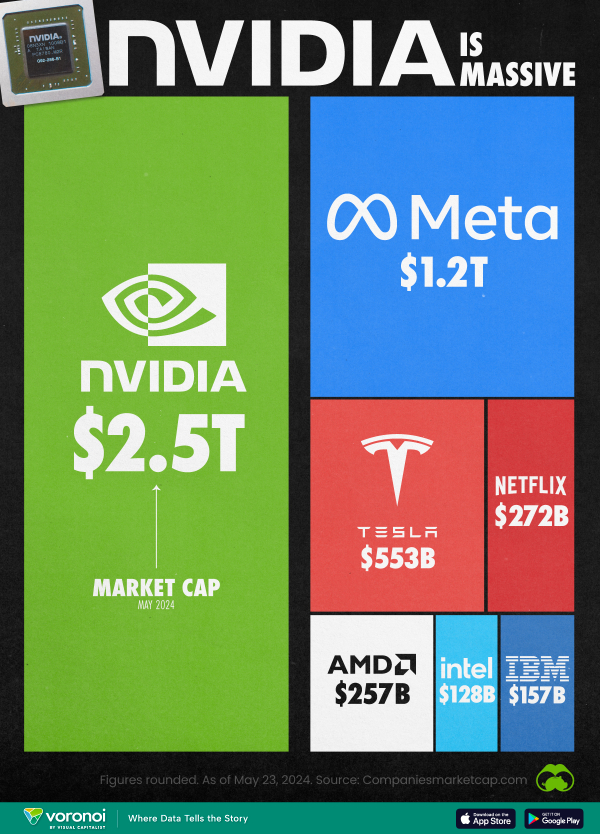
    Take just that last one. Nvidia has been the primary beneficiary of GPU growth, and it is one of the highest-performing stocks of the past few decades (with a market cap of well over 2 trillion dollars). 

    It’s hard to believe how poorly this image aged. 

    Remember that the trend is your friend while it continues.

    Just because something is overhyped – doesn’t mean you shouldn’t be excited about it

    The key is to stop thinking about the thing that’s being hyped and, instead, to start thinking about how to use things like that to create what you really want.

    Onwards!

  • Velocity Versus Speed

    Recently, I've been thinking a lot about how businesses scale and technology adoption accelerates.

    For example, consider how fast AI is improving and transforming business.

    Last year, I shared a short video called Speed Matters. It includes some thought-provoking ideas. You can view it by clicking here.


    While speed matters, faster is not always better.

    As you focus on doing more things faster, it becomes more essential to give people room to do important things slower.

    You've almost certainly heard the phrase, "It's better to measure twice and cut once."  It's much easier to do something the right way from the beginning rather than trying to fix it after you mess it up. 

    Activity does not create progress if it doesn't move you in the right direction.

    This reminds me of a distinction my friend Nic Peterson makes. What you want in your business is velocity rather than speed. Velocity implies a vector (and preferably only one vector). You want to move fast in the desired direction, not fast towards distractions, mistakes, or money down the drain. 

    To add one more layer to this, there's an "almost true" axiom in technology: you can only have two out of these three things: a project done fast, done right, and done cheaply.

    But it's only almost true for a big reason. If you've already built the team and put in the work, replicating that work for new projects can be done fast, right, and comparatively cheaper. 

    Are you just moving fast, or do you have velocity in your business?

    Something to think about … 

  • House Prices Versus Income in America

    As we discuss the economy, I also think about my youngest son, who is looking at houses right now. 

    In countless ways, today's youth have it easier than we did. Access to opportunities, the internet, capital sources, etc., has gotten more accessible, yet there are a few things that have gone the other way, such as buying a house. 

    OC-U.S.-Income-Housing-Gap_Feb14

    via visualcapitalist

    The chart above does not show interest rates or inflation. For example, in 1984, the 30-year fixed rate was close to 14%, over double what it is now. 

    But, to put things in perspective … I moved to Texas in 1986. Part of my rationale was that I could buy a "nice" home for a little less than my initial starting salary as a lawyer.

    Recently, policy decisions have vastly increased house prices. How much? Median house prices are nearly 6x the median household income in America. Meanwhile, the economics of renting are significantly better than buying. According to the WSJ, it's 52% more expensive to buy than rent due to mortgage prices

    When housing costs are this high, consumer spending and mobility are reduced, making individuals less likely to relocate for job opportunities. 

    We live in interesting times. Sometimes, I miss the good old days.

  • Checking Back In with Dr. Doom

    In 2018, while in New York for work, I was invited to a party that ended up being a pretty unique experience. 

    The rules were that for the first hour it would be first names only, no discussion of what you do, etc. Part of the fun was figuring out who was there and why they were special. And, there were a lot of pretty impressive people in the room. As I was wondering who was able to bring all these experts and thought leaders into one home for a house party, I found it was Nouriel Roubini – the infamous Harvard economist known as Dr. Doom. 

    Nouriel Roubini's predictions have earned him the nicknames "DrDoom" and "PermaBear" in the media. He predicted the housing bubble crash in 2007-2008, and has extensively studied the collapse of emerging economies. 

    So, after a tumultuous few years for the global economy, I thought I'd check back in and see what he was saying. 

    It turns out he's less pessimistic than you would guess. He's pretty optimistic about 2024 growth and not particularly worried about a recession—though he is expecting a downturn. 

    He also thinks there's a possibility that growth remains above potential, and inflation remains sticky. That would be good news for the economy, but bad news for markets – as the Fed likely wouldn't cut as much or as soon as people are hoping for. 

    Now, Nouriel has been wrong before, and I don't trust any singular pundit. My mindset is to listen to voices that don't already believe what I do. I tend to be optimistic as a rule, and I've been optimistic on things like blockchain, whereas Nouriel has been staunchly negative.

    But, he's a smart and educated voice who can justify his opinions. And I end up more educated – and often modifying my stance a little bit – based on the context he's able to give. 

    By the way, as I was editing this post, I saw that Chase CEO Jamie Dimon and billionaire hedge fund founder Ray Dalio admit they got warnings on the US economy wrong — for now.

    Are you listening to voices outside of your preferred channels?

  • The State Of Pop Culture As An Allegory For All Culture

    There are talks of a Gladiator 2, of remaking American Psycho, of another John Wick or Fast & Furious

    It feels like art has begun to repeat itself more than before. That's not to say we've never had copycats or derivative works … but that as media has become more ubiquitous, its influence has become more heavy-handed. 

    It feels like there isn't a place in the current market for mid-budget films targeting a niche market and a release that makes a bit of money… Instead, it's all blockbusters or straight-to-DVD (now straight to streaming.) 

    While it "feels" that way, the data agrees with that belief. 

    2ecc7ddd-23d6-410e-909e-32cec48a23c7_600x380

    via Adam Mastroianni

    I'm using movies as the benchmark, but if you go to Adam's article, You can see it's true for authors, musicians, the silver screen, and more. 

    Media, like the news, and capitalism, has arguably become an oligopoly. 

    It's interesting to see because, in all three scenarios, the internet has led to the rise of indie initiatives. There are more entrepreneurs than ever. There are more independent news sources than ever, and by a large margin, more "art" is being created than ever before. 

    Access to ears, creation, and opportunity has never been more widespread.

    And yet, the vast majority of dollars and eyes have congregated on a select few. Like the dwindling middle class, art seems to be moving away from the mid-market. 

    Mastroianni offers various theories, but I'd love to hear yours … 

    What do you think is causing this shift, and what do you think it would take to create a more equal distribution?

    Is it even possible? Does human nature prevent it?

  • The Most Valuable Brands In 2024

    In the past, most profitable companies built or sold tangible products. The Titans of industry were automobile manufacturers, oil producers, land owners, etc.

    Over the past 20 years, the Titans have changed dramatically. Now, many of the leaders are in tech, IP, and other intangible assets.

    Here are the most valuable companies as of today. 

    100-most-valuable-brands-of-2024via visualcapitalist

    Now, to be clear, these aren't the most profitable companies. This is about value. 

    That being said, it wouldn't be surprising to see Apple top either of those lists. Meanwhile, Tesla has dropped off the Top 10 list due to more EV competition and probably some backlash from Elon Musk's Twitter purchase. 

    Also, unsurprisingly, Nvidia is the fastest-growing brand right now. 

    With technology becoming more ubiquitous and businesses booming, I think the trend will continue, which makes protecting your businesses' intangibles even more important. 

    Patents and trademarks are a great way to build a moat between you and your competitors. Remember, however, that anything you get a patent on becomes public knowledge – so be careful with your trade secrets.

  • The U.S. Is Back On The Moon!

    When I was young, the Space Race captured the hearts and souls of Americans.  But, for the past few decades, it was in the background.  Recently, that has changed.  The space race is getting hot again.  Resources are pouring into this area, and SpaceX is leading the pack. 

    In 2018, I shared excitement that the boosters he used were reusable.  Today, people are talking about how his ship, Starship, could render other rocket programs obsolete. 

    Fifty-one years after we last landed on the moon, the U.S. is back, and it wasn’t Elon, but the private company Intuitive Machines finally accomplishing the feat. 

    Odysseus, the unmanned lander, is now sending data back to Earth. 

    Despite the massive leapfrog in technology over the past 51 years, this is still a massive achievement for several reasons.  It was done by a private company, it was still very expensive, it precedes a 2026 manned flight from NASA, and it’s the first commercial flight – not just from the U.S. – to make it to the moon.  The trip’s goal is to research the area NASA plans to use for an upcoming mission.  They believe there are beads of frozen water in the area, which could help sustain a permanent settlement. 

    For many years, landing on the moon wasn’t getting any money.  Money was scarce.  We brought back over 800 pounds of moon rock on our last visit, and what little money there was went to more novel missions.  The moon landing symbolizes excitement about the long-term potential of the moon, not just space travel. 

    I love spaceflight for a lot of the same reasons I love AI. 

    It’s a global initiative heralding innovation and improvements that transform the world.  It’s the genesis of many exponential technologies. 

    Many astronauts, even from back in the Apollo days, talk about the incredible feeling they get after a few days in space.  As they gaze on the Earth from above, they lose their sense of borders and nationality.  The Saudi astronaut Sultan bin Salman Al-Saud, who flew on the Space Shuttle in 1985, commented on this, saying, “The first day or so we all pointed to our countries.  On the third or fourth day, we were pointing to our continents.  By the fifth day, we were aware of only one Earth.”

    It reminds me of Carl Sagan’s video on “The Pale Blue Dot.” 

    In 1977, five years after we left the moon, the Voyager 1 launched into space.  Just over a dozen years later, the Voyager 1 spacecraft had traveled farther than any spacecraft/probe/human-made anything had gone before.  It was approximately 6 billion kilometers away from Earth.  At that point, the Voyager 1 was “told” by Carl Sagan to turn around and take one last photo of the Earth … a pale blue dot. 

    The resulting photo is impressive precisely because it shows so little in so much.

    “Every saint and sinner in the history of our species lived there–on a mote of dust suspended in a sunbeam.” – Carl Sagan

    Earth is in the far right sunbeam – a little below halfway down the image.  This image (and the ability to send it back to Earth) was the culmination of years of effort, the advancement of technology, and the dreams of humankind.

    The resulting speech from Carl Sagan is still profound, moving, and worth a listen. 


    via Carl Sagan

    Here’s the transcript: 

    _____

    Look again at that dot.  That’s here.  That’s home.  That’s us.  On it everyone you love, everyone you know, everyone you ever heard of, every human being who ever was, lived out their lives.  The aggregate of our joy and suffering, thousands of confident religions, ideologies, and economic doctrines, every hunter and forager, every hero and coward, every creator and destroyer of civilization, every king and peasant, every young couple in love, every mother and father, hopeful child, inventor and explorer, every teacher of morals, every corrupt politician, every “superstar,” every “supreme leader,” every saint and sinner in the history of our species lived there–on a mote of dust suspended in a sunbeam.

    The Earth is a very small stage in a vast cosmic arena.  Think of the rivers of blood spilled by all those generals and emperors so that, in glory and triumph, they could become the momentary masters of a fraction of a dot.  Think of the endless cruelties visited by the inhabitants of one corner of this pixel on the scarcely distinguishable inhabitants of some other corner, how frequent their misunderstandings, how eager they are to kill one another, how fervent their hatreds.

    Our posturings, our imagined self-importance, the delusion that we have some privileged position in the Universe, are challenged by this point of pale light.  Our planet is a lonely speck in the great enveloping cosmic dark.  In our obscurity, in all this vastness, there is no hint that help will come from elsewhere to save us from ourselves.

    The Earth is the only world known so far to harbor life.  At least in the near future, there is nowhere else to which our species could migrate.  Visit, yes.  Settle, not yet.  Like it or not, for the moment the Earth is where we make our stand.

    It has been said that astronomy is a humbling and character-building experience.  There is perhaps no better demonstration of the folly of human conceits than this distant image of our tiny world.  To me, it underscores our responsibility to deal more kindly with one another, and to preserve and cherish the pale blue dot, the only home we’ve ever known.

    ____ 

    Today, we have people living in space, posting videos from the ISS, and high-resolution images of space and galaxies near and far. 

    We take for granted the immense phase shift in technology.  You have more computing power in your pocket than we first used to go to the moon.

    As humans, we’re wired to think locally and linearly.  We evolved to live in small groups, fear outsiders, and stay in a general region until we die.  We’re not wired to think about the billions and billions of individuals on our planet, or the rate of technological growth – or the minuteness of that all in regard to the expanse of space.  

    However, today’s reality necessitates thinking about the world, our impact, and what’s now possible.

    We created better and faster ways to travel, we’ve created instantaneous communication networks across vast distances, and we’ve created megacities.  Our tribes have gotten much bigger – and with that, our ability to enact massive change has grown as well. 

    Space was the first bastion of today’s innovation, but today, we can look toward AI, medicine, epigenetics, and more. 

    It’s hard to comprehend the scale of the universe and the scale of our potential … but that’s what makes it worth exploring!

    Onwards!