Traders whose only investment strategy is to buy stocks may be subjecting themselves to unnecessary risks.
There is always something working in the Markets. So, if you limit yourself to looking solely at U.S. Equities, you might be missing something.
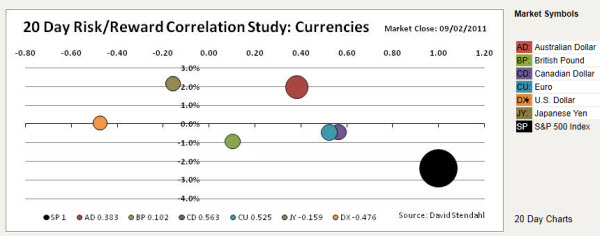
For example, here is a chart (from David Stendahl) comparing the risk and reward of trading various Currencies to the performance of the S&P 500 Index.
Notice that each of these markets recently did better, while also having a very low correlation with the S&P (shown by the big black dot in the lower right of the chart).
The point is that there are many other markets and products you can use to diversify your portfolio and improve your risk-to-reward ratio.
Wherever there is danger, opportunity lurks, and vice versa The two are inseparable … but they don't have to be equal.
What About the S&P 500?
History doesn't usually repeat itself exactly, but it often rhymes.
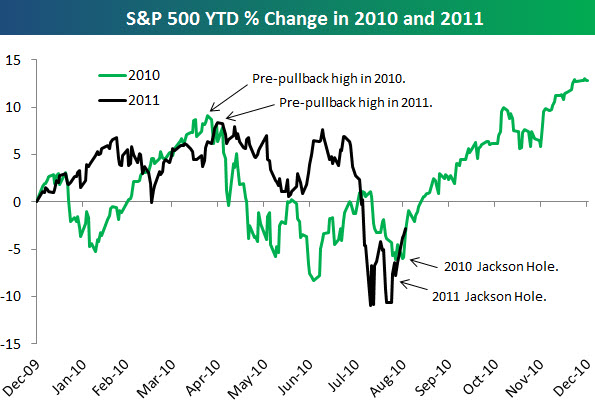
Take a look at Bespoke's comparison of the S&P 500's price chart in 2010 to this year's price chart. It is easy to see why people are hoping that we get something even remotely similar to what happened last year.
Here is what Bespoke had to say:
Last year, the S&P 500 made its pre-correction high in late April, and it wasn't until Bernanke's Jackson Hole speech in late August that the market broke out of its summer funk.
As shown above, the S&P 500 also made its pre-correction high in late April of this year, and people are hoping that we made a short-term bottom at the end of August right around the time of this year's Jackson Hole speech.
In 2010, the S&P 500 was down 3.12% on September 1st, and it closed the year up 12.8% after pretty much going straight up over the last four months of the year.
As we enter this September, the S&P currently sits down just under 3%. If history repeats itself, the country will surely end the year in a much better mood than it's in now.
Most people say they want to be healthy. That's the easy part … it's more challenging to do.
To be fair, life happens … and it is hard to find sufficient time to exercise. Nonetheless, in this case, procrastination can be a real killer.
Procrastination doesn't just happen with exercise. Many things get put off while waiting for better circumstances, more data, or for it to be the "right" time. Well, it turns out that it's always a good time to take right action.
Here is a great video called "How Bad Do You Want It?" It is inspirational and worth watching. It's not just some exercise video … there is a great message in there worth hearing about business and life, too.
How Badly Do You Want It?
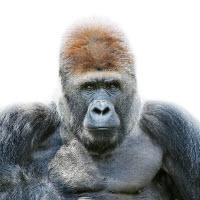
Have you ever looked in the mirror and thought "how did that happen"? Pictures of me on the beach resembled the image on the right.
Perhaps I should blame genetics. My grandfather was a professional wrestler who tipped the scales well above 300 lbs., and my Dad spent plenty of time north of 300 as well.
A year-and-a-half ago I was Twinkie away from there myself.
At 265 lbs., my doctor told me I had a 10% chance of having a heart attack in the next year. That was my wake-up call.
I'm down to 228; and I am committed to being healthy and vital. That makes all the difference.
You Manage What You Measure.
One of the things I really like about the Fitbit is that it's constantly monitoring and reminding me about the actions I take – or the amount of non-action I tolerate.
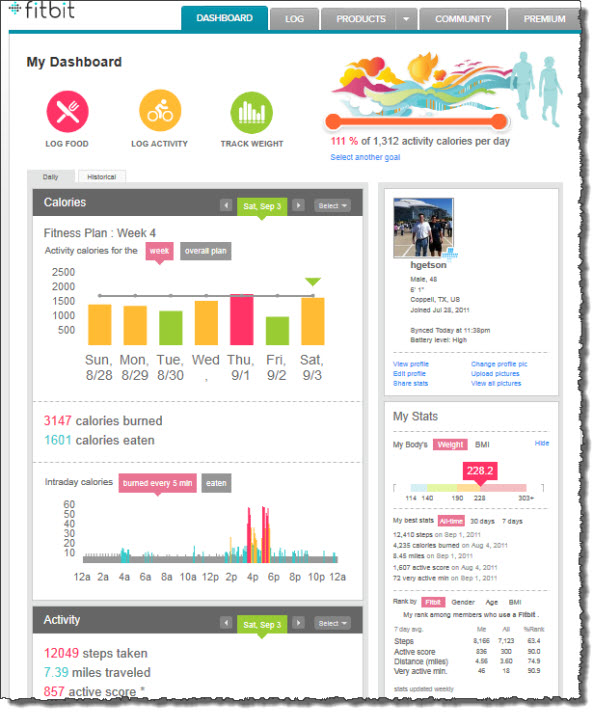
Here is a screenshot of my Fitbit home screen. It's graphically pleasing and lets me quickly focus on the number of important fitness and activity metrics.
Notice that there is an activity graph that shows the amount and intensity of my activity in five-minute increments throughout the day. It updates wirelessly, and automatically, without me having to press any buttons.
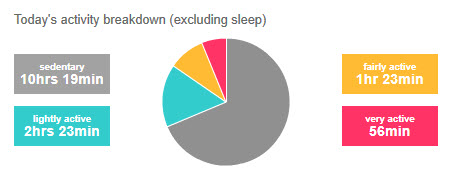
In addition, here is a graph that shows the days activity broken into intensity levels.
I use a graph like this to figure out whether I'm happy with what I'm doing. At work, I do something similar. I ask the team to think about whether we are 'walking', 'jogging', 'running', or 'sprinting'? More importantly, to achieve what we want, what's the right mix?
It's one thing to tell yourself you're working hard; it's another to compare your levels with benchmarks or standards. Here's another area that Fitbit excels. This graph shows that last week my activity level fell in the 90th percentile.
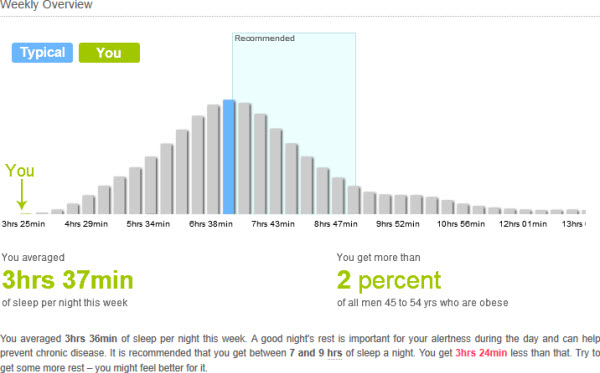
However, this graph shows that recently my sleep patterns fell in the bottom 2%.
While I am competitive and want to increase the number of steps or the percentage of time I'm in higher levels of activity, the quickest way for me to improve my health is probably to get more sleep.
The point is Fitbit doesn't just focus on activity; it helps you figure out the right activities on which to focus.
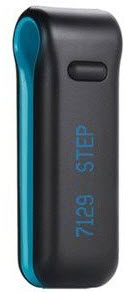
There are lots of other things I could tell you (like, it is about the size of money-clip) … but the most important is to just go get one. It is about $90 at Amazon.
Most people say they want to be healthy. That's the easy part … it's more challenging to do.
To be fair, life happens … and it is hard to find sufficient time to exercise. Nonetheless, in this case, procrastination can be a real killer.
Procrastination doesn't just happen with exercise. Many things get put off while waiting for better circumstances, more data, or for it to be the "right" time. Well, it turns out that it's always a good time to take right action.
Here is a great video called "How Bad Do You Want It?" It is inspirational and worth watching. It's not just some exercise video … there is a great message in there worth hearing about business and life, too.
How Badly Do You Want It?
Have you ever looked in the mirror and thought "how did that happen"? Pictures of me on the beach resembled the image on the right.
Perhaps I should blame genetics. My grandfather was a professional wrestler who tipped the scales well above 300 lbs., and my Dad spent plenty of time north of 300 as well.
A year-and-a-half ago I was Twinkie away from there myself.
At 265 lbs., my doctor told me I had a 10% chance of having a heart attack in the next year. That was my wake-up call.
I'm down to 228; and I am committed to being healthy and vital. That makes all the difference.
You Manage What You Measure.
One of the things I really like about the Fitbit is that it's constantly monitoring and reminding me about the actions I take – or the amount of non-action I tolerate.
Here is a screenshot of my Fitbit home screen. It's graphically pleasing and lets me quickly focus on the number of important fitness and activity metrics.
Notice that there is an activity graph that shows the amount and intensity of my activity in five-minute increments throughout the day. It updates wirelessly, and automatically, without me having to press any buttons.
In addition, here is a graph that shows the days activity broken into intensity levels.
I use a graph like this to figure out whether I'm happy with what I'm doing. At work, I do something similar. I ask the team to think about whether we are 'walking', 'jogging', 'running', or 'sprinting'? More importantly, to achieve what we want, what's the right mix?
It's one thing to tell yourself you're working hard; it's another to compare your levels with benchmarks or standards. Here's another area that Fitbit excels. This graph shows that last week my activity level fell in the 90th percentile.
However, this graph shows that recently my sleep patterns fell in the bottom 2%.
While I am competitive and want to increase the number of steps or the percentage of time I'm in higher levels of activity, the quickest way for me to improve my health is probably to get more sleep.
The point is Fitbit doesn't just focus on activity; it helps you figure out the right activities on which to focus.
There are lots of other things I could tell you (like, it is about the size of money-clip) … but the most important is to just go get one. It is about $90 at Amazon.
Steve Jobs deserves credit. He is a world-class innovator and showman.
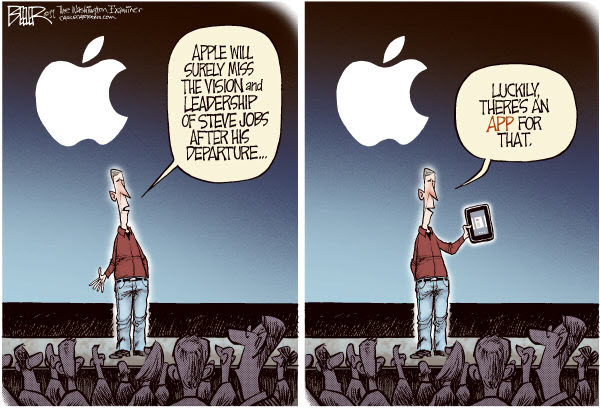
Despite what the cartoon says, there is not an app for that. Replacing Steve Jobs will not be easy. He was one of a kind.
His latest accomplishment is that he figured-out how to get everyone to eulogize him while he's still alive.
Brilliant.
To be fair, these may be the last years (or days) of Jobs' life. But, as HBR points out, if so, Jobs no doubt knew that something needed to change. Perhaps it really is time for Jobs to go home, as he put it, to a "wonderful family" and an "amazing woman" and re-reflect on a few of the provocative questions (slightly altered) that he posed to the world in his 2005 Stanford Commencement Address.
Are you wasting your life "living someone else's?"
Do you "have the courage to follow your heart and intuition?"
Are you nurturing a "great relationship," one that "just gets better and better as the years roll on?"
Do you tell "your kids everything you thought you'd have the next 10 years to tell them in just a few months" or days?
Do you make "sure everything is buttoned up so that it will be as easy as possible for your family" when "the single best invention of Life" takes its toll?
Do you say "your goodbyes" before it's too late to say them?
For almost four decades Steve Jobs has certainly tried his best to "put a ding in the universe."
It Matters that it Matters."Do you want to spend the rest of your life selling sugar water — or do you want to change the world?" That's what Steve famously asked John Sculley. Translation: do you really want to spend your days slaving over work that fails to inspire, on stuff that fail to count, for reasons that fail to touch the soul of anyone?
Do the insanely great."When you're a carpenter making a beautiful chest of drawers, you're not going to use a piece of plywood on the back, even though it faces the wall and nobody will ever see it." We're awash in a sea of the tedious, the humdrum, the predictable. If your goal is rising head and shoulders above this twisting mass of mediocrity, then it's not enough, anymore, to tack on another 99 features every month and call it "innovation." Just do great work.
Those aren't the only lessons, nor probably the best lessons. There are lots to choose from.
Umair Haque challenges: Steve took on the challenge of proving that the art of enterprise didn't have to culminate in a stagnant pond of unenlightenment — and won. In doing so, he might just have built something approximating the modern world's most dangerously enlightened company. Can you?
What a great thing career he had. He ends his Stanford speech with a quote that sums it up well. "Stay Hungry … Stay Foolish."
Steve Jobs deserves credit. He is a world-class innovator and showman.
Despite what the cartoon says, there is not an app for that. Replacing Steve Jobs will not be easy. He was one of a kind.
His latest accomplishment is that he figured-out how to get everyone to eulogize him while he's still alive.
Brilliant.
To be fair, these may be the last years (or days) of Jobs' life. But, as HBR points out, if so, Jobs no doubt knew that something needed to change. Perhaps it really is time for Jobs to go home, as he put it, to a "wonderful family" and an "amazing woman" and re-reflect on a few of the provocative questions (slightly altered) that he posed to the world in his 2005 Stanford Commencement Address.
Are you wasting your life "living someone else's?"
Do you "have the courage to follow your heart and intuition?"
Are you nurturing a "great relationship," one that "just gets better and better as the years roll on?"
Do you tell "your kids everything you thought you'd have the next 10 years to tell them in just a few months" or days?
Do you make "sure everything is buttoned up so that it will be as easy as possible for your family" when "the single best invention of Life" takes its toll?
Do you say "your goodbyes" before it's too late to say them?
For almost four decades Steve Jobs has certainly tried his best to "put a ding in the universe."
It Matters that it Matters."Do you want to spend the rest of your life selling sugar water — or do you want to change the world?" That's what Steve famously asked John Sculley. Translation: do you really want to spend your days slaving over work that fails to inspire, on stuff that fail to count, for reasons that fail to touch the soul of anyone?
Do the insanely great."When you're a carpenter making a beautiful chest of drawers, you're not going to use a piece of plywood on the back, even though it faces the wall and nobody will ever see it." We're awash in a sea of the tedious, the humdrum, the predictable. If your goal is rising head and shoulders above this twisting mass of mediocrity, then it's not enough, anymore, to tack on another 99 features every month and call it "innovation." Just do great work.
Those aren't the only lessons, nor probably the best lessons. There are lots to choose from.
Umair Haque challenges: Steve took on the challenge of proving that the art of enterprise didn't have to culminate in a stagnant pond of unenlightenment — and won. In doing so, he might just have built something approximating the modern world's most dangerously enlightened company. Can you?
What a great thing career he had. He ends his Stanford speech with a quote that sums it up well. "Stay Hungry … Stay Foolish."